Cisco CCNA (200-301) Exam Details
What the exam is, and what Cisco does not tell you
CCNA is a single exam — 200-301 — that runs 120 minutes and covers six skill areas, from subnetting and switching through to routing, wireless, security and network automation. There is no prerequisite. You can book it with no prior certification and no Cisco training.
Two things are worth knowing before you start preparing. First, Cisco does not publish a passing score. Its own wording is that grading is pass/fail, so there is no number to target — any site quoting you “you need 825 out of 1000” is repeating an old figure Cisco no longer stands behind. Second, Cisco publishes the percentage weight of each skill area only in its own exam-topics document, not on the certification page. We link that document below rather than reprint numbers we have not verified line by line.
Our programme prepares you for it with live online sessions across India, and classroom sessions at our Kharadi campus in Pune.
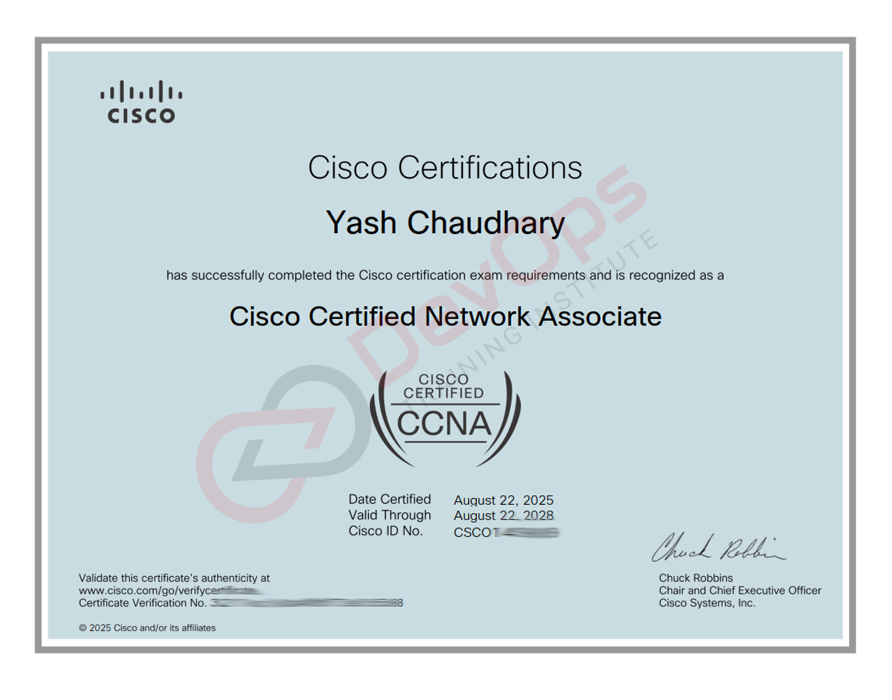
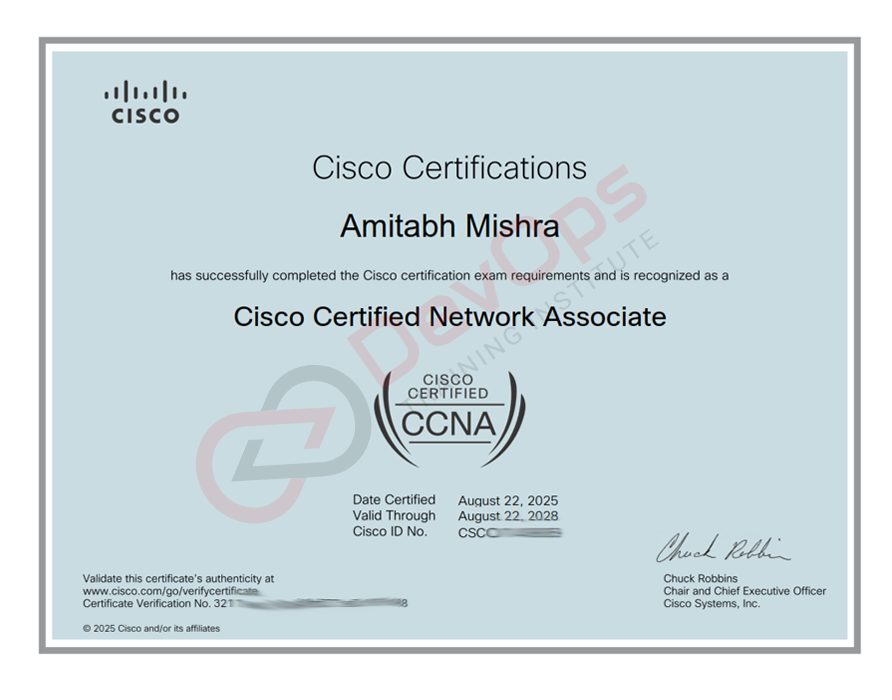
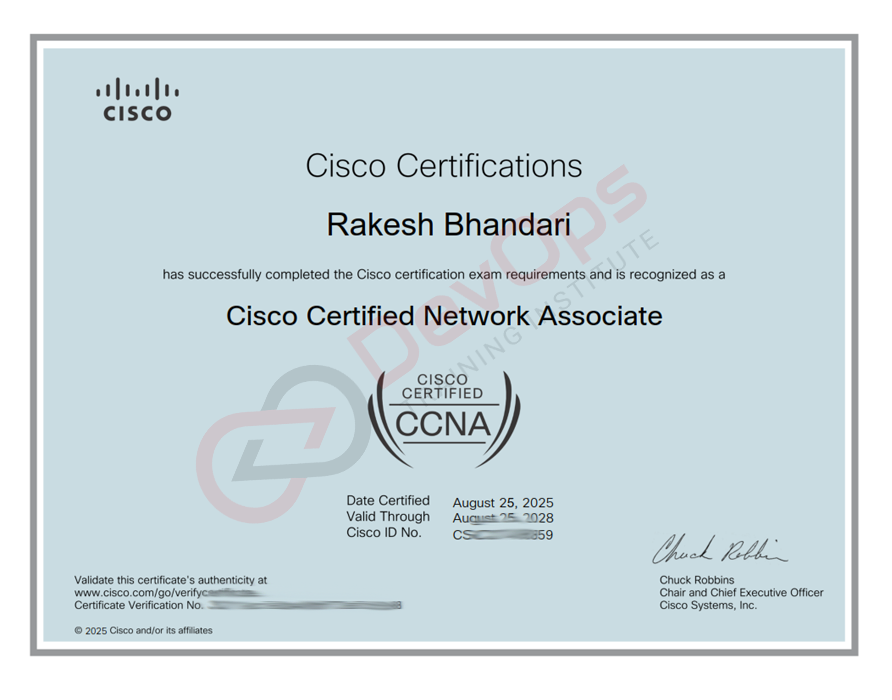
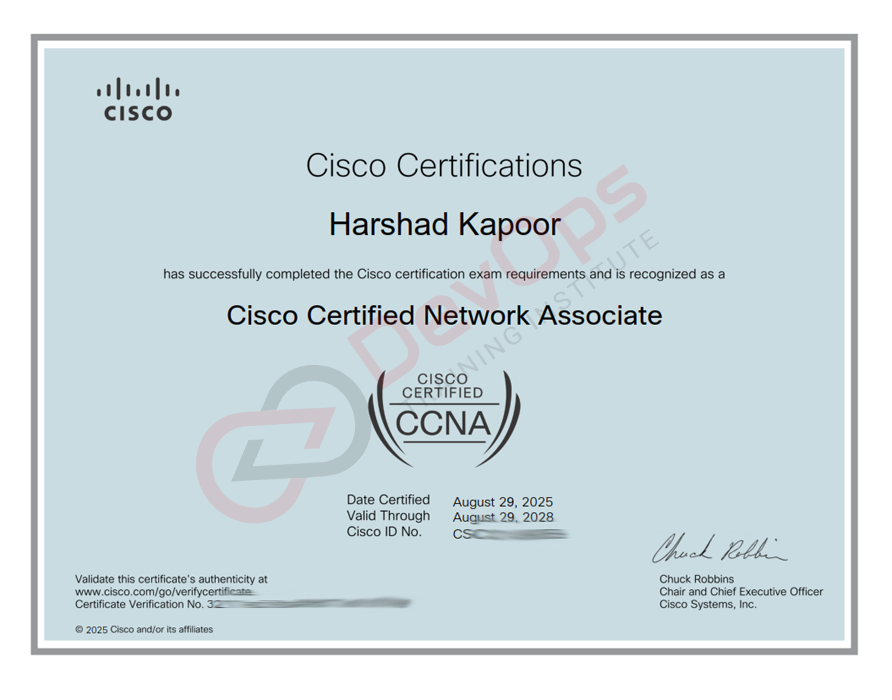
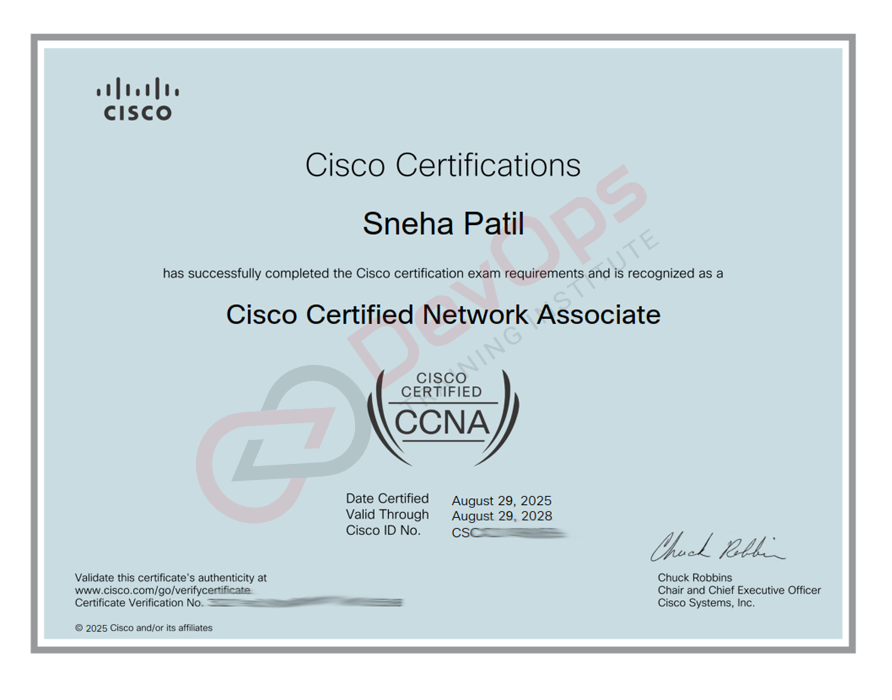
Recently Certified Candidates
Exam Overview
| Exam Attribute |
Details |
| Exam code |
200-301 CCNA |
| Certification earned |
Cisco Certified Network Associate (CCNA) |
| Certifying body |
Cisco. No third-party body is involved. |
| Duration |
120 minutes |
| Prerequisites |
None. Cisco states this plainly — you do not need any prior certification or Cisco training to book it. |
| Grading |
Pass/fail. Cisco does not publish a numeric passing score for CCNA. There is no percentage to aim at, and no score breakdown to study from afterwards. |
| Results |
Available online within 48 hours of sitting the exam. |
| Validity |
3 years. You renew by retaking a qualifying exam before it expires, or by earning Cisco Continuing Education credits. Passing 200-301 also counts towards recertifying other Cisco certifications you hold. |
| Number of questions |
Cisco does not publish a fixed count for CCNA. If you see an exact number quoted elsewhere, it did not come from Cisco. |
| Price |
Cisco’s own two pages currently disagree. The CCNA certification page lists $US400; the 200-301 exam page still shows $US300. Both also mention Cisco Learning Credits as an alternative. We are not going to pick one for you — confirm the fee at the point of booking, and note that local taxes apply on top in India.
|
| Languages |
Also inconsistent between Cisco’s pages: the certification page lists English, the exam page lists English and Japanese. Check when you book. |
| Exam version |
Cisco’s exam page describes it as Implementing and Administering Cisco Solutions (200-301 CCNA) v1.1; the certification page calls it Administering Cisco Solutions (200-301 CCNA). Cisco refreshes the blueprint periodically — always download the current exam-topics document before you start studying. |
The Six Skill Areas
These are Cisco’s own headings from the CCNA certification page. Percentage weightings are published by Cisco in its exam-topics document, linked at the end of this section — we do not reproduce them here.
| Skill area |
What it means in practice |
| Network fundamentals |
Device roles, topology architectures, cabling, TCP and UDP, IPv4 and IPv6 addressing, subnetting by hand, wireless principles and virtualisation basics. |
| Network access |
VLANs, access and trunk ports, interswitch connectivity, EtherChannel, Rapid PVST+ spanning tree, CDP and LLDP, and wireless LAN controller configuration. |
| IP connectivity |
Reading a routing table, administrative distance and metrics, static routing, single-area OSPFv2, and first-hop redundancy concepts. |
| IP services |
NAT and PAT, DHCP server and relay, NTP, DNS, SNMP, Syslog, per-hop QoS behaviour, SSH, and TFTP or FTP for file transfer. |
| Security fundamentals |
Threats and mitigation, AAA with RADIUS and TACACS+, standard and extended access control lists, port security, DHCP snooping, dynamic ARP inspection, WPA2 and WPA3, and VPN types. |
| Automation and programmability |
Controller-based and software-defined networking, REST APIs, reading JSON, and where Ansible, Terraform and Puppet fit in managing network configuration. This is the area experienced network engineers most often underprepare for. |
How We Prepare You
- Subnetting until it is automatic: not a formula sheet, but enough repetition that you can do it in your head while the clock runs. This is where most candidates lose time they cannot afford.
- Real topologies, not slides: you build multi-switch, multi-router networks from a written requirement, then break them deliberately and repair them.
- Automation taken seriously: the automation and programmability area is the one that catches out engineers who have run networks for years. We cover REST, JSON and configuration management properly rather than as an afterthought.
- Timed full-length attempts: at least two, under clock, before you book. 120 minutes is less generous than it sounds once you meet a long scenario.
- Blueprint-driven revision: we work from Cisco’s current exam-topics document, and we re-check it when Cisco revises the blueprint.
- Your certificate and badge: issued by Cisco in your certification profile, not by any training provider. You claim and share it yourself.
Where We Checked
Every figure above comes from Cisco’s own pages:
the CCNA certification page,
the 200-301 exam page, and
Cisco’s 200-301 exam topics, where the section weightings are published.
We last checked these on 30 August 2026, and that is when we noticed the price and language mismatch between Cisco’s two pages. Cisco revises exam blueprints and fees without notice — if you find a difference on their site, theirs is correct, and we would be glad to be told.


 20+ Modules
 100+ Hrs
 2,500+ Learners