Pune, Maharashtra

+91 90310 44395

CCNA Training in Panaji

20+ Modules

100+ Hrs

2,500+ Learners

4.9 (1,900+ Ratings)

Top-Rated

The 200-301 CCNA exam is scenario-based: you are given a situation and asked to choose the right design, not to recall a service name. This programme is built around Cisco's six published CCNA skill areas and the kind of failures that actually show up in production. It reaches Panaji learners as live online sessions. The city has an IT market, though we have not verified which employers here run enterprise networks.

This comprehensive program follows the official CCNA skill areas and focuses on hands-on practice. You’ll learn to operate and secure production-grade clusters and be guided through mock exams and time-management strategies for the live CCNA exam.

Build a Cisco Skill Set That Travels

Interview Prep & Career Support
Trusted By

1000+ Leading Universities And Companies

DevOps Student Success Story
DevOps Training Institute & Certification

Learn at DevOps Training Institute

Build a Job-Ready Cisco Skill Set

Like these Successful Students!

Join our DevOps courses in CI/CD, Cloud DevOps, Cisco, or DevSecOps and gain the skills to excel in the tech industry.

Enroll Now

What Our Learners Say About Our CCNA Course ❤️

Discover how our CCNA Training has helped learners build Cisco expertise, clear the Cisco exam, and advance their careers in DevOps and cloud engineering.

CCNA Training Image
Student Image Student Image Student Image Student Image Student Image

10,000+ Reviews

Arrow Icon
Background Image Background Image

Why Choose Our CCNA Training

A point-by-point look at what this Cisco Certified Network Associate (CCNA) programme includes for learners in Panaji, next to what shorter, lecture-only Cisco courses usually cover. Compare the two before you enrol.

Features Our CCNA Training Institute Other Institutes
Trainers Practising Cisco Engineers, Cisco-Certified Varies by provider
Course Curriculum Comprehensive, Cisco-Aligned 200-301 CCNA Curriculum (Cluster, Networking, Security, Troubleshooting) Basic or Outdated Cisco Topics
Hands-on Experience Real Cisco Cluster Labs & Exam-Oriented Practice Limited Hands-On Exposure
Certifications Official Cisco Certified Network Associate (CCNA) Exam Guidance Generic or Non-Recognized Certificates
Placement Support Resume Review, Mock Interviews and Interview Preparation Varies by provider
Learning Mode Flexible Online + Classroom Training Options Rigid Timings, Limited Flexibility
Resources 1-Year LMS Access to 100+ Recorded 200-301 CCNA Sessions No or Limited Learning Materials
Batch Size Small Batches with Individual Mentorship Large Crowded Batches
Essential Tools

DevOps with AI Tools

Explore next-generation DevOps and AI-powered tools for automation, security, observability, and software delivery. Learn to integrate AI into DevOps workflows with hands-on projects and expert guidance.

DevOps AI Tools Background
Learning Options

Flexible CCNA Training Modes in Panaji

Learners in Panaji, Goa take this course as live online sessions. Our classroom is in Kharadi, Pune — we do not run a centre in Panaji. Corporate batches can be arranged for teams.

Background Shape
Live Training

Engage in real-time online sessions with expert instructors, offering interactive learning and immediate feedback.

Apply Now
Background Shape
1-1 Training

Experience personalized coaching tailored to your pace and goals, ensuring focused skill development.

Enroll Now
Background Shape
Classroom Training

Learn in-person at our Kharadi, Pune campus with hands-on sessions and collaborative peer learning experiences.

Apply Now
Class Schedule

Class Schedule

Explore flexible learning options tailored to your schedule at Python Training Institute.

Date Mode of Class Batch Form Time Status Action
Sunday, August 30, 2026 Online/Classroom Weekdays 6:30 PM IST Batch Full Enrollment Closed →
Sunday, September 6, 2026 Online/Classroom Weekdays 6:30 PM IST Only 1 Seat AvailableMax intake limit is 10 Enrollment Open →
Monday, September 14, 2026 Online/Classroom Weekdays 8:00 AM IST Only 5 Seats AvailableMax intake limit is 10 Enrollment Open →
Saturday, September 5, 2026 Online/Classroom Weekends 10:00 AM IST Only 2 Seats AvailableMax intake limit is 10 Enrollment Open →
Sunday, August 30, 2026

Mode: Online/Classroom

Batch: Weekdays

Time: 6:30 PM IST

Batch Full
Enrollment Closed →
Sunday, September 6, 2026

Mode: Online/Classroom

Batch: Weekdays

Time: 6:30 PM IST

Only 1 Seat AvailableMax intake limit is 10
Enrollment Open →
Monday, September 14, 2026

Mode: Online/Classroom

Batch: Weekdays

Time: 8:00 AM IST

Only 5 Seats AvailableMax intake limit is 10
Enrollment Open →
Saturday, September 5, 2026

Mode: Online/Classroom

Batch: Weekends

Time: 10:00 AM IST

Only 2 Seats AvailableMax intake limit is 10
Enrollment Open →
img img
Cisco Certified Network Associate (CCNA) Course
Course Overview

The curriculum follows the Cisco's six published CCNA skill areas and weights them the way the exam does — troubleshooting carries the most marks, so it gets the most lab time. You build environments, break things deliberately, and fix what you did not build.

The course includes hands-on labs, project-based learning, and mock exams so you enter the 200-301 CCNA test confident and prepared.

Prerequisites for CCNA Training
  • Basic knowledge of Linux commands and system administration.
  • Familiarity with containers (Docker or Podman) and their usage.
  • Understanding of networking fundamentals such as IPs, DNS, and firewalls.
  • Prior exposure to cloud platforms (Cisco, Azure, or GCP) is helpful but not mandatory.
  • Basic scripting knowledge (Bash or Python) is an added advantage.
  • No prior Cisco experience required — fundamentals are covered in the training.
What You'll Learn
  • Designing and operating Cisco clusters.
  • Working with switches, routers, VLANs, trunking and routing protocols.
  • Designing VPCs with public and private subnets, NAT and security groups.
  • IPv4 and IPv6 addressing and subnetting design, done by hand.
  • Implementing access control lists, port security, AAA and Layer 2 hardening.
  • Monitoring and logging with SNMP, Syslog and NTP, and reading device logs.
CCNA Course Syllabus

The curriculum covers all essential CCNA skill areas with practical labs and exam-focused mock tests.

  • Routers, switches, firewalls, access points and where each one sits in a design
  • TCP and UDP, the OSI layers that actually matter on the exam, and cabling types
  • IPv4 addressing and subnetting done by hand, plus IPv6 addressing and types

  • VLANs, access and trunk ports, and interswitch connectivity with 802.1Q
  • EtherChannel with LACP, and Rapid PVST+ spanning tree behaviour
  • CDP and LLDP for discovering what is actually plugged in where

  • WLC architecture, AP modes and the split between control and data
  • Building a WLAN: SSID, security profile, QoS profile and advanced settings
  • WPA2 and WPA3 configuration, and why open networks fail an audit

  • Reading a routing table: prefix length, administrative distance, metric
  • Static routing including default, host and floating static routes
  • Single-area OSPFv2: neighbour states, adjacencies, router ID and cost

  • NAT and PAT, DHCP server and relay, NTP in client and server mode
  • DNS, SNMP, Syslog severity levels and what each one is for on the exam
  • SSH, TFTP and FTP, and per-hop QoS behaviour at a conceptual level

  • Threats, vulnerabilities and mitigation, plus AAA with RADIUS and TACACS+
  • Standard and extended access control lists, and where to place each one
  • Layer 2 hardening: port security, DHCP snooping and dynamic ARP inspection

  • Controller-based and software-defined networking versus traditional management
  • REST APIs, and reading JSON well enough to answer the exam's questions
  • Where Ansible, Terraform and Puppet fit in network configuration management

  • A repeatable fault-isolation method instead of guessing at the CLI
  • The show and debug commands that resolve most problems, and their traps
  • Working a broken topology under time pressure, which is what the exam rewards

  • Building multi-switch, multi-router topologies from a written requirement
  • Breaking your own working topology deliberately and repairing it
  • Diagnosing faults an instructor introduced without telling you what they were

  • Full-length timed attempts, because 120 minutes goes faster than it reads
  • Blueprint-driven revision against Cisco's six published skill areas
  • Booking, ID requirements and what happens on exam day
Cisco CCNA (200-301) Exam Details
What the exam is, and what Cisco does not tell you

CCNA is a single exam — 200-301 — that runs 120 minutes and covers six skill areas, from subnetting and switching through to routing, wireless, security and network automation. There is no prerequisite. You can book it with no prior certification and no Cisco training.

Two things are worth knowing before you start preparing. First, Cisco does not publish a passing score. Its own wording is that grading is pass/fail, so there is no number to target — any site quoting you “you need 825 out of 1000” is repeating an old figure Cisco no longer stands behind. Second, Cisco publishes the percentage weight of each skill area only in its own exam-topics document, not on the certification page. We link that document below rather than reprint numbers we have not verified line by line.

Our programme prepares you for it with live online sessions across India, and classroom sessions at our Kharadi campus in Pune.

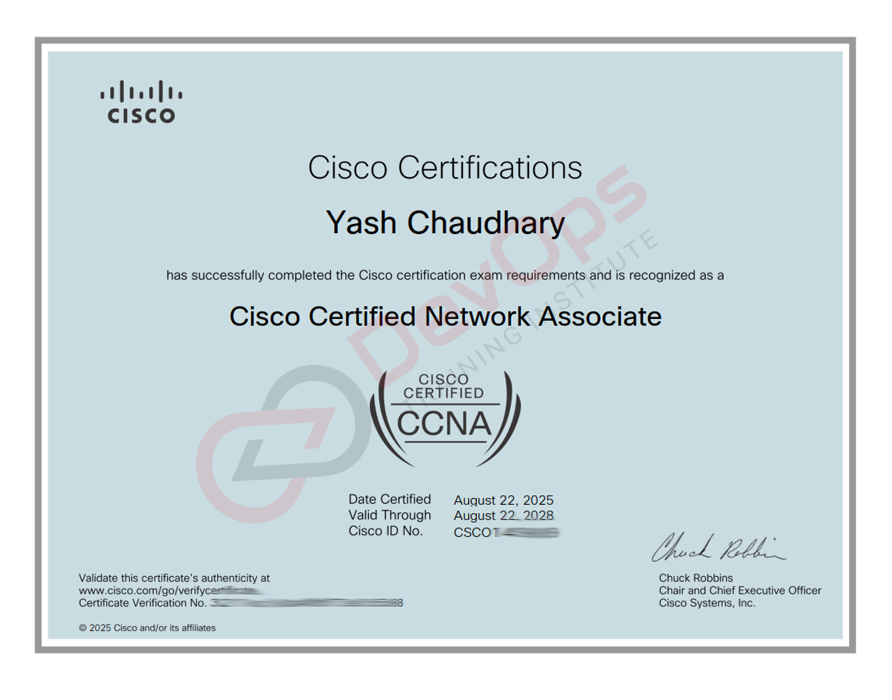
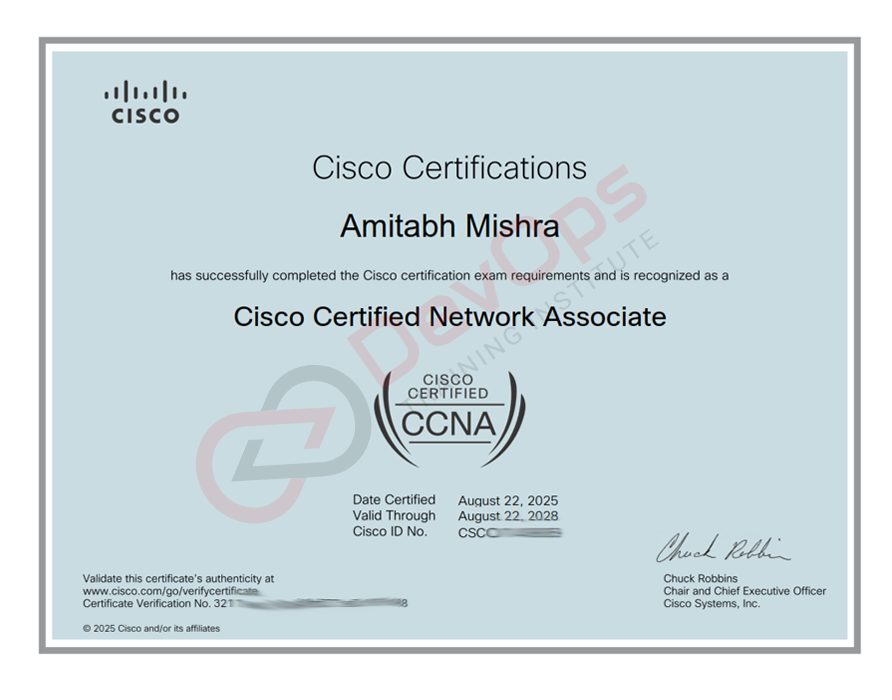
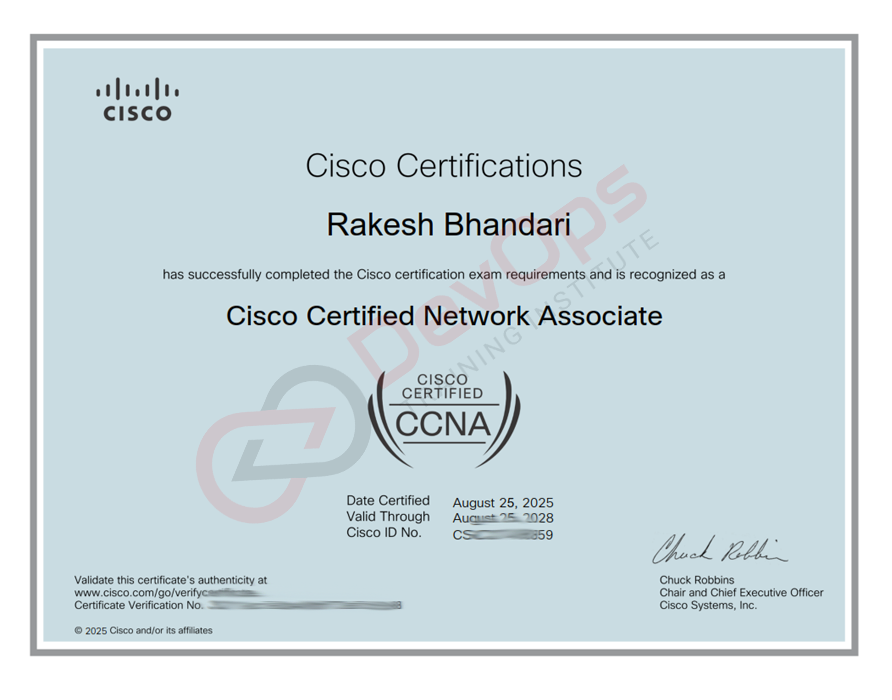
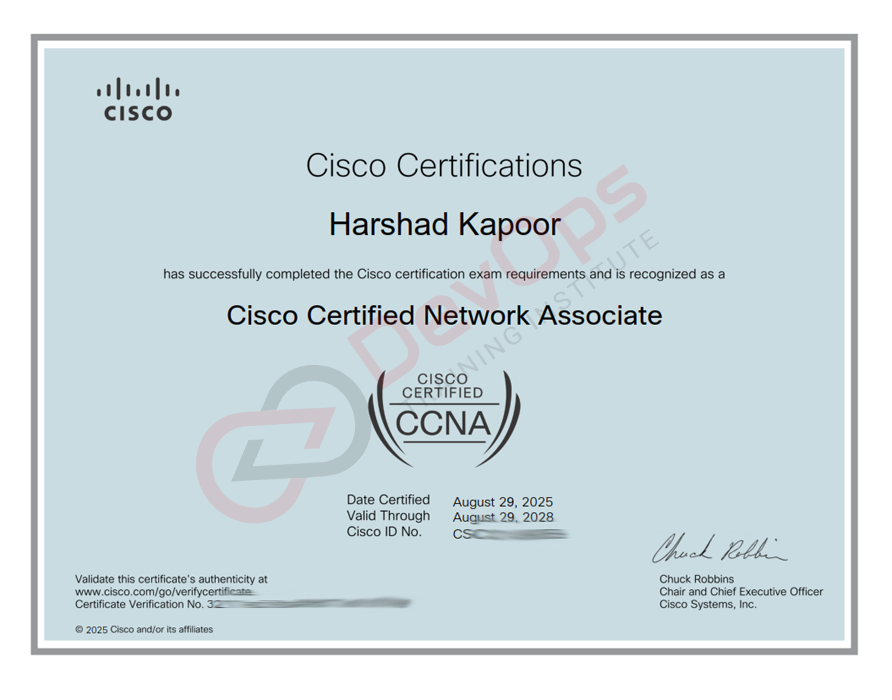
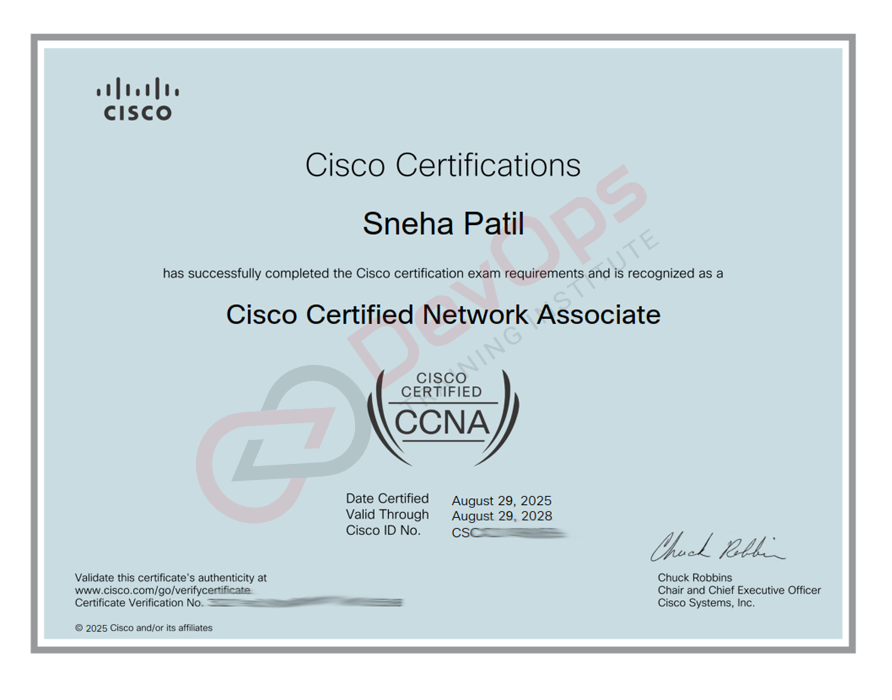
Recently Certified Candidates
Exam Overview
Exam Attribute Details
Exam code 200-301 CCNA
Certification earned Cisco Certified Network Associate (CCNA)
Certifying body Cisco. No third-party body is involved.
Duration 120 minutes
Prerequisites None. Cisco states this plainly — you do not need any prior certification or Cisco training to book it.
Grading Pass/fail. Cisco does not publish a numeric passing score for CCNA. There is no percentage to aim at, and no score breakdown to study from afterwards.
Results Available online within 48 hours of sitting the exam.
Validity 3 years. You renew by retaking a qualifying exam before it expires, or by earning Cisco Continuing Education credits. Passing 200-301 also counts towards recertifying other Cisco certifications you hold.
Number of questions Cisco does not publish a fixed count for CCNA. If you see an exact number quoted elsewhere, it did not come from Cisco.
Price Cisco’s own two pages currently disagree. The CCNA certification page lists $US400; the 200-301 exam page still shows $US300. Both also mention Cisco Learning Credits as an alternative. We are not going to pick one for you — confirm the fee at the point of booking, and note that local taxes apply on top in India.
Languages Also inconsistent between Cisco’s pages: the certification page lists English, the exam page lists English and Japanese. Check when you book.
Exam version Cisco’s exam page describes it as Implementing and Administering Cisco Solutions (200-301 CCNA) v1.1; the certification page calls it Administering Cisco Solutions (200-301 CCNA). Cisco refreshes the blueprint periodically — always download the current exam-topics document before you start studying.
The Six Skill Areas

These are Cisco’s own headings from the CCNA certification page. Percentage weightings are published by Cisco in its exam-topics document, linked at the end of this section — we do not reproduce them here.

Skill area What it means in practice
Network fundamentals Device roles, topology architectures, cabling, TCP and UDP, IPv4 and IPv6 addressing, subnetting by hand, wireless principles and virtualisation basics.
Network access VLANs, access and trunk ports, interswitch connectivity, EtherChannel, Rapid PVST+ spanning tree, CDP and LLDP, and wireless LAN controller configuration.
IP connectivity Reading a routing table, administrative distance and metrics, static routing, single-area OSPFv2, and first-hop redundancy concepts.
IP services NAT and PAT, DHCP server and relay, NTP, DNS, SNMP, Syslog, per-hop QoS behaviour, SSH, and TFTP or FTP for file transfer.
Security fundamentals Threats and mitigation, AAA with RADIUS and TACACS+, standard and extended access control lists, port security, DHCP snooping, dynamic ARP inspection, WPA2 and WPA3, and VPN types.
Automation and programmability Controller-based and software-defined networking, REST APIs, reading JSON, and where Ansible, Terraform and Puppet fit in managing network configuration. This is the area experienced network engineers most often underprepare for.
How We Prepare You
  • Subnetting until it is automatic: not a formula sheet, but enough repetition that you can do it in your head while the clock runs. This is where most candidates lose time they cannot afford.
  • Real topologies, not slides: you build multi-switch, multi-router networks from a written requirement, then break them deliberately and repair them.
  • Automation taken seriously: the automation and programmability area is the one that catches out engineers who have run networks for years. We cover REST, JSON and configuration management properly rather than as an afterthought.
  • Timed full-length attempts: at least two, under clock, before you book. 120 minutes is less generous than it sounds once you meet a long scenario.
  • Blueprint-driven revision: we work from Cisco’s current exam-topics document, and we re-check it when Cisco revises the blueprint.
  • Your certificate and badge: issued by Cisco in your certification profile, not by any training provider. You claim and share it yourself.
Where We Checked

Every figure above comes from Cisco’s own pages: the CCNA certification page, the 200-301 exam page, and Cisco’s 200-301 exam topics, where the section weightings are published. We last checked these on 30 August 2026, and that is when we noticed the price and language mismatch between Cisco’s two pages. Cisco revises exam blueprints and fees without notice — if you find a difference on their site, theirs is correct, and we would be glad to be told.

CCNA Lab Work You Do in This Programme
Why reading about networks does not work

CCNA questions are written as situations, not definitions. You are shown a topology and a symptom and asked what is wrong, or given a requirement and asked which configuration meets it. You cannot answer those reliably from reading, because the reasoning depends on having watched a protocol behave. You will not really understand why an OSPF adjacency is stuck until you have caused it yourself with a mismatched area or timer.

So the work below is built around configuring, breaking and repairing. Each lab ends with a written explanation of what failed and how you found it — because on exam day that reasoning is what you are selling. Sessions run live online across India, and the same labs run in the classroom at our Kharadi campus in Pune.

Lab List
  • Addressing plan from a requirement: given a department structure and host counts, produce an IPv4 subnetting plan with no wasted space, then do the same in IPv6 and explain why the approach differs.
  • Switching foundation: build VLANs across multiple switches, configure 802.1Q trunks, and then deliberately mismatch a native VLAN to see exactly what breaks and what the logs say.
  • EtherChannel and spanning tree: bundle links with LACP, then force a topology change and watch Rapid PVST+ reconverge. Work out which port became root and why.
  • Static and default routing: connect three sites, add floating static routes for backup, then fail the primary path and confirm the backup takes over.
  • Single-area OSPFv2: bring up adjacencies, influence path selection with cost, then break the adjacency four different ways — mismatched area, timers, subnet mask and authentication — and diagnose each from the CLI alone.
  • NAT and PAT: give a private network internet access, then translate a single inside host statically for inbound access and verify the translation table.
  • IP services in one build: DHCP server and relay, NTP synchronisation, Syslog to a collector and SNMP monitoring on the same topology, so you see how they interact.
  • Access control lists: write standard and extended ACLs against a written policy, place them, then test whether traffic that should pass actually passes — placement is where most people go wrong.
  • Layer 2 hardening: configure port security, DHCP snooping and dynamic ARP inspection, then attempt the attacks they prevent and confirm the switch stops you.
  • Wireless LAN on a controller: build a WLAN with a WPA2 or WPA3 security profile, set QoS, and understand what the controller does that a standalone access point does not.
  • Automation and APIs: read device state from a REST API, parse the JSON, and push a small configuration change with Ansible — enough to answer the exam’s automation questions from experience rather than memory.
  • Fault-finding under clock: an instructor breaks a working topology in a way you were not told about, and you have a fixed time to find and fix it. This is the closest thing to the exam’s actual demand.

A note on college projects: if your college or university has a fixed project specification, share it with us and we will map the lab work to it where the syllabus allows. If a requirement falls outside what this course covers, we will say so rather than promise to cover it.

Our Trainers
Expert Cisco Trainers

Sessions are led by practitioners who hold current a current Cisco certification and work with Cisco outside the classroom.

  • Working experience with production Cisco, not classroom-only instruction.
  • Cisco certifications.
  • Hands-on experience with Cisco IOS, IOS-XE and wireless LAN controllers.
  • Practical mentorship and interview readiness training.
Career Benefits of 200-301 CCNA Certification
Why Learn 200-301 CCNA?

Cisco skills are highly sought after. This certification demonstrates you can manage and operate enterprise network infrastructure — a skillset that opens roles across DevOps, SRE, and cloud engineering.

Key Benefits
  • Panaji has an IT market; we have not verified which employers there hire for Cisco specifically.
  • Roles exist across India and in remote-first teams, which matters from Panaji, where we have not verified a local Cisco employer.
  • Practical portfolio of projects and exam-ready experience.
200-301 CCNA Job Roles and Typical Salary Ranges in India
Career Opportunities

The 200-301 CCNA certification maps to roles that work directly with Cisco, container orchestration and cloud platforms. Panaji has an IT market, but we have not verified which employers there run enterprise networks. The salary ranges below are India-wide indicators, not Panaji-specific figures.

Job Profile Role Description Average Salary (INR)
Network Engineer Deploy, manage and troubleshoot Cisco clusters. Entry-Level: ₹8L–₹12L
Experienced: ₹14L–₹20L
DevOps Engineer Integrate CI/CD and automate deployments using Cisco. Entry-Level: ₹9L–₹13L
Experienced: ₹15L–₹22L
Cloud Engineer Run networking workloads on public cloud providers. Entry-Level: ₹9L–₹14L
Experienced: ₹16L–₹24L
Site Reliability Engineer (SRE) Maintain reliability, scaling and monitoring for clusters. Entry-Level: ₹12L–₹18L
Experienced: ₹20L–₹30L
Key Notes
  • These are indicative India-wide ranges for the role, not Panaji-specific figures and not an earnings promise. Panaji has an IT market, but we have not verified which employers there hire for Cisco. Glassdoor India benchmark: ₹5–12 LPA base range for DevOps Engineer; city-specific figure not verified. Actual pay depends on experience, employer, location and interview outcome.
  • networking roles reachable from Panaji are in the local market and in remote-first teams.
  • It also strengthens applications for international and remote roles, on top of the local market in Panaji.
Why Choose Our CCNA Training in Panaji?
Your Path to Cloud-Native Success

Panaji has an established IT market, though we have not verified a named IT cluster here. That shapes the honest advice for a learner here: build a skill that travels — to remote roles, to a larger employer, or to a relocation — rather than one that depends on Panaji’s own market.

Why Us?
  • Experienced, certified instructors.
  • Real labs replicating production scenarios.
  • Mock tests and exam strategy sessions.
  • Placement support with interview coaching.
CCNA Training Modes in Panaji
Flexible Learning Paths

Sessions run in the evenings and on weekends, in IST, so people already working in Goa can attend. Most Panaji learners take the weekend batch. Lab access continues outside session hours, which matters more for this exam than the live sessions do.

Training Modes
  • Classroom Training: On-site, instructor-led sessions at our Kharadi, Pune campus — we do not run a centre in Panaji.
  • Online Training: Live interactive classes with lab access.
  • Corporate Training: Tailored programs for teams and enterprises.
Your CCNA Training Questions

Frequently Asked Questions

Questions people in Panaji ask before enrolling — answered plainly, including where this course is and is not delivered.

Enrol through the website or call +91 90310 44395. We do not have a Panaji centre — the course is delivered live online to learners here. In-person registration is possible only at our Kharadi campus in Pune.

The programme runs 10–12 weeks with weekday and weekend batches. Most Panaji learners take the weekend batch; current dates are on the schedule above, in IST.

Basic Linux skills help, but beginners are welcome. We cover essential Linux and Docker concepts required for Cisco.

We provide interview preparation and resume guidance. We do not guarantee placement, and we do not claim hiring relationships in Panaji. networking roles reachable from Panaji are in the local market and in remote-first teams.

Yes, multiple mock exams and practice labs are included to help you prepare for the live CCNA exam environment.

Yes. Book a free demo session and sit in on a live class before deciding. For Panaji learners the demo runs online, on the same platform as the course.

The course covers the Cisco IOS command line, switching and routing, wireless, IP services, security and the automation concepts the exam asks about.

Yes, you’ll receive study guides, lab manuals, recorded sessions, and practice questions for CCNA exam preparation.

We provide session recordings and allow you to attend the missed class in the next batch without extra cost.

Yes, we start with the basics and progress to advanced Cisco concepts, suitable for beginners and professionals. Panaji has an IT market, though we have not verified which employers there run enterprise networks.

Sessions are led by practitioners who hold current a current Cisco certification and work with enterprise network infrastructure outside the classroom.

Yes. Panaji’s employers sit mainly in tourism, hospitality technology, fintech and emerging software services, so corporate batches here are usually for in-house IT teams rather than software firms; we deliver online or at your site, and module emphasis can be adjusted to what your platform actually runs.

The CCNA exam is a 2-hour, hands-on performance-based test conducted online by Cisco.

Yes, our curriculum is 100% aligned with Cisco’s official exam domains and updated regularly.

You will receive a course completion certificate from DevOps Training Institute and guidance for the official CCNA certification exam.

Yes, we offer both classroom and live instructor-led online training with lab access.

You will deploy applications, configure networking, manage storage, and troubleshoot real-world Cisco scenarios.

Yes, we provide EMI options and flexible payment plans for students and working professionals.

network engineer, DevOps engineer, platform engineer and SRE. Panaji has an IT market, though we have not verified which employers there hire for Cisco.

200-301 CCNA focuses on cluster administration and operations, while Cisco Developer Associate is more about application development and deployment on Cisco.

The course fee ranges from ₹15,000 to ₹24,999 depending on the batch type and whether certification support is included. EMI options are available. Contact us at [email protected] for the exact fee for your chosen batch.

Exam topics, current fees and registration are published by Cisco, not by us. You can verify the latest details at https://www.cisco.com/site/us/en/learn/training-certifications/certifications/enterprise/ccna/index.html and in Cisco's official 200-301 exam topics document. We last checked the published exam details in August 2026.

The 200-301 CCNA exam runs 120 minutes. Cisco does not publish a numeric passing score — its own wording is that grading is pass/fail, and results are available online within 48 hours. There are no prerequisites, and the certification is valid for 3 years. Cisco lists the price as $US400 on the CCNA certification page while its exam page still shows $US300, so confirm the fee when you book. Languages are listed as English on the certification page and English and Japanese on the exam page. We last checked these against Cisco's own pages in August 2026.

For this exam, live online is arguably the better fit, and the reason is the exam format. The 200-301 CCNA exam runs 120 minutes and is graded pass or fail: you solve tasks from a command line in a browser terminal on your own machine. Training in exactly that setup means exam day is not the first time you work that way. The labs are cloud-hosted, so a classroom seat would give you the same browser terminal anyway — there is no lab hardware you would be missing out on.

Our only classroom is in Kharadi, Pune. Rather than claim a Panaji centre we do not have, we deliver the same course live online to learners here. Sessions are two-way: you speak, share your screen and get your cluster debugged in real time, and you also get a chat channel to ask questions without interrupting the class.

Three things that matter for this exam specifically. Every session is recorded and stays available for a year, so you can replay a troubleshooting demo the night before the exam — a classroom session is gone once it ends. You read the trainer’s terminal on your own screen at your own font size instead of squinting at a projector, which matters when the work is all command line. And the hours you would have spent commuting go into lab time, which is what actually moves your CCNA result.

A laptop or desktop, a stable internet connection of around 5 Mbps, and a headset. The labs run in your browser, so you do not need a powerful machine — no local cloud environment and no 16 GB RAM requirement.

We recommend the weekend batch for Panaji learners. Weekend suits students/working professionals; weekday is preferable for learners seeking faster continuity. Final choice should follow current batch calendar.

Network support staff, desktop and helpdesk engineers, system administrators who look after switches and routers, and anyone moving into networking from another IT role. Cisco sets no prerequisite for CCNA — you can book it with no prior certification — though it helps to have handled real network kit or a lab before you start.

If you want a certificate without touching a CLI, this is the wrong exam — CCNA rewards people who have configured, broken and repaired real topologies. If you are already working at CCNP level, this will be below you. And if you are shopping for a course that promises the exact percentage weight of each exam section, we cannot sell you that honestly: Cisco publishes the weightings only in its own exam-topics document, and we would rather point you there than repeat numbers we have not verified.

Design, configure and troubleshoot a small enterprise network end to end: VLANs and trunking, EtherChannel and spanning tree, static routing and single-area OSPFv2, NAT, DHCP and NTP, access control lists and Layer 2 hardening, a wireless LAN on a controller, and the automation concepts Cisco now tests — then find the fault when it breaks.

You should be comfortable using a computer, reading technical documentation and doing arithmetic in binary once you have been shown how. Cisco sets no formal prerequisite. We cover subnetting and the CLI from the ground up, but the pace assumes you are willing to practise between sessions.

What we can state about Panaji: Panaji’s economy runs on tourism, hospitality technology, fintech and emerging software services; the city has an established IT market; we deliver this course to Panaji live online, and our only classroom is in Kharadi, Pune. What we cannot: how many networking roles are open in Panaji right now; which employers in Panaji run enterprise networks; what a network engineer is paid specifically in Panaji; how many of our past learners came from Panaji. We leave those blank rather than publishing a number we have not checked.

networking roles reachable from Panaji are in the local market and in remote-first teams. We list this for orientation only — we do not claim hiring relationships with any employer.

We are Available in Top Cities

Best Online aws (Cisco Certified Network Associate (CCNA)) Course Training Institute

DevOps Training Institute runs live online Cisco Certified Network Associate (CCNA) training built around Cisco's six published CCNA skill areas, with troubleshooting weighted the way the exam weights it. The program is led by certified instructors who deliver practical, hands-on labs and real-world scenarios to ensure you gain job-ready expertise.

Our CCNA course online provides the flexibility of learning from anywhere, combined with expert mentorship and 24/7 access to virtual labs. The curriculum covers Cisco cluster setup, workload management, networking, storage, IAM, and troubleshooting — fully aligned with Cisco’s official exam domains.

This globally recognized certification helps you master container orchestration and prepare with confidence for the CCNA exam. With step-by-step guidance, mock tests, and career support, the CCNA training covers Cisco's six published CCNA skill areas, with the most lab time on troubleshooting because that carries the most marks.

DevOps AI Tools Background