











Full-Time DevOps Diploma in Bangalore: What to Check
How to evaluate a full-time DevOps diploma in Bangalore: credential issuer, syllabus, lab hours, trainers, certification and placement claims to verify.
A full-time DevOps diploma in Bangalore is worth paying for only if you can verify who issues the credential, what the syllabus covers week by week, how much hands-on lab time you get, who teaches, and what "placement support" means in writing. Check all five before you pay, and compare the program with self-study plus vendor certifications.
We do not run a diploma program. For Bangalore, our DevOps training is live online, and our classroom is in Kharadi, Pune. This post is a buyer's checklist for any full-time program you are considering, including ours if you compare against it.
Key takeaways
- "Diploma" can mean an academic qualification from a university or board, or a private certificate of completion. Ask which one you are buying.
- Ask for the full syllabus with hours per topic. A list of tool logos is not a syllabus.
- Hands-on time matters more than lecture time. Ask how many hours you spend at a terminal and what you build.
- Industry certifications such as CKA or AWS DevOps Engineer Professional come from the certifier, not from the training provider. The provider can only prepare you.
- Get placement support terms in writing. The CCPA has issued guidelines against misleading coaching ads, so be wary of vague guarantees.
- A full-time program is a big time commitment. Compare it with part-time study and self-study before deciding.
What a "full-time DevOps diploma" usually means
The phrase covers very different products. Some universities and recognised institutions offer postgraduate diplomas or certificate programs in cloud computing or DevOps, with credits, exams and a formal transcript. Many private training companies also call their longer courses "diplomas", even though the document you receive is a certificate of completion issued by the company itself.
Neither is automatically better. A private certificate can be backed by excellent teaching, and an academic diploma can have an out-of-date syllabus. What matters is that you know which one you are paying for, because the two are valued differently. Employers hiring for DevOps roles mostly look at skills, projects and industry certifications. Some government jobs, higher education applications and visa processes care about formal academic qualifications. If the second group matters to you, ask the provider directly whether the credential is recognised by a university or statutory body, and ask for the recognition document.
"Full-time" also varies. For some providers it means a daytime batch of a few hours a day for several months. For others it means a whole working day of class and lab. Ask for the weekly timetable before you compare prices.
The checklist: ten questions to ask any provider
| Question | A good answer looks like | A warning sign |
|---|---|---|
| Who issues the credential? | A named university, board or the provider itself, stated plainly | Vague words like "globally recognised" with no issuer |
| Can I see the full syllabus? | Topics with hours, labs and projects per week | A page of tool logos |
| How much hands-on time? | A stated share of hours in labs, with your own environment | "Practical-oriented" with no numbers |
| Who teaches? | Named trainers with verifiable work history | Unnamed "industry experts" |
| What do I build? | Specific projects you keep in your own GitHub | Projects you cannot take with you |
| Which certifications does it prepare for? | Named exams, with the exam fee shown separately | "Certification included" without naming the certifier |
| What is the total cost? | Course fee, taxes, exam fees and any lab costs listed | Fees revealed only after a sales call |
| What does placement support include? | Written list of services, such as resume review and interview practice | Guarantees or "100%" claims |
| What is the refund policy? | Written policy with dates | No written policy |
| Can I attend a class first? | A real session or recording from the actual course | Only a sales presentation |
Checking the syllabus
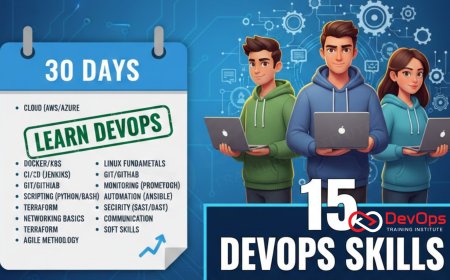
A credible DevOps syllabus follows the path code takes to production. It starts with Linux administration and networking basics, then version control with Git, then scripting with Bash or Python. After that come containers with Docker, a CI/CD tool such as Jenkins, GitHub Actions or GitLab CI, Kubernetes, infrastructure as code with Terraform or OpenTofu, configuration management with Ansible, monitoring with Prometheus and Grafana, and at least one cloud platform. Security practices should run through all of it rather than sit in a single week at the end.
Ask how many hours each block gets. Kubernetes squeezed into two days is an introduction, not training. Ask whether the course teaches current versions. For example, Kubernetes v1.37.1 is the latest release listed on kubernetes.io at the time of writing, and current Jenkins LTS releases need Java 21 or 25. A trainer teaching from slides made three years ago may not know that.
Our DevOps career roadmap after graduation lays out the order in which these topics usually make sense, and you can use it to judge whether a program's sequence is sensible.
Checking hands-on time and labs
DevOps is learned at a terminal. Ask what environment each student gets. Some programs give each learner cloud accounts or virtual machines. Others expect you to run everything on your own laptop. Both can work, but you need to know in advance, because a laptop with too little memory will struggle with a local Kubernetes cluster. Minikube's documentation lists 2 CPUs, 2 GB of free memory and 20 GB of free disk as the minimum, and real projects need more.
Ask to see a lab exercise. A good lab gives you a broken or incomplete setup and asks you to fix or finish it. A weak lab asks you to copy commands from a slide. The first builds the troubleshooting skill interviewers test. The second builds very little.
Checking the trainers
Ask for the names of the people who will teach your batch, not the founder or a guest speaker. Then check their background on public profiles. Look for hands-on work running systems in production: on-call experience, pipelines they maintained, migrations they took part in. Certifications held by trainers are a plus, but they are easy to list and harder to verify, so ask for the verification link if one is claimed. The Linux Foundation and AWS both provide credential verification for their certifications.
Ask what the student-to-trainer ratio is in lab sessions and how doubts are handled outside class. In a full-time format you will get stuck many times a day, and how quickly you get unstuck decides how much you learn.
Checking certification claims
Industry certifications are issued by the certifier, never by the training provider. For example, the Linux Foundation runs the CKA, CKAD and CKS exams. Its pages list each as an online, proctored, performance-based exam of 2 hours, priced at $445 for the exam alone, with one retake and two Killer.sh simulator sessions included. AWS runs the DevOps Engineer Professional exam: 75 questions in 180 minutes, priced at 300 USD.
Microsoft has announced that the DevOps Engineer Expert certification and its AZ-400 exam retire on 1 February 2027, with AZ-401 replacing it. If a program advertises AZ-400 preparation as a long-term credential, ask how they are handling that change.
When a provider says "certification included", ask whether that means the exam voucher, a practice test, or only their own certificate of completion. Our comparison of DevOps certification programs explains which exams fit which roles.
Checking placement claims
This is where most marketing goes wrong. No training provider controls who an employer hires, so any guarantee of a job is a promise the provider cannot keep on its own. The CCPA has issued guidelines against misleading coaching ads, which is one more reason to read placement claims carefully.
Realistic placement support includes resume reviews, mock interviews, help preparing a GitHub portfolio, and sharing job openings the provider hears about. Ask for the list in writing. If a provider quotes a placement percentage, ask how it was calculated: out of all students who enrolled, or only those who finished and asked for help? Ask for the time period. Our guide on how to evaluate job guarantee claims goes through these questions in more detail, and the post on reading DevOps training reviews explains how to tell real feedback from paid reviews.
Full-time, part-time or self-study?
A full-time program suits people who can stop working or studying for several months and want structure and daily feedback. It is a poor fit for someone who needs to keep a job, because the schedule leaves little room for anything else.
Part-time live online training covers the same topics over a longer period and lets you practise between sessions. Self-study with official documentation, free tools and vendor certifications costs the least in money and the most in discipline. Many working engineers mix the two: a structured course for the core path, then self-study for specialisations.
The right choice depends on your current skills, how much time you can give each week, and how you learn best. Our post on how long it takes to learn DevOps gives general time ranges for each route.
Questions about online delivery in Bangalore
Many providers that advertise in Bangalore teach some or all batches online. That is fine, but be clear about it before you pay. Ask whether your batch is in a classroom or online, where the classroom is if there is one, and whether recordings are available if you miss a session. Ask what time zone and hours the live sessions run, and whether lab support is available outside those hours.
For online learning, check your own setup too. A stable connection, a second screen if possible, and a laptop that can run containers will make a bigger difference to what you learn than the provider's office address.
Red flags to walk away from
- Pressure to pay the same day, or a "discount" that expires within hours.
- Placement guarantees, salary promises or "100%" figures without a written method.
- Claims to be an official exam centre or partner that you cannot verify on the certifier's own site.
- No written syllabus, refund policy or fee breakdown.
- Reviews that all sound the same, or that appear only on the provider's own site.
- Refusal to name the trainers.
How to compare two programs side by side
Put the answers from the checklist into a simple sheet with one column per provider. Fill in the issuer of the credential, total cost including exam fees, total hours, lab hours, project list, trainer names and the written placement terms. Gaps in a column are information too: a provider that will not give you a number usually does not have one.
Then ask to sit in on a real class from each. Twenty minutes of a live session tells you more about teaching quality than any brochure. If you want to see how we teach, the DevOps course page lists our syllabus, and you can ask us the same ten questions.
Questions to ask yourself before enrolling
The checklist above tests the provider. These questions test whether a full-time program fits you, and they matter just as much.
First, what can you already do? If you have never used a Linux terminal, the first weeks of any DevOps program will be hard going, and a few weeks of free self-study beforehand will help you get more from the paid part. If you already work as a developer or system administrator, you may not need a full program at all. A focused course on Kubernetes or infrastructure as code, plus a certification, might close your gap faster.
Second, how will you pay for the months you are not earning? A full-time format means several months with little or no income for many learners. Work out that cost honestly before you compare course fees, because it is often larger than the fee itself.
Third, what role are you aiming for? DevOps job titles cover build and release engineering, cloud operations, platform engineering and site reliability work. Read ten real job descriptions for the role you want in Bangalore and list the skills that appear most often. Then check how many of those skills the program teaches in depth.
Fourth, how do you learn best? Some people need a fixed timetable and a trainer watching their progress. Others learn faster alone with documentation and a project. Be honest about which describes you, because a full-time classroom schedule will not suit someone who works best in long uninterrupted blocks of self-directed practice.
Finally, what will you have at the end? Picture the GitHub profile, the projects and the certifications you expect to hold when the program finishes. If the provider cannot describe that outcome clearly, ask them to. A concrete picture of the result makes it much easier to judge whether the time and money are worth it.
Frequently asked questions
Do you offer a full-time DevOps diploma in Bangalore?
No. We do not offer a diploma. For Bangalore, our DevOps training is live online, and our classroom is in Kharadi, Pune. This post is a checklist for evaluating any diploma program.
Is a private DevOps diploma the same as a university diploma?
No. A private provider's diploma is usually a certificate of completion issued by that company. An academic diploma is issued by a university or recognised body. Ask the provider which one you will receive and for proof of any recognition.
Does a training provider issue the CKA or AWS certification?
No. The Linux Foundation issues CKA, CKAD and CKS, and AWS issues its own certifications. A provider can only prepare you. Check whether the exam fee is included or extra.
Can a DevOps program guarantee me a job?
No provider controls hiring decisions. Ask for placement support terms in writing and be cautious of guarantees. The CCPA has issued guidelines against misleading coaching ads.
What should a DevOps diploma syllabus include?
Linux, networking basics, Git, scripting, Docker, a CI/CD tool, Kubernetes, infrastructure as code, configuration management, monitoring, one cloud platform and security practices, with hours and labs for each.
Is full-time study better than part-time for DevOps?
It depends on your situation. Full-time suits people who can pause work and want daily structure. Part-time and self-study suit people who need to keep earning or prefer to practise between sessions.
Is AZ-400 still worth preparing for?
Microsoft has announced that the DevOps Engineer Expert certification and AZ-400 retire on 1 February 2027, with AZ-401 replacing it. Check Microsoft Learn before planning your exam.
References
What's Your Reaction?
 Like
0
 Dislike
0
 Love
0
 Funny
0
 Angry
0
 Sad
0
 Wow
0