












![Kong Interview Preparation Guide [2025]](https://www.devopstraininginstitute.com/blog/uploads/images/202509/image_430x256_68dbb95326997.jpg)






12 CI/CD Deployment Rollout Types Explained
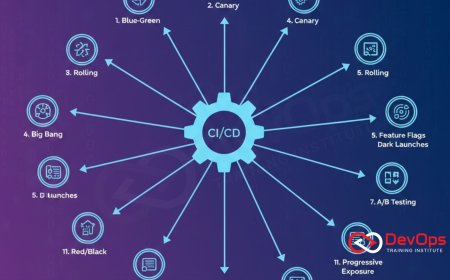
Master the twelve essential CI/CD deployment rollout types to ensure zero downtime and high availability for your modern software applications. This comprehensive guide provides beginner-friendly explanations of industry-standard strategies, including rolling updates, blue-green deployments, canary releases, and shadow deployments. Learn how to choose the right rollout pattern based on your infrastructure, risk tolerance, and business requirements to accelerate your release cycles while maintaining peak system stability. Discover how advanced orchestration and automated feedback loops empower your DevOps team to ship code faster and more reliably in today's demanding and highly automated digital landscape.
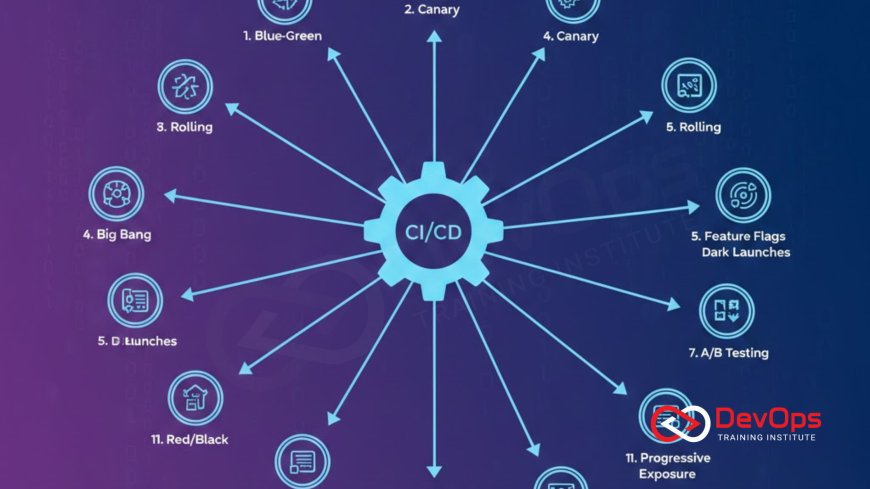
Introduction to CI/CD Rollout Strategies
In the high-speed world of modern software engineering, the way you deliver code to your users is just as important as the code itself. A deployment rollout strategy is a specific technique used to transition an application from one version to another within a production environment. The primary goal of these strategies is to minimize risk, reduce downtime, and provide a seamless experience for the end user. As we move into 2026, the complexity of distributed systems and cloud-native architectures has made choosing the right rollout type a critical decision for every DevOps team aiming for high performance and reliability.
A well-executed rollout allows teams to validate new features in a live setting without exposing the entire user base to potential bugs. It involves orchestrating how new versions are started, how old versions are decommissioned, and how traffic is shifted between them. This transition requires a deep integration of automation and observability to ensure that every change is stable before it is fully committed. Understanding these twelve essential rollout types is the first step toward building a resilient delivery ecosystem that supports continuous innovation and rapid business growth in today’s competitive global market.
The Default Rolling Update Strategy
The Rolling Update is perhaps the most common deployment strategy, serving as the default for platforms like Kubernetes. In this model, the system replaces instances of the old application version with the new version one by one or in small batches. This ensures that a minimum number of healthy instances are always available to serve traffic, providing a near zero-downtime experience for stateless applications. By controlling the "surge" and "unavailability" parameters, teams can tune the speed and safety of the rollout to match their specific infrastructure capabilities and user demands.
This strategy is ideal for frequent, low-risk updates where the application can handle a "mixed-version" state—where both the old and new versions run simultaneously. If the new version fails its readiness probes, the orchestrator automatically halts the rollout, preventing a broken version from taking over the entire cluster. It is a cost-effective approach because it does not require duplicate environments, making it a favorite for teams focused on efficiency. However, it requires careful management of database migrations and backward compatibility to ensure that the user experience remains consistent during the gradual transition between software versions.
Zero-Downtime with Blue-Green Deployments
Blue-Green deployment is a high-availability strategy that involves running two identical production environments side-by-side. The "Blue" environment currently hosts the live production traffic, while the "Green" environment is used to deploy and test the new version. Once the Green environment is fully verified, the load balancer simply switches traffic from Blue to Green. This provides an instant cutover with zero downtime and a nearly instantaneous rollback path—if an issue is discovered, you simply flip the traffic back to the Blue environment. This strategy is a cornerstone of incident handling and risk mitigation.
While extremely safe, Blue-Green deployments can be resource-intensive, as they require double the infrastructure capacity during the release window. This makes them most suitable for mission-critical applications where the cost of hardware is secondary to the need for absolute uptime and rapid recovery. It is a powerful technique for cultural change within organizations that want to move away from stressful maintenance windows toward routine, daytime releases. By utilizing cloud architecture patterns that support on-demand environment provisioning, teams can implement this strategy without the long-term cost of idle servers.
Canary Releases for Risk Mitigation
A Canary release is a progressive delivery strategy where a new version of the software is exposed to a small, specific subset of users before being rolled out to the entire population. The name comes from the historical practice of using canaries in coal mines to detect dangerous gases. In a DevOps context, the "canary" version serves as a real-world test case. Teams monitor key performance indicators—such as error rates, latency, and user feedback—for the small group. If the results are positive, the traffic percentage is gradually increased until the new version becomes the primary production environment.
This strategy is highly effective for identifying subtle bugs or performance regressions that only manifest under real-world load. It allows for data-driven decisions during the release cycle, ensuring that the majority of users are never affected by a faulty update. To implement this correctly, teams often use a service mesh or an advanced Ingress controller to manage the fine-grained traffic shifting. Canary releases are essential for managing continuous verification loops, providing the high-quality feedback needed to maintain a stable and secure production environment while shipping code at a high frequency.
Comparison Table of Deployment Rollout Types
| Rollout Type | Primary Focus | Downtime Level | Infrastructure Cost |
|---|---|---|---|
| Rolling Update | Gradual Batch Update | Zero / Minimal | Low |
| Blue-Green | Instant Environment Swap | Zero | High (2x) |
| Canary Release | Incremental Traffic Shift | Zero | Low |
| Recreate | Full Stop and Restart | High | Low |
| Shadow Deployment | Traffic Mirroring | Zero | Medium |
| A/B Testing | User Variant Comparison | Zero | Low |
Shadow Deployments and Traffic Mirroring
Shadow deployment is an advanced rollout type where a new version of the application is deployed alongside the production version and receives a copy (mirror) of the live traffic, but the responses are not returned to the users. This allows you to test how the new version handles real-world production data and loads without any risk to the user experience or data integrity. It is the ultimate tool for performance testing and identifying edge cases that unit tests and staging environments might miss. You can compare the output of the "shadow" version with the "live" version to ensure total accuracy before the actual release.
This technique is particularly useful for major architectural changes, such as moving from a monolith to microservices or switching to a new database engine. It ensures that your cluster states remain stable while you validate high-stakes changes. While shadow deployments require extra resources to process the mirrored traffic, the insights gained are invaluable for mission-critical systems. This rollout type represents a high level of DevOps maturity, allowing teams to experiment with significant technical updates with complete confidence. It is a key part of choosing containerd or other efficient runtimes to handle the increased load of traffic mirroring.
The Simple Recreate Strategy
The Recreate strategy is the most straightforward rollout type, where all instances of the old application are stopped before any instances of the new version are started. This inevitably causes a period of downtime, as the system must wait for the old pods to shut down and the new ones to boot up and pass health checks. While this sounds counter-intuitive to the goal of zero downtime, it is often a necessary approach for legacy applications or those that cannot support multiple versions running at the same time due to database schema locks or session management constraints.
Using the Recreate strategy simplifies deployment quality because you never have to worry about data inconsistencies caused by mixed-version access. It provides a "clean slate" for every release, which can be useful for non-critical internal tools or batch processing services where a brief outage is acceptable in exchange for technical simplicity. In your continuous synchronization manifests, you simply set the deployment strategy to Recreate. While it is the least sophisticated of the twelve types, it remains a vital tool in the DevOps professional's arsenal for specific use cases where complexity must be kept to an absolute minimum.
A/B Testing and Feature Flagging
While often grouped with deployment, A/B testing is a business-focused rollout type where different versions of a feature are shown to different groups of users to measure their impact on specific business metrics, such as conversion rates or user engagement. Unlike a canary release, which focuses on technical stability, A/B testing focuses on the effectiveness of the feature itself. This is often managed through feature flagging, which allows developers to turn specific pieces of code on or off for individual users without requiring a full redeployment of the application.
Feature flagging is a powerful technique that separates "deployment" from "release." You can deploy code to production in a dormant state and then use a control panel to enable it for specific users or regions. This supports highly targeted release strategies and allows for rapid "kill-switch" functionality if a feature performs poorly from a business perspective. By integrating feature flags into your CI/CD pipeline, you foster a culture of experimentation and continuous learning. It is a key driver for cultural change, empowering product teams to take ownership of their releases while ensuring that the underlying technical infrastructure remains stable and secure.
Advanced Rollout Techniques for 2026
- Ramped Deployment: A variation of rolling updates where the rollout happens in specific increments, such as 10% at a time, with mandatory pauses for validation.
- Linear Traffic Shifting: Gradually increasing traffic to a new version in a linear fashion (e.g., 10% every 5 minutes) using an automated controller.
- Immutable Infrastructure: Deploying new versions by creating entirely new servers or clusters and destroying the old ones, ensuring no configuration drift.
- Multi-Service Deployment: Coalescing the rollout of multiple interdependent microservices to ensure they all move to a compatible state simultaneously.
- Policy-Based Rollouts: Using admission controllers to enforce security and resource policies on all new versions introduced during a rollout.
- AI-Augmented Rollouts: Utilizing AI augmented devops tools to automatically detect anomalies and trigger rollbacks during a deployment.
- GitOps-Driven Sync: Managing the entire rollout process through declarative configuration in Git, ensuring cluster states are always versioned and auditable.
Selecting the right combination of these rollout techniques requires a deep understanding of your application's architecture and the needs of your business. As you move toward GitOps and more automated workflows, you will find that the lines between these strategies often blur. The ultimate goal is to create a frictionless path from code commit to successful user delivery. By mastering these twelve types, you are positioning your organization for long-term success in an era where software agility is the primary competitive advantage. The journey to deployment excellence is continuous, and these strategies are your roadmap.
Conclusion: Mastering the Art of the Release
In conclusion, the twelve CI/CD deployment rollout types discussed in this guide provide a robust framework for managing application lifecycles in the modern cloud era. From the simplicity of the Rolling Update to the precision of Canary releases and the safety of Blue-Green environments, each strategy offers unique benefits for different technical and business scenarios. By automating these rollouts and integrating deep observability, you can significantly reduce the risk of production failures and ensure a consistent, high-quality experience for your users. The choice of rollout strategy should always align with your organization's risk tolerance and infrastructure capabilities.
As you continue to refine your delivery process, remember that the most successful teams are those that view deployment not as a single event, but as a continuous cycle of learning and improvement. Stay informed about the latest release strategies and the emerging trends in AI-augmented DevOps to keep your pipeline modern and efficient. Ultimately, the best rollout is the one that user never notices—a seamless transition to a better version of your software. Embrace these twelve patterns today to transform your deployment workflow into a well-oiled machine that drives innovation and excellence across your entire organization.
Frequently Asked Questions
What is the primary goal of a CI/CD rollout strategy?
The primary goal is to transition an application to a new version while minimizing risk, reducing downtime, and ensuring a seamless experience for users.
What is the main benefit of a Blue-Green deployment?
The main benefit is zero downtime and an instant rollback path by maintaining two identical environments and switching traffic between them easily.
How does a Canary release differ from a Rolling Update?
A Canary release targets a specific subset of users for initial testing, while a Rolling Update updates all instances gradually in batches.
When should I use the Recreate deployment strategy?
Use Recreate for applications that cannot handle multiple versions running simultaneously, such as those with breaking database schema changes or locks.
What is a Shadow Deployment used for?
It mirrors production traffic to a new version for testing without affecting users, which is ideal for performance and stability validation.
Does a Rolling Update cause any downtime for users?
No, if configured correctly with readiness probes, it ensures that a minimum number of healthy instances are always serving live traffic.
What is feature flagging in a DevOps context?
Feature flagging allows developers to toggle specific features on or off for users without requiring a full redeployment of the application.
How can AI help in the deployment rollout process?
AI can monitor health metrics in real-time, detect anomalies, and automatically trigger rollbacks if a new version performs poorly or crashes.
What is the "blast radius" of a deployment?
The blast radius refers to the potential number of users affected if a deployment fails; canary releases aim to minimize this radius.
Is a Blue-Green deployment more expensive than other types?
Yes, it usually requires double the infrastructure capacity during the release, making it more resource-intensive than rolling or canary strategies.
Can I combine multiple rollout strategies in one pipeline?
Yes, many teams use a "canary-then-rolling" approach, where they test with a small group before completing the rollout to everyone else.
What role does a service mesh play in rollouts?
A service mesh provides the fine-grained traffic control and observability needed to implement sophisticated strategies like canary and shadow deployments effectively.
How does GitOps relate to deployment rollout types?
GitOps uses Git as the source of truth for configuration, automating the synchronization of rollout states with the version-controlled repository manifests.
What is a readiness probe in Kubernetes?
A readiness probe is a health check that tells Kubernetes when a pod is ready to receive traffic during a rollout process.
What is the first step to choosing a rollout strategy?
The first step is to assess your application's statefulness, your database compatibility, and your organization's risk tolerance for downtime or bugs.
What's Your Reaction?
 Like
0
Like
0
 Dislike
0
Dislike
0
 Love
0
Love
0
 Funny
0
Funny
0
 Angry
0
Angry
0
 Sad
0
Sad
0
 Wow
0
Wow
0





![100+ Azure DevOps Interview Questions and Answers [Updated 2025]](https://www.devopstraininginstitute.com/blog/uploads/images/202509/image_140x98_68c40aa9a3834.jpg)






![Future Scope of DevOps Careers in Pune [Updated 2025]](https://www.devopstraininginstitute.com/blog/uploads/images/202510/image_140x98_68e3a84652312.jpg)