


































![Kong Interview Preparation Guide [2025]](https://www.devopstraininginstitute.com/blog/uploads/images/202509/image_430x256_68dbb95326997.jpg)
















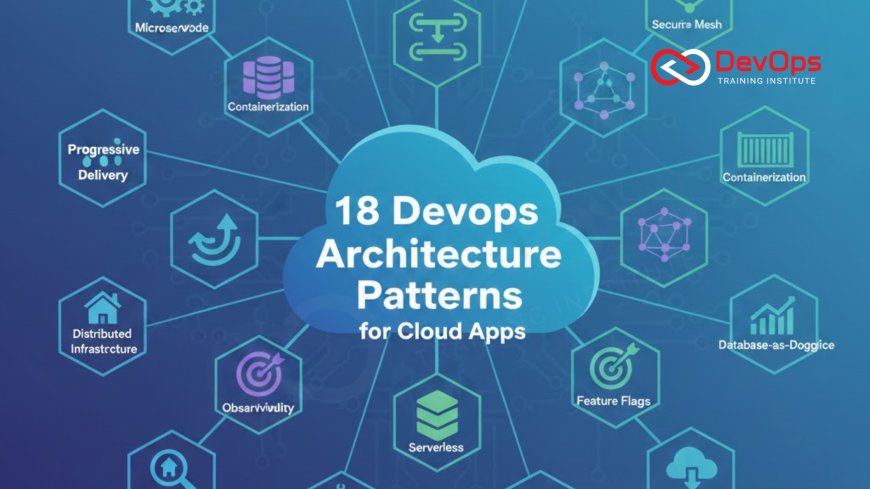
18 DevOps Architecture Patterns for Cloud Apps
In the twenty twenty six cloud-native landscape, DevOps architecture patterns are the blueprints for building scalable, resilient, and high-performance applications. This extensive guide breaks down eighteen essential design patterns, including microservices, circuit breakers, and event-driven architectures, to help your engineering team minimize downtime and optimize resource efficiency. Learn how to bridge the gap between human collaboration and automated technical execution using industry-standard strategies for fault tolerance, data management, and secure deployment. Whether you are transitioning from a monolith or managing massive global clusters, these proven architectural patterns provide the roadmap for achieving enterprise-grade reliability and rapid innovation in today’s demanding digital economy.
Introduction to Modern DevOps Architectures
As we navigate the technological landscape of twenty twenty six, DevOps has evolved from a simple set of tools into a complex architectural discipline. Architecture patterns for cloud applications provide repeatable, proven solutions to common challenges such as scaling, resilience, and secure delivery. By adopting these patterns, organizations can move away from fragile, manual configurations toward robust, self-healing systems. These patterns serve as the technical foundation that allows development and operations teams to work in perfect harmony, delivering software at a global scale with minimal risk.
The transition to cloud-native architecture requires more than just moving virtual machines to the cloud; it requires a fundamental rethink of how components interact. Modern DevOps architectures prioritize loose coupling, automation, and data-driven decision-making. By implementing these eighteen patterns, teams can ensure their applications are not only fast but also capable of withstanding the unpredictable nature of distributed cloud environments. Let us explore the core patterns that define high-performing engineering teams today, providing the insights needed to build future-proof systems in an increasingly competitive market.
Patterns for Fault Tolerance and Resilience
In a distributed system, failures are inevitable. The goal is to design systems that can degrade gracefully rather than failing catastrophically. The Circuit Breaker pattern is essential for preventing a single service failure from cascading throughout the entire application. Much like an electrical circuit breaker, it monitors for failures and "trips" the circuit when a service is unhealthy, preventing further requests from overwhelming the system. This allows the struggling service time to recover while the rest of the application remains functional. It is a vital component of any robust incident handling strategy.
Similarly, the Bulkhead pattern isolates different parts of an application into separate pools, similar to the watertight compartments of a ship. If one compartment (or service pool) fails, the others remain untouched, ensuring that a surge in traffic to one feature does not crash the entire platform. By utilizing these resilience patterns, teams can maintain high availability even during maintenance windows or localized outages. These strategies are a core part of modern architecture patterns that prioritize the user experience and system reliability above all else.
Modular and Composable Design Patterns
The move away from monolithic applications is driven by the need for agility and independent scaling. The Microservices pattern is the most famous example, breaking an application into small, independent services that communicate via lightweight APIs. This allows teams to update, scale, and deploy features without impacting the entire system. To manage the complexity of these distributed services, the Sidecar pattern is used to offload auxiliary tasks like logging, monitoring, and security to a separate container running alongside the main application. This keeps the application code clean and focused on business logic.
For teams modernizing legacy systems, the Strangler Fig pattern provides a safe path forward. Instead of a risky "big bang" rewrite, the old system is gradually "strangled" by replacing individual features with new microservices one by one. Over time, the new architecture takes over completely. This approach reduces risk and allows for continuous synchronization between the old and new systems during the transition. By leveraging these modular patterns, organizations can achieve a cultural change where technical debt is managed proactively and innovation is delivered in small, manageable increments.
Data Management and Performance Patterns
As data volumes explode in twenty twenty six, managing state and performance becomes a primary architectural challenge. The CQRS (Command and Query Responsibility Segregation) pattern separates the operations that update data from the operations that read data. This allows each to be scaled and optimized independently, significantly improving performance for read-heavy applications. To handle massive datasets that exceed the capacity of a single database, the Database Sharding pattern is used to distribute data across multiple physical nodes, ensuring that no single database becomes a bottleneck for the entire system.
Caching is another critical technique for improving response times and reducing load on backend systems. The Cache-Aside pattern involves the application checking a cache before querying the database, while the Valet Key pattern provides clients with a temporary, restricted token to access large files directly from cloud storage. These data patterns ensure that your cluster states remain performant even under heavy load. By integrating these strategies into your GitOps workflows, you can manage complex data infrastructure with the same automation and version control used for your application code.
Summary of 18 DevOps Architecture Patterns
| Pattern Group | Key Patterns | Primary Benefit | Strategic Focus |
|---|---|---|---|
| Resilience | Circuit Breaker, Bulkhead, Retry | Prevents cascading failures | System Stability |
| Modernization | Microservices, Strangler Fig, Sidecar | Agile scaling and updates | Feature Velocity |
| Data & Scaling | CQRS, Sharding, Cache-Aside | High-performance data access | Resource Efficiency |
| Communication | Event-Driven, Ambassador, Gateway | Decoupled service interaction | Operational Agility |
| Deployment | Blue-Green, Canary, Shadow | Zero-downtime releases | Quality Assurance |
Deployment and Release Strategies
To deliver software with high confidence, DevOps teams must utilize advanced rollout strategies that minimize the "blast radius" of a failure. The Blue-Green Deployment pattern maintains two identical production environments, allowing for an instant switch from the old version to the new one. The Canary Release pattern takes a more gradual approach, exposing a small percentage of users to the new version before a full rollout. These patterns are essential for maintaining release strategies that prioritize uptime and user satisfaction. They allow for rigorous testing in production-like environments without impacting the entire user base.
For more advanced scenarios, the Shadow Deployment pattern mirrors live traffic to a new version of the application without the results being visible to users. This provides a safe way to perform performance testing under real-world conditions. By utilizing admission controllers, teams can ensure that every new deployment meets organizational security and compliance policies before it is ever accepted by the cluster. These deployment patterns, when managed through GitOps, turn releases into a routine and predictable part of the engineering lifecycle, fostering a culture of technical excellence and shared responsibility.
Communication and Connectivity Patterns
How services communicate is just as important as the services themselves. The Event-Driven Architecture pattern allows services to interact asynchronously via events, which is perfect for building highly scalable and decoupled systems. In this model, a service emits an event that multiple other services can react to, preventing bottlenecks and improving overall system responsiveness. To manage the complexity of external requests, the API Gateway pattern provides a single point of entry for all clients, handling tasks like authentication, rate limiting, and request routing in one central location.
To simplify network interactions for internal microservices, the Ambassador pattern places a proxy service alongside each instance to manage common tasks like service discovery and logging. This allows developers to focus on application logic while the ambassador handles the operational heavy lifting. These connectivity patterns are a key part of choosing ChatOps techniques for real-time monitoring and coordination. By utilizing these strategies, teams can build systems that are as flexible as they are powerful, ensuring that communication between services remains fast, secure, and reliable in any cloud environment.
Best Practices for Architecture Implementation
- Design for Failure: Assume that every component will eventually fail and use patterns like Circuit Breaker and Bulkhead to contain the damage.
- Decouple Everything: Use microservices and event-driven designs to ensure that a change in one area does not break the entire system.
- Automate Infrastructure: Use who drives cultural change strategies to treat your environment as code, ensuring consistency and auditability.
- Optimize Container Runtimes: Check if you should use containerd for better efficiency and performance in your production clusters.
- Secure Secrets Proactively: Integrate secret scanning tools into your pipelines to catch credentials before they reach version control.
- Validate with Feedback Loops: Incorporate continuous verification to ensure that every architectural choice is delivering the expected performance.
- Standardize with Platforms: Use Internal Developer Platforms (IDPs) to provide a "paved road" of golden architectural patterns for your developers.
Implementing these eighteen architecture patterns requires a disciplined approach and a commitment to continuous learning. As your application grows, you should regularly review your architecture against the five pillars of the Well-Architected Framework: Reliability, Security, Cost Optimization, Operational Excellence, and Performance Efficiency. By utilizing release strategies that allow for rapid, safe changes, you can evolve your architecture alongside your business needs. The future of cloud DevOps is increasingly automated and intelligent, and these patterns are the foundation upon which that future is built.
Conclusion: Architecting for Twenty Twenty Six Success
In conclusion, the eighteen DevOps architecture patterns discussed in this guide provide a comprehensive roadmap for building world-class cloud applications. From the resilience of circuit breakers to the agility of microservices and the speed of event-driven communication, these patterns target the most critical challenges of modern software engineering. By automating these designs through GitOps and Infrastructure as Code, you create a technical environment that is as stable as it is innovative. The shift toward these patterns is not just a technical change, but a fundamental evolution in how we deliver value to users at scale.
Looking ahead, the integration of AI augmented devops will further simplify how we implement and manage these complex architectures. Staying informed about AI augmented devops trends will ensure your team remains at the cutting edge of industry best practices. Ultimately, the goal of architecture is to serve the business and the end user. By prioritizing reliability, scalability, and security today, you are building a future-proof foundation that will support your organization through any digital challenge. Start by identifying the biggest bottleneck in your current architecture and apply the specific pattern that addresses it—your journey to operational excellence begins with a single design choice.
Frequently Asked Questions
What is the primary goal of DevOps architecture patterns?
The primary goal is to provide proven, repeatable solutions for building scalable, resilient, and manageable cloud applications in a distributed environment.
Why is the Circuit Breaker pattern essential for microservices?
It prevents a single service failure from causing a system-wide outage by blocking requests to an unhealthy service until it has recovered and is stable.
What is the benefit of the Strangler Fig pattern for legacy systems?
It allows for a low-risk, gradual migration from a monolithic system to microservices by replacing one feature at a time over a set period.
How does CQRS improve database performance?
CQRS separates read and write operations, allowing each to be optimized and scaled independently, which is ideal for read-heavy or write-heavy applications.
What role does an API Gateway play in DevOps?
An API Gateway acts as a single entry point for all clients, managing authentication, rate limiting, and request routing for a complex backend system.
Is the Sidecar pattern only for Kubernetes?
While most commonly used in Kubernetes, the sidecar pattern can be applied to any containerized environment to offload auxiliary tasks like logging and monitoring.
How does Database Sharding help with scalability?
Sharding splits a large database into smaller, faster pieces called shards, distributing the load across multiple servers to handle more data and users.
What is a Blue-Green deployment strategy?
It maintains two identical production environments, allowing for an instant switch from the old version to the new one with zero user downtime.
How does Event-Driven Architecture improve decoupling?
By using asynchronous event-based communication, services do not need to know about each other's status, making the system more flexible and resilient to failures.
What is the difference between a sidecar and an ambassador?
A sidecar handles tasks for a single pod, while an ambassador service acts as a proxy to manage network requests on behalf of a consumer application.
Why should I use Infrastructure as Code for my architecture?
IaC ensures that your architectural design is version-controlled, reproducible, and automated, eliminating manual errors and configuration drift across environments.
What is a "blast radius" in a cloud application?
The blast radius is the potential impact area of a failure; patterns like Bulkhead and Canary are designed to minimize this radius for outages.
How can I ensure my architecture remains secure?
Incorporate DevSecOps practices like secret scanning, automated security gates, and signed artifacts into every stage of your delivery pipeline and architecture.
Does DevOps architecture impact developer productivity?
Yes, by providing a "paved road" of standardized patterns, DevOps architecture reduces cognitive load and allows developers to focus on building new business features.
What is the first architectural pattern most teams should adopt?
Most teams should start by containerizing their applications and implementing the Circuit Breaker pattern to improve the basic resilience and scalability of their services.
What's Your Reaction?
 Like
0
Like
0
 Dislike
0
Dislike
0
 Love
0
Love
0
 Funny
0
Funny
0
 Angry
0
Angry
0
 Sad
0
Sad
0
 Wow
0
Wow
0





![100+ Azure DevOps Interview Questions and Answers [Updated 2025]](https://www.devopstraininginstitute.com/blog/uploads/images/202509/image_140x98_68c40aa9a3834.jpg)






![Future Scope of DevOps Careers in Pune [Updated 2025]](https://www.devopstraininginstitute.com/blog/uploads/images/202510/image_140x98_68e3a84652312.jpg)


