
























![Kong Interview Preparation Guide [2025]](https://www.devopstraininginstitute.com/blog/uploads/images/202509/image_430x256_68dbb95326997.jpg)











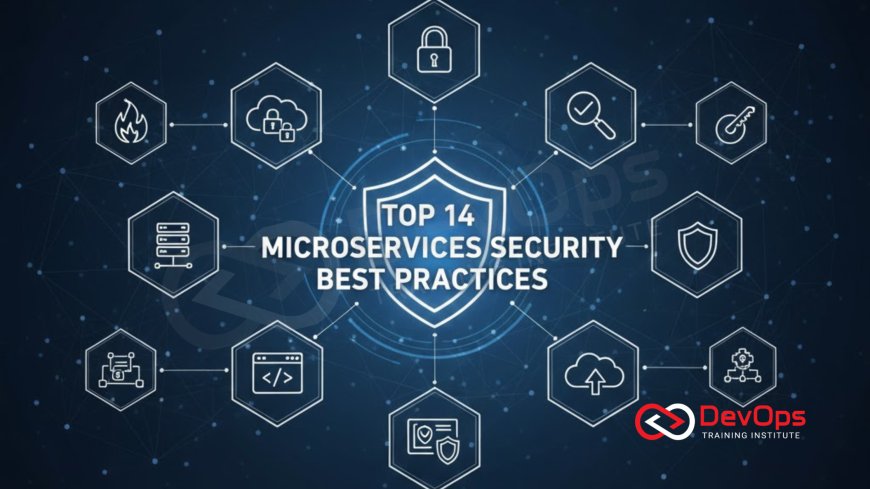
Top 14 Microservices Security Best Practices
Securing a microservices architecture requires a comprehensive approach that goes beyond traditional perimeter defense. This expert guide explores the top fourteen best practices for protecting distributed systems, including zero trust networking, API gateway implementation, and robust identity management. Learn how to safeguard your data and ensure system resilience by integrating advanced security protocols into your development lifecycle, preventing common vulnerabilities, and maintaining a high standard of operational safety across your entire cloud native infrastructure today.
Introduction to Microservices Security Challenges
Transitioning from a monolithic architecture to microservices brings incredible benefits in terms of scalability and development speed. However, this shift also dramatically expands the attack surface of your application. Instead of one single entry point, you now have dozens or even hundreds of smaller services communicating over a network. Each of these communication paths represents a potential target for malicious actors, requiring a fundamental rethink of how we approach digital safety and data protection in modern software systems.
Security in a distributed environment cannot rely on a simple firewall at the edge of the network. Because services are constantly talking to each other, a compromise in one small area could potentially spread if proper safeguards are not in place. This article outlines the essential strategies needed to create a hardened environment. By implementing these fourteen best practices, engineering teams can ensure that their microservices are not only fast and flexible but also inherently secure from the ground up, protecting both business reputation and sensitive user information.
Implementing Zero Trust and mTLS
The concept of zero trust is based on the principle that no user or service should be trusted by default, even if they are already inside the internal network. In a microservices world, this means every single request between services must be authenticated and authorized. We can no longer assume that a request is safe just because it comes from a local IP address. Implementing a zero trust model ensures that every interaction is verified, significantly reducing the risk of lateral movement by an attacker who has gained access to a single service.
A primary tool for achieving zero trust is Mutual Transport Layer Security, or mTLS. While standard TLS ensures that a client can trust a server, mTLS requires both the client and the server to present certificates to each other. This creates a secure, encrypted tunnel where both parties are absolutely certain of the other's identity. By automating the issuance and rotation of these certificates, often through a service mesh, teams can maintain a high level of security without adding significant manual overhead to their daily operations. This is a core part of platform engineering in modern environments.
The Crucial Role of API Gateways
An API Gateway acts as the single point of entry for all external requests entering your microservices ecosystem. Instead of exposing every individual service to the public internet, the gateway handles incoming traffic and routes it to the appropriate destination. This setup provides a centralized location to enforce security policies such as rate limiting, authentication, and request filtering. It simplifies the security landscape because developers don't have to rebuild these complex features into every individual microservice they create.
Beyond simple routing, the gateway can also perform protocol translation and hide the internal structure of your services from outsiders. By centralizing these functions, you can more easily monitor traffic patterns and detect potential attacks before they reach your core business logic. The gateway essentially serves as a robust shield, ensuring that only valid and authorized requests are allowed to pass through to your sensitive internal components. This centralized control is essential for managing the complexity of modern cloud applications while maintaining a strong and consistent defensive posture.
Identity and Access Management with OAuth2 and JWT
Managing user identities and their permissions across a distributed system is a complex task. Using industry standards like OAuth2 and JSON Web Tokens (JWT) provides a reliable framework for handling authentication and authorization. OAuth2 allows users to grant limited access to their resources without sharing their credentials, while JWTs serve as compact, URL safe containers for transferring claims between parties. These tokens are digitally signed, ensuring that the information they contain cannot be tampered with by an unauthorized middleman.
When a user logs in, they receive a JWT that includes their identity and specific permissions. As this token is passed from one service to another, each service can independently verify the token's validity without needing to call a central authentication server every time. This approach improves performance and reduces the load on your identity provider. However, it is vital to keep these tokens short lived and implement a secure way to revoke them if they are ever compromised. Proper token management is a fundamental pillar of any secure microservices strategy, ensuring that access is always granted to the right people for the right reasons.
Table: Summary of Security Best Practices
| Security Practice | Primary Goal | Key Component | Benefit |
|---|---|---|---|
| Zero Trust Networking | Eliminate implicit trust. | mTLS Certificates | Prevents lateral movement of attackers. |
| API Gateway Usage | Centralize entry points. | Reverse Proxy | Simplifies authentication and rate limiting. |
| Token Based Auth | Secure identity transfer. | JWT / OAuth2 | Enables stateless, scalable authorization. |
| Secrets Management | Protect credentials. | HashiCorp Vault / KMS | Keeps API keys and passwords out of code. |
| Defense in Depth | Layered protection. | WAF / Firewalls | Multiple barriers against sophisticated threats. |
Securing the CI CD Pipeline
A secure application begins long before it ever reaches a production environment. The automated pipeline that builds, tests, and deploys your code must be hardened against attack. If a malicious actor can compromise your build server, they can inject backdoors directly into your software without anyone noticing. This is why securing the delivery process is just as important as securing the application itself. Protecting your automation scripts and build artifacts is a critical step in maintaining a clean and trustworthy software supply chain.
To achieve this, teams should integrate automated security scanning at every step of the journey. This includes scanning container images for known vulnerabilities and checking source code for hardcoded secrets or insecure coding patterns. Adopting a devsecops culture ensures that security is a shared responsibility rather than an afterthought. By making security checks a mandatory part of the pipeline, you can catch and fix issues early, which is significantly cheaper and less risky than trying to patch a live system under pressure during an active incident.
Observability and Security Monitoring
In a complex microservices environment, you cannot secure what you cannot see. Observability is the ability to understand the internal state of your system by looking at the data it produces, such as logs, metrics, and traces. Security monitoring uses this data to detect unusual patterns that might indicate a breach or an ongoing attack. For example, a sudden spike in failed login attempts or a service suddenly talking to an unknown external IP address should immediately trigger an investigation by your response team.
Understanding observability is key because it allows you to trace a single request as it travels across multiple services. This granular view is essential for identifying the source of a security problem. By centralizing your logs and using specialized security tools to analyze them in real time, you can gain the visibility needed to respond quickly to threats. Without these insights, an attacker could remain hidden in your network for months, slowly stealing data while you remain completely unaware of their presence within your infrastructure.
Secrets Management Best Practices
Microservices often require access to sensitive information like database passwords, API keys for third party services, and encryption certificates. Storing these secrets in plain text within your source code or configuration files is a major security risk. If a developer accidentally pushes this code to a public repository, your entire system could be compromised. Instead, organizations should use dedicated secrets management tools that encrypt this sensitive data and provide it to services only when needed at runtime.
- Avoid Hardcoding: Never store passwords or keys directly in your application code or environment variables.
- Dynamic Secrets: Use tools that can generate temporary, short lived credentials for databases and other services.
- Access Control: Limit which services can access specific secrets using the principle of least privilege.
- Audit Logging: Keep a record of every time a secret is accessed and by which service or user.
- Automatic Rotation: Frequently change your passwords and keys automatically to limit the impact of a potential leak.
By centralizing your secrets, you can manage them more effectively and ensure that they are rotated frequently. This reduces the "blast radius" of a potential leak, as old credentials will quickly become useless. Modern cloud platforms provide native services for this, but many teams also choose independent solutions like HashiCorp Vault for more advanced features. Regardless of the tool, the goal is to ensure that sensitive data is always protected by strong encryption and strict access policies, keeping your most valuable assets safe from unauthorized discovery or theft. This is particularly important when using gitops to manage your cluster state.
Resilience and Proactive Security Testing
A truly secure system is one that can withstand both malicious attacks and accidental failures. Building resilience into your microservices means designing them to handle unexpected conditions gracefully. This includes implementing patterns like circuit breakers, which prevent a single failing service from taking down the entire system. From a security perspective, resilience also means being able to recover quickly from a compromise by having clean backups and automated deployment procedures that can restore the system to a known good state.
Proactive testing is another essential component of a strong security posture. Many teams now use chaos engineering to intentionally inject failures into their system to see how it responds. While this is often used for performance testing, it can also be used for security by simulating the loss of a security service or the corruption of a configuration file. This type of "security chaos engineering" helps teams find hidden weaknesses before real attackers do. It turns security from a static checklist into a dynamic, ongoing process of discovery and improvement, ensuring that your defenses are always ready for the real world.
Safe Deployment Strategies
How you release new code can significantly impact your overall security. Traditional "big bang" deployments are risky because a single mistake can impact all your users at once. Modern strategies like canary releases allow you to roll out changes to a small subset of users first. This allows you to monitor the new version for both bugs and security anomalies before completing the full rollout. If something goes wrong, you can quickly roll back the change with minimal impact on your user base.
Similarly, using blue green deployment techniques allows you to have two identical production environments. You can deploy and test the new version in the "green" environment while users continue to use the "blue" environment. Once you are confident that the new version is secure and stable, you simply switch the traffic over. This method provides a safe way to test in production conditions and ensures that you always have a working version to fail back to if a security vulnerability is discovered at the last minute. Integrating feature flags can also help in decoupling deployment from release for even more safety.
Conclusion
Securing a microservices architecture is a journey that requires constant vigilance and a commitment to best practices at every layer of the stack. By moving away from perimeter based security and embracing concepts like zero trust, mTLS, and centralized API gateways, you can build a system that is resilient by design. The strategies discussed in this guide provide a solid foundation for protecting your applications, your data, and your users. Remember that security is not just about the tools you use, but also about the culture you build within your engineering team. Encouraging a shift left mindset ensures that security is considered at every stage of the development lifecycle, from the first line of code to the final deployment. As the threat landscape continues to evolve, staying informed and proactive will be your best defense, allowing you to innovate with confidence while maintaining the highest standards of digital safety in the cloud.
Frequently Asked Questions
What is the biggest security risk in microservices?
The largest risk is the increased attack surface due to numerous inter service communications and the complexity of managing distributed identities.
How does mTLS help microservices?
It ensures that both services in a communication path are authenticated and that the data exchanged between them is fully encrypted.
What is an API Gateway?
An API Gateway is a central entry point that manages traffic, enforces security policies, and routes requests to various internal microservices.
Should I use JWT for internal service communication?
Yes, JWTs are an excellent way to pass user identity and permissions between services in a stateless and scalable manner.
What is Zero Trust?
Zero Trust is a security model that requires strict identity verification for every person and device trying to access network resources.
How do I manage secrets in microservices?
Use a dedicated secrets manager like HashiCorp Vault or AWS Secrets Manager to store and rotate credentials away from your code.
What is the difference between authentication and authorization?
Authentication verifies who a user is, while authorization determines what specific actions they are allowed to perform within the system.
How can observability improve security?
It provides the visibility needed to detect anomalous behavior and trace the path of a request to find the source of a breach.
Is a service mesh necessary for security?
While not strictly necessary, a service mesh simplifies the implementation of mTLS, observability, and traffic control across many different services.
What is Shift Left security?
It is the practice of moving security testing and considerations earlier in the software development process to catch issues early.
How do I prevent SQL injection in microservices?
Always use prepared statements and parameterized queries, and ensure that each service has its own isolated database with limited permissions.
What is Rate Limiting?
Rate limiting is a security measure that restricts the number of requests a user can make to a service in a set time.
How does a WAF protect microservices?
A Web Application Firewall filters and monitors HTTP traffic between a web application and the internet to block common malicious attacks.
Can I automate security testing?
Yes, you should integrate static and dynamic analysis tools into your CI CD pipeline to scan for vulnerabilities during every build.
Why is logging important for security?
Logs provide a historical record of events that is essential for auditing, forensic analysis after a breach, and meeting compliance requirements.
What's Your Reaction?
 Like
0
Like
0
 Dislike
0
Dislike
0
 Love
0
Love
0
 Funny
0
Funny
0
 Angry
0
Angry
0
 Sad
0
Sad
0
 Wow
0
Wow
0





![100+ Azure DevOps Interview Questions and Answers [Updated 2025]](https://www.devopstraininginstitute.com/blog/uploads/images/202509/image_140x98_68c40aa9a3834.jpg)






![Future Scope of DevOps Careers in Pune [Updated 2025]](https://www.devopstraininginstitute.com/blog/uploads/images/202510/image_140x98_68e3a84652312.jpg)