






























![Kong Interview Preparation Guide [2025]](https://www.devopstraininginstitute.com/blog/uploads/images/202509/image_430x256_68dbb95326997.jpg)















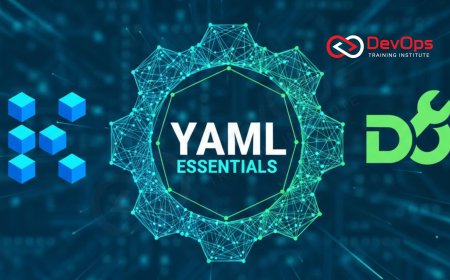
10 YAML Essentials for Kubernetes & DevOps
Master the YAML skills every Kubernetes and DevOps engineer needs in 2025. This beginner-friendly yet comprehensive guide explains the 10 most important YAML concepts and patterns with clear examples, common pitfalls, and production-ready best practices. Learn how to write clean, safe, and maintainable Kubernetes manifests, Helm charts, GitOps configurations, and CI/CD pipelines without getting lost in indentation errors or security surprises. Perfect for newcomers and experienced practitioners who want to level up their YAML game.

Introduction
YAML has become the universal language of modern cloud-native infrastructure. Whether you are declaring a Kubernetes Deployment, writing a GitHub Actions workflow, configuring ArgoCD Application, or Helm values file, you are speaking YAML. Despite looking simple, YAML hides many sharp edges that cause frustration, failed deployments, and even security incidents when used incorrectly.
This guide breaks down the ten most essential YAML concepts every Kubernetes and DevOps professional must deeply understand. Each section includes real-world examples, common mistakes beginners make, and pro tips used by elite teams. By the end, you will write cleaner, safer, and more maintainable configuration files that survive production at scale.
1. Master Proper Indentation and Spacing
Indentation is meaningful in YAML and the number one source of errors for newcomers. YAML uses spaces only, never tabs. Most teams standardize on two spaces per level.
A single wrong space can change the data type or create completely different structures. Kubernetes API server will reject malformed YAML with cryptic messages that are hard to debug.
- Always use exactly two spaces, never tabs
- Enable editor plugins that highlight YAML indentation errors
- Use kubectl apply --dry-run=client -f file.yaml to catch syntax issues early
- Tools like yamllint and kubeconform save hours of troubleshooting
2. Understand the Three Dashes (Document Separator)
The triple dash --- separates multiple Kubernetes objects in a single file. This pattern is heavily used in GitOps and Helm templates.
Many beginners forget the dashes or place them incorrectly, causing kubectl to process only the first object or throw errors.
- --- starts a new document
- ... optionally ends a document (rarely needed)
- You can mix different kinds like Deployment, Service, ConfigMap in one file
- ArgoCD and Flux love multi-document files for atomic applies
- Always include a blank line after --- for readability
3. Use Comments Liberally
YAML supports # comments, yet many manifests lack them. Six months later, no one remembers why a specific value was chosen.
Good comments prevent accidents and make onboarding faster. Elite teams treat comments as mandatory.
- Explain non-obvious values and business decisions
- Document allowed ranges for resources
- Mark deprecated fields during migrations
- Add links to runbooks or design documents
- Never comment out large sections, delete or use Helm templates instead
4. Anchors, Aliases & Merge Keys (DRY Principle)
Avoid Copy-Paste with & and *
Repeating the same labels, annotations, or securityContext across objects creates maintenance nightmares.
YAML anchors (&) and aliases (*) let you reuse blocks. Merge keys (<<: *) make this even more powerful.
- Define common labels once and reuse everywhere
- Perfect for sharing securityContext or podAntiAffinity rules
- Helm already does this under the hood, but raw YAML benefits too
- Be careful, overuse reduces readability
5. Multi-line Strings Done Right
Kubernetes ConfigMaps and commands and scripts often require multi-line strings. There are three ways, each with different behavior.
- | (literal block) preserves newlines, great for scripts
- > (folded block) collapses newlines into spaces, good for long commands
- |- and >- strip final newline (most common in real manifests)
- Always indent the content one level deeper than the key
- Use dead-letter queue patterns in scripts to handle failures gracefully
6. Safe and Secure Secrets Handling
Never write secrets in plain YAML. Even Kubernetes Secrets are only base64-encoded, not encrypted.
Best Practices in 2025
- Use external secret managers: HashiCorp Vault, AWS Secrets Manager, Sealed Secrets, External Secrets Operator
- Never commit real secrets to Git, use .gitignore and pre-commit hooks
- Use Helm secrets plugins or SOPS for encrypted values files
- Enable etcd encryption at rest in production clusters
- Rotate secrets regularly using automation
7. Labels and Annotations – The Hidden Superpower
Labels are the primary way Kubernetes identifies and groups objects. Annotations carry non-identifying metadata.
Poor labeling breaks selectors, monitoring, network policies, and GitOps reconciliation.
- Follow Kubernetes recommended labels: app.kubernetes.io/name, version, instance, component, part-of
- Use annotations for tool-specific data (prometheus.io/scrape, fluxcd.io/automated)
- Never use labels for large data, use annotations instead
- Enforce label policies with Kyverno or OPA Gatekeeper
8. Resource Requests and Limits – Get This Wrong and Pay the Price
One of the most common production disasters comes from missing or incorrect resource requests/limits.
- Requests determine scheduling and bin-packing
- Limits prevent a single pod from killing the node
- Always set both CPU and memory
- Use tools like Goldilocks or VPA to find optimal values
- Combine with CloudFront cache invalidation for frontend assets to reduce backend load
9. Environment-Specific Values and Templating
Never maintain separate YAML files for dev/staging/prod. It leads to drift and mistakes.
Modern Approaches
- Helm with values-dev.yaml, values-prod.yaml
- Kustomize overlays for environment patching
- Jsonnet or CUE for programmatic generation
- ArgoCD Application per environment pointing to different paths
- Never use envsubst or raw sed in production
10. Validation, Linting and Testing Your YAML
Treating YAML as code means testing it like code.
- kubeconform, kube-linter, kube-score for static analysis
- yamllint for syntax and style
- datree or Polaris for policy enforcement
- Pre-commit hooks to catch issues before Git
- CI pipeline step: kubectl apply --dry-run=server
- Send validation failures to SNS alerts
Kubernetes YAML Best Practices Table
| Practice | Why It Matters | Tooling |
|---|---|---|
| Two-space indentation | Prevents parsing errors | EditorConfig + yamllint |
| Multi-document separator --- | Atomic applies in GitOps | ArgoCD/Flux |
| External secrets management | Security compliance | Vault, Sealed Secrets |
| Kustomize/Helm overlays | No YAML duplication | Kustomize, Helm |
| Pre-commit validation | Catch errors early | kubeconform, yamllint |
Conclusion
YAML may look simple, but small mistakes have caused massive outages at companies you know. The ten essentials covered here, proper indentation, document separators, comments, DRY techniques, secure secrets, smart labeling, resource management, templating, and rigorous validation, form the foundation of professional-grade Kubernetes operations. Master these patterns and your manifests will be readable, secure, and resilient. Treat YAML as real code: version control it, review it, test it, and automate it. Teams that do this ship faster and sleep better.
Frequently Asked Questions
Is YAML case-sensitive?
Yes. true and True are different. Always use lowercase for booleans.
Can I use tabs in YAML?
No. YAML specification forbids tabs. Use spaces only.
Are comments preserved when using kubectl apply?
No. Kubernetes strips comments. Keep important notes in Git or external docs.
How many spaces should I indent?
Two spaces is the universal standard in the Kubernetes community.
Can I store secrets safely in Git?
Not in plain text. Use SOPS, Sealed Secrets, or external secret operators.
Should I use Helm or Kustomize?
Both are excellent. Helm for packaging, Kustomize for overlays and GitOps.
Is it safe to use anchors and aliases in production?
Yes when used sparingly. Avoid deep nesting that hurts readability.
What is the difference between | and > for multi-line?
| preserves newlines (use for scripts), > folds them into spaces (use for commands).
Do I need --- between every object?
Yes, except the very last one. Include a trailing newline at end of file.
How do I validate YAML before applying?
Run kubectl apply --dry-run=client -f your-file.yaml or use kubeconform.
Can I mix different API versions in one file?
Yes. Multi-document files can contain any object kinds.
Should I add comments to every field?
No. Comment non-obvious choices and business constraints.
Is YAML better than JSON for Kubernetes?
Yes. YAML is human-readable and supports comments, which JSON does not.
What is the maximum nesting depth?
No hard limit, but beyond 5-6 levels becomes unreadable. Refactor.
How do big companies manage YAML at scale?
They use code generation, strict linting, policy engines, and GitOps tools with approval workflows.
What's Your Reaction?
 Like
0
Like
0
 Dislike
0
Dislike
0
 Love
0
Love
0
 Funny
0
Funny
0
 Angry
0
Angry
0
 Sad
0
Sad
0
 Wow
0
Wow
0


![100+ Azure DevOps Interview Questions and Answers [Updated 2025]](https://www.devopstraininginstitute.com/blog/uploads/images/202509/image_140x98_68c40aa9a3834.jpg)






![Future Scope of DevOps Careers in Pune [Updated 2025]](https://www.devopstraininginstitute.com/blog/uploads/images/202510/image_140x98_68e3a84652312.jpg)