



One-on-One vs Batch DevOps Training in Bangalore
Choosing between one-on-one DevOps coaching and batch training in Bangalore? Compare pace, feedback, cost per hour and fit, plus how to judge a mentor.
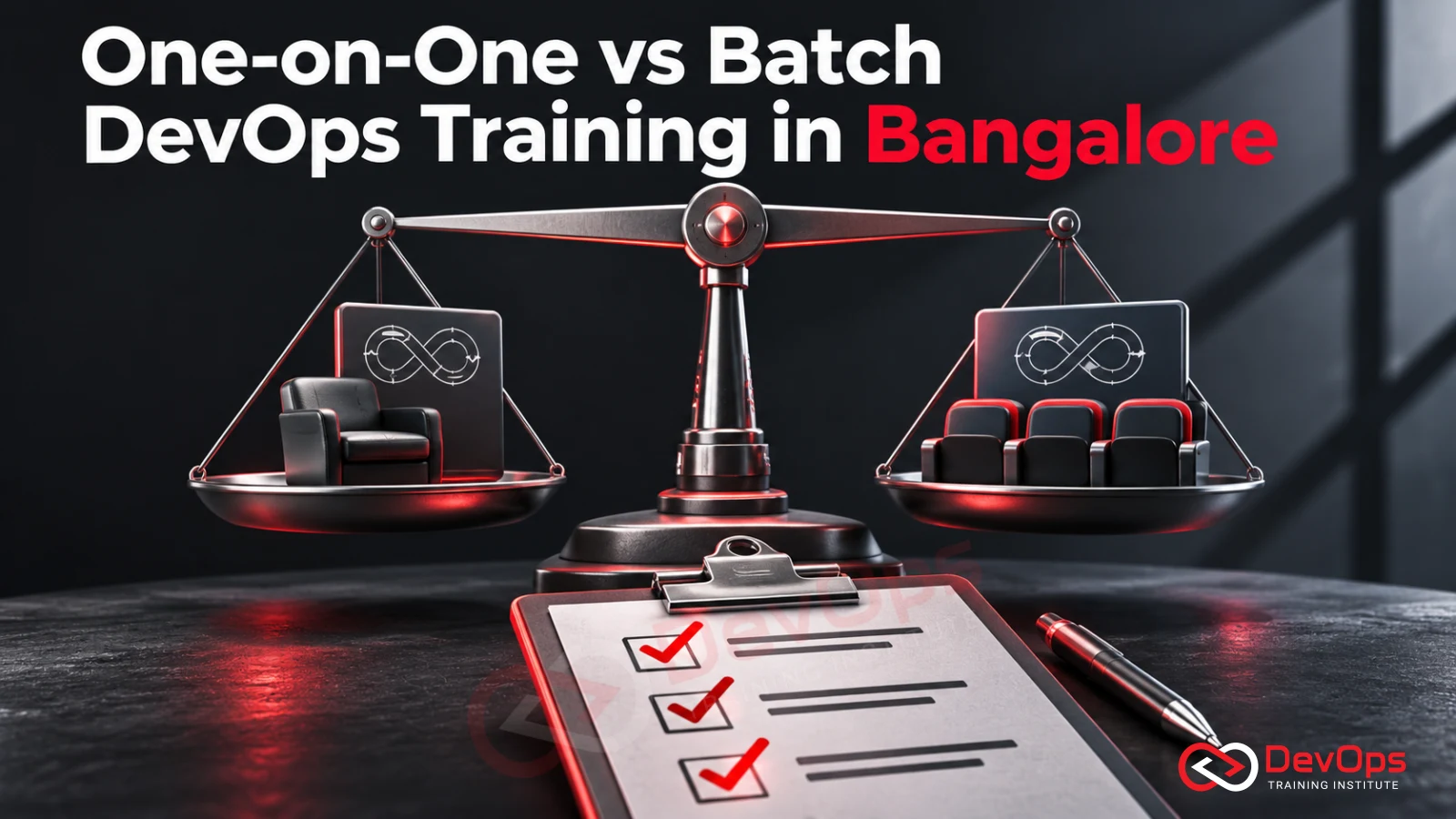
One-on-one DevOps coaching gives you a mentor's full attention and a pace set around you, while batch training gives you a fixed syllabus, peers and usually a lower cost per hour. Choose 1:1 for a narrow, urgent goal or an unusual schedule; choose a batch for a broad foundation. In Bangalore, both are typically delivered online.
This guide helps you decide between personal coaching and group training for DevOps. It does not sell either. We explain what each format is good at, where each falls short, which questions to ask a mentor or institute, and how to combine them sensibly. If you are new to the field, start with what DevOps is so you know what you are learning before you decide how to learn it.
A note on our own format: for learners in Bangalore, our DevOps training runs as live online batches. The only classroom is in Kharadi, Pune. Ask our team about the current formats and schedules; this post does not describe a specific coaching product.
Key takeaways
- 1:1 coaching suits targeted goals: a specific certification, a tool your new job uses, interview preparation or a career switch with a tight deadline.
- Batch training suits building a broad foundation from scratch, because the syllabus, pacing and peer learning do much of the work for you.
- The quality of the person teaching matters more than the format. Check their hands-on experience, not their title.
- Ask for a trial session in either format before you pay in full.
- Many learners do best with a batch for the foundation and a few focused 1:1 sessions for gaps and interview practice.
- For Bangalore, both formats are online in practice, so compare session quality and lab access rather than location.
What one-on-one DevOps coaching actually involves
In 1:1 coaching, one mentor works with one learner. Sessions are scheduled around both people, usually online with screen sharing. A good coach starts by assessing what you know, agrees a goal with you, and builds a plan that skips what you already understand and spends extra time on what you do not. Between sessions you work on labs or projects, and the next session reviews them.
The big advantage is fit. If you already know Linux and Docker but struggle with Kubernetes networking, a coach can spend three sessions on exactly that. If your new employer uses GitLab CI and Terraform on Azure, the coach can build examples around that stack. If you work night shifts, you can book sessions at times a batch would never run.
The other advantage is feedback. A coach reads your code, watches you debug, and points out habits that a group trainer would not have time to notice, such as committing secrets, skipping plan review in Terraform, or guessing at fixes instead of reading logs.
Where 1:1 coaching falls short
Cost per hour is usually higher, because one person's time is spent on one learner. Quality varies widely, since anyone can call themselves a DevOps mentor. Without a fixed syllabus, it is easy to drift: sessions turn into answering whatever question came up that week, and months later you have covered a lot of topics without finishing any of them. You also miss what peers bring, such as hearing other people's questions and seeing different ways to solve the same lab.
What batch DevOps training involves
In batch training, a trainer teaches a group on a fixed schedule with a set syllabus. Good batches mix short explanations with a lot of live lab work, provide recordings, and offer some way to get help between sessions. The syllabus usually runs from Linux and Git through Docker, CI/CD, cloud, Terraform, Kubernetes and monitoring, ending in a project.
The strengths are structure and momentum. You do not have to decide what to learn next; the course has already sequenced it. Fixed session times make it harder to postpone study. Peers ask questions you would not have thought of, and comparing approaches in labs teaches you a lot. Cost per hour is usually lower.
Where batch training falls short
The pace is set for the middle of the group. If you are ahead you may be bored; if you are behind you may lose the thread. The trainer has less time to look at your individual work. The schedule is fixed, which can be hard for people with shifting work hours. And the syllabus may include topics you already know or skip a tool your target job needs.
Side-by-side comparison
| Factor | One-on-one coaching | Batch training |
|---|---|---|
| Pace | Set around you | Set for the group |
| Syllabus | Custom, depends on the coach's planning | Fixed and sequenced |
| Feedback on your work | Detailed and frequent | Limited by group size |
| Peer learning | None unless arranged | Built in |
| Schedule | Flexible | Fixed session times |
| Cost per hour | Usually higher | Usually lower |
| Risk | Drift without a plan; quality varies by individual | Falling behind or being held back |
| Best for | Narrow goals, gaps, interview prep, unusual schedules | Broad foundation from scratch |
When one-on-one coaching makes sense
Choose 1:1 when your goal is specific and you can describe it in a sentence. Examples: "pass a Kubernetes certification exam in eight weeks", "get comfortable with the Terraform and Azure setup my new team uses", "prepare for senior DevOps interviews", or "move from Linux administration into CI/CD and containers". In each case a coach can plan backwards from the goal.
1:1 also makes sense if you already have most of the foundation and only need to fill gaps, if your work hours make batch schedules impossible, or if you have tried group courses and found you need someone to check your work closely. Experienced engineers preparing for a step up often fall in this category; our career tips for senior DevOps engineers describe the kinds of skills those sessions usually target.
When batch training makes sense
Choose a batch if you are starting from little or no DevOps background. Learning ten connected areas in the right order is hard to plan alone, and a good syllabus already does that. The peer group helps with motivation over several months. And because cost per hour is lower, you can afford more total hours of instruction, which a beginner needs.
Batches also suit freshers, who benefit from seeing how other learners approach the same problems. Our post on job-ready DevOps skills for freshers lists what a foundation course should cover.
A hybrid that works for many learners
You do not have to choose only one. A common approach is to join a batch for the foundation, then book a small number of 1:1 sessions for the areas where you struggled and for mock interviews near the end. This keeps the structure and lower cost of a batch while giving you the targeted feedback that only individual attention provides.
If you take this route, keep notes during the batch of topics that did not click. Bring those to the 1:1 sessions with specific questions and your own lab code, so the coach spends time on your real gaps rather than repeating the syllabus.
How to judge a DevOps mentor or trainer
The person matters more than the format. A strong batch trainer beats a weak personal coach, and the reverse is also true. Check these points before you commit.
- Hands-on experience: ask what systems they have built or run, which tools they used in production, and what kind of incidents they have handled.
- Teaching approach: ask how a typical session runs and how much of it is you working rather than them talking.
- Current material: check that tool versions and examples are recent. DevOps tools change quickly.
- Lab environment: ask where labs run, who provides access, and who pays for cloud usage.
- Plan and milestones: for 1:1, ask for a written plan with goals for each few sessions.
- Honest claims: be cautious of anyone who promises jobs, quotes salary figures or shows testimonials you cannot verify.
Our guide to DevOps training reviews and ratings explains how to read reviews critically, and DevOps certification programs compared helps you see what different programs include.
Questions to ask before you pay
For either format, ask for a trial or demo session. Ask what happens if you miss a session: is there a recording, a make-up slot or nothing? Ask for the refund policy in writing. Ask how you can get help between sessions and how quickly questions are answered. For 1:1, ask how many sessions the coach expects your goal to take and what you will be able to do at the end. For a batch, ask for the size of the group and the full schedule.
Compare costs in the same unit. Divide the total fee by the number of live instruction hours, and note separately what is included, such as lab access, recordings, project reviews and mock interviews. Exam fees paid to certifying bodies are usually separate; our post on DevOps certification costs in Bangalore explains the difference.
Online delivery in Bangalore
For Bangalore learners, most of this choice now happens online. Our own training for Bangalore is live online, with the classroom in Kharadi, Pune. Online works well for DevOps because labs run in cloud accounts or remote machines anyway, and screen sharing lets a trainer see exactly what you see. What matters is that sessions are live and interactive, that you can share your screen when stuck, and that recordings are available.
Set up your environment properly: a reliable connection, a second monitor if you can manage it, and a quiet place for live sessions. Treat online sessions with the same commitment as a classroom; it is easy to half-listen while doing something else, and you lose most of the value that way.
You can see the current syllabus and batch options on our DevOps training page and ask our team which formats are available for your goal.
Making whichever format you choose work
Whatever you pick, the learning happens in the hours between sessions. Do every lab yourself rather than watching. Break things on purpose and fix them. Keep a short log of what you learned and what confused you each week. Build one project that grows through the course, and write its README as you go. Bring specific questions to each session.
Review your progress every few weeks against your goal. If a batch is moving too slowly or too fast, talk to the trainer. If 1:1 sessions are drifting, ask the coach to return to the written plan. The format is a tool; your own practice decides how much you get from it.
Signs you chose the wrong format
It helps to know the warning signs early, so you can change course before you have spent too much time or money. In a batch, warning signs include regularly not finishing labs before the next session, feeling lost for more than a week or two, or the opposite: sitting through sessions on topics you already know well. In 1:1 coaching, the signs are sessions that feel like casual chats, no written plan, no homework reviewed, or a coach who answers questions without checking whether you can now do the task yourself.
If you notice these signs, talk to the trainer or coach first. Many problems can be fixed with a different batch, extra practice sessions, or a firmer plan. If not, the earlier you switch, the less you lose. This is another reason to read the refund and transfer policy before you join.
Frequently asked questions
Is one-on-one DevOps coaching better than batch training?
Neither is better for everyone. 1:1 suits narrow, urgent goals and unusual schedules. Batches suit building a broad foundation from scratch.
Is one-on-one coaching more expensive?
Usually it costs more per hour because one person's time goes to one learner. Compare formats by dividing total fee by live instruction hours.
Can I combine batch training with 1:1 sessions?
Yes. Many learners join a batch for the foundation and book a few focused 1:1 sessions for gaps and mock interviews.
How do I check a DevOps mentor's quality?
Ask what systems they have built or run, how sessions are structured, where labs run, and for a written plan. Be cautious of job or salary promises.
Should beginners choose one-on-one coaching?
Most beginners do better in a structured batch, since the syllabus sequences many connected topics and peers help with motivation.
Does DevOps Training Institute offer one-on-one coaching?
Ask our team about current formats. For Bangalore learners our DevOps training runs as live online batches.
Is there a DevOps classroom in Bangalore?
No. Bangalore learners join online. The only classroom is in Kharadi, Pune.
Official references
What's Your Reaction?
 Like
0
 Dislike
0
 Love
0
 Funny
0
 Angry
0
 Sad
0
 Wow
0