



![Kong Interview Preparation Guide [2025]](https://www.devopstraininginstitute.com/blog/uploads/images/202509/image_430x256_68dbb95326997.jpg)




10 Career Tips to Become a Senior DevOps Engineer
Advance your career from mid-level to Senior DevOps Engineer with these 10 essential tips focused on mastering architecture, reliability, and leadership. Learn to shift your focus from operating tools to designing scalable, multi-cloud platforms, defining Service Level Objectives (SLOs), and championing DevSecOps principles. This guide emphasizes the transition from writing scripts to driving organizational change, mentoring junior engineers, and mastering complex distributed systems like Kubernetes. Follow this roadmap to achieve expert-level proficiency, command a top-tier salary, and become the technical authority on operational excellence and system resilience within your organization.
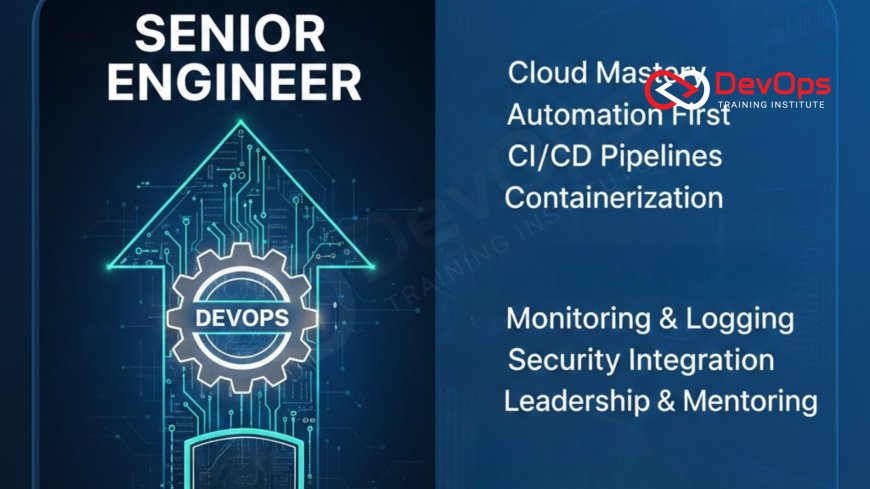
Introduction
The transition from a mid-level DevOps Engineer to a Senior DevOps Engineer is less about accumulating more tool knowledge and more about fundamentally changing your scope of responsibility, your technical depth, and your sphere of influence. A mid-level engineer executes tasks and fixes immediate problems; a senior engineer designs the system architecture, anticipates future failures, drives organizational standards, and mentors others. This career shift requires moving beyond tactical execution—mastering a specific CI/CD pipeline or a set of Terraform files—to focusing on strategic outcomes, system resilience, and business alignment. The senior role is the technical backbone of a high-performing engineering organization.
The journey demands a deep dive into the operational realities of massive, distributed systems, adopting the rigorous principles of Site Reliability Engineering (SRE), and cultivating the soft skills required to lead technical initiatives and champion cultural change. You must evolve from being a consumer of infrastructure to being its architect and ultimate guardian. The following 10 career tips provide a structured roadmap to help you navigate this transition successfully, ensuring your skills and mindset align with the requirements of a top-tier senior role in the rapidly evolving cloud-native ecosystem, demonstrating that you understand the historical and operational context of the entire technology stack, including the lineage of the operating system itself.
1. Shift Focus from Tools to Architecture and Design
The most significant leap in a DevOps career is the shift in focus from mastering individual tools to designing and architecting cohesive systems. The mid-level engineer knows how to write a Terraform module; the senior engineer understands why that module should exist, how it impacts the network topology, and the security implications across the entire environment. Your value is no longer in the code you write, but in the systems you design and the standards you enforce.
As a senior candidate, you must be able to evaluate trade-offs between different cloud platforms, container orchestrators (e.g., Kubernetes vs. serverless), and networking models. This involves understanding complex relationships, such as how Linux became the preferred OS for cloud infrastructure and how that historical context affects modern choices like virtualization models and file systems. You should be able to blueprint a highly available, multi-region application deployment from scratch, justifying every architectural decision based on cost, resilience, and operational simplicity, transforming your role from a doer into a strategic problem solver.
2. Master Reliability with SRE Principles
The core responsibility of a senior role is ensuring the production system is reliable and scalable. This requires adopting the discipline of Site Reliability Engineering (SRE). Instead of simply reacting to alerts, you must proactively engineer systems for resilience and define objective measures of service health. SRE principles provide the necessary framework for applying software engineering practices to operational problems.
- Define and Track SLOs (Service Level Objectives): Move beyond simple uptime monitoring. Define clear, measurable, and customer-centric SLOs for latency, error rate, and throughput. Your job is to drive the engineering work required to keep the system within these targets, effectively managing the error budget that dictates how fast teams can innovate safely.
- Reduce Toil Through Code: Dedicate time to writing code (Python or Go) that permanently eliminates manual, repetitive, tactical operational work ("toil"). This includes automating complex incident responses, routine patching, and system maintenance. Your goal is to automate yourself out of recurring low-value tasks, freeing up time for high-level architectural work.
- Implement Blameless Post-Mortems: Champion a culture where system failures are treated as systemic process defects, not personal mistakes. Lead post-incident reviews to identify root causes, document findings, and implement actionable preventative measures, ensuring that every failure contributes to long-term system resilience.
3. Champion Security: Become a DevSecOps Leader
Security is the paramount concern in modern software delivery. A senior engineer must drive the security agenda by proactively embedding checks and governance into the pipeline, making security an enabler of speed, not a final gate. This requires a strong commitment to the DevSecOps philosophy, viewing security practices as mandatory automation tasks.
Your expertise should cover every layer of the software supply chain: implementing static analysis (SAST) on application code, scanning container images (Trivy), enforcing policy on IaC (Checkov/Sentinel), and managing complex network security groups. You must become the primary source of knowledge on secrets management, guiding teams on the secure integration of tools like HashiCorp Vault. This leadership ensures that security is baked into the development process from the very first commit, providing confidence that the infrastructure is compliant and protected against common vulnerabilities.
4. Lead the Observability and Feedback Loop
The ability to deploy quickly is meaningless without the ability to monitor effectively. A senior engineer designs the comprehensive observability platform, ensuring that teams have deep, correlated insights into system behavior—metrics, logs, and traces—rather than just simplistic health checks. You must move beyond configuring Prometheus and Grafana to defining what data is crucial for the business.
This includes implementing distributed tracing (OpenTelemetry/Jaeger) to follow user requests across microservices, ensuring that every deployment is validated against real-time performance indicators, and creating automated rollback mechanisms triggered by alert thresholds. You must teach junior engineers and developers how to effectively instrument their code and use the observability platform to diagnose and resolve issues themselves, closing the feedback loop from production back to development efficiently and rapidly.
5. Table: Senior DevOps Focus vs. Mid-Level Focus
This table highlights the fundamental shift in responsibilities, tools, and mindset that defines the transition to a senior role, illustrating how the focus moves from local execution to global architecture, governance, and organizational impact.
| Area of Focus | Mid-Level Engineer | Senior Engineer |
|---|---|---|
| IaC & Cloud | Writes and maintains specific Terraform modules; provisions development environments; fixes IaC bugs. | Designs the multi-cloud IaC architecture; defines best practices for state management and modularity; owns the security policies embedded in the IaC. |
| Reliability & SRE | Responds to alerts; manages monitoring dashboards; participates in on-call rotation. | Defines SLOs and error budgets; leads incident resolution and blameless post-mortems; writes code to automate operational tasks ("toil"). |
| CI/CD | Builds and debugs pipeline stages (e.g., builds a Docker image, runs tests); integrates a new tool. | Architects the entire continuous delivery platform (e.g., Kubernetes + ArgoCD); selects deployment strategies (Canary/Blue-Green); manages governance. |
6. Become a Master of Distributed Systems (Kubernetes)
In today's cloud landscape, applications are rarely monolithic; they are distributed, containerized microservices managed by orchestrators. Kubernetes is the dominant orchestrator, and its mastery is essential for a senior role. This goes beyond deploying an application using Helm or YAML; it involves deep knowledge of its internal components, networking (CNI), and complex storage requirements.
You must understand how to secure a Kubernetes cluster (RBAC, Pod Security Policies), optimize its performance (autoscaling, resource limits), and troubleshoot complex issues like network connectivity between Pods across different nodes. Furthermore, learn how to manage and operate Kubernetes clusters efficiently on major cloud platforms like EKS, AKS, or GKE, ensuring that the platform is reliable for the product teams that depend on it. This deep dive into complexity is what unlocks the highest senior-level salaries.
7. Drive and Document Organizational Standards
A true senior engineer’s influence extends beyond code to processes and people. You are responsible for documenting and socializing the "paved road" for the entire engineering organization. This means creating clear, concise documentation for best practices, such as standardized CI/CD pipeline templates, approved Terraform module structures, and definitive guidelines for setting up new projects in a compliant, secure manner. This documentation must be accessible and easy for everyone—from new hires to senior developers—to understand and adopt.
Driving standards ensures consistency, reduces technical debt, and accelerates onboarding. It also provides the governance necessary for scaling the engineering team while maintaining high operational quality. This involves constantly evaluating the current tooling (e.g., why is GitLab CI better for our specific multi-cloud environment than GitHub Actions?) and proposing actionable roadmaps for adopting superior solutions, securing buy-in from both engineers and management.
8. Master Multi-Cloud and FinOps Strategy
Enterprise resilience often dictates a multi-cloud or hybrid strategy. A senior engineer must not only be an expert in one cloud (e.g., AWS) but must also understand the core differences in service models, networking, and security between major platforms (AWS, Azure, GCP). Your expertise should leverage cloud-agnostic tools like Terraform and Kubernetes to enable workload portability and mitigate vendor lock-in risk.
Furthermore, you must integrate FinOps (Cloud Financial Operations) into your architectural decisions. This involves understanding cloud billing models, optimizing resource utilization through automated cleanup and rightsizing, and driving cost accountability across development teams. By balancing resilience and technical design with cost optimization, you demonstrate a strategic business perspective that is essential for a senior leadership role, proving that your solutions are financially sound and sustainable.
9. Embrace Mentorship and Knowledge Transfer
Seniority inherently carries the responsibility of mentorship. A significant portion of your role will involve elevating the skills of mid-level and junior engineers. This involves formal coaching on best practices, reviewing code (both application and IaC) with a focus on teaching long-term concepts, and conducting internal workshops on new technologies or SRE principles. Effectively multiplying your knowledge across the team is the best measure of your leadership and technical impact on the organization, ensuring that the entire engineering function grows in capability and maturity.
Mentorship also extends to improving the overall engineering environment. By acting as a technical liaison between the core product teams and the platform team, you ensure that the tooling and automation provided meet the product teams' needs, fostering the collaborative DevOps culture that drives high-performing organizations. You become the go-to expert for complex problems, leading by example and prioritizing knowledge transfer over simply solving problems alone.
Conclusion
The path to becoming a Senior DevOps Engineer is a journey from tactical execution to strategic architecture and leadership. It demands that you evolve your skillset to include the rigorous principles of SRE, the comprehensive governance of DevSecOps, and the strategic thinking of a multi-cloud architect. Your focus must shift from writing individual scripts to designing resilient systems, defining organizational standards, and mentoring the next generation of engineers. By mastering these 10 tips—specifically by adopting the proactive mindset of reliability engineering and extending your influence to security, architecture, and governance—you will secure your position as a technical authority.
This senior role is the engine of operational excellence, ensuring that the organization can maintain high velocity without compromising system stability or security. Achieving this level requires years of dedicated practice, a relentless commitment to automation, and a strong cultural belief in the power of collaboration and continuous improvement. Embrace the complexity, drive the change, and your career trajectory will be secured at the highest technical levels of the modern IT industry.
Frequently Asked Questions
What is the difference between an SRE and a Senior DevOps Engineer?
An SRE focuses intensely on reliability and toil reduction through code, while a Senior DevOps Engineer has a broader scope, encompassing CI/CD architecture, IaC governance, and security.
What is the biggest mistake a mid-level engineer makes?
The biggest mistake is focusing only on learning new tools without understanding the underlying architectural or operational principles behind why those tools are used strategically.
Why are SLOs important for a Senior DevOps Engineer?
SLOs are crucial because they define objective, measurable targets for service reliability from the customer's perspective, guiding prioritization and engineering effort.
How does IaC security (DevSecOps) fit into the senior role?
The senior role defines the IaC security policy (Policy-as-Code) and integrates automated scanning tools like Checkov into the CI pipeline to enforce those policies globally.
What is the "paved road" in DevOps?
The "paved road" refers to the standardized, opinionated, and well-documented set of tools and practices established by the platform team for developers to use easily and safely.
Should a Senior Engineer still write code?
Yes, they should write code, but their code focuses primarily on architecture, complex automation (toil reduction), core platform components, and defining reusable modules.
What is the relevance of Linux history in a senior role?
Understanding Linux history and architecture provides the foundation for troubleshooting system internals, kernel tuning, and making informed choices about the fundamental OS used in the cloud and containers.
What is the role of FinOps in the senior scope?
FinOps involves driving cloud cost accountability, optimizing resource usage via automation, and ensuring that architectural decisions balance cost-effectiveness with high reliability requirements.
How does mentorship help a senior engineer's career?
Mentorship accelerates the senior engineer's career by demonstrating leadership, multiplying their knowledge across the organization, and creating leverage on their time.
What tool is key for multi-cloud IaC strategy?
Terraform is key for multi-cloud IaC because its cloud-agnostic language (HCL) allows the same workflow and code logic to manage resources across AWS, Azure, and GCP, reducing vendor lock-in risk.
Why is blameless post-mortem culture important?
A blameless culture encourages engineers to report incidents honestly, focusing on improving systemic processes rather than assigning personal fault, which maximizes learning from failure.
What is the importance of version control standards?
Version control standards, such as consistent Git branching strategies and code review mandates, are crucial for maintaining the auditability, quality, and collaboration necessary for continuous delivery at scale.
What does it mean to be a technical authority?
It means being the expert who owns the ultimate architectural decisions, drives technical standards, and is the final escalation point for complex, systemic production issues.
How do virtualization concepts still apply in cloud DevOps?
Concepts like hypervisors and virtual machine management are still relevant for understanding the underlying virtualization layers on which cloud infrastructure operates, aiding in performance tuning and troubleshooting.
What is the most effective way to close the feedback loop?
The most effective way is by designing the observability platform (metrics, logs, traces) so that production data immediately flows back to developers, allowing them to fix issues proactively.
What's Your Reaction?
 Like
0
Like
0
 Dislike
0
Dislike
0
 Love
0
Love
0
 Funny
0
Funny
0
 Angry
0
Angry
0
 Sad
0
Sad
0
 Wow
0
Wow
0




![100+ Azure DevOps Interview Questions and Answers [Updated 2025]](https://www.devopstraininginstitute.com/blog/uploads/images/202509/image_140x98_68c40aa9a3834.jpg)





![Future Scope of DevOps Careers in Pune [Updated 2025]](https://www.devopstraininginstitute.com/blog/uploads/images/202510/image_140x98_68e3a84652312.jpg)