


![Kong Interview Preparation Guide [2025]](https://www.devopstraininginstitute.com/blog/uploads/images/202509/image_430x256_68dbb95326997.jpg)




12 Benefits of GitOps for Kubernetes Clusters
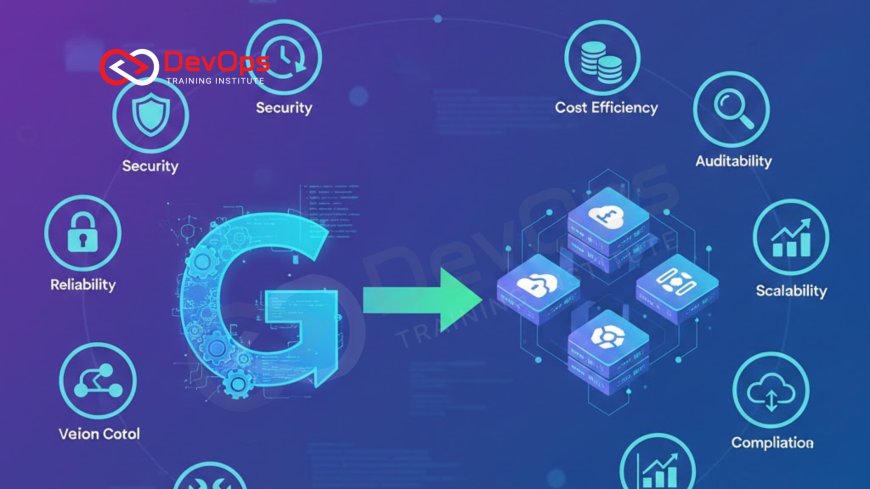
Explore the 12 transformative benefits of adopting GitOps for managing your Kubernetes clusters, moving beyond traditional CI/CD to a declarative, developer-centric model. Learn how GitOps leverages Git as the single source of truth for infrastructure and application configurations, driving unparalleled operational efficiency, enhanced security, and rapid disaster recovery. This guide details how GitOps simplifies complex deployments, improves auditability, enables consistent environments, and facilitates automatic drift detection, empowering DevOps teams to manage Kubernetes at scale with confidence and precision, reducing human error and increasing deployment velocity.
Introduction
The rise of Kubernetes as the standard for container orchestration has simultaneously introduced the challenge of managing increasingly complex and dynamic cluster configurations. Traditional methods of deployment, often involving manual steps or imperative scripts, struggled to keep pace with the velocity and scale of cloud-native development. GitOps emerged as the necessary evolution of Continuous Delivery, offering a revolutionary way to manage these environments. GitOps is not just a tool; it is an operating model that uses Git, the ubiquitous version control system, as the single, authoritative source of truth for the desired state of both applications and infrastructure. This approach brings the rigor, auditability, and collaboration benefits of code development to the world of operations and infrastructure management.
GitOps works on two core principles: first, defining the entire system (infrastructure and application) declaratively, typically using YAML manifest files. Second, using an automated process, or "operator," inside the cluster to continuously reconcile the actual state of the cluster with the desired state defined in the Git repository. Any change to the cluster, whether a new application version, an updated configuration, or a modified network policy, is initiated through a pull request (PR) to the Git repository. This simple but profound shift unlocks a cascade of operational benefits that fundamentally change how development, operations, and security teams interact with Kubernetes. For any organization looking to scale its cloud-native strategy, understanding and implementing GitOps is now a fundamental requirement.
Benefit of Declarative Cluster State Management
The foundation of GitOps is the principle of defining the system's desired state declaratively. In the context of Kubernetes, this means that the cluster configuration, application deployments, service definitions, and network policies are all described in static YAML files stored in a Git repository. This stands in sharp contrast to imperative models, where you issue commands (like kubectl run or kubectl apply) that describe how to transition to a new state. The declarative approach simply states what the final state should look like, leaving the reconciliation logic to the automated operator within the cluster. This single change dramatically simplifies cluster management and makes the state predictable, which is essential for managing complex infrastructure.
This declarative management provides the first and most critical benefit: Cluster Consistency. Because the desired state is version-controlled and immutable (until a new commit is made), every environment (development, staging, and production) can be configured identically, minimizing the "it worked on my machine" problem. The human factor is removed from the deployment path, ensuring that a single source of configuration governs every deployment. This consistency is vital for reliability and security, as it drastically reduces the chances of configuration drift or human error introducing subtle differences between environments, which are often the source of production bugs. Furthermore, using a standard version control system for configuration allows teams to easily collaborate, review, and test configuration changes just as they would application code, a major step forward in operational rigor.
Benefit of Enhanced Security and Access Control
GitOps inherently provides a robust security model by shifting the locus of control away from direct cluster access to the Git repository. This is known as "Pull" based deployment, which is a major security improvement over "Push" based CI/CD. In traditional "Push" pipelines, the CI server requires extensive credentials (often high-privilege access) to directly access and modify the production Kubernetes cluster. This CI tool becomes a high-value target for attackers, as compromising it grants immediate access to the production environment. This is a crucial security consideration that GitOps effectively mitigates, significantly reducing the attack surface by decentralizing control and limiting the direct access a single component holds.
With the GitOps "Pull" model, the CI tool only pushes code changes to the Git repository. The actual deployment is performed by an agent (e.g., ArgoCD or Flux) running inside the Kubernetes cluster itself. This agent only requires read-only access to the Git repository and specific privileges to modify the resources within its own cluster. This setup enforces the principle of least privilege: the CI tool doesn't need production credentials, and developers don't need direct cluster access to deploy. All access to the production cluster's state is channeled through the highly auditable Git repository, effectively managing and limiting who can access and modify the live environment's configuration. This structured workflow provides a powerful mechanism for controlling read, write, and execute permissions across the deployed components, making security auditing much simpler and more effective.
Benefit of Complete Auditability and Traceability
One of the standout benefits of GitOps for compliance and operational governance is the automatic creation of a complete, non-repudiable audit trail for every change made to the cluster. Since all changes, whether application updates or infrastructure modifications, must originate as a commit in the Git repository, Git's inherent version control system becomes the ultimate change log. Every deployment is tied directly to a specific commit, which in turn is tied to a Pull Request, which usually includes code reviews, approvals, and context regarding the change. This chain of custody is invaluable for security, compliance, and post-incident analysis, as you can instantly identify exactly what changed, when it changed, and who approved the change before it went live.
In a world increasingly concerned with compliance standards like SOC, ISO, and GDPR, this level of traceability is not just a feature; it is a necessity. If an outage occurs or a security vulnerability is introduced, the team can instantly pinpoint the exact commit that caused the issue, providing a rapid path to remediation. Furthermore, the Git commit history provides an unalterable record of all infrastructure changes over time, simplifying compliance audits significantly. Auditors no longer need to rely on scattered logs or manual documentation; the entire history of the cluster's state is contained within the version control system itself. This dramatically reduces the effort required for governance, ensuring that every deployment adheres to established security policies and organizational standards, creating a single, verifiable source of truth.
12 Key Benefits of GitOps for Kubernetes
| Benefit Category | Benefit Name | Operational Impact | Direct Result |
|---|---|---|---|
| Speed | Faster Time to Market | Automated, standardized deployment process minimizes manual configuration and errors. | Increased deployment frequency and reduced change lead time. |
| Stability | Automated Rollbacks | Reverting to a previous stable state is as simple as reverting a Git commit. | Significantly reduced Mean Time to Recover (MTTR). |
| Security | Pull-Based Security Model | No need to grant CI tools or developers direct write access to production clusters. | Reduced attack surface and adherence to the principle of least privilege. |
| Compliance | Comprehensive Audit Trail | Every change is tied to a Git commit, reviewer, and time stamp. | Simplified compliance, non-repudiable history of cluster state. |
| Reliability | Automatic Drift Detection | In-cluster agent constantly checks and repairs unexpected changes. | Eliminates configuration drift and maintains desired state resilience. |
| Consistency | Environment Parity | The same Git repository configures Dev, Staging, and Production. | Minimizes "works on my machine" bugs and improves testing reliability. |
| Developer Experience | Familiar Tooling | Developers use existing Git workflows (PRs, code review) for operational changes. | Lower learning curve for operations, increased team collaboration. |
| Automation | Full Self-Service Deployment | Developers trigger deployments by merging a PR, not by running scripts. | Decouples teams, boosts developer productivity, eliminates deployment bottlenecks. |
| Risk Mitigation | Mandatory Peer Review | All changes require a code review (PR approval) before being deployed. | Reduces Change Failure Rate (CFR) and catches errors pre-deployment. |
| Scalability | Seamless Multi-Cluster Management | Easily manage and deploy configurations across tens or hundreds of clusters from one central Git repository. | Centralized control plane for large-scale, distributed infrastructure. |
| Disaster Recovery | Rapid Cluster Rebuild | A new cluster can be instantly bootstrapped to the last known good state from Git. | Superior disaster recovery time objectives (RTO). |
| Operational Efficiency | Reduced Cognitive Load | Engineers only need to understand Git and YAML, not complex deployment tools or commands. | Simplified onboarding and less time spent troubleshooting manual errors. |
Benefit of Automatic Drift Detection and Correction
A persistent challenge in managing any infrastructure, especially dynamic systems like Kubernetes, is configuration drift. Drift occurs when the actual state of the cluster deviates unintentionally from the desired state defined in your source configuration. This can happen due to an accidental manual intervention, a failed deployment, or a rogue script. In traditional environments, detecting drift is difficult and often happens only after an incident. GitOps fundamentally solves this problem by introducing the concept of continuous reconciliation, turning configuration drift into an automatically manageable failure state that can be instantly identified and resolved without human intervention.
The in-cluster GitOps operator (the reconciliation agent) is constantly monitoring the cluster and comparing its current state against the desired state defined in the Git repository. If the operator detects that a configuration file or a deployed application resource has been modified outside of the GitOps flow, it immediately flags the drift. More importantly, GitOps tools like ArgoCD or Flux are designed to automatically correct this drift by reapplying the configuration from the repository, restoring the cluster to the desired state. This self-healing property ensures that the cluster is always compliant with the configuration approved by the team, guaranteeing the reliability of the system and preventing unexpected production behavior. This feature also simplifies the process of managing user and group permissions within the cluster, as it prevents manual, unsanctioned modifications to security-critical resources.
Benefit of Rapid, Reliable Rollbacks
In software development, the ability to recover quickly from failure is often more important than the ability to avoid failure entirely. Rollbacks are an essential component of failure recovery, but they can be complex and error-prone in traditional imperative pipelines, often requiring custom scripting or manual intervention. GitOps transforms the rollback process, making it one of the simplest and fastest operations available to the operations team. Since the entire cluster state is version-controlled, a rollback becomes a simple Git operation, drastically reducing the time needed to restore service and directly lowering the Mean Time to Recover (MTTR), a key DevOps metric.
When a deployment causes an issue in production, the team simply reverts the offending commit or configuration change in the Git repository and merges the revert commit to the main branch. The GitOps operator running inside the cluster detects this change and automatically pulls the previous, known-good state, applying it instantly to the cluster. This mechanism turns a potentially hours-long, stressful recovery process into a simple, standardized, and fully automated version control operation. The inherent confidence in the rollback mechanism is so high that it enables Continuous Deployment, allowing teams to push changes more frequently because they trust their ability to recover immediately. This simple Git workflow empowers teams to move faster, secure in the knowledge that a previous stable configuration is only a commit revert away, demonstrating the power of version-controlled resilience.
Benefit of Self-Service for Developers and Collaboration
GitOps is inherently developer-centric, greatly improving the developer experience (DevEx) by enabling true self-service deployment without compromising operational safety. Developers are already masters of Git, using workflows involving branching, Pull Requests, and merging daily for their application code. GitOps extends this familiar mental model to infrastructure and operations. Instead of waiting for an operations team to run a deployment script, a developer initiates a deployment simply by merging a PR that updates the application's manifest files in the configuration repository. This approach allows developers to own the deployment process end-to-end, which aligns perfectly with the core philosophy of DevOps.
This self-service model drastically reduces deployment bottlenecks and improves collaboration between development and operations teams. Operations teams focus on maintaining the GitOps operator and defining the core security policies and environment constraints within the Git repository, while developers focus on the application and its configuration manifests. This clear separation of responsibilities promotes autonomy and speed. Furthermore, the mandatory PR review process provides a natural collaboration point, forcing developers and operations specialists to review configuration changes together before they are merged. This practice of peer review on infrastructure configuration acts as a high-quality gate, reducing the Change Failure Rate and ensuring that operations and security policies are automatically enforced before the code ever reaches the cluster.
Benefit of Seamless Multi-Cluster and Multi-Cloud Management
For organizations operating at scale, managing multiple Kubernetes clusters across different environments (Dev, QA, Prod) or even across different cloud providers (multi-cloud) can quickly become an operational nightmare due to inconsistent configurations and disparate tools. GitOps provides an elegant solution to this complexity by centralizing the source of truth. A single Git repository, often structured with folders for each environment or cluster, can define the desired state for tens or even hundreds of clusters. This centralization is vital for maintaining clean, visible borders between development and production environments, ensuring that security and scaling configurations are applied universally, and simplifying the overall management landscape.
This capability allows platform teams to define configuration templates for critical components, like monitoring agents, security configurations, or cluster add-ons, and apply them consistently across their entire fleet of clusters. Any change to a global configuration is made in one central location, reviewed via a single PR, and automatically propagated to all relevant clusters by their respective in-cluster GitOps operators. This eliminates the manual toil of configuring each cluster individually and guarantees configuration parity, which is essential for environments that must adhere to strict security and compliance standards. The ability to manage global configuration from a single, auditable source makes GitOps the definitive strategy for operationalizing Kubernetes at enterprise scale, vastly improving the efficiency of platform engineering teams.
Conclusion
GitOps represents a transformative shift in the management of Kubernetes clusters, elevating the process from imperative scripting to a highly disciplined, declarative, and automated workflow. The 12 benefits outlined in this guide—from the foundational declarative cluster consistency and the powerful pull-based security model to the operational safety nets of automatic drift detection and rapid rollbacks—collectively position GitOps as the necessary best practice for any modern cloud-native organization. By leveraging Git as the single source of truth, teams gain full auditability, a massive increase in deployment velocity, and a dramatically reduced Mean Time to Recover from incidents. These advantages translate directly into higher operational efficiency and enhanced organizational confidence in the resilience of their production environments.
Adopting GitOps is not just about installing a new tool; it’s about adopting a new operating model that embeds security, compliance, and quality checks into the standard development workflow. It empowers developers with self-service deployment capabilities while simultaneously strengthening the cluster's security posture by eliminating the need for direct access credentials. For leaders, GitOps offers the promise of seamless multi-cluster management and a clear, automated path to production, turning infrastructure management into a reproducible, version-controlled process. Embracing GitOps is the most effective strategic decision an organization can make to master Kubernetes at scale and drive true operational excellence in the demanding landscape of continuous delivery.
Frequently Asked Questions
What is the "single source of truth" in a GitOps model?
The Git repository is the single source of truth, containing all declarative configuration files for both the application and the cluster infrastructure.
How does GitOps make deployments more secure than traditional CI/CD?
GitOps uses a pull-based model, meaning the CI tool does not need high-privilege credentials to access the production cluster, reducing the attack surface.
What is "drift detection" in GitOps?
Drift detection is when the in-cluster operator automatically monitors and corrects any difference between the live cluster state and the state defined in Git.
Which GitOps benefit is tied to reduced MTTR?
The benefit of automated rollbacks, achieved by reverting a Git commit, is directly responsible for reducing the Mean Time to Recover.
How does GitOps simplify compliance and auditing?
It provides a comprehensive, non-repudiable audit trail because every single change to the live cluster is documented as an approved Git commit.
What common developer practice is leveraged by GitOps?
GitOps leverages the familiar developer practice of using Pull Requests (PRs) for code review and merging to manage infrastructure changes.
Can GitOps manage multiple Kubernetes clusters?
Yes, GitOps is ideal for managing multiple clusters from a single central repository, ensuring configuration parity across all environments.
What does it mean for infrastructure to be "declarative"?
It means the configuration files describe the desired end state, rather than specifying the sequence of commands to achieve that state.
What is the role of the in-cluster operator (like ArgoCD or Flux)?
Its role is to continuously check the live cluster against the Git repository and reconcile any discrepancies found, maintaining the desired state.
How does GitOps address the "works on my machine" problem?
It addresses this by enforcing environment parity, using the same version-controlled configuration to deploy to all development, staging, and production clusters.
Does GitOps require developers to have root access to the cluster?
No, GitOps generally removes the need for developers or CI systems to have direct write access to the production cluster, enhancing security.
How does secure sudo access relate to GitOps security?
GitOps security is about minimizing the use of privileged access entirely, channeling all changes through the auditable Git workflow instead of direct privileged commands.
Is GitOps a replacement for Continuous Integration (CI)?
No, GitOps is the Continuous Deployment (CD) strategy. CI still runs tests and builds artifacts, which are then referenced by the GitOps configuration.
How do you apply a security patch quickly using GitOps?
You make the necessary configuration change in a new Git commit and merge it. The operator detects the change and automatically applies it quickly to the cluster.
What is the main benefit for the Operations team?
The main benefit is the ability to easily manage, review, and audit all cluster configurations from a single, centralized, and familiar version control system.
What's Your Reaction?
 Like
0
Like
0
 Dislike
0
Dislike
0
 Love
0
Love
0
 Funny
0
Funny
0
 Angry
0
Angry
0
 Sad
0
Sad
0
 Wow
0
Wow
0



![100+ Azure DevOps Interview Questions and Answers [Updated 2025]](https://www.devopstraininginstitute.com/blog/uploads/images/202509/image_140x98_68c40aa9a3834.jpg)






![Future Scope of DevOps Careers in Pune [Updated 2025]](https://www.devopstraininginstitute.com/blog/uploads/images/202510/image_140x98_68e3a84652312.jpg)