








![Kong Interview Preparation Guide [2025]](https://www.devopstraininginstitute.com/blog/uploads/images/202509/image_430x256_68dbb95326997.jpg)






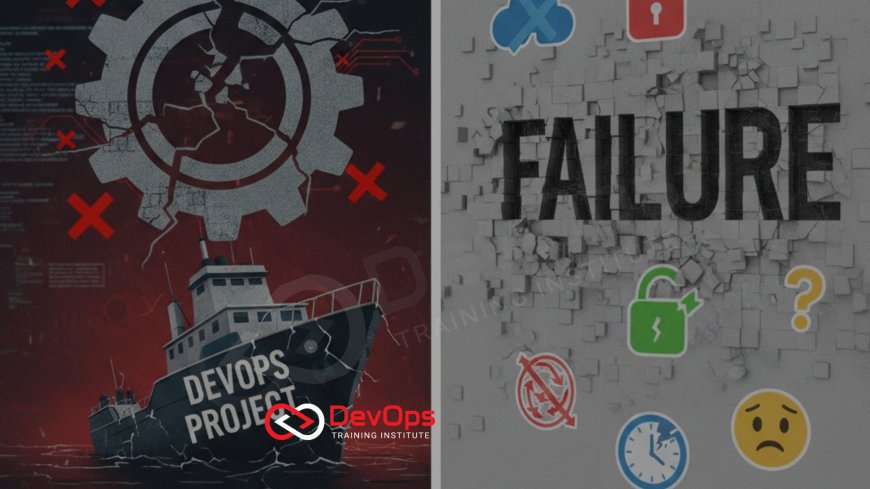
10 Major Reasons Why DevOps Projects Fail
Explore the ten most common and critical reasons why ambitious DevOps initiatives often stall or fail entirely, despite significant investment in tools and infrastructure. This in-depth analysis moves beyond simple technical shortcomings, focusing instead on the deeper cultural, organizational, and leadership failures that undermine digital transformation. Learn how misaligned incentives, a lack of executive sponsorship, insufficient automation expertise, and clinging to rigid monolithic architectures can derail your efforts. Discover the vital importance of psychological safety, end-to-end automation, and meaningful metrics for building a sustainable, high-performing technology organization that truly embodies the DevOps philosophy.
Introduction
DevOps is far more than a set of tools or a job title; it is a profound cultural and operational transformation centered on delivering business value faster and more reliably. While the promise of DevOps is compelling reduced lead times, fewer incidents, and accelerated innovation the reality is that many organizations struggle to move past initial pilot projects. The failure of a DevOps initiative is rarely due to a single, easily identifiable technical glitch. Instead, it is usually the result of a complex interplay of cultural resistance, misaligned incentives, and a fundamental misunderstanding of the methodology's scope. Recognizing these deep-seated issues is the first, most crucial step toward successful adoption.
An unsuccessful DevOps project often wastes significant capital, creates internal friction, and, most damagingly, reinforces the existing separation between development and operations teams. Many organizations make the mistake of focusing solely on implementing a CI/CD pipeline, believing that automating deployment alone constitutes a DevOps transformation. This technology-first approach inevitably overlooks the human and process elements that are the true accelerators of change. A failed project can breed cynicism, making future attempts at genuine transformation even harder. Therefore, understanding the major pitfalls, particularly the non-technical ones, is essential for every leader, manager, and engineer embarking on this critical journey.
Failure to Address Organizational Culture
The single most cited reason for DevOps failure is the neglect of the cultural element. DevOps necessitates breaking down the traditional "silos" between Development, Operations, and increasingly, Security. When teams remain separated by rigid organizational structures, separate budgets, and conflicting goals, automation efforts inevitably fail. If the Development team is rewarded for speed and the Operations team is rewarded for stability, any increase in deployment frequency will be met with resistance and hostility from the operations side. This deep-rooted conflict of interest creates a cultural chasm that no amount of fancy automation tooling can bridge.
A successful DevOps culture requires psychological safety and a shared sense of ownership. When incidents occur in production, teams must engage in blameless post-mortems, focusing on systemic weaknesses rather than individual errors. A culture of fear or finger-pointing will instantly discourage developers from deploying frequently and will ensure that operations teams remain hesitant to grant greater automation access. Leaders must proactively dismantle these cultural barriers by reorganizing teams around product value streams, establishing shared KPIs, and fostering an environment where experimentation, learning from failure, and continuous communication are the accepted norms. Without this cultural groundwork, DevOps is merely a fragile automation layer on top of a broken system. Furthermore, ensuring that proper group management is in place across the organization is vital for collaborative and secure access to shared resources, reinforcing the cultural shift toward shared responsibility for infrastructure and code.
Misguided Focus on Tools Over Principles
Many organizations fall into the trap of believing that purchasing the latest tools automatically equates to adopting DevOps. They invest heavily in a complex stack of technologies, including Kubernetes, various CI/CD tools, and monitoring systems, only to find that their underlying delivery problems persist. This is often referred to as "tool sprawl" a scenario where too many disconnected tools are implemented without a clear, standardized pipeline or a defined process for how they should interact. The result is a system that is overly complex, difficult to maintain, and often requires specialized "DevOps engineers" to manage, thereby reintroducing a new silo.
Effective DevOps starts with defining the desired process and then selecting the simplest, most effective tools to automate that process end-to-end. Neglecting the automation prerequisite is a common technical pitfall. If configuration management, testing, and security scanning are not fully automated before deploying a new CI/CD pipeline, the new tools simply automate the existing manual, slow, and error-prone procedures. The DevOps philosophy mandates that the pipeline itself should be treated as code, managed via Infrastructure as Code (IaC) principles, ensuring that environments are provisioned consistently and reliably. Without this foundational commitment to full automation, the shiny new tools will only highlight the underlying fragility of the processes they were meant to support, leading to frustration and eventual project abandonment.
Technical Debt and Architectural Hurdles
Attempting to implement a Continuous Delivery pipeline on top of a highly coupled, monolithic application is a primary reason why many DevOps efforts stall. Monolithic architectures inherently resist the core DevOps principle of small, frequent, low-risk deployments. A single code change often necessitates rebuilding and redeploying the entire massive application, resulting in long build times, extensive testing cycles, and a high-risk release process. The architectural style itself becomes a bottleneck, effectively capping the possible deployment frequency regardless of the automation level achieved.
Furthermore, a lack of robust automated testing is a critical technical hurdle tied to technical debt. High-performing DevOps requires comprehensive unit, integration, and acceptance tests to provide the necessary confidence for automated deployment. When technical debt is high, test coverage is usually low or nonexistent. Without reliable tests, the final deployment step must remain a manual, high-risk process, undermining the entire Continuous Delivery effort. Leaders often fail to allocate sufficient time for developers to address this legacy debt, forcing teams to bolt on new automation without fixing the foundation. This creates a scenario where teams are perpetually slowed down by manual testing, which is often unreliable, or are constantly battling production bugs that escaped detection because of poor test coverage. For a deployment process to be truly reliable, the system must not be vulnerable to changes in permissions, meaning that understanding read, write, and execute permissions and managing them programmatically is essential for minimizing human error and risk.
Table: 10 Major Reasons for DevOps Failure
| Reason | Category of Failure | Symptom | Recommended Solution |
|---|---|---|---|
| Cultural Resistance | Culture & Organization | Dev and Ops blame-shifting; fear of production incidents. | Implement blameless post-mortems and reorganize into cross-functional teams. |
| Lack of Executive Buy-in | Leadership & Strategy | Inconsistent funding, lack of centralized strategy, uncommitted resources. | Identify an executive sponsor and tie KPIs directly to business outcomes (e.g., revenue). |
| Ignoring Technical Debt | Technical & Architecture | Slow build times, low test coverage, high Change Failure Rate (CFR). | Allocate dedicated time (e.g., 20% of sprints) to address testing and refactoring debt. |
| Tooling-First Approach | Process & Automation | Overly complex, brittle pipelines; too many disparate automation tools. | Define the ideal value stream process first, then automate it end-to-end with minimal tools. |
| Monolithic Architecture | Technical & Architecture | Long deployment windows, high-risk "big bang" releases. | Adopt the Strangler Fig pattern to incrementally extract services rather than attempting a full rewrite. |
| Misaligned or Absent Metrics | Measurement & Feedback | Teams focusing on vanity metrics (e.g., lines of code) instead of DORA metrics. | Standardize on DORA metrics (Lead Time, Deployment Frequency, MTTR, CFR) across all teams. |
| Ignoring Security (DevSecOps) | Security & Compliance | Security checks performed manually and late in the pipeline. | Automate security scanning (SAST/DAST) into the CI phase to shift security left. |
| Treating Infrastructure as Pets | Process & Automation | Manual server configuration, reliance on tribal knowledge for environment setup. | Implement Infrastructure as Code (IaC) to treat all servers as immutable "cattle." |
| Insufficient Training/Skills | People & Capability | Over-reliance on external consultants; inability of in-house teams to maintain pipelines. | Invest in cross-training developers in operations skills and operations teams in coding/automation. |
| Neglecting Monitoring and Feedback | Measurement & Feedback | High Mean Time to Recover (MTTR) due to difficulty in diagnosing production issues. | Implement comprehensive observability (metrics, logging, tracing) as a core feature of every service. |
Inadequate Measurement and Feedback
A DevOps project cannot be deemed successful unless its benefits are rigorously measured and tied back to business goals. A common reason for failure is the use of misguided or absent KPIs. Teams often focus on "vanity metrics" like the number of lines of code written or the number of commits, which do not actually reflect delivery performance or system stability. This misplaced focus prevents leaders from identifying the true bottlenecks in their value stream. If you do not know your lead time for changes, you cannot measure the impact of your automation efforts; if you do not track your change failure rate, you cannot gauge the reliability of your pipeline.
High-performing organizations standardize on the four DORA metrics (Deployment Frequency, Lead Time for Changes, Mean Time to Recover, and Change Failure Rate) because these metrics have been scientifically proven to correlate with better business outcomes. These measures provide a balanced view of both speed and stability, preventing teams from optimizing for one at the expense of the other. The feedback loop must be closed; the data gathered from monitoring and metrics should immediately inform the next iteration of the pipeline or the next prioritization decision. Without this continuous, data-driven feedback, improvement efforts become random guesswork, leading to stalled projects and wasted effort. Furthermore, managing file ownership correctly across the deployment infrastructure ensures accountability for the code and configurations being deployed, reinforcing the importance of metrics in validating correct changes.
Ignoring Security and Compliance (DevSecOps)
In many organizations, security remains a manual, late-stage gate in the delivery process. A failure to integrate security practices early the principle known as "shifting left" is a guarantee that the DevOps project will fail to achieve continuous flow. When security teams perform lengthy, manual vulnerability scans or penetration tests just before a planned release, they inevitably introduce a significant bottleneck. A manual security sign-off creates a fear of frequent deployments and forces the entire process to slow down, negating the speed benefits of CI/CD. This "bolt-on" security approach is incompatible with high-speed delivery.
DevOps projects must evolve into DevSecOps, where security is fully automated and embedded at every stage. This means implementing Static Analysis Security Testing (SAST) and Dynamic Analysis Security Testing (DAST) directly into the Continuous Integration phase, automatically scanning code and dependencies for vulnerabilities. Secure configurations must be enforced via Infrastructure as Code, and access controls, including secure sudo access, must be managed programmatically. When security teams collaborate with development and operations to define automated guardrails instead of acting as manual gatekeepers, security becomes an accelerator rather than a blocker. A failure to make this cultural and technical shift means the DevOps effort will never mature, as regulatory and security pressures will always force the pipeline to revert to a slow, manual process to reduce risk. Automating security checks is a critical step in building trust in the pipeline.
Weak Leadership and Lack of Investment
DevOps transformation must be championed by committed, high-level executive leadership. A project will invariably fail if it is treated as a bottom-up, grassroots movement without top-down strategic support. Lack of executive buy-in translates directly into inconsistent funding, the inability to allocate dedicated time for refactoring technical debt, and, most importantly, the failure to mandate the necessary cross-organizational changes. When leadership fails to restructure teams and align incentives, the project is left exposed to internal resistance and resource competition from established departments, leading to a slow, painful death.
The failure to invest in people, specifically through cross-training and skill development, is another critical leadership failure. DevOps requires developers to understand operational concepts (monitoring, infrastructure, resilience) and operations teams to understand automation and coding principles. If an organization relies heavily on external consultants to build the pipeline without a robust plan to upskill its internal workforce, the project will fail at the maintenance stage. The internal teams will lack the essential knowledge to debug, modify, and improve the automated systems, resulting in a brittle pipeline that quickly falls into disrepair. Furthermore, leaders must prioritize building systems that can handle failures gracefully, ensuring that robust mechanisms to automate backups are in place as a safety net, demonstrating a commitment to resilience and operational prudence.
Sustaining the Transformation: The Road to Success
Overcoming these 10 major failure reasons requires a sustained, strategic commitment that begins with culture and ends with continuous measurement. The most successful organizations understand that they are not buying a solution; they are undertaking a multi-year journey of continuous improvement. They maintain this momentum by treating the pipeline as the product, constantly improving its efficiency, resilience, and security. They use metrics like Lead Time and MTTR to drive behavioral changes and investment decisions, ensuring every effort contributes to demonstrable business outcomes. They also understand the essential link between automation and artifact management, ensuring all their deployed assets are version controlled, secure, and easily restorable, often leveraging practices to archive files for deployment consistency.
The journey from a siloed, manual process to a high-performing DevOps model is challenging, but the rewards are transformative: faster time-to-market, superior quality, increased customer satisfaction, and a more engaged, less stressed workforce. Success hinges on realizing that every failure is simply a learning opportunity. By proactively addressing the cultural friction, dismantling the architectural barriers, securing executive commitment, and investing in the right skills and measurements, organizations can navigate the pitfalls and achieve the full potential of their DevOps transformation. The shift is not about the technology itself, but about creating an adaptable, resilient system where change is the norm, and failure is a low-impact learning moment.
Conclusion
DevOps projects fail not because the technology is too complex, but because organizations underestimate the necessary depth of cultural and leadership change. The ten major reasons for failure, spanning from unaddressed organizational silos and a lack of executive sponsorship to debilitating technical debt and ignored security integration, reveal that the root causes are predominantly non-technical. Many attempts flounder by adopting a "tools-first" approach, building fragile automation on top of fundamentally broken processes and resistant organizational structures. The success stories, conversely, are built on a foundation of psychological safety, shared ownership between Dev and Ops, and a relentless commitment to full, end-to-end automation.
To succeed, leaders must mandate a culture of blamelessness, prioritize clearing technical debt, integrate security from the beginning (DevSecOps), and standardize on meaningful metrics like the DORA framework. The project must be sponsored from the top and backed by continuous investment in training and resources, ensuring that the in-house teams can sustain and evolve the automated pipeline. By focusing on people and process first, and using technology as the enabler rather than the solution, organizations can avoid the common pitfalls and realize the true potential of DevOps, achieving high-frequency, low-risk deployment that directly fuels competitive advantage and business growth.
Frequently Asked Questions
What is the single biggest reason why DevOps projects fail?
The biggest reason is the failure to address cultural resistance and organizational silos between the Development and Operations teams.
What are organizational silos in the context of DevOps failure?
Silos are rigid walls between teams, often with conflicting goals, preventing the necessary collaboration and shared responsibility for the software.
How does a monolithic architecture hinder DevOps adoption?
It hinders adoption by forcing long, high-risk, and infrequent deployments, making the core goal of continuous flow impossible to achieve.
Why is executive buy-in crucial for a successful DevOps project?
Executive buy-in is crucial because it provides the necessary budget, authority, and mandate to enforce cross-organizational change.
What is a "tools-first" approach and why is it problematic?
A tools-first approach focuses on purchasing technology before defining the process, often leading to tool sprawl and automating existing waste.
What are the DORA metrics and how do they prevent failure?
DORA metrics measure speed and stability, preventing failure by balancing deployment velocity with system reliability and resilience.
What is the DevSecOps principle of "shifting left"?
Shifting left means integrating security practices and automated scanning earlier in the development pipeline, rather than waiting until the end.
How does a lack of automated testing contribute to project failure?
It forces teams to keep a manual release gate, undermining the core automation goal and increasing the risk of production bugs.
What is the solution for managing technical debt during a DevOps transformation?
The solution is to allocate dedicated, protected time for engineering teams to systematically reduce the debt and improve test coverage.
Why must teams learn about special permissions like SUID, SGID, and Sticky Bits?
Understanding these bits is essential for securing the deployment environment and controlling execution rights in the automated infrastructure.
How does the lack of monitoring lead to a high MTTR?
Lack of monitoring makes it difficult to quickly detect and diagnose production issues, directly causing the Mean Time to Recover (MTTR) to spike.
How should a leader address the problem of insufficient skills?
The leader must invest in continuous cross-training, teaching developers operations skills and operations teams automation skills.
What is the role of blameless post-mortems in a successful DevOps culture?
Blameless post-mortems foster psychological safety and focus the team on fixing systemic issues rather than punishing individual mistakes.
Why is controlling file ownership important for pipelines?
Controlling file ownership in the pipeline is key to enforcing service accountability and ensuring the security context of deployed artifacts.
What is the importance of a clear strategy for group management in a transformation?
It's important to align team structure and access rights with the new collaborative operational model, ensuring appropriate resource access.
What's Your Reaction?
 Like
0
Like
0
 Dislike
0
Dislike
0
 Love
0
Love
0
 Funny
0
Funny
0
 Angry
0
Angry
0
 Sad
0
Sad
0
 Wow
0
Wow
0


![100+ Azure DevOps Interview Questions and Answers [Updated 2025]](https://www.devopstraininginstitute.com/blog/uploads/images/202509/image_140x98_68c40aa9a3834.jpg)






![Future Scope of DevOps Careers in Pune [Updated 2025]](https://www.devopstraininginstitute.com/blog/uploads/images/202510/image_140x98_68e3a84652312.jpg)