


Event-Driven Architectures for Real-Time DevOps Pipelines
How to design an event-driven DevOps pipeline: producers, event bus, consumers, CloudEvents and CDEvents, Argo Events, Tekton Triggers, idempotency.
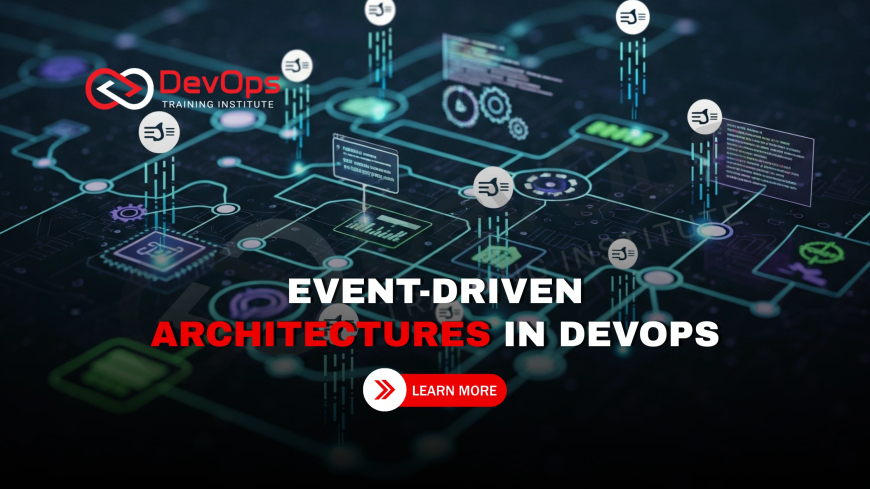
An event-driven DevOps pipeline reacts to events as they happen instead of polling or running on a timer. A push, a merged pull request, a new container image, a failed health check or an alert is published as an event, and independent consumers start builds, deployments, rollbacks or notifications. The result is faster feedback and loosely coupled tooling.
This guide covers how such a pipeline is designed: the parts it is made of, the event standards worth adopting, the tools that implement each part on Kubernetes and AWS, and the reliability patterns that keep it from losing or duplicating work. For broader pipeline context see our CI/CD pipeline examples pillar. Tool facts were checked against project documentation in November 2026.
Key takeaways
- An event-driven pipeline has four parts: producers that emit events, a router or bus, consumers that act, and a contract that describes the event.
- CloudEvents (v1.0.2, a CNCF graduated project since January 2024) gives events a common envelope. CDEvents, a Continuous Delivery Foundation project, adds a CI/CD vocabulary on top of it.
- Webhooks are the simplest event source. GitHub expects a 2XX response within 10 seconds, so queue the payload and process it in the background.
- Consumers must be idempotent. Deliveries can be retried or redelivered, so the same event may arrive twice.
- Use event-driven triggers for things that happen at unpredictable times. Keep schedules for work that really is periodic.
- Tracing an event across tools needs an ID that travels with it. Without one, debugging becomes guesswork.
Polling, schedules and events compared
Most pipelines start with polling: Jenkins checks the repository every few minutes, or a cron job runs a deployment script at night. That works, but it wastes cycles when nothing changed and adds delay when something did. An event-driven design inverts the flow. The system that knows something happened announces it, and whoever cares reacts.
| Model | How work starts | Latency | Coupling | Good fit |
|---|---|---|---|---|
| Polling | Consumer asks "anything new?" on an interval | Up to one interval | Consumer must know the source | Legacy systems without webhooks |
| Schedule | Clock fires at fixed times | Fixed | Low | Nightly scans, reports, cleanup |
| Direct webhook | Source calls one consumer URL | Seconds | Source must know each consumer | Small setups, one CI system |
| Event bus | Source publishes once; router fans out | Seconds | Producers and consumers do not know each other | Many tools, many teams |
Our post on replacing cron jobs with event-driven workflows looks at that decision for scheduled jobs. This article focuses on the delivery pipeline itself.
The four building blocks
1. Event producers
Anything that changes state can produce events. In a delivery pipeline the usual producers are:
- Source control: pushes, pull request opened or merged, tag created, review approved.
- CI: build started, test failed, artifact published.
- Registries: new image pushed, vulnerability scan finished.
- Deployment tools: sync started, rollout healthy, rollout degraded.
- Runtime and monitoring: alert fired, error budget burned, autoscaling event, object written to storage.
2. Router or event bus
The router receives events and delivers them to interested consumers based on rules. Options range from a managed service such as Amazon EventBridge, to a message broker such as Apache Kafka or NATS, to Kubernetes-native components such as the Argo Events EventBus. The router is what lets you add a new consumer, for example a compliance logger, without touching the producer.
3. Consumers
Consumers do the work: start a pipeline run, update a GitOps repository, open a ticket, page someone, roll back a release. Each consumer should do one job and own its own retry logic.
4. The event contract
The contract defines what an event looks like. Without one, every consumer parses a different JSON shape from every producer. With one, a consumer can handle "artifact published" the same way whether it came from GitHub Actions, GitLab CI or Jenkins.
Event standards: CloudEvents and CDEvents
CloudEvents is a specification for describing event data in a common way. Its latest release is v1.0.2, and it graduated in the CNCF on 25 January 2024. A CloudEvent carries a small set of context attributes (including id, source, specversion and type) plus the payload, and it has bindings for HTTP, Kafka and other transports.
{
  "specversion": "1.0",
  "type": "com.example.artifact.published",
  "source": "/ci/payments-service",
  "id": "b7a1c2e4-1f0e-4c2b-9d61-5a3f2e7c9a10",
  "time": "2026-11-07T09:15:00Z",
  "datacontenttype": "application/json",
  "data": {
    "image": "registry.example.com/payments:1.42.0",
    "commit": "3f9c2ab"
  }
}
CDEvents is an incubated project at the Continuous Delivery Foundation. It extends CloudEvents with a shared vocabulary for continuous delivery, grouped into source code control, continuous integration, testing, continuous deployment, continuous operations and core events such as pipeline runs and task runs. The aim is that CI/CD tools can exchange events without custom integration code for every pair. The specification is still pre-1.0, so check the current release before you build on a specific event schema.
Tools that implement each part
| Role | Kubernetes-native | AWS | Platform-hosted |
|---|---|---|---|
| Receive webhooks and external events | Argo Events EventSource, Tekton Triggers EventListener | Amazon API Gateway, EventBridge partner sources | GitHub and GitLab webhooks |
| Route and filter | Argo Events EventBus and Sensor, Tekton Interceptors | EventBridge rules | Workflow trigger filters |
| Durable transport | Kafka, NATS JetStream | Amazon SQS, Amazon MSK | Managed by the platform |
| Act | Argo Workflows, Tekton PipelineRuns, Argo CD or Flux syncs | Lambda, CodePipeline, Step Functions | GitHub Actions workflows, GitLab pipelines |
A few specifics from the project docs:
- Argo Events is built around EventSource (connects to the outside world), EventBus (transport, with JetStream, Kafka and STAN listed as backends), Sensor (dependencies and filters) and Trigger (the action, such as creating an Argo Workflow).
- Tekton Triggers uses an EventListener that listens on a port, Triggers that combine a TriggerBinding (extract fields from the payload) with a TriggerTemplate (the PipelineRun or TaskRun to create), and Interceptors that validate, filter or transform payloads before binding.
- GitHub Actions workflows are themselves event-driven: they start on events such as
push,pull_request,workflow_runandrepository_dispatch, the last of which lets an external system start a workflow through the API. - Amazon EventBridge rules match events by pattern and send them to targets such as Lambda. Our guide on automating CloudWatch events with Lambda walks through one such rule.
A reference flow: commit to production
Here is one way the pieces connect for a containerised service deployed with GitOps.
- A pull request is merged. GitHub sends a
pushwebhook. - CI builds and tests the commit, then pushes an image and emits an "artifact published" event with the image digest.
- A consumer receives that event and opens a pull request against the GitOps repository with the new image tag for staging.
- Argo CD or Flux syncs staging. A health event ("rollout healthy" or "degraded") is published.
- On a healthy event, a consumer runs smoke tests. Passing tests emit an event that promotes the change to production, subject to approval.
- In production, an alert from monitoring publishes an event. A consumer checks whether a deployment happened in the last few minutes and, if so, starts a rollback or pages the on-call engineer with the deployment ID attached.
Each step only knows about the event it consumes and the event it produces. You can swap the CI system, add a security scan that listens for "artifact published," or add a chat notification without editing the other steps. Our sibling posts on progressive delivery and backward-compatible releases cover what happens inside the promotion and rollback steps.
Reliability patterns you cannot skip
Acknowledge fast, process later
GitHub's webhook guidance says your server should respond with a 2XX within 10 seconds, or the delivery counts as failed. It recommends queuing payloads for background processing. The receiver writes the event to a queue and returns immediately, and a worker does the slow part.
Make consumers idempotent
Assume every event can arrive more than once: brokers retry, operators redeliver missed webhooks, and producers resend after timeouts. Store the event ID (the CloudEvents id, or GitHub's X-GitHub-Delivery header) and skip events you have already handled. Note that GitHub keeps the same delivery ID on redelivery, which is exactly what makes it useful for deduplication.
def handle(event, store, deploy):
    event_id = event["id"]
    if store.seen(event_id):
        return "duplicate, skipped"
    deploy(event["data"]["image"])
    store.mark_seen(event_id)
    return "deployed"
Verify the sender
Use a high-entropy webhook secret and validate the signature on every delivery, serve the endpoint over HTTPS, and do not put credentials in the payload URL. GitHub also publishes its webhook source IP ranges through the GET /meta API if you want an allow list, but those ranges change, so refresh them.
Plan for failure
- Retries with backoff for transient errors.
- A dead-letter queue for events that keep failing, with an alert on its depth.
- A replay path, so you can re-run events after fixing a consumer bug.
Ordering
Do not assume events arrive in order across partitions, queues or webhook deliveries. If order matters, for example "deploy 1.42" must not be applied after "deploy 1.43", include a version or sequence number and have the consumer ignore anything older than what it last applied.
Correlation and tracing
Carry a correlation ID (commit SHA, pipeline run ID or a trace ID) through every event in a chain. Log it in each consumer. When a production alert fires you can then follow the chain back to the commit in one search. The observability vs monitoring guide explains why this matters for distributed systems.
When event-driven pipelines are the wrong choice
- One repository, one CI system, one deployment target. A plain pipeline file is easier to read and debug than a bus with three consumers.
- Strict sequential workflows. If every step must run in order with shared state, a workflow engine or a single pipeline expresses that better than a chain of events.
- No owner for the bus. An event bus is shared infrastructure. Someone has to own schemas, retention, access control and monitoring.
A common middle ground is to keep each pipeline linear inside one tool and use events only at the boundaries: between CI and CD, between CD and monitoring, and between monitoring and incident response.
Getting started in small steps
- Replace one polling trigger with a webhook, and make the receiver queue the payload and answer immediately.
- Publish one event from CI, such as "artifact published," in CloudEvents format.
- Add a second consumer to that event (a notification or audit log) to prove producers and consumers are decoupled.
- Add idempotency, retries and a dead-letter queue before you add more consumers.
- Connect monitoring alerts to deployment events so on-call engineers see the last change next to each alert.
If you are also deciding how far to automate infrastructure changes in this flow, read when infrastructure provisioning should be automated in CI. For release speed specifically, how event-driven architectures speed up release cycles focuses on cycle time rather than design.
Learn it with labs
Webhooks, GitOps with Argo CD and pipeline triggers are part of the hands-on work in our DevOps training, run in the Kharadi, Pune classroom and live online.
FAQ
What is an event-driven DevOps pipeline?
It is a pipeline where steps start because an event happened, such as a merge, a new image or an alert, rather than because a tool polled for changes or a timer fired. Producers publish events and independent consumers react.
What is the difference between CloudEvents and CDEvents?
CloudEvents is a general CNCF specification for describing any event in a common envelope. CDEvents, a Continuous Delivery Foundation project, builds on CloudEvents and defines event types specific to CI/CD, such as pipeline runs, builds and deployments.
Do I need Kafka to build an event-driven pipeline?
No. Webhooks with a small queue are enough for many teams. Kafka, NATS JetStream or a managed bus such as EventBridge become useful when many producers and consumers share events or when you need durable replay.
How do I avoid running the same deployment twice?
Make consumers idempotent. Record each event ID after processing and skip events you have already seen. Include a version number so older events cannot overwrite newer state.
How fast must a webhook receiver respond to GitHub?
GitHub expects a 2XX response within 10 seconds, otherwise it treats the delivery as failed. Queue the payload and do the work asynchronously.
Which Kubernetes tools handle event-driven triggers?
Argo Events (EventSource, EventBus, Sensor, Trigger) and Tekton Triggers (EventListener, TriggerBinding, TriggerTemplate, Interceptors) are the two common choices. Both can start pipelines or workflows from webhooks and other sources.
When should I keep a scheduled job instead?
Keep schedules for work that is genuinely periodic, such as nightly dependency scans, reports or cleanup, where no single event signals that the work is due.
References
What's Your Reaction?
 Like
0
 Dislike
0
 Love
0
 Funny
0
 Angry
0
 Sad
0
 Wow
0