






















Top 15 Kubernetes Certifications for Cloud Professionals
Compare 15 real Kubernetes certifications: KCNA, KCSA, CKA, CKAD, CKS, CNCF ecosystem exams and Red Hat OpenShift, with format, duration and price.
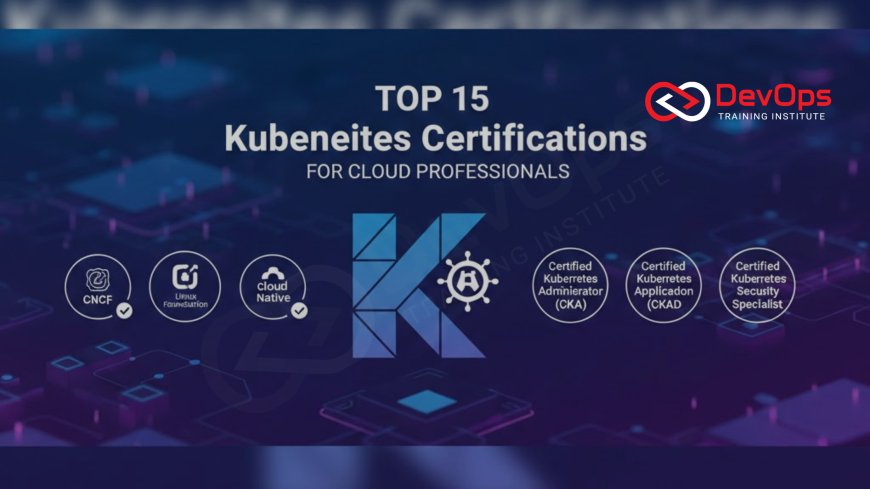
The top Kubernetes certifications are the five CNCF Kubernetes exams (KCNA, KCSA, CKA, CKAD and CKS), eight CNCF ecosystem exams that test tools running on Kubernetes, and Red Hat's two hands-on OpenShift exams. Start with KCNA if you are new, take CKA or CKAD for job-ready skills, then add CKS for security.
This guide compares 15 certifications on format, duration, price and prerequisites, all taken from the Linux Foundation, CNCF and Red Hat exam pages in November 2026. If you want the concepts behind these exams first, read our guide to the 12 must-know Kubernetes architecture components. Exam fees change, so confirm the price on the official page before you pay.
Key takeaways
- CKA, CKAD and CKS are performance-based: you solve tasks on live clusters from a command line for two hours. KCNA and KCSA are 90-minute multiple-choice exams.
- On the Linux Foundation site, CKA, CKAD and CKS cost $445 each (exam only) and the associate exams cost $250. Every exam includes one retake and stays valid for two years.
- CKS is the only exam on this list with a hard prerequisite: you must have passed CKA first.
- Holding KCNA, KCSA, CKA, CKAD and CKS at the same time (all active) earns the CNCF Kubestronaut title.
- Red Hat's EX280 (OpenShift administration) and EX288 (OpenShift application development) are practical exams on a live system, based on OpenShift Container Platform 4.22.
- Pick by role: administrators and SREs start with CKA, developers with CKAD, security engineers with CKA then CKS, and platform engineers with CNPA then CNPE.
How this list was built
The old version of this article included several certifications that do not exist, such as an "AKS Developer Specialty" and an IBM or HashiCorp "Kubernetes" exam. This version only lists exams that the certifying body itself publishes. That leaves two sources:
- CNCF and the Linux Foundation. The CNCF certification page lists 15 exams. We include the five Kubernetes exams and the eight ecosystem exams whose subject is a tool that runs on, or manages, Kubernetes clusters (platform engineering, GitOps, Argo, Istio, Cilium, Kyverno and Prometheus). We left out the OpenTelemetry (OTCA) and Backstage (CBA) associate exams because their subject is less about Kubernetes itself.
- Red Hat. OpenShift is Red Hat's Kubernetes distribution, and its two OpenShift exams are hands-on Kubernetes work on a live cluster.
Cloud provider certifications from AWS, Microsoft and Google cover Kubernetes services as one topic among many, so they are not ranked here. They are still worth taking if your job is tied to one cloud.
All 15 Kubernetes certifications compared
| # | Certification | Level | Format | Duration | Exam price | Prerequisite |
|---|---|---|---|---|---|---|
| 1 | KCNA: Kubernetes and Cloud Native Associate | Beginner | Multiple choice | 90 min | $250 | None |
| 2 | KCSA: Kubernetes and Cloud Native Security Associate | Beginner | Multiple choice | 90 min | $250 | None |
| 3 | CKA: Certified Kubernetes Administrator | Intermediate | Performance-based | 2 hours | $445 | None |
| 4 | CKAD: Certified Kubernetes Application Developer | Intermediate | Performance-based | 2 hours | $445 | None |
| 5 | CKS: Certified Kubernetes Security Specialist | Advanced | Performance-based | 2 hours | $445 | Passed CKA |
| 6 | CNPA: Certified Cloud Native Platform Engineering Associate | Beginner | Multiple choice | 120 min | $250 | None |
| 7 | CNPE: Certified Cloud Native Platform Engineer | Advanced | Performance-based | 2 hours | $445 | None |
| 8 | CGOA: Certified GitOps Associate | Beginner | Multiple choice | 90 min | $250 | None |
| 9 | CAPA: Certified Argo Project Associate | Beginner | Multiple choice | 90 min | $250 | None |
| 10 | ICA: Istio Certified Associate | Intermediate | Performance-based and multiple choice | 2 hours | $250 | None |
| 11 | CCA: Cilium Certified Associate | Beginner | Multiple choice | 90 min | $250 | None |
| 12 | KCA: Kyverno Certified Associate | Beginner | Multiple choice | 90 min | $250 | None |
| 13 | PCA: Prometheus Certified Associate | Beginner | Multiple choice | 90 min | $250 | None |
| 14 | Red Hat EX280: Certified System Administrator in OpenShift | Intermediate | Hands-on, live system | 3 hours | Varies by country | None required (RHCSA strongly recommended) |
| 15 | Red Hat EX288: Certified Advanced Developer in Cloud-native Applications | Intermediate | Hands-on, live system | 4 hours | Varies by country | None required |
Prices are the "exam only" figures in US dollars from the Linux Foundation Training site. Bundles with a course or the THRIVE-ONE subscription cost more. Red Hat does not show one global price on its exam pages, so check the price for your country when you book. All the Linux Foundation exams are online and proctored, include one retake, give you 12 months from purchase to sit the exam, and stay valid for two years.
Core Kubernetes certifications (CNCF)
These five exams are what most job descriptions mean when they say "Kubernetes certified". They are also the five exams that count toward the Kubestronaut title.
1. KCNA: Kubernetes and Cloud Native Associate
KCNA is the entry point. It checks that you understand what Kubernetes does and where it sits in the cloud native ecosystem, not that you can operate a cluster. The exam is 90 minutes of multiple-choice questions with no prerequisites.
The domain weights show where to spend your study time: Kubernetes Fundamentals 44%, Container Orchestration 28%, Cloud Native Application Delivery 16% and Cloud Native Architecture 12%.
Take it if: you are a fresher, a Linux or Windows administrator moving into containers, or a manager who needs the vocabulary. If you can already deploy and debug workloads with kubectl, you can skip straight to CKA or CKAD.
2. KCSA: Kubernetes and Cloud Native Security Associate
KCSA is the security counterpart to KCNA: 90 minutes, multiple choice, no prerequisites. It covers the Kubernetes threat model, how cluster components are secured, platform security, and compliance frameworks.
Domains: Overview of Cloud Native Security 14%, Kubernetes Cluster Component Security 22%, Kubernetes Security Fundamentals 22%, Kubernetes Threat Model 16%, Platform Security 16%, Compliance and Security Frameworks 10%.
Take it if: you work in security, audit or DevSecOps and need to talk about Kubernetes risks without running clusters every day. It is also a good warm-up before CKS, though CKS does not require it.
3. CKA: Certified Kubernetes Administrator
CKA is the most widely requested Kubernetes certification. It is a two-hour, performance-based exam: you get a set of tasks on real clusters and complete them from a terminal. There are no multiple-choice questions, so you cannot pass on theory alone. The Linux Foundation page lists the exam environment as Kubernetes v1.37 at the time of writing.
| CKA domain | Weight |
|---|---|
| Troubleshooting | 30% |
| Cluster Architecture, Installation and Configuration | 25% |
| Services and Networking | 20% |
| Workloads and Scheduling | 15% |
| Storage | 10% |
Troubleshooting carries the most weight, so practise fixing broken nodes, failing pods and misrouted Services, not only creating resources. Our list of 10 Kubernetes commands every DevOps engineer uses daily covers the kubectl habits that save time in the exam.
Take it if: you are, or want to be, a DevOps engineer, SRE, platform engineer or cluster administrator. Our CKA training follows the current exam domains, in the Kharadi, Pune classroom or live online.
4. CKAD: Certified Kubernetes Application Developer
CKAD has the same format as CKA (two hours, performance-based, $445) but tests the developer's side: designing, configuring, deploying and observing applications on a cluster that already exists. You will not install or upgrade clusters in CKAD.
Domains: Application Environment, Configuration and Security 25%, Application Design and Build 20%, Application Deployment 20%, Services and Networking 20%, Application Observability and Maintenance 15%.
Take it if: you write or ship services that run on Kubernetes. Many people take CKAD right after CKA because about half the skills overlap. See our CKAD training if you want guided labs.
5. CKS: Certified Kubernetes Security Specialist
CKS is the hardest of the five. It is performance-based and two hours long, and you must have passed CKA before you can sit it. Tasks cover hardening the cluster and host, locking down workloads, securing the software supply chain, and runtime monitoring.
Domains: Cluster Setup 15%, Cluster Hardening 15%, System Hardening 10%, Minimize Microservice Vulnerabilities 20%, Supply Chain Security 20%, Monitoring, Logging and Runtime Security 20%.
Take it if: you hold CKA and work on platform security or DevSecOps. Our 12 Kubernetes security best practices is a useful map of the topics before you start CKS labs.
Platform engineering and delivery certifications
These four exams test how teams build internal platforms and ship software to Kubernetes. They suit people who already know core Kubernetes.
6. CNPA: Certified Cloud Native Platform Engineering Associate
CNPA is a 120-minute multiple-choice exam on platform engineering ideas: internal developer platforms, platform APIs, self-service provisioning, continuous delivery and how to measure a platform. The largest domain is Platform Engineering Core Fundamentals at 36%.
Take it if: your team is building an internal platform on Kubernetes and you want a shared vocabulary for it.
7. CNPE: Certified Cloud Native Platform Engineer
CNPE is the hands-on follow-up to CNPA. It is performance-based, two hours long and costs $445. You complete tasks in a Linux remote desktop using a terminal and web interfaces. Domains: GitOps and Continuous Delivery 25%, Platform APIs and Self-Service Capabilities 25%, Observability and Operations 20%, Platform Architecture and Infrastructure 15%, Security and Policy Enforcement 15%.
Take it if: you run the platform day to day. It has no formal prerequisite, but treat CKA-level skill as the real entry bar.
8. CGOA: Certified GitOps Associate
CGOA tests GitOps principles and patterns rather than one tool: 90 minutes, multiple choice. GitOps Principles is the largest domain at 30%, followed by Terminology and Patterns at 20% each.
Take it if: you are moving deployments from push-based CI scripts to Git-driven reconciliation. Our top GitOps tools for Kubernetes post shows which tools put these principles into practice.
9. CAPA: Certified Argo Project Associate
CAPA covers the four Argo projects: Argo Workflows 36%, Argo CD 34%, Argo Rollouts 18% and Argo Events 12%. It is a 90-minute multiple-choice exam.
Take it if: your organisation deploys with Argo CD or runs pipelines in Argo Workflows. Note that Workflows carries slightly more weight than Argo CD, which surprises many candidates who only use Argo CD.
Networking, security and observability certifications
These exams go deep on one project that runs inside Kubernetes clusters.
10. ICA: Istio Certified Associate
ICA is a two-hour exam on the Istio service mesh. The Linux Foundation page describes it as both performance-based and multiple choice. Traffic Management is the biggest domain at 35%, followed by Securing Workloads 25%, Installation, Upgrade and Configuration 20%, and Troubleshooting 20%.
Take it if: you operate Istio for traffic shifting, mutual TLS or service-to-service policy.
11. CCA: Cilium Certified Associate
CCA is a 90-minute multiple-choice exam on Cilium, the eBPF-based networking, security and observability project. Domains include Architecture 20%, Network Policy 18%, Service Mesh 16%, and 10% each for Network Observability, Installation and Configuration, Cluster Mesh and eBPF. The page recommends Kubernetes knowledge and basic networking (the OSI model, TCP, UDP, DNS and HTTP) before you start.
Take it if: your clusters use Cilium as the CNI or you are evaluating it.
12. KCA: Kyverno Certified Associate
KCA tests Kyverno, the Kubernetes-native policy engine. It is 90 minutes and multiple choice. Writing Policies is 32% of the exam, so expect questions on policy YAML, not only concepts. Other domains cover installation, the Kyverno CLI, applying policies and policy management.
Take it if: you enforce admission rules, such as required labels or blocked privileged pods, with Kyverno.
13. PCA: Prometheus Certified Associate
PCA is a 90-minute multiple-choice exam on Prometheus. PromQL is the largest domain at 28%, with Prometheus Fundamentals 20%, Observability Concepts 18%, Alerting and Dashboarding 18%, and Instrumentation and Exporters 16%.
Take it if: you build monitoring and alerting for Kubernetes workloads. Prometheus is not limited to Kubernetes, which is why PCA sits at the edge of this list.
Red Hat OpenShift certifications
Red Hat exams are practical: you perform real tasks on a live system, with product documentation available but no outside help. Both exams below are based on Red Hat OpenShift Container Platform 4.22, according to Red Hat's exam pages.
14. EX280: Red Hat Certified System Administrator in OpenShift
EX280 is a three-hour hands-on exam for administering OpenShift clusters. Passing it earns the Red Hat Certified System Administrator in OpenShift credential, which also counts toward the Red Hat Certified Architect in OpenShift credential. Red Hat recommends RH124 or equivalent Linux skills, plus the DO180 and DO280 OpenShift administration courses. RHCSA is strongly recommended but not required.
Take it if: your employer runs OpenShift. Our OpenShift interview questions give you a feel for what OpenShift administrators are asked in practice.
15. EX288: Red Hat Certified Advanced Developer in Cloud-native Applications
EX288 is a four-hour hands-on exam on building and deploying applications on OpenShift. Red Hat's page lists the credential as Red Hat Certified Advanced Developer in Cloud-native Applications and recommends DO180, DO188 (containers with Podman) and DO288 as preparation.
Take it if: you are a developer in an OpenShift shop. If you are not tied to OpenShift, CKAD is the more portable choice.
Kubestronaut and Golden Kubestronaut
CNCF recognises people who hold several exams at once:
- Kubestronaut: pass CKA, CKAD, CKS, KCNA and KCSA, with all five active at the same time. The order does not matter, and other CNCF exams cannot substitute for any of the five.
- Golden Kubestronaut: pass every CNCF certification plus LFCS (Linux Foundation Certified SysAdmin), all current. The CNCF FAQ says the Golden title is permanent once earned.
Because each exam is valid for two years, plan the five Kubestronaut exams inside a window where none of them expires before you finish the last one.
Which certification should you take first?
| Your role or goal | Suggested order | Why |
|---|---|---|
| Fresher or career changer | KCNA, then CKA | KCNA builds vocabulary; CKA proves you can do the work |
| System administrator or SRE | CKA, then CKS | Cluster operations first, then hardening |
| Application developer | CKAD, then CKA if you also operate clusters | CKAD matches daily developer tasks |
| Security or DevSecOps engineer | KCSA, then CKA, then CKS | CKS requires CKA; KCSA gives the threat-model background |
| Platform engineer | CKA, then CNPA, then CNPE | CNPE assumes strong cluster skills |
| GitOps or release engineer | CKAD, then CGOA or CAPA | Deploying apps first, then the delivery model and tools |
| OpenShift shop | EX280 (admins) or EX288 (developers) | Matches the platform your employer runs |
If you are still deciding whether to learn Kubernetes at all, read 12 things to know before learning Kubernetes before you buy an exam.
How to prepare for the hands-on exams
CKA, CKAD, CKS, CNPE and the Red Hat exams are scored on what you actually configure. A study plan that works for most people looks like this:
- Read the current curriculum. Download the domain list from the official exam page. Domains change when Kubernetes versions move, and the Linux Foundation updates the exam environment within weeks of a new minor release.
- Build a practice cluster. Use kind, minikube or kubeadm on a couple of virtual machines. For CKA, practise kubeadm upgrades and etcd backup and restore, because you cannot learn those on a managed cloud cluster.
- Get fast with imperative commands. Generate YAML with
kubectl create ... --dry-run=client -o yamland edit it, instead of typing manifests from memory.
kubectl create deployment web --image=nginx --replicas=3 --dry-run=client -o yaml > web.yaml
kubectl expose deployment web --port=80 --target-port=80 --dry-run=client -o yaml > web-svc.yaml
kubectl explain deployment.spec.strategy --recursive- Practise troubleshooting under time pressure. Break things on purpose: a wrong image tag, a Service selector that matches nothing, a node with kubelet stopped. Then fix them against a clock.
- Use your retake wisely. Every Linux Foundation exam on this list includes one retake. If you fail, note which domains felt slow and drill those before booking again.
- Check the candidate handbook. Rules on allowed browser tabs, ID and room setup are set by the Linux Foundation and Red Hat, and they change. Read them a week before your exam, not on the day.
Interview prep helps too. Our Kubernetes scenario-based interview questions use the same kind of "this is broken, fix it" problems as the performance-based exams.
Common mistakes when choosing a Kubernetes certification
- Collecting associate badges instead of one hands-on exam. Recruiters screening for Kubernetes roles usually look for CKA or CKAD first.
- Booking CKS without CKA. The Linux Foundation will not let you sit CKS until CKA is passed.
- Studying old material. Courses recorded for older Kubernetes versions may miss newer exam topics. Compare the course outline with the current domain list.
- Trusting third-party price lists. Fees and bundles change. The Linux Foundation and Red Hat pages are the only reliable source.
- Ignoring expiry. Linux Foundation certifications last two years. If you are aiming for Kubestronaut, one expired exam drops you out of the program until you renew it.
Frequently asked questions
Which Kubernetes certification is best for beginners?
KCNA. It has no prerequisites, is 90 minutes of multiple-choice questions and covers Kubernetes fundamentals and the wider cloud native ecosystem. If you already use kubectl at work, go straight to CKA or CKAD instead.
How much does the CKA exam cost?
The Linux Foundation lists CKA at $445 for the exam only, including one retake. Bundles with a course or the THRIVE-ONE subscription cost more. Check the official CKA page before you buy, because prices and offers change.
Is CKA or CKAD harder?
Both are two-hour, performance-based exams. CKA covers cluster installation, upgrades and troubleshooting, which many people find harder. CKAD focuses on deploying and configuring applications and rewards speed with kubectl and YAML.
Do I need CKA before CKS?
Yes. The Linux Foundation requires a passed CKA before you can attempt the CKS exam. KCSA is not required for CKS, but it is useful background on the Kubernetes threat model.
How long are Kubernetes certifications valid?
Linux Foundation and CNCF certifications on this list are valid for two years. You also have 12 months from purchase to schedule and take the exam. Check Red Hat's policy separately for EX280 and EX288.
What is a Kubestronaut?
A Kubestronaut holds five active CNCF certifications at the same time: KCNA, KCSA, CKA, CKAD and CKS. Golden Kubestronaut requires every CNCF certification plus LFCS.
Are the CKA and CKAD exams multiple choice?
No. CKA, CKAD and CKS are performance-based. You solve tasks on live Kubernetes clusters from a command line. KCNA and KCSA are the multiple-choice Kubernetes exams.
Should I take a Red Hat OpenShift exam instead of CKA?
Take EX280 if your employer runs OpenShift. CKA is more portable across clouds and distributions. Many OpenShift administrators hold both, since OpenShift is built on Kubernetes.
Official references
- CNCF certification list
- Linux Foundation: Certified Kubernetes Administrator (CKA)
- Linux Foundation: Certified Kubernetes Application Developer (CKAD)
- Linux Foundation: Certified Kubernetes Security Specialist (CKS)
- Linux Foundation: Kubernetes and Cloud Native Associate (KCNA)
- Linux Foundation: Kubernetes and Cloud Native Security Associate (KCSA)
- Linux Foundation: CNPA and CNPE
- Linux Foundation: CGOA and CAPA
- Linux Foundation: ICA, CCA, KCA and PCA
- CNCF Kubestronaut FAQ
- Red Hat EX280 exam page
- Red Hat EX288 exam page
What's Your Reaction?
 Like
0
 Dislike
0
 Love
0
 Funny
0
 Angry
0
 Sad
0
 Wow
0