


![Kong Interview Preparation Guide [2025]](https://www.devopstraininginstitute.com/blog/uploads/images/202509/image_430x256_68dbb95326997.jpg)



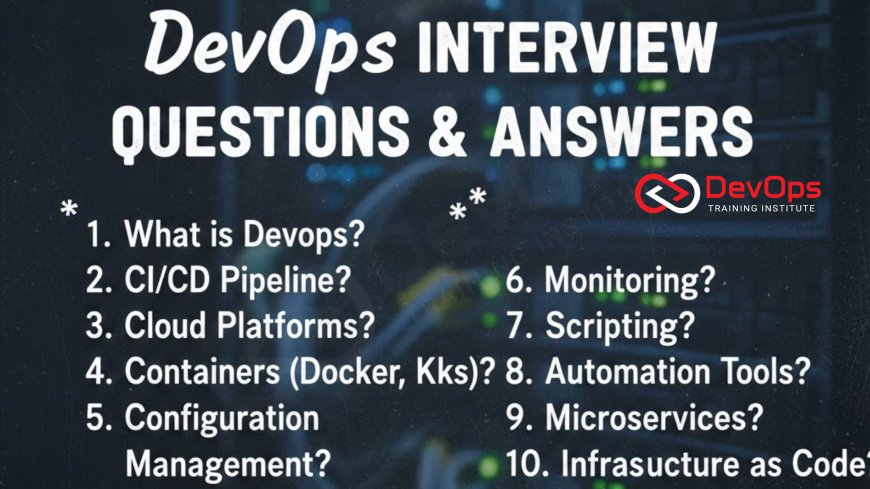
20 Most Common DevOps Interview Questions & Answers
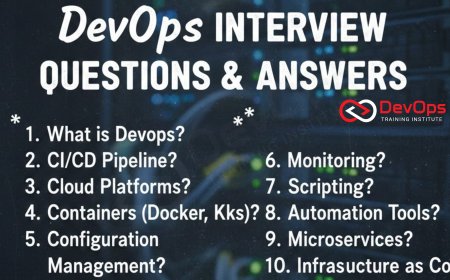
Prepare for your next DevOps interview with these 20 most common questions and expert answers. Covering core concepts like CI/CD, IaC, containers, cloud security, and monitoring. Perfect for beginners to senior engineers aiming to land top DevOps roles in 2025-2026.
Introduction
DevOps interviews test your practical knowledge of automation, collaboration, and reliable software delivery. Whether you're a fresher or experienced engineer, these 20 common questions cover the essentials interviewers ask most. We've included clear, concise answers to help you explain concepts confidently. A well-designed Virtual Private Cloud (VPC) is often the first topic senior engineers discuss in real-world scenarios.
1. What is DevOps?
DevOps is a set of practices that combines software development (Dev) and IT operations (Ops) to shorten the development lifecycle and provide continuous delivery with high software quality. It emphasizes automation, collaboration, and monitoring.
2. What are the key benefits of DevOps?
- Faster time to market
- Improved collaboration between teams
- Higher deployment frequency
- Reduced failure rate
- Quicker recovery from failures
- Increased customer satisfaction
3. Explain CI/CD pipeline.
CI/CD stands for Continuous Integration/Continuous Delivery. CI automates building and testing code changes frequently. CD extends this to automate deployment to production. Tools like Jenkins or GitHub Actions are commonly used – and proper network design with public and private subnets ensures secure pipeline runners.
4. What is Infrastructure as Code (IaC)?
- Managing infrastructure through code instead of manual processes
- Tools: Terraform, Ansible, Pulumi
- Benefits: Version control, repeatability, faster provisioning
- Reduces configuration drift
- Enables self-service for developers
- Supports multi-cloud environments
5. What is the difference between Docker and Kubernetes?
Docker is a platform for containerizing applications. Kubernetes is an orchestration tool that manages, scales, and deploys those containers across clusters. Think of Docker as the box and Kubernetes as the warehouse manager.
6. How do you secure an AWS VPC?
- Use security groups for instance-level firewalls
- Implement NACLs for subnet-level control
- Enable VPC flow logs for monitoring
- Use private subnets for sensitive resources
- Set up IAM roles instead of access keys
- Secure outbound traffic using managed NAT Gateways
7. What is GitOps?
GitOps uses Git repositories as the single source of truth for declarative infrastructure and application deployments. Tools like ArgoCD or Flux automatically sync the desired state from Git to production.
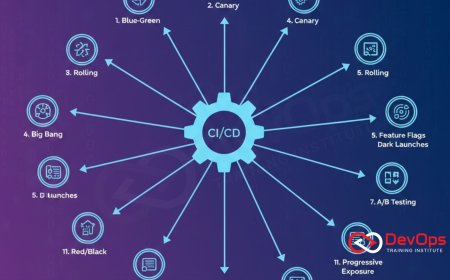
8. Explain Blue-Green Deployment.
- Two identical environments: blue (live) and green (staging)
- Deploy new version to green
- Switch traffic from blue to green
- Rollback by switching back if issues arise
- Achieves zero-downtime deployments
- Common in cloud setups
9. What are the DORA metrics?
DORA metrics measure DevOps performance: Deployment Frequency, Lead Time for Changes, Change Failure Rate, and Time to Restore Service. They help identify if you're an elite, high, medium, or low performer – traffic routing during deployments often depends on route tables and Internet Gateways working together.
10. How do you handle secrets in DevOps?
- Use tools like HashiCorp Vault or AWS Secrets Manager
- Avoid hardcoding in code or repos
- Implement rotation policies
- Scan for exposed secrets in CI
- Use environment variables securely
- Encrypt at rest and in transit
11. What is Container Orchestration?
Container orchestration automates deployment, scaling, and management of containerized applications. Kubernetes is the most popular tool, handling load balancing, auto-scaling, and self-healing.
12. Explain Microservices Architecture.
- Application broken into small, independent services
- Each service handles a specific function
- Communicate via APIs
- Benefits: Scalability, easier updates
- Challenges: Distributed tracing, service discovery
- Multi-account communication often uses VPC Peering
13. What is Observability?
Observability allows you to understand a system's internal state from its external outputs. It includes metrics, logs, and traces. Tools like Prometheus, ELK Stack, and Grafana are essential.
14. How do you automate testing in DevOps?
- Unit tests with JUnit or pytest
- Integration tests in CI pipeline
- End-to-end tests with Selenium
- Performance tests with JMeter
- Shift testing left in the pipeline
- Aim for 80%+ code coverage
15. What is a Jenkins Pipeline?
A Jenkins Pipeline is a suite of plugins that supports implementing and integrating continuous delivery into Jenkins. It uses Jenkinsfile for defining build, test, and deploy stages as code.
16. Explain Trunk-Based Development.
- All developers commit to a single trunk/main branch
- Short-lived feature branches if needed
- Use feature flags for incomplete work
- Daily integrations
- Reduces merge conflicts
- Enables faster releases
17. What is Chaos Engineering?
Chaos Engineering intentionally introduces failures into production systems to test resilience. Tools like Chaos Monkey help identify weaknesses before real outages occur.
18. How do you implement monitoring in DevOps?
- Set up metrics collection with Prometheus
- Log aggregation with ELK or Splunk
- Dashboards in Grafana
- Alerting via PagerDuty or Slack
- Define SLOs and error budgets
- Secure remote access often uses VPN tunnels into the VPC
19. What is the role of Agile in DevOps?
Agile provides iterative development and feedback loops. DevOps extends Agile by automating delivery and operations, enabling faster iterations and continuous improvement.
20. How do you prepare for a DevOps interview?
- Practice hands-on with tools like Docker, Kubernetes, Terraform
- Build personal projects on GitHub
- Understand real-world scenarios
- Review DORA metrics and case studies
- Explain your past experiences clearly
- Stay updated with industry trends
Conclusion
Mastering these 20 DevOps interview questions will boost your confidence and help you stand out. Focus on understanding concepts deeply, not just memorizing answers. Practice explaining them out loud and apply them in real projects – many interviewers also test VPC networking knowledge such as VPC Peering vs Transit Gateway. Good luck with your interview – you've got this!
Frequently Asked Questions
What skills are must-haves for DevOps engineers?
Automation scripting (Bash/Python), CI/CD tools, cloud platforms (AWS/Azure), containerization (Docker/K8s), and strong Linux knowledge.
How long does it take to learn DevOps?
3-6 months for basics if you practice daily. Mastery comes with 1-2 years of real-world experience.
Is coding required for DevOps?
Yes, scripting and IaC require coding, but you don't need to be a full-stack developer.
What is the salary for DevOps engineers?
In the US, $110K-$160K average. Varies by experience and location.
Can I switch to DevOps from software development?
Absolutely. Your coding skills transfer well; focus on learning ops tools.
What are popular DevOps certifications?
AWS DevOps Engineer, Google Professional DevOps Engineer, Docker Certified Associate.
How do you secure databases in the cloud?
Use managed services like Amazon RDS placed in private subnets with encrypted connections.
Feature flags or feature branches?
Feature flags with trunk-based development is the modern standard.
Monorepo or multi-repo?
Most high-performing teams prefer monorepos for faster integration.
Who should own DevOps in an organization?
Everyone – DevOps is a culture, not a single team.
What's Your Reaction?
 Like
0
Like
0
 Dislike
0
Dislike
0
 Love
0
Love
0
 Funny
0
Funny
0
 Angry
0
Angry
0
 Sad
0
Sad
0
 Wow
0
Wow
0

![Scenario-Based Fastly Interview Questions [2025]](https://www.devopstraininginstitute.com/blog/uploads/images/202509/image_430x256_68dbb931cca47.jpg)
![Real-Time Kong Interview Questions and Answers [2025]](https://www.devopstraininginstitute.com/blog/uploads/images/202509/image_430x256_68dbb94355c1a.jpg)
![Kong Engineer Interview Questions with Answers [2025]](https://www.devopstraininginstitute.com/blog/uploads/images/202509/image_430x256_68dbb93e8b60d.jpg)
![Scenario-Based Kong Interview Questions with Answers [2025]](https://www.devopstraininginstitute.com/blog/uploads/images/202509/image_430x256_68dbb94b171df.jpg)
![Advanced Fastly Interview Questions [2025]](https://www.devopstraininginstitute.com/blog/uploads/images/202509/image_430x256_68dbb92f6aeaf.jpg)
![Kong FAQs Asked in DevOps Interviews [2025]](https://www.devopstraininginstitute.com/blog/uploads/images/202509/image_430x256_68dbb94df1498.jpg)
![100+ Azure DevOps Interview Questions and Answers [Updated 2025]](https://www.devopstraininginstitute.com/blog/uploads/images/202509/image_140x98_68c40aa9a3834.jpg)





![Future Scope of DevOps Careers in Pune [Updated 2025]](https://www.devopstraininginstitute.com/blog/uploads/images/202510/image_140x98_68e3a84652312.jpg)