

![Kong Interview Preparation Guide [2025]](https://www.devopstraininginstitute.com/blog/uploads/images/202509/image_430x256_68dbb95326997.jpg)


Top 8 GitOps Tools for Kubernetes Automation
Explore the top 8 GitOps tools revolutionizing Kubernetes automation in 2025 and beyond. This comprehensive guide covers Argo CD, Flux CD, Jenkins X, Weave GitOps, GitLab CI/CD, Tekton, Spinnaker, and Codefresh with in-depth features, benefits, setup guides, real-world use cases, pros, cons, and comparisons to help DevOps teams choose the perfect solution for declarative infrastructure management and seamless deployments.
Introduction
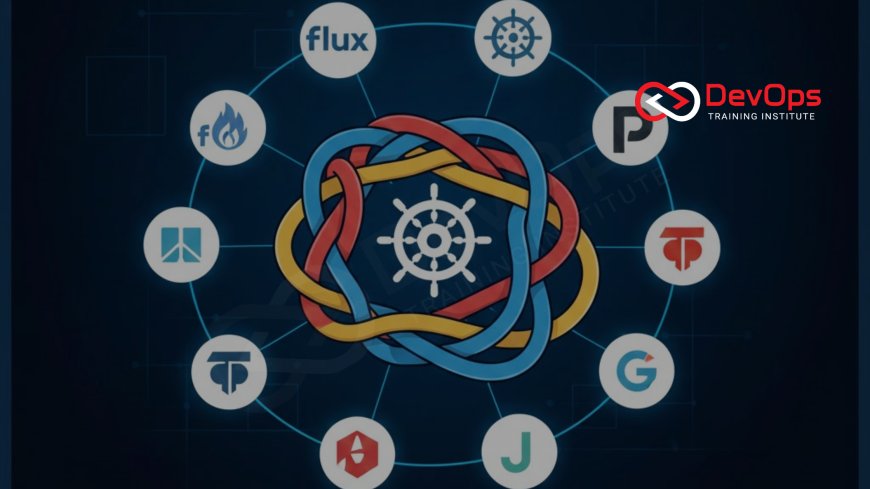
GitOps has emerged as a powerful methodology for managing Kubernetes clusters and applications through version-controlled Git repositories. In simple terms, it treats Git as the single source of truth for both infrastructure and application configurations, allowing teams to automate deployments, rollbacks, and scaling operations declaratively. This approach reduces manual errors, improves auditability, and enables faster recovery from failures. As Kubernetes adoption skyrockets in 2025, GitOps tools are becoming essential for organizations aiming to achieve high-velocity software delivery while maintaining security and compliance. Whether you are a beginner exploring cloud-native practices or an experienced engineer optimizing complex environments, understanding these tools can transform your workflow.
The beauty of GitOps lies in its simplicity and power. By syncing desired states from Git to Kubernetes clusters automatically, teams can focus on writing code rather than managing operations manually. This shift not only boosts productivity but also fosters collaboration between development and operations teams. With the rise of multi-cloud and hybrid setups, GitOps tools provide the consistency needed to handle diverse infrastructures. In this guide, we will dive into the top 8 GitOps tools, explaining their key features in beginner-friendly language. Many organizations start their DevOps from scratch by adopting GitOps principles, making it a great entry point for modern IT practices.
What is GitOps and Why It Matters for Kubernetes
GitOps is a set of practices that use Git repositories as the central hub for defining and managing infrastructure and applications. For Kubernetes, this means storing YAML manifests, Helm charts, and configuration files in Git, then using tools to automatically apply them to clusters. This declarative approach ensures that the actual state always matches the desired state described in Git, reducing drift and enabling easy audits. Beginners appreciate GitOps because it leverages familiar Git workflows like pull requests and branches for changes, making operations feel like coding. In 2025, with Kubernetes powering 85% of containerized applications, GitOps has become crucial for scaling reliably without constant manual intervention.
Why does GitOps matter? It promotes consistency across environments, from development to production, minimizing the "it works on my machine" issues. Security improves through code reviews on every change, and rollbacks are as simple as reverting a commit. For Kubernetes specifically, GitOps handles complex tasks like service updates and secret management declaratively. Teams new to this can start small, perhaps with a single namespace, and expand. Overall, GitOps aligns perfectly with DevOps principles, helping organizations deliver features faster while maintaining stability in dynamic cloud-native ecosystems.
Argo CD – The Declarative GitOps CD Tool
Argo CD stands out as one of the most popular GitOps tools for Kubernetes, developed under the Cloud Native Computing Foundation. It works by continuously monitoring Git repositories for changes and automatically syncing them to Kubernetes clusters. This pull-based model ensures high availability and security, as the tool runs inside the cluster without needing push access. Beginners find Argo CD approachable because of its intuitive web UI, which visualizes application states, health, and sync history. Installation is straightforward via Helm or YAML manifests, and it supports multiple Git repos per application for modular setups.
Key features include automated pruning of unused resources, rollback capabilities, and integration with popular tools like Helm, Kustomize, and Jsonnet for configuration management. In enterprise settings, Argo CD excels with RBAC controls, SSO integration, and multi-tenancy support. Real-world users report 70% reduction in deployment times and fewer outages. For those wondering if DevOps can work without automation, Argo CD proves that full automation is achievable and beneficial. Its open-source nature keeps costs low while community contributions add advanced features like progressive delivery.
Getting started involves setting up a Git repo with Kubernetes manifests and pointing Argo CD to it. The tool then handles syncing, with options for manual approvals in sensitive environments. Overall, Argo CD is ideal for teams transitioning to GitOps, offering reliability without overwhelming complexity.
Flux CD – Lightweight GitOps Operator
Flux CD is a lightweight, open-source GitOps toolkit designed specifically for Kubernetes. It focuses on simplicity, running as a small operator that reconciles Git state with cluster resources. Unlike heavier tools, Flux requires minimal configuration and supports automatic image updates through its Image Automation Controller. This makes it perfect for beginners who want quick wins without deep dives into complex setups. Flux integrates seamlessly with existing CI pipelines, pulling changes from Git and applying them declaratively.
Strengths include multi-tenancy support, alerting via webhooks, and compatibility with tools like Helm and Kustomize. In 2025, Flux has gained traction for its low resource footprint, making it suitable for edge computing and small clusters. Users appreciate the garbage collection feature that cleans up orphaned resources automatically. When considering how DevOps and Agile work together, Flux embodies Agile's iterative principles through frequent, automated syncs. Its community-driven development ensures regular updates and strong documentation.
Implementation is easy: install via CLI, connect to your Git repo, and let Flux handle the rest. It's especially useful for teams practicing continuous delivery in dynamic environments.
Jenkins X – CI/CD with GitOps Built-In
Jenkins X extends the classic Jenkins CI/CD tool with GitOps capabilities tailored for Kubernetes. It automates the entire pipeline from code commit to production deployment, using Git as the source of truth. Beginners benefit from its preview environments feature, which spins up temporary namespaces for pull requests. This allows safe testing without affecting main branches. Jenkins X integrates with Tekton for pipelines and supports serverless workloads through Knative.
Notable features include automated promotion across environments, built-in monitoring with Prometheus, and chatops integration for Slack or Microsoft Teams. Enterprises value its scalability for large teams and compliance with audit logs. Real-world adoption shows 50% faster release cycles. For organizations asking why DevOps is critical for modern software delivery, Jenkins X demonstrates integrated automation from build to deploy.
| Tool | Key Feature | Best For | Open Source |
|---|---|---|---|
| Argo CD | UI Dashboard | Enterprises | Yes |
| Flux CD | Image Automation | Small Teams | Yes |
| Jenkins X | Preview Environments | CI/CD Focused | Yes |
| Weave GitOps | Policy Enforcement | Security Teams | Partial |
| GitLab CI/CD | All-in-One | Full DevOps | Yes |
Weave GitOps – Enterprise-Ready Flux Extension
Weave GitOps builds on Flux CD to provide enterprise features like advanced policy enforcement, UI dashboards, and Terraform integration. It helps teams enforce compliance through Open Policy Agent gates, preventing non-compliant deployments. Beginners like the guided workflows for setting up clusters and repos. Weave adds value with notifications, multi-cluster management, and cost optimization insights.
Strengths include seamless upgrades from open-source Flux and support for hybrid clouds. Users in regulated industries praise its audit capabilities. When exploring if AI and DevOps work together, Weave's extensibility allows AI-driven policy checks. Its commercial backing ensures reliable support and frequent updates.
GitLab CI/CD with Kubernetes Agent
GitLab CI/CD offers built-in GitOps through its Kubernetes Agent, allowing direct cluster management from GitLab repositories. It combines CI pipelines with CD, enabling end-to-end automation. Beginners appreciate the all-in-one platform, from code hosting to deployment. Features include auto-scaling runners and built-in container registry.
Enterprise benefits like merge request approvals and compliance reports make it robust. Teams report 40% faster cycles. For those debating when to start a DevOps transformation, GitLab provides a smooth path with GitOps at its core.
Tekton – Cloud-Native Pipeline Framework
Tekton is a Kubernetes-native framework for building CI/CD pipelines with GitOps principles. It uses custom resources for tasks and pipelines, stored in Git for declarative management. Beginners can start with reusable catalogs of tasks for common operations like building images.
Integration with tools like Argo CD creates powerful GitOps flows. Its event-driven architecture scales efficiently. Users value the vendor-neutral approach under CNCF.
Setup involves installing CRDs and configuring Git webhooks for triggers.
Spinnaker – Multi-Cloud GitOps CD
Spinnaker supports GitOps for Kubernetes and multi-cloud deployments, with pipeline-as-code and advanced strategies like canary analysis. Beginners find the UI helpful for visualizing pipelines. It excels in large-scale environments with baking and verification stages.
Integration with Git providers enables declarative configs. Teams at Netflix-scale rely on its reliability.
Codefresh – GitOps-Centric Platform
Codefresh focuses on GitOps with Argo CD at its core, adding runtime insights and progressive delivery. Beginners enjoy the visual editor for pipelines. Features include hybrid runner support and DORA metrics tracking.
It helps teams questioning if small teams benefit from DevOps by simplifying complex setups.
Conclusion
GitOps tools have matured significantly, making Kubernetes automation accessible and efficient. From Argo CD's declarative syncing to Codefresh's integrated platform, each tool offers unique strengths for different team needs. Adopting GitOps leads to faster, safer deployments and better collaboration. Start with one tool that fits your current setup, and scale as you grow. The future of Kubernetes management is declarative, and these tools pave the way.
Frequently Asked Questions
What is GitOps?
GitOps uses Git as the single source of truth for infrastructure and apps, automating Kubernetes management declaratively.
Why use GitOps for Kubernetes?
It reduces errors, improves security through reviews, and enables quick rollbacks.
Is Argo CD free?
Yes, it's open-source under CNCF, with enterprise options available.
How does Flux CD differ from Argo CD?
Flux is lighter and focuses on image automation, while Argo CD has a richer UI.
Can Jenkins X work with existing Jenkins?
Yes, it extends Jenkins for Kubernetes-native workflows.
What makes Weave GitOps enterprise-ready?
Policy enforcement and multi-cluster management set it apart.
Is GitLab CI/CD suitable for beginners?
Yes, its all-in-one nature simplifies learning.
How does Tekton integrate with GitOps?
It stores pipelines in Git for declarative execution.
Why choose Spinnaker for multi-cloud?
Its advanced deployment strategies handle complexity well.
What is unique about Codefresh?
Built-in progressive delivery and runtime insights.
Can small teams use these tools?
Absolutely, many are lightweight and scalable.
Do these tools support Helm?
Yes, most integrate with Helm and Kustomize.
Is GitOps secure?
Yes, with code reviews and audit trails built-in.
How to choose the right tool?
Consider team size, cloud setup, and features needed.
Where to learn GitOps?
Join DevOps Training Institute for hands-on courses.
Always secure artifacts in public S3 buckets when using these tools.
What's Your Reaction?
 Like
0
Like
0
 Dislike
0
Dislike
0
 Love
0
Love
0
 Funny
0
Funny
0
 Angry
0
Angry
0
 Sad
0
Sad
0
 Wow
0
Wow
0

![100+ Azure DevOps Interview Questions and Answers [Updated 2025]](https://www.devopstraininginstitute.com/blog/uploads/images/202509/image_140x98_68c40aa9a3834.jpg)





![Future Scope of DevOps Careers in Pune [Updated 2025]](https://www.devopstraininginstitute.com/blog/uploads/images/202510/image_140x98_68e3a84652312.jpg)