





![Kong Interview Preparation Guide [2025]](https://www.devopstraininginstitute.com/blog/uploads/images/202509/image_430x256_68dbb95326997.jpg)




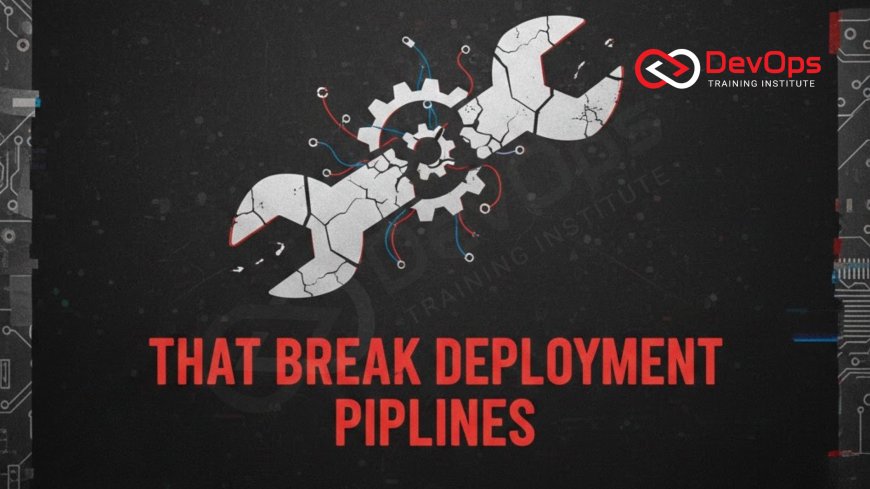
10 Jenkins Mistakes That Break Deployment Pipelines
Avoid catastrophic failures and pipeline downtime by mastering the 10 most critical Jenkins mistakes that break deployment pipelines in enterprise environments. This detailed guide covers common pitfalls ranging from mismanaging the Master node and exposing security credentials to neglecting Pipeline as Code and misconfiguring Master-Agent networking. Learn best practices for Jenkins-on-Kubernetes adoption, secure credential handling, advanced error management, and proper architectural segregation to ensure your Continuous Integration/Continuous Delivery (CI/CD) system is scalable, secure, and reliable enough to support high-velocity software delivery at scale, transforming your automation capabilities and achieving operational excellence.
Introduction: The High Cost of Jenkins Misconfiguration
Jenkins remains the undisputed king of open-source automation servers, providing the foundational engine for Continuous Integration and Continuous Delivery (CI/CD) for thousands of organizations worldwide, including many Fortune 500 companies. Its immense power, flexibility, and vast plugin ecosystem make it indispensable for managing complex, heterogeneous deployment pipelines that span legacy systems and modern cloud infrastructure. However, this same flexibility is also its greatest weakness. Jenkins is a platform, not a solution, and the responsibility for architecting, securing, and maintaining it falls entirely to the DevOps team. A misconfigured Jenkins instance can quickly transform from a productivity engine into a single point of failure that halts the entire software delivery process, leading to costly downtime, security breaches, and developer frustration.
Experience shows that pipeline breakage is rarely caused by Jenkins itself but almost always by fundamental architectural and configuration errors made during setup or scaling. These mistakes range from neglecting basic security protocols to adopting inefficient resource management patterns that cripple performance under load. As companies transition to high-velocity delivery models, these seemingly small configuration flaws become massive bottlenecks that prevent true continuous deployment. This comprehensive guide dissects the 10 most common and costly mistakes DevOps teams make with Jenkins, providing clear best practices and architectural solutions to ensure your pipelines are robust, scalable, and secure enough to meet modern enterprise demands.
Architectural and Configuration Flaws
Two of the most destructive mistakes made in Jenkins involve the fundamental architectural design of the CI/CD system. These flaws are architectural in nature, meaning they affect scalability and stability from the ground up, making the entire platform incapable of handling increasing build volume or maintaining consistent build environments. Rectifying these issues after they are entrenched in production is often a monumental and painful effort that requires significant downtime and migration planning.
1. Using the Master Node as an Executor: The Jenkins Master node is the brain of the operation; its sole responsibility should be managing the CI/CD dashboard, scheduling jobs, maintaining the state of the plugins, and orchestrating the distributed build agents. A critical mistake is allowing the Master node to execute resource-intensive build and test jobs. When the Master runs builds, its CPU, memory, and disk I/O are consumed by application tasks, leading to instability, dashboard freezes, corrupted job history, and total failure of the scheduling mechanism under heavy load. The correct architecture dictates that the Master must be isolated from execution and rely entirely on external, disposable agents to perform all build and test work, preserving the stability of the orchestration layer.
2. Relying on Manual Job Configuration (Freestyle Jobs): Building pipelines using the old Freestyle job type, which relies on clicking buttons and entering commands in a GUI, is a fatal flaw for any enterprise team. This manual approach prevents version control, lacks an audit trail, and makes complex jobs impossible to manage or reproduce. The solution is mandatory adoption of Pipeline as Code (PaC), using the Declarative Pipeline (or Scripted Pipeline) syntax defined entirely within a Jenkinsfile committed to the application’s Git repository. PaC ensures that the entire build process is version-controlled, auditable, reusable, and easy to roll back, aligning the CI/CD configuration directly with the application code itself, which is the foundational principle of a modern, stable delivery system.
Critical Security Vulnerabilities
Security flaws in Jenkins pipelines are frequently the easiest to exploit and the most damaging, as the CI/CD system holds privileged access keys to virtually all critical systems—source code repositories, cloud accounts, databases, and production servers. Mismanagement of credentials and exposure to the public internet are two errors that can result in immediate, catastrophic breaches, compromising the entire technology footprint of the organization. Securing Jenkins requires treating it as a mission-critical server that controls financial and customer data.
3. Storing Credentials in Groovy/Files: A common and dangerous anti-pattern is storing cloud secrets, database passwords, or private keys directly in the Jenkinsfile or in unencrypted files on the Master node. This exposes sensitive data to anyone who can view the pipeline code or access the file system. The correct approach is mandatory use of the Jenkins Credentials Plugin, which stores secrets in a secure, encrypted vault. For even greater security, secrets should be managed externally in dedicated tools like HashiCorp Vault or AWS Secrets Manager and injected into the pipeline at runtime only, ensuring they are never logged or stored permanently within the CI system. This strict isolation of secrets is crucial for enterprise security.
4. Exposing Jenkins to the Public Internet: Exposing the Jenkins Master node directly to the public internet, even behind simple authentication, is a massive security risk, given the number of exploitable vulnerabilities in legacy plugins and the general difficulty of hardening a CI server against targeted attacks. Jenkins should only be accessible via a Virtual Private Network (VPN) or internal corporate network, ideally through a bastion host or proxy server. Strict firewall rules must be enforced to restrict all incoming traffic, referencing knowledge of commonly exploited ports and protocols. The practice of restricting access based on source IP is a minimal requirement for safeguarding the integrity of the CI environment against external threats and reducing the attack surface exponentially.
The Pipeline as Code Pitfalls
Even after adopting Pipeline as Code (PaC), teams often make mistakes within the Jenkinsfile structure that lead to brittle, hard-to-debug pipelines and inconsistent build results. These errors often involve poor dependency management and a failure to handle non-happy-path scenarios, meaning the pipeline fails messily without reporting the actual cause of the problem, leading to wasted time and slow recovery during production incidents. The declarative nature of Groovy requires a disciplined approach to defining environment integrity and managing failure states transparently.
5. Hardcoding Dependencies/Environment Specifics: A pipeline that explicitly runs commands like npm install -g some-tool or relies on a static path like /opt/jdk/bin/java on the build agent is highly brittle and not scalable. This practice leads to "works on my machine" syndrome across different agents and environments. The solution is to mandate the use of Docker containers as build environments. The Jenkinsfile should define the exact Docker image (e.g., agent { docker { image 'node:18-alpine' } }) needed for the job, ensuring that the entire build environment, including the operating system, language runtime, and dependencies, is fully isolated, immutable, and consistent for every single run.
6. Ignoring Pipeline Error Handling: A common mistake is defining a linear pipeline that simply halts on the first error without performing crucial cleanup or notification steps. This leaves orphaned cloud resources, causes silent failures, and fails to alert the correct team members. Robust pipelines must use the try/catch/finally construct within Groovy (or the post block in Declarative syntax) to execute necessary cleanup steps regardless of the outcome. For example, the finally or always block must be used to tear down dynamically provisioned test environments and notify the development team via Slack or email, ensuring accountability and preventing unnecessary cloud costs from running indefinitely.
Performance and Resource Bottlenecks
Performance in a CI/CD system is directly tied to developer experience and deployment frequency. Slow build times and long job queues can negate all the advantages gained by adopting DevOps practices. Mistakes in resource management, particularly the use of outdated agent models and poor handling of dependencies, are the primary culprits that create these performance bottlenecks, causing developer frustration and encouraging teams to bypass the CI process entirely, which is a major organizational risk.
7. Using Unmanaged, Static Agents: Traditionally, Jenkins used statically provisioned virtual machines as build agents. This model is inefficient because the agent sits idle and incurs cloud compute costs when no jobs are running, and it cannot scale dynamically to meet peak load, leading to long, frustrating job queues. The modern best practice is to adopt elastic, disposable agents using the Kubernetes Plugin or Docker Agent Plugin. This pattern allows the system to provision an execution environment only when a job is triggered and tear it down immediately afterward, optimizing costs and providing infinitely scalable capacity.
8. Ignoring Artifact and Cache Management: Two related issues that drastically slow down pipelines are neglecting dependency caching and failing to properly manage artifacts. Pipeline stages often re-download gigabytes of dependencies (Maven, npm, Gradle) on every run if caching is not configured. Artifacts (compiled code, test reports) must be explicitly passed between stages using archiveArtifacts and unarchive, not recompiled or rebuilt. Failure to manage these can lead to minutes of wasted time per build, causing CI execution time to bloat and directly impacting the speed of the critical feedback loop to the developers.
Networking and Communication Errors
In a distributed Jenkins architecture, the stability of the entire pipeline relies on seamless and secure network communication between the Master node and its Agents. Mistakes in configuring the network infrastructure, often compounded by a lack of understanding of underlying network protocols, lead to intermittent build failures, slow agent connections, and critical security gaps that expose the entire CI system to attack. Understanding network fundamentals is non-negotiable for enterprise DevOps teams.
9. Ignoring Agent-Master Network Stability: Intermittent pipeline failures are often caused by unstable network connections between the Master and its Agents. Since Jenkins agents frequently use protocols built on TCP and UDP for communication, packet loss or high latency can cause connections to drop, leading to failed builds and corrupted logs. DevOps teams must ensure the network path is optimized, often leveraging tools like Kubernetes and VPC networking to place agents close to the Master, and ensuring that firewalls are correctly configured to allow persistent connections on the required ports for Master-Agent communication, thus preserving the reliability of the distributed system.
10. Lack of Network Segmentation and Port Management: Exposing the Jenkins Master's ports (like the default 8080 or the inbound JNLP port for agents) to unmanaged network traffic is a massive security oversight. This is compounded by a lack of network segmentation for agents, allowing a compromised agent to potentially access sensitive production systems. Understanding network fundamentals, including the difference between MAC addresses and IP addressing, is crucial for setting up secure network policies. The DevOps team must enforce strict access control lists (ACLs) and firewall rules, limiting traffic to only the known, required ports and applying the principle of least privilege to all CI/CD components.
Securing Your Jenkins Infrastructure
Moving Jenkins into an enterprise-grade CI/CD solution requires adopting stringent security practices, particularly around network isolation and credential management. These measures transform Jenkins from an easily compromised public server into a hardened orchestration layer that manages sensitive credentials and deployments without undue risk exposure. Adhering to these principles is essential for complying with modern regulatory standards and protecting the integrity of the software supply chain.
The following practices are mandatory for securing Jenkins at scale:
- Network Isolation and Zero Trust: Never expose the Master node directly to the internet. Isolate the Master and Agents within private subnets of your VPC. Use a VPN or internal load balancer (or Kubernetes Ingress with proper authentication) for access. All Master-Agent communication should be encrypted (TLS/SSL).
- Credential Management: Implement external secrets managers (Vault, Azure Key Vault, AWS Secrets Manager) and configure Jenkins to dynamically fetch credentials at runtime. Avoid using static credentials stored internally whenever possible, eliminating the risk of plaintext exposure.
- Role-Based Access Control (RBAC): Enforce strict RBAC using the Role-Based Authorization Strategy Plugin. Access to specific jobs, credentials, and configuration should be limited based on the user's defined role (e.g., developers can only trigger dev builds, release managers can approve production).
- Regular Auditing and Patching: Keep the Jenkins core and all plugins up-to-date to patch known vulnerabilities. Regularly audit user access, job configurations, and the script console for unauthorized code execution. Treating the CI server like any other production workload is essential for operational security.
- Agent Segregation: Ensure different projects or security levels run on physically or logically separate agents (e.g., Kubernetes namespaces or separate VMs). A pipeline running untrusted code should never share resources or a network segment with a pipeline deploying to production, enforcing strong resource and security isolation across the cloud infrastructure.
Conclusion
The flexibility and power of Jenkins make it an ideal engine for enterprise CI/CD, but its misconfiguration is the single greatest cause of pipeline failure, downtime, and security exposure. The 10 mistakes detailed—from neglecting the architectural segregation of the Master node to failures in secure credential management and network isolation—all point to a common failing: treating Jenkins as a simple automation server rather than a mission-critical, distributed system that requires rigorous planning and operational discipline. The path to robust, scalable CI/CD lies in mandating Pipeline as Code, adopting elastic agents (Kubernetes/Docker), enforcing external secrets management, and treating network configuration with the utmost security diligence.
By moving away from static, brittle configurations to a modern, container-based architecture, DevOps teams can mitigate the most common risks, ensure consistent build environments, and achieve the operational stability required to support high-velocity software delivery. Correctly architecting Jenkins, using the principles of least privilege, strict network control, and fully version-controlled pipelines, transforms the system into the resilient, secure engine necessary to sustain a high-performing organization in the cloud-native era, providing the stable foundation required for achieving true continuous deployment.
Frequently Asked Questions
Why is the Master node instability a major issue?
Master instability leads to corrupted job history, scheduling failures, and total cessation of the CI/CD pipeline, halting all software delivery processes.
What is the purpose of the Jenkinsfile?
The Jenkinsfile is the file used to define the entire pipeline logic as code, ensuring version control, auditability, and reproducibility for all builds.
How do you secure the JNLP port used by agents?
It is secured by isolating the Jenkins Master and agents in a private network and strictly limiting inbound traffic via firewall rules to only necessary internal IPs.
Why is caching important for pipeline performance?
Caching prevents the pipeline from re-downloading large dependencies (like npm or Maven packages) on every run, significantly reducing CI execution time.
How does Jenkins relate to MAC addresses?
While Jenkins doesn't use MAC addresses, understanding them helps engineers isolate agents on the network layer and enforce strict access policies based on physical interface identity.
What is the benefit of using elastic agents (Kubernetes)?
Elastic agents provision a clean, isolated environment only when a job is needed and terminate afterward, optimizing costs and providing scalable capacity.
What is the risk of using unmanaged, static agents?
They incur constant cloud compute costs while idle, cannot scale to meet peak demand, and are prone to build environment drift, leading to intermittent failures.
Why is external secrets management preferred over the Credentials Plugin?
External management ensures credentials are not stored in Jenkins at all, reducing the risk if the Master node or its persistence layer were ever compromised.
How do you debug intermittent failures caused by network issues?
By analyzing pipeline logs for connection timeouts or slow responses and verifying network path stability and proper configuration of necessary firewall ports for Master-Agent communication.
What is the post section used for in a Declarative Pipeline?
The post section is used to define cleanup actions and notifications that run after the main pipeline stages, regardless of whether the stage succeeded or failed.
Why should DevOps engineers understand the OSI and TCP/IP models?
Understanding these models is crucial for diagnosing complex network and protocol issues that cause build failures, ensuring proper network security, and optimizing application communication.
What is the purpose of Artifact Management?
It ensures that compiled code and build products are passed efficiently between pipeline stages without needing to be recompiled, preserving build integrity and saving time.
How is security testing integrated into the pipeline?
Security testing is integrated by running automated jobs (using tools like OWASP ZAP or SonarQube) that execute DAST/SAST scans immediately after the build stage, failing the pipeline if critical vulnerabilities are found.
How does Jenkins integration differ between traditional and Cloud networking?
In the Cloud, Jenkins uses APIs and managed services (like K8s or EC2) for agent management and scaling, contrasting with traditional networks that rely on persistent SSH connections to static VMs.
What is the purpose of the Declarative options block?
The options block is used to configure pipeline-specific behaviors such as timeouts, retries, and build discarding rules, enhancing the reliability and resource management of the job.
What's Your Reaction?
 Like
0
Like
0
 Dislike
0
Dislike
0
 Love
0
Love
0
 Funny
0
Funny
0
 Angry
0
Angry
0
 Sad
0
Sad
0
 Wow
0
Wow
0



![100+ Azure DevOps Interview Questions and Answers [Updated 2025]](https://www.devopstraininginstitute.com/blog/uploads/images/202509/image_140x98_68c40aa9a3834.jpg)






![Future Scope of DevOps Careers in Pune [Updated 2025]](https://www.devopstraininginstitute.com/blog/uploads/images/202510/image_140x98_68e3a84652312.jpg)