


























![Kong Interview Preparation Guide [2025]](https://www.devopstraininginstitute.com/blog/uploads/images/202509/image_430x256_68dbb95326997.jpg)






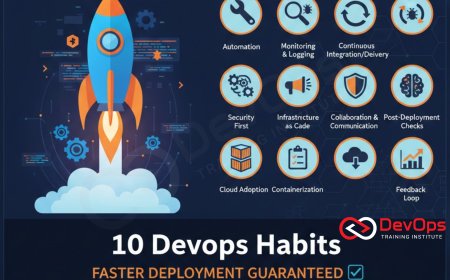








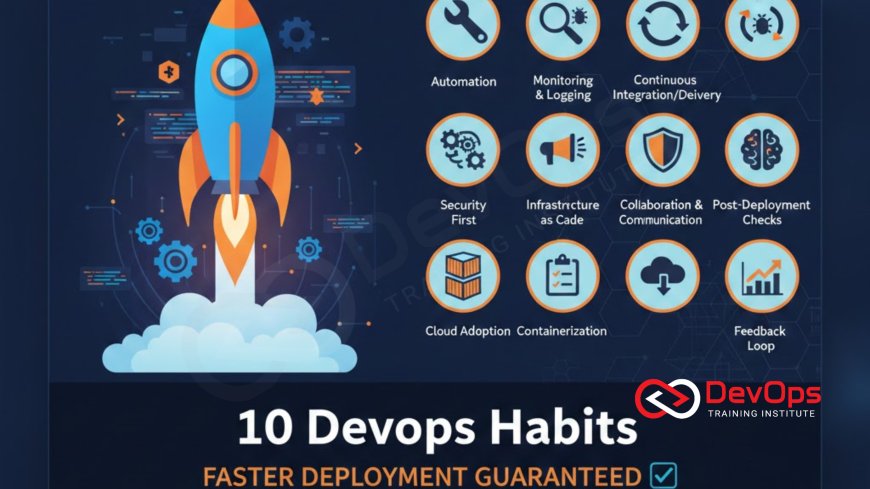
10 DevOps Habits That Guarantee Faster Deployment
Unlock high-velocity software delivery by adopting 10 essential DevOps habits that guarantee faster, safer deployments. This guide focuses on practices that minimize deployment risk and bottlenecks, including small batch sizes, immutable infrastructure, continuous testing, and GitOps workflows. Learn how to transform your daily routine to eliminate toil, automate manual gates, and utilize advanced observability for rapid validation, ensuring your team can achieve high-frequency releases with confidence and maintain a stable, high-performing production environment in the face of continuous change.
Introduction
The speed of deployment is the single most important metric distinguishing high-performing DevOps organizations from their traditional counterparts. Faster deployment doesn't just mean quicker features; it means lower risk. When changes are small, isolated, and deployed frequently, the blast radius of any potential failure is dramatically reduced, and the Mean Time to Repair (MTTR) plummets. In a world where customer expectations demand constant, seamless updates, cultivating the right daily habits is the key to accelerating the time from code commit to successful production release.
Achieving this velocity requires more than just installing CI/CD tools. It demands a cultural shift—a set of deeply ingrained DevOps habits that permeate every stage of the software delivery lifecycle. These habits focus on reducing manual toil, moving validation to the earliest possible stage, and ensuring that every change is traceable, automated, and observable. They empower developers and operations teams to work collaboratively, with shared responsibility for reliability and security.
This guide outlines 10 essential DevOps habits that, when adopted consistently, will guarantee faster, safer, and more reliable deployments. These practices cover everything from the size of your code changes and how you manage infrastructure to how you validate performance and handle operational monitoring. By implementing these habits, your team can eliminate deployment bottlenecks, accelerate its release cadence, and sustain a competitive advantage in the high-velocity technology landscape.
Habit 1: Commit and Deploy in Small Batches
The size of a code change (batch size) is directly proportional to the risk and time required for deployment. Large, infrequent merges lead to complex code reviews, difficult troubleshooting, and high-risk deployments. Conversely, committing and merging tiny, isolated changes frequently allows for quick reviews, easy rollbacks, and rapid detection of the exact commit that introduced a bug.
Practice: Trunk-Based Development is the supporting branching strategy here. Developers should merge code to the main branch multiple times per day. Each commit should ideally represent a single, atomic, complete change. Small batches ensure that the CI/CD pipeline can run quickly, validating the change with minimal latency. This habit is fundamental to maintaining a high velocity flow and minimizing merge conflicts.
Habit 2: Treat Everything as Code (IaC and GitOps)
Manual infrastructure and configuration management are slow, inconsistent, and error-prone. The habit of treating everything—from cloud infrastructure to application configuration and security policies—as code is essential. Infrastructure as Code (IaC) tools like Terraform and Ansible enforce consistency. Furthermore, adopting GitOps means Git is the single source of truth for your desired state, automatically triggering deployments when code is merged.
Practice: Store all infrastructure definitions (e.g., Terraform files, Kubernetes manifests) in Git. Automate the application of these changes through the CI/CD pipeline. This ensures environments are immutable and consistent, preventing configuration drift. Every change must be reviewed and deployed via the same controlled process. This extends to even low-level system configuration, such as configuring SSH keys security in RHEL 10, ensuring all environment setup is codified and traceable.
Habit 3: Build and Deploy Immutable Artifacts
Never modify a deployed application or server in place (mutable infrastructure). The habit of building and deploying immutable artifacts means that every deployment involves replacing the old container or VM with a new, fully configured one. This eliminates configuration drift and significantly increases reliability, as you know exactly what artifact is running in production. If a bug is found, you simply replace the unhealthy artifact with the previous stable version.
Practice: Use Docker or Packer to create standardized, versioned images that include all dependencies and configurations. The CI/CD pipeline should push these images to a trusted container registry. The deployment stage (e.g., Kubernetes) then pulls the new image and replaces the old one. The image, once built, is never modified, guaranteeing consistency across all environments.
Habit 4: Automate Every Validation Gate (Shift Left)
Manual testing and approval steps are the primary bottlenecks in any pipeline. The habit of automating every validation gate means shifting testing left—running checks as early and quickly as possible. This includes unit tests, integration tests, security scans, and policy checks, all triggered automatically on code commit.
Practice: Integrate automated testing at multiple levels: unit tests (fastest), integration tests (service-to-service checks), and end-to-end (E2E) tests (slowest, for critical paths). Implement security checks like SAST and SCA directly into the pull request workflow to enforce continuous security, ensuring low-quality or insecure code cannot be merged. Automating these gates eliminates manual sign-offs and accelerates the flow of code through the pipeline, which directly impacts the high-velocity requirements of modern DevOps continuous delivery pipeline management.
Habit 5: Integrate Security and Compliance Continuously (DevSecOps)
Security must be a continuous, automated process, not a painful, manual audit at the end. The habit of integrating DevSecOps checks continuously ensures that security is an accelerator, not a roadblock. This is particularly vital when managing the security profile of the base infrastructure.
Practice: Use tools like Checkov or OPA to scan IaC for compliance issues before deployment. Implement automated vulnerability scanning on container images. Ensure that host systems adhere to required standards. For example, compliance with RHEL 10 hardening best practices should be validated by an automated configuration management tool (like Ansible) that reports status back to the pipeline, guaranteeing that the operating system foundation is secure before the application runs, providing a strong defense-in-depth security posture.
Habit 6: Monitor Deployment Progress with Observability
After deployment, knowing quickly whether the change is safe is crucial. The habit of using observability tools—metrics, logs, and traces—to validate deployment health provides rapid confirmation. Simply checking if a service is "up" is insufficient; you must know if it's performing correctly for the user.
Practice: Deploy your services using Canary or Blue/Green techniques, monitoring key metrics (Golden Signals: Latency, Errors, Traffic) in real-time. If the error rate on the new version spikes, the deployment must be instantly and automatically rolled back. Ensure that every metric, log line, and trace includes deployment metadata (version, commit ID) to allow for immediate correlation and diagnosis. This habit allows for proactive validation by tracking key indicators like the percentage of successful requests and the P99 latency. Leveraging advanced insights from the observability pillars is key to achieving this rapid validation.
Habit 7: Implement Deployment Resilience (Auto-Rollbacks)
The fastest path to recovery after a failed deployment is an immediate, automatic rollback. The habit of implementing deployment resilience means designing your deployment strategy with a built-in safety switch that prioritizes service availability over new feature delivery. This capability drastically reduces MTTR.
Practice: Configure your orchestration platform (e.g., Kubernetes, Spinnaker) to automatically monitor critical service health checks and metrics immediately after a deployment. If the service health check fails, or a critical metric threshold (e.g., 5xx error rate > 5%) is violated, the system must instantly trigger a rollback to the last known stable version. This makes deployments safer and faster because the risk of a long outage is eliminated, reinforcing the safety net for frequent releases.
Habit 8: Use Log Management for Immediate Feedback
Logs are indispensable for debugging failed deployments and rapid root cause analysis. The habit of integrating robust log management ensures that every event is centralized, structured, and instantly searchable, turning logs into a powerful diagnostic tool rather than unstructured noise.
Practice: Instrument your applications to produce structured logs (e.g., JSON format) enriched with context (user ID, session ID, trace ID, deployment version). Use a centralized log aggregator (e.g., Fluentd, Logstash) to ship all logs to a unified platform (e.g., Elasticsearch, Grafana Loki). This enables engineers to pinpoint the exact failure line from a deployment-related error instantly, drastically speeding up the debugging process, which is a key component of effective RHEL 10 log management best practices and overall system health.
Habit 9: Leverage Feature Flags to Decouple Release
The habit of using feature flags (or feature toggles) decouples the act of deploying code from the act of releasing a feature to users. This separation is critical for achieving true deployment velocity, as it eliminates the dependency on final user-testing approval before the code can be merged and deployed.
Practice: Wrap new or risky code paths behind feature flags managed by an external service. Deploy all code, including disabled features, to production. When the code is live, the product team can flip the flag to release the feature to a controlled segment of users (e.g., internal staff, a small beta group). If issues arise, the flag can be flipped off instantly, reducing the need for a code rollback and allowing developers to fix the problem in the background. This allows for safe, high-frequency deployment without waiting for feature completion.
Habit 10: Continuously Learn from Incidents and Post-Mortems
Reliability is built through a cycle of failure and learning. The habit of conducting thorough, blameless post-mortems (incident reviews) after every significant deployment failure or incident is essential. Post-mortems are not about finding fault; they are about identifying systemic weaknesses in the pipeline, code, or processes.
Practice: After an incident, dedicate time to writing a blameless post-mortem that identifies root causes (e.g., a missing test, a weakness in the deployment script, a lack of observability). The most important outcome is a set of prioritized, actionable tasks aimed at preventing recurrence. These tasks must be fed back into the development backlog and prioritized over new feature work when necessary, ensuring that reliability improvements are continuously incorporated. This commitment to iterative improvement is what sustains a rapid, yet stable, release cadence and prevents the recurrence of past failures, accelerating long-term deployment speed.
Conclusion
Achieving faster deployment in DevOps is a direct outcome of cultivating disciplined, automated habits across the entire engineering organization. The 10 practices outlined—from committing small batches and treating everything as code to leveraging auto-rollbacks and feature flags—collectively form a powerful strategy to minimize risk and eliminate friction. These habits shift the focus from manual effort and anxious gatekeeping to automated validation and continuous resilience.
By automating security and compliance checks (Habit 5), maintaining immutable infrastructure (Habit 3), and implementing robust observability (Habit 6), you build confidence in every deployment. This confidence allows your team to move faster. Furthermore, integrating features like auto-rollbacks (Habit 7) and decoupled releases via feature flags (Habit 9) ensures that when things inevitably go wrong, the system automatically recovers in seconds, drastically improving MTTR and overall service availability. The commitment to continuous learning (Habit 10) completes the loop, ensuring that every failure makes the pipeline stronger and faster for the next deployment.
Adopting these habits is the single most effective way to secure a competitive advantage in modern software delivery. They ensure that your team can confidently manage a high-velocity DevOps continuous delivery pipeline, delivering value to customers rapidly and reliably. Make these 10 habits the non-negotiable standard for your engineering practice, and watch your deployment speed and system stability accelerate dramatically, turning the complex challenge of continuous delivery into a predictable, low-risk operational process.
Frequently Asked Questions
What is the benefit of deploying in small batches?
Small batches reduce the complexity of code reviews, minimize merge conflicts, and drastically reduce the risk and blast radius of any deployment failure, accelerating the overall flow of changes.
Why is immutable infrastructure a habit that guarantees faster deployment?
Immutability ensures environment consistency by eliminating configuration drift. If a deployment fails, you simply revert to the last known stable image, which is faster than debugging in-place changes.
How does GitOps contribute to faster deployments?
GitOps uses Git as the single source of truth, automating deployment through a reconciliation agent. This eliminates manual steps and ensures that code merges directly translate to predictable, automated releases.
What is "shifting left" in the context of deployment validation?
Shifting left means moving quality and security checks (testing, scanning, policy checks) to the earliest possible stages of development, catching errors when they are cheapest and fastest to fix, rather than during deployment.
How does automated security scanning fit into the habit of fast deployment?
Automated security scanning provides instant feedback. By failing the build early on an insecure artifact, it prevents costly, time-consuming security audits and fixes later in the pipeline.
What role does feature flagging play in accelerating the release cadence?
Feature flagging decouples deployment from release. Code can be deployed to production safely and quickly, then features are released later by flipping a flag, enabling continuous deployment without waiting for product sign-off.
How does the DevSecOps habit ensure faster deployments?
By automating security and compliance checks (e.g., using OPA or RHEL 10 hardening best practices validation) and embedding them into the CI/CD pipeline, DevSecOps eliminates manual security gatekeeping bottlenecks, maintaining high velocity with assurance.
What is the difference between simple monitoring and using observability pillars for deployment?
Monitoring checks simple health (up/down). Observability uses metrics, logs, and traces to understand why a service is performing poorly, enabling rapid correlation and immediate diagnosis of issues in the new deployment version.
Why is log management a critical habit for fast incident recovery?
Robust, structured log management (e.g., RHEL 10 log management best practices) ensures that every event is centralized and instantly searchable, allowing engineers to pinpoint the root cause of a deployment failure in seconds, drastically reducing MTTR.
How does post-mortem culture accelerate long-term deployment speed?
Post-mortems transform failure into learning. By identifying systemic weaknesses and prioritizing reliability tasks, they prevent the recurrence of past deployment failures, making the pipeline progressively more stable and faster over time, sustaining a high velocity.
Why is configuring SSH keys security in RHEL 10 relevant to deployment speed?
It's relevant because strong security for host access must be automated via IaC. Manual security setup is slow; codifying and automating robust key management ensures a fast, secure, and consistent host foundation for deployment.
How does the DevOps continuous delivery pipeline benefit from small commits?
Small commits trigger quick pipeline runs, minimizing testing time and risk. The smaller the change, the faster it flows through the pipeline, maintaining the continuous and rapid nature of the delivery process.
What is the benefit of auto-rollback in high-frequency deployment?
Auto-rollback provides a non-negotiable safety net. If a deployment fails, the system instantly recovers, eliminating the need for manual intervention and protecting the service availability, making frequent deployments far less risky.
What foundational practice ensures environments are consistent across the pipeline?
The habit of treating everything as code (IaC) ensures that all environments (dev, staging, prod) are provisioned from the same source of truth (Git), preventing configuration drift and guaranteeing consistency.
How does the observability pillars concept help in making the deployment safer?
By monitoring the deployed service using all three pillars—metrics, logs, and traces—teams can get comprehensive, real-time feedback on user impact and internal health, allowing for quick, data-driven decisions on whether to proceed or roll back the deployment.
What's Your Reaction?
 Like
0
Like
0
 Dislike
0
Dislike
0
 Love
0
Love
0
 Funny
0
Funny
0
 Angry
0
Angry
0
 Sad
0
Sad
0
 Wow
0
Wow
0





![100+ Azure DevOps Interview Questions and Answers [Updated 2025]](https://www.devopstraininginstitute.com/blog/uploads/images/202509/image_140x98_68c40aa9a3834.jpg)






![Future Scope of DevOps Careers in Pune [Updated 2025]](https://www.devopstraininginstitute.com/blog/uploads/images/202510/image_140x98_68e3a84652312.jpg)