

![Kong Interview Preparation Guide [2025]](https://www.devopstraininginstitute.com/blog/uploads/images/202509/image_430x256_68dbb95326997.jpg)

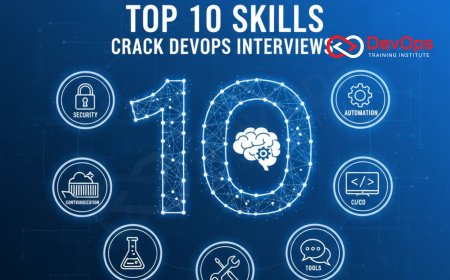
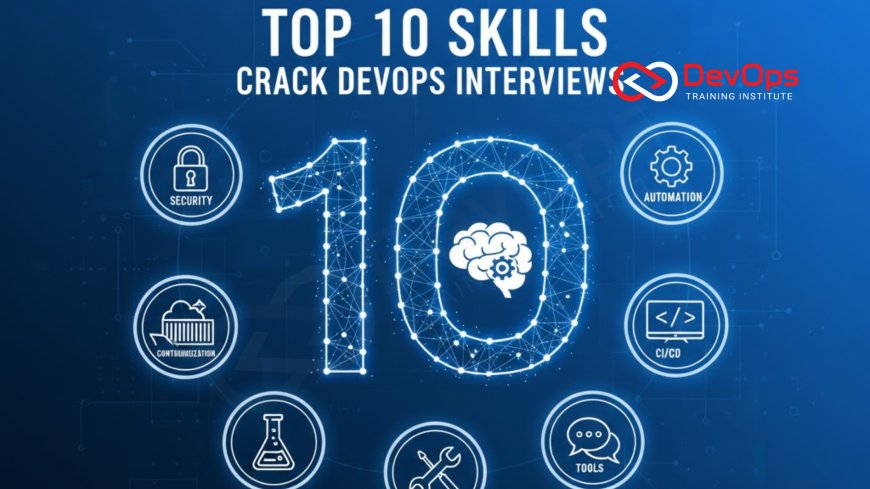
Top 10 Skills Needed to Crack DevOps Interviews
Land your dream DevOps job with these 10 must-have skills that interviewers at Amazon, Google, Netflix, and startups are testing in 2025. From Linux mastery and CI/CD pipelines to Kubernetes, Terraform, CloudWatch, SQS, EKS, and soft skills — this complete guide includes real interview questions, practical examples, and preparation tips to help you stand out and clear even the toughest DevOps interviews.
Introduction
DevOps interview processes in 2025 have become significantly more rigorous than even two years ago. Companies no longer just ask “What is CI/CD?” — they expect you to design resilient, observable, and cost-optimized systems under time pressure. Whether you’re interviewing at FAANG, a fintech unicorn, or a fast-growing startup, the same ten skill areas repeatedly decide who gets the offer. Mastering these will not only help you clear technical rounds but also impress hiring managers with production-ready thinking. From deep Linux troubleshooting to building SQS-to-Lambda integrations and monitoring EKS clusters with CloudWatch, these are the exact topics that appear in real interviews today.
1. Linux & Shell Scripting – The Foundation
Every DevOps role starts with Linux proficiency. Interviewers expect you to debug at the command line without a GUI.
- Find the top 5 CPU-consuming processes and kill the oldest one
- Write a script to alert when disk usage > 80%
- Troubleshoot “Too many open files” error
- Explain inode exhaustion vs disk full
- Use netstat/ss to find which process listens on port 8080
- Parse JSON logs with jq in a one-liner
- Difference between hard and soft links with real examples
Practice: Solve 50 Linux questions on platforms like Linux Journey or OverTheWire Bandit.
Real Interview Question
“You SSH into a production and see 100% CPU. Walk me through your debugging steps.”
2. Git & Branching Strategies
Git is non-negotiable. You must know more than basic commit/push.
- GitFlow vs GitHub Flow vs Trunk-Based Development
- How to safely rewrite history (rebase -i, filter-branch)
- Cherry-pick hotfixes across branches
- Resolve complex merge conflicts in YAML manifests
- Git hooks for linting and security scanning
- Monorepo vs multi-repo trade-offs
Pro tip: Know how to recover a deleted branch using reflog — it has saved multiple candidates.
3. CI/CD Pipelines (Jenkins, GitHub Actions, GitLab CI)
Expect to design a complete pipeline on a whiteboard or CoderPad.
- Parallel stages, matrix builds, cache optimization
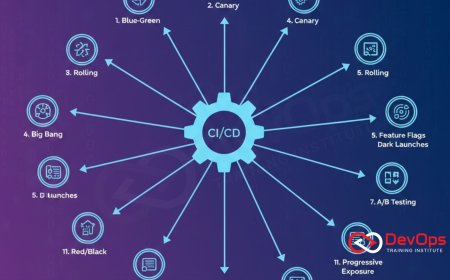
- Blue-green vs canary vs rolling deployments
- Promote artifacts between environments securely
- Fail-fast vs continue-on-error strategies
- Secret management (GitHub Secrets, HashiCorp Vault, AWS SSM)
- Pipeline as Code best practices
Real question: “Design a zero-downtime deployment pipeline for a database-backed application.”
4. Infrastructure as Code – Terraform Mastery
Terraform dominates interviews. Be ready for live coding.
- Modules, remote state backend configuration
- terraform plan vs apply vs destroy
- State locking and workspace usage
- Drift detection and remediation
- Writing reusable modules with variables and outputs
- Terraform vs Pulumi vs CloudFormation trade-offs
Bonus: Know how to safely manage secrets with SOPS or Terraform Cloud variables.
5. Cloud Platforms – AWS is Still King
AWS appears in 70%+ of DevOps roles. Focus on:
- EC2, ECS/EKS, Lambda, RDS, ELB, VPC, IAM
- Well-Architected Framework pillars
- Cost optimization strategies
- Disaster recovery (pilot light, warm standby, multi-region)
- Setting up CloudWatch alarms for failures
- Automating responses with CloudWatch Events + Lambda
6. Containerization & Orchestration – Docker + Kubernetes
Kubernetes questions are now mandatory, even for mid-level roles.
- Dockerfile best practices (multi-stage builds, .dockerignore)
- Pod, Deployment, Service, Ingress, ConfigMap, Secret differences
- K8s networking (CNI, service mesh)
- Troubleshooting: kubectl describe, logs, exec, port-forward
- Helm charts vs Kustomize vs raw manifests
- RBAC, NetworkPolicy, PodSecurityPolicies
- Managing Amazon EKS clusters
Common K8s Interview Question
“A pod is in CrashLoopBackOff. Debug it step by step.”
7. Monitoring, Logging & Observability
You will be asked to design an observability stack.
- Prometheus + Grafana vs Datadog vs New Relic
- Golden Signals: Latency, Traffic, Errors, Saturation
- SLOs, SLIs, error budgets
- Distributed tracing with Jaeger/Tempo
- Setting up custom CloudWatch dashboards
- CloudWatch Logs Insights queries
- Alert fatigue reduction strategies
8. Configuration Management & Automation
Ansible is the most asked tool after Terraform.
- Idempotency and why it matters
- Playbooks, roles, inventory, variables
- Ansible vs Chef vs Puppet (know the differences)
- Writing custom modules when needed
- Integration with CI/CD and ChatOps
9. Networking & Security Basics
Security is now everyone’s job.
- VPC design, subnets, route tables, NACLs, security groups
- SSL/TLS handshake explanation
- Zero-trust architecture principles
- Secrets management (Vault, AWS Secrets Manager)
- Compliance frameworks (SOC2, PCI, HIPAA basics)
- Common vulnerabilities (Log4Shell, S3 bucket leaks)
10. Soft Skills & System Design Thinking
Technical depth alone isn’t enough — interviewers want to see how you think.
- Explain complex topics simply (e.g., Kubernetes to a 5-year-old)
- Blameless post-mortems and learning culture
- Trade-off discussions: cost vs performance vs reliability
- How to influence without authority
- Designing systems with failure in mind
- Teaching and documentation mindset
DevOps Interview Skills Matrix Table
| Skill | Interview Weight | Must-Know Tools/Concepts |
|---|---|---|
| Linux/Shell | Critical | grep, awk, find, netstat |
| CI/CD | Critical | Jenkins, GitHub Actions |
| IaC | Critical | Terraform, CDK |
| Kubernetes | High | EKS, pods, services |
| AWS | High | EC2, S3, RDS, Lambda |
| Observability | High | CloudWatch, Prometheus |
Conclusion
The DevOps interview landscape in 2025 rewards well-rounded engineers who combine deep technical knowledge with strong communication, and real-world problem-solving. Focus intensely on these ten areas, practice explaining your thought process out loud, and build small projects that demonstrate multiple skills together (for example, an EKS cluster with Terraform, monitored by CloudWatch, deployed via GitHub Actions). Candidates who can confidently discuss trade-offs, teach concepts clearly, and show genuine passion consistently receive multiple offers. Start preparing these skills today — your next big opportunity is waiting.
Frequently Asked Questions
How many rounds are typical in DevOps interviews?
Usually 4–6: screening, technical deep-dive, system design, culture fit, and sometimes a take-home project.
Should I learn Azure and GCP too?
AWS first (70%+ market), then one more cloud for multi-cloud questions.
Are certifications helpful?
AWS Solutions Architect / DevOps Engineer Pro and CKA are highly respected.
How important are LeetCode-style questions?
Less than before, but basic algorithms (hash maps, queues) still appear.
What’s the biggest red flag for interviewers?
Not admitting “I don’t know” and inability to explain past failures.
How to prepare for system design?
Practice designing URL shortener, chat system, and e-commerce platform with DevOps focus.
Is open-source contribution necessary?
Not required, but a well-maintained GitHub with real projects helps tremendously.
Best resources for practice?
KodeKloud, Linux Journey, AWS Free Tier projects, and “DevOps Exercises” GitHub repo.
Should I focus on tools or concepts?
Concepts first (immutability, idempotency, observability), tools second.
Any last tip?
Record yourself explaining a past project — if you can’t explain it clearly, interviewers will notice.
What's Your Reaction?
 Like
0
Like
0
 Dislike
0
Dislike
0
 Love
0
Love
0
 Funny
0
Funny
0
 Angry
0
Angry
0
 Sad
0
Sad
0
 Wow
0
Wow
0

![Most Asked Kong Interview Questions [2025 Edition]](https://www.devopstraininginstitute.com/blog/uploads/images/202509/image_430x256_68dbb940e81fc.jpg)
![Scenario-Based Kong Interview Questions with Answers [2025]](https://www.devopstraininginstitute.com/blog/uploads/images/202509/image_430x256_68dbb94b171df.jpg)
![Fastly Certification Interview Questions and Answers [2025]](https://www.devopstraininginstitute.com/blog/uploads/images/202509/image_430x256_68dbb92cbfed7.jpg)
![Real-Time Fastly Interview Questions [2025]](https://www.devopstraininginstitute.com/blog/uploads/images/202509/image_430x256_68dbb92a07738.jpg)
![Fastly CDN & Edge Interview Questions [2025]](https://www.devopstraininginstitute.com/blog/uploads/images/202509/image_430x256_68dbb93715598.jpg)
![100+ Azure DevOps Interview Questions and Answers [Updated 2025]](https://www.devopstraininginstitute.com/blog/uploads/images/202509/image_140x98_68c40aa9a3834.jpg)




![Future Scope of DevOps Careers in Pune [Updated 2025]](https://www.devopstraininginstitute.com/blog/uploads/images/202510/image_140x98_68e3a84652312.jpg)