

![Kong Interview Preparation Guide [2025]](https://www.devopstraininginstitute.com/blog/uploads/images/202509/image_430x256_68dbb95326997.jpg)

Top 15 Docker Alternatives for Containerization
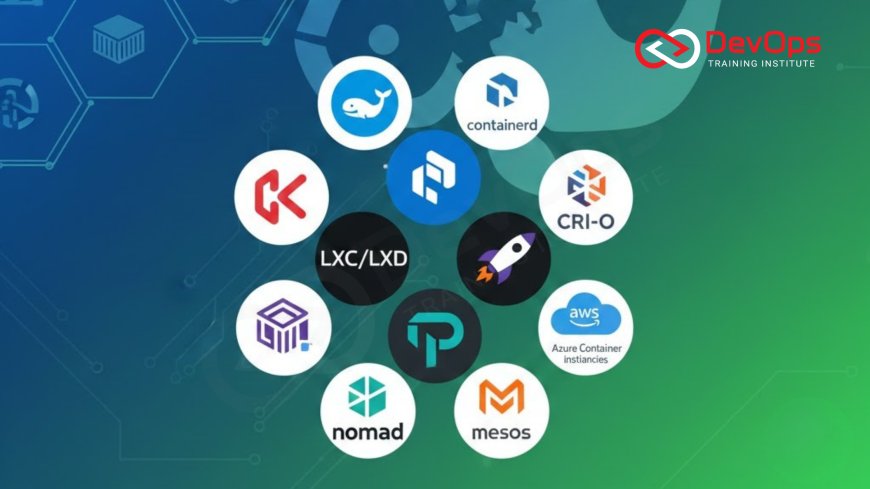
Explore the top 15 alternatives to Docker for containerization, spanning the entire container lifecycle from image building and runtime to advanced security and serverless environments. This guide dives into daemonless solutions like Podman and Buildah, lightweight Kubernetes runtimes like CRI-O, and security-focused platforms such as Kata Containers and gVisor. Understand the modular nature of the Open Container Initiative (OCI) ecosystem and how tools like containerd and runC provide the foundation for container execution beyond the traditional Docker engine. We cover the specific benefits of each tool, including its compliance with the OCI standard, its ease of use via familiar basic commands, and its role in enhancing security, compliance, and efficient file system management in modern cloud-native infrastructures.
Introduction
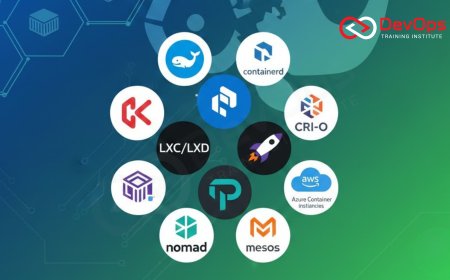
Docker revolutionized modern software development by standardizing the way applications are packaged and shipped. However, the container landscape has evolved significantly, driven by the need for greater security, modularity, and compliance with the Open Container Initiative (OCI) standards. Today, Docker is often viewed not as a single monolithic tool, but as a suite of components (CLI, daemon, runtime) that can be replaced or augmented by alternatives offering specialized advantages. These 15 tools are key players in the post-Docker ecosystem, often providing superior integration with orchestration systems like Kubernetes, enhanced security features by eliminating the root daemon, or better fit for specific environments like high-performance computing (HPC). Understanding these alternatives is crucial for any organization looking to optimize its container strategy, whether that means adopting a daemonless architecture for security or choosing a runtime specifically optimized for the Kubernetes Container Runtime Interface (CRI). The move away from Docker's monolithic design towards specialized, interchangeable components is the foundation of modern cloud-native maturity. [Image illustrating the OCI container stack components]
1. Podman: The Daemonless Docker Replacement
Podman is a Linux-native tool designed as a direct replacement for the Docker CLI, with one massive difference: it is completely daemonless (it does not require a constantly running background service).
- Daemonless Architecture: Eliminating the central daemon (Docker's `dockerd`) drastically improves security. Podman allows users to run containers as non-root users, preventing a security breach in the daemon from compromising the entire host system.
- Familiar CLI: Podman maintains syntax compatibility with the Docker CLI (e.g., `podman run` instead of `docker run`), making the transition easy for developers already familiar with Docker workflows.
- Rootless Containers: It supports running containers under a regular user's context, providing enhanced isolation and fulfilling the principle of least privilege, a key security best practice for modern environments.
- Systemd Integration: Podman integrates natively with `systemd`, allowing containers and pods to be easily managed and supervised by the operating system's service manager, offering robust lifecycle control.
- Pod Concept: Podman introduced the concept of a "Pod" (a group of containers sharing resources) outside of Kubernetes, allowing developers to test complex, multi-container applications locally before deploying them to K8s.
- OCI Compliant: It adheres strictly to the OCI standards for images and runtimes, ensuring that images built with Podman can run anywhere, including on Docker or Kubernetes.
- Easy Adoption: Its robust and familiar interface, combined with superior security features, has made Podman a favored choice in many security-conscious and Red Hat-based environments.
2. LXC/LXD: OS-Level Virtualization and System Containers
Linux Containers (LXC) and its user-friendly management layer, LXD, represent an older form of containerization that predates Docker's popularity. Unlike application containers (which package a single application process), LXC/LXD focuses on creating system containers—full operating system environments that behave more like lightweight Virtual Machines (VMs). These system containers run a full init system (like `systemd` or `sysvinit`) and can host multiple services, managing resources through Linux kernel features like control groups (cgroups) and namespaces. For many use cases, especially testing complex, multi-service environments or migrating legacy applications that require specific OS capabilities, LXC/LXD offers a much better fit than Docker's single-process model. While it lacks the application portability of Docker (since it's tightly bound to the Linux OS), it provides near-native performance with much lower overhead than traditional hardware virtualization, making it ideal for CI environments or large-scale hosting platforms that need full OS access within a containerized world. LXD simplifies the management of LXC containers with features like image management, live migration, and advanced networking.
3. containerd: Core Container Runtime and Daemon
Containerd is the core industry-standard container runtime used to manage the complete container lifecycle, from image transfer and storage to container execution and supervision. It is an essential building block in the OCI ecosystem.
- OCI Foundation: Containerd manages the transfer, storage, and execution of OCI-compliant container images, providing the stable, robust core necessary for running containers.
- Kubernetes Standard: It serves as the primary runtime used by Kubernetes (via the Container Runtime Interface or CRI), replacing the older Docker integration and becoming the official choice for large-scale orchestration.
- Modularity: Containerd is designed for embedding, providing a minimal API and clear separation of concerns, which makes it highly extensible and easier to integrate into larger systems.
- Image Management: It handles pulling images from registries, verifying manifest integrity, and managing local image storage, providing a reliable content-addressable storage model.
- Process Supervision: It uses its internal API to supervise container execution, ensuring the container processes are properly started, monitored, and restarted if they fail.
- Low Overhead: Compared to the full Docker daemon, containerd is a lightweight runtime designed purely for execution and lifecycle management, reducing resource overhead on worker nodes.
- Extensibility: Due to its modular design, various storage and networking plugins can be easily added to extend its functionality without modifying the core runtime.
4. CRI-O: Kubernetes-Optimized Container Runtime
CRI-O is a dedicated container runtime implementation designed specifically to be used with the Kubernetes Container Runtime Interface (CRI). Unlike Docker or even containerd, CRI-O aims to be Kubernetes-only, meaning it strips away non-essential features that Kubernetes does not require, resulting in a lean, fast, and highly reliable runtime optimized purely for orchestration use cases. By eliminating redundant components, CRI-O simplifies the maintenance and security footprint of the Kubernetes worker node. It handles downloading OCI images from registries, managing image storage, and then interfacing with a low-level runtime like runC (or Kata Containers) to actually execute the container process. Its direct focus on the CRI API ensures the tightest possible integration with Kubernetes, offering minimal resource consumption and maximizing efficiency. This makes it a popular choice in environments where the primary goal is to run Kubernetes at massive scale, prioritizing operational stability and performance over developer-centric features found in the full Docker engine.
5. Buildah: The Efficient Image Builder
Buildah is a command-line tool designed specifically for building OCI-compliant container images. It excels at simplicity and security, allowing users to build images without relying on a Dockerfile or the Docker daemon.
- Daemonless Building: Buildah operates without a central daemon, enhancing security by allowing image builds to be run as non-root users, similar to Podman.
- Scripting Focus: Unlike the traditional Dockerfile, Buildah allows image construction to be managed through standard shell scripts, giving users granular control over each layer and making complex build logic easier to debug and manage.
- Layer Optimization: Buildah enables efficient layer management. It allows users to commit a new image layer after any set of commands, giving precise control over the final image structure and optimizing layer reuse.
- Familiar Syntax: It maintains a familiar command structure that aligns with traditional Linux usage, making the transition from shell scripting to image building intuitive for system administrators.
- Compatibility: Images built with Buildah are OCI-compliant and can be used seamlessly by Docker, Podman, and Kubernetes, ensuring maximum portability.
- Modular Ecosystem: Buildah integrates perfectly with Podman (for running/managing containers) and Skopeo (for image transfer), forming a robust, modular suite of container tools.
- Security Best Practices: By facilitating rootless builds, Buildah helps enforce security best practices for CI/CD pipelines, preventing the entire host from being vulnerable if the build process is compromised.
6. Skopeo: Image Inspection and Transfer Utility
Skopeo is a versatile command-line utility used for moving, copying, and inspecting container images without requiring a local container runtime daemon to be running.
Daemonless Management
It is indispensable for tasks like copying an image directly from one registry to another (e.g., Docker Hub to an internal registry) or inspecting the image metadata and manifest, without pulling the entire image locally.
This daemonless capability saves significant time and bandwidth, which is crucial for CI/CD pipelines that only need to transfer or verify an image's existence across different storage locations without full local execution.
Security and Verification
Skopeo supports image signing verification, allowing teams to ensure that the container images they pull have not been tampered with and originated from a trusted source, upholding security chain of custody.
It plays a vital role in air-gapped environments. Skopeo can be used to manually copy images between offline systems and registries, managing the entire container image pipeline efficiently.
7. rkt (Deprecated): Runtime for Pod-Based Workloads
rkt (pronounced "rocket") was an early open-source container runtime focused on security, speed, and simplicity, created by CoreOS (now Red Hat) with a strong emphasis on OCI compliance and the "Pod" concept.
- Process Isolation: Rkt aimed for stronger process isolation by running containers directly under the `systemd` supervisor, providing clear lifecycle management and utilizing existing OS controls.
- Pod Native: It treated application containers as first-class citizens within a Pod structure, similar to Kubernetes, emphasizing running multi-container applications collectively.
- No Daemon: Rkt was daemonless, executing containers directly via the CLI and running them as children of the init system, avoiding the security risks associated with a privileged, central daemon.
- Image Format: It introduced the App Container Image (ACI) format, which competed briefly with Docker's format before the industry standardized on the OCI image format.
- Security Focus: Rkt was designed with security in mind, utilizing tools like SELinux and kernel namespaces heavily to provide robust isolation between the host and the container.
- Legacy Context: Although now officially archived and deprecated (development halted in favor of tools like Podman and CRI-O), rkt was instrumental in driving the industry toward OCI standardization and daemonless runtimes.
- Operational Setup: The initial setup procedures for environments using rkt required careful adherence to host configuration, often referencing the post-installation checklist to ensure kernel modules and security settings were correctly applied.
8. Singularity/Apptainer: HPC and Scientific Computing
Singularity, now known as Apptainer, is a specialized container platform designed primarily for High-Performance Computing (HPC), academic research, and enterprise environments that need to execute code securely and reproducibly on shared resources. Its design philosophy is diametrically opposed to Docker in one key area: security integration within multi-user environments. Unlike Docker, which defaults to granting root privileges on the host, Apptainer defaults to running containers as the invoking user. This ensures that a containerized application cannot gain elevated privileges on the HPC cluster, which is vital for security in multi-tenant academic and scientific environments. Apptainer focuses heavily on reproducibility by supporting execution from single, immutable image files and facilitating seamless integration with existing resource managers (like Slurm or PBS). It also simplifies the use of hardware accelerators (like GPUs) and complex networking configurations common in HPC clusters. For scientists, it allows them to package their entire software environment, data, and dependencies, guaranteeing that their code runs reliably years later, irrespective of changes to the host operating system or installed libraries.
9. runC: The OCI Reference Runtime
RunC is the low-level, ubiquitous container runtime that actually creates and runs containers according to the OCI Runtime Specification. While typically invisible to the end-user, it is the underlying technology used by Docker, Podman, and containerd to execute processes.
- Lowest Layer: RunC sits at the bottom of the container stack, handling the kernel calls required to set up namespaces, cgroups, and root file systems for the container process.
- OCI Reference: It is the official reference implementation for the OCI Runtime Specification, ensuring maximum interoperability and standardization across the container ecosystem.
- Universality: Every major container solution, including Docker's legacy engine and the current Kubernetes runtimes, uses runC or a close variant to execute the final container process.
- Security: RunC focuses on minimal codebase and execution scope, reducing its attack surface, although it requires the host to be configured with security modules like SELinux or AppArmor for robust isolation.
- Configuration File: It consumes a standardized `config.json` file defined by the OCI specification, which details the environment, mounts, and resource limits for the container.
- Developer Abstraction: While developers don't interact with runC directly, its stability and OCI compliance ensure that high-level tools built on top (like Podman or Docker) deliver a reliable experience.
- User Isolation: Security features like user management and namespace mapping are configured by the higher-level runtime (containerd/CRI-O) and then executed by runC, ensuring strong separation between host and container processes.
10. Kata Containers: VM-Level Security for Containers
Kata Containers is a container runtime that provides VM-level security isolation for containers by running each container or Pod within its own dedicated, lightweight virtual machine (MicroVM).
- Hardware Isolation: Unlike traditional containers that share the host OS kernel, Kata Containers uses a small virtualization layer, providing the same security separation found between full VMs, but with the speed of container runtime.
- Security Focus: This is the ideal solution for running highly sensitive or untrusted workloads (e.g., multi-tenant cloud functions) where a breach in one container must not be allowed to affect the kernel of the host or other tenant containers.
- K8s Compatible: Kata implements the CRI interface, allowing it to be used seamlessly as a runtime within Kubernetes clusters, leveraging the orchestration benefits alongside hardware security.
- Performance Trade-off: While generally faster than a full VM, Kata introduces a small performance and memory overhead compared to native runC containers due to the minimal hypervisor and guest kernel layer.
- Shared Resources: The Kata approach supports using native kernel features for resource management while still offering strong isolation, representing a beneficial hybrid model.
- Defense-in-Depth: Running critical services with Kata provides an excellent defense-in-depth strategy, particularly when running alongside native containers, compartmentalizing the highest risk applications.
- Network Segmentation: The isolation ensures that even if a container is compromised, the attacker still faces the barrier of the virtual machine and cannot easily access the host's networking stack, maintaining the integrity of rules similar to those set by Firewalld commands.
11. gVisor: Application Kernel for Sandboxing
GVisor, developed by Google, is an application kernel written in Go that provides a robust security boundary for containers. It interposes between the container's application processes and the host operating system kernel. Instead of running system calls directly on the host, the container's processes make calls to gVisor, which then intercepts them, translating them and executing them safely within a sandboxed environment. This unique approach creates a much tighter security sandbox than standard Linux namespaces and cgroups, mitigating the risk of zero-day kernel exploits by drastically limiting the host kernel's API surface exposed to the container. GVisor is OCI-compatible and is used heavily in Google Cloud's container services (like GKE Sandbox) to provide isolation for multi-tenant workloads. While it introduces a small performance overhead due to the system call interception and translation, its significant security benefits make it an ideal choice for running untrusted or high-risk applications where security isolation is paramount, without requiring the full overhead of a traditional virtual machine.
12. Firecracker: MicroVMs for Serverless Functions
Firecracker is an open-source virtual machine monitor (VMM) developed by AWS that is specifically designed to create and manage secure, lightweight MicroVMs. It is the technology underpinning AWS Lambda and AWS Fargate.
- Minimal Overhead: Firecracker uses a minimalist kernel and only exposes the essential hardware devices needed to run a single service, resulting in extremely fast boot times (under 125ms) and minimal memory overhead.
- Serverless Use Case: Its speed and minimal footprint make it ideal for rapidly deploying serverless functions and containers that need strong isolation but rapid instantiation, maximizing efficiency in cloud environments.
- Security Model: Each Firecracker MicroVM runs in its own secure boundary, providing hardware virtualization for security isolation—crucial in the shared, multi-tenant environment of public cloud functions.
- OCI Compatibility: Firecracker can run OCI-compliant container images, demonstrating its versatility as a secure execution environment that bridges the gap between traditional VMs and containers.
- External Management: Firecracker itself is not a scheduler; it is integrated and managed by orchestration layers (like the one used by AWS Lambda) that handle resource management and workload scheduling.
- Open-Source Access: While developed by AWS, Firecracker is open-source, allowing other cloud providers and organizations to leverage its secure, lightweight virtualization technology.
- Operational Access: For managing the MicroVMs, traditional remote access via methods using SSH keys is typically not possible, as the environment is tightly controlled and ephemeral, relying entirely on orchestration APIs for debugging and monitoring.
13. crictl: Debugging Interface for K8s
Crictl is a command-line utility designed specifically to interact with the Container Runtime Interface (CRI) of Kubernetes, acting as a direct interface to the container runtime (e.g., containerd or CRI-O).
K8s Node Debugging
It is an indispensable tool for operations engineers and SREs for debugging and inspecting the state of containers and pods directly on a Kubernetes worker node, bypassing the standard `kubectl` commands.
Crictl allows engineers to view runtime information (like image lists and container status) that may not be fully exposed or easily retrievable via the high-level Kubernetes API, facilitating deep root cause analysis.
Logging and Inspection
The utility provides simple commands to view container logs, stop/start specific containers, and inspect the runtime configuration, making it a powerful tool for low-level node diagnostics.
Mastery of crictl is essential for troubleshooting node-level issues, such as container startup failures or problems with the local image registry, integrating directly with the node's log management system for raw data extraction.
14. Kaniko: Container Image Building in Kubernetes
Kaniko is a tool designed to build container images entirely inside a container or Kubernetes cluster, without needing to run a privileged Docker daemon on the build host.
- Unprivileged Builds: Kaniko runs as a normal user container within Kubernetes, providing a much safer way to build images in CI/CD pipelines as it eliminates the security risk associated with granting privileged access to the build process.
- K8s Native: It is often used in pipelines (like Jenkins or GitLab CI) where the build process itself runs inside a Kubernetes Pod, adhering to the principle of "everything as a container."
- Daemonless Build Process: Kaniko achieves daemonless operation by executing each command in the Dockerfile in user-space, simulating the traditional build process layer by layer.
- Security Integration: Its unprivileged nature makes it highly compliant with strict security policies common in multi-tenant CI/CD environments where security separation is crucial.
- Direct Registry Push: Kaniko can push the finished image directly to the target registry without needing an intermediate local image daemon, streamlining the build-to-push workflow.
- CI/CD Optimization: It simplifies CI/CD by removing the dependency on external build hosts or complex security configurations needed to run `docker in docker` setups.
- OCI Compatibility: Images built by Kaniko are fully OCI-compliant, ensuring they are portable across all major runtimes and orchestrators.
15. Nix/NixOS: Declarative Operating System and Packaging
Nix and NixOS offer a fundamentally different approach to packaging and system management, emphasizing declarative configuration and reproducibility that goes beyond containers. Nix uses a purely functional approach to package management, where dependencies are isolated, and package installations are hermetic, ensuring that a build works exactly the same way every time, regardless of the host environment. NixOS applies this functional approach to the entire operating system configuration, allowing the entire OS to be managed declaratively. While not a container runtime itself, Nix serves as an alternative to containerization for ensuring reproducible environments. Engineers can define their application environment, dependencies, and even the host operating system state using the Nix language, achieving dependency isolation and immutability often sought from containers, but applied directly to the host OS. This approach eliminates the problem of container image drift and makes environments highly consistent. Nix is used increasingly for building reproducible development environments and defining the precise software stack for CI/CD, complementing or even replacing the need for traditional application container images in some contexts by providing extreme consistency across host machines.
Container Alternatives Summary Matrix
| # | Tool | Primary Function | Key Differentiator from Docker |
|---|---|---|---|
| 1 | Podman | Daemonless Container Manager | Rootless execution, K8s Pod integration. |
| 3 | containerd | Core Container Runtime (K8s Standard) | Lightweight, modular, OCI-compliant core execution. |
| 5 | Buildah | Daemonless Image Builder | Shell script image creation, rootless builds. |
| 9 | runC | OCI Reference Runtime | Lowest-level execution engine (used by Docker/Podman). |
| 10 | Kata Containers | Security Runtime (MicroVMs) | VM-level hardware isolation for every container. |
| 11 | gVisor | Application Kernel Sandbox | System call interception for enhanced security isolation. |
| 14 | Kaniko | Container-native Image Builder | Builds images inside K8s cluster without Docker daemon. |
Conclusion
The container ecosystem has moved decisively towards modularity, OCI compliance, and security-first runtimes. While Docker remains the dominant force in developer experience, the alternatives listed here—from the operational efficiency of Podman and CRI-O to the strict isolation of Kata Containers and gVisor—offer compelling advantages for specific use cases. For instance, any organization serious about security should evaluate daemonless architectures and MicroVM runtimes, while those scaling Kubernetes should understand and utilize lightweight runtimes like containerd or CRI-O. The common theme is the decoupling of the build, transfer, and run processes, allowing specialized tools to excel in their domain. This flexibility enables engineers to build highly optimized, secure, and reproducible systems, ensuring that containers are run with the exact security and resource constraints required by the application. Embracing this OCI landscape is the key to building truly resilient and mature cloud-native infrastructure that meets modern demands for security and operational excellence.
Frequently Asked Questions
What is the benefit of a daemonless container architecture?
The primary benefit is enhanced security and improved user access. Daemonless tools like Podman allow containers to run as non-root users, eliminating the central attack surface of a privileged root daemon. This means security vulnerabilities are less likely to compromise the entire host, and it simplifies user management by allowing standard users to manage their own containers.
Why did Kubernetes stop using Docker as its primary container runtime?
Kubernetes did not stop using containers; it standardized on the Container Runtime Interface (CRI). Docker’s monolithic structure included components that Kubernetes didn't need. Kubernetes now directly uses lightweight, OCI-compliant runtimes like containerd and CRI-O for better performance, stability, and lower resource consumption on worker nodes.
How do security runtimes like gVisor and Kata Containers differ?
They offer different isolation levels. Kata Containers uses hardware virtualization (MicroVMs) for strong isolation, guaranteeing kernel separation. gVisor uses a lightweight application kernel (written in Go) to intercept system calls, providing a tighter sandbox without the full overhead of a traditional VM. Both are focused on running untrusted workloads securely.
Can I use basic commands with Podman just like I use them with Docker?
Yes. Podman was explicitly designed to be syntax-compatible with Docker. Most Docker commands (e.g., `docker run`, `docker pull`) work nearly identically when using basic commands like `podman run` or `podman pull`, making the transition for developers very seamless and quick.
What is the purpose of Skopeo in the container workflow?
Skopeo's purpose is image transfer and inspection without execution. It allows you to copy images between registries (e.g., between an internal registry and a public one), verify image signatures, and view metadata without needing to download the entire image or start the Docker daemon locally.
How does Firecracker contribute to serverless technology?
Firecracker creates MicroVMs that boot extremely fast and have minimal overhead. This technology is the engine behind services like AWS Lambda and Fargate, providing the necessary security isolation (hardware separation) for multi-tenant, serverless functions while maintaining the speed required for rapid execution.
Why is managing SSH keys less relevant for a daemonless container host?
Managing SSH keys for container access is less relevant because you typically don't SSH into application containers; you use `kubectl exec` or the runtime CLI. However, SSH keys remain essential for secure, automated remote access to the host machine itself (VM or bare metal) for administrative tasks and debugging.
Which tools are best for building secure container images in CI/CD?
Buildah (for daemonless, shell-script builds) and Kaniko (for secure, in-cluster K8s builds) are excellent choices. Both focus on building OCI images without requiring privileged access or a vulnerable Docker daemon in the CI pipeline, greatly enhancing security.
How do these tools help ensure correct file system management for containers?
Tools like containerd and CRI-O handle the underlying storage drivers (e.g., overlayfs) for ephemeral container layers. For persistent data, they manage the mounting of external volumes (e.g., Kubernetes Persistent Volumes), ensuring that the underlying file system management is correctly configured and separated from the container's volatile storage.
What is the benefit of LXD/LXC creating "system containers"?
System containers (LXC/LXD) run a full init system and host multiple services, behaving more like a lightweight VM. This is beneficial for users needing to containerize legacy applications that rely on OS services or for creating complex, multi-service testing environments with near-native performance.
How does crictl help with log management?
Crictl allows SREs to directly interact with the container runtime on a Kubernetes node to view raw container logs using commands like `crictl logs
What is the OCI and why is it important for these alternatives?
The OCI (Open Container Initiative) is a neutral, open standards body that governs the specifications for container images and runtimes. Its importance is that every tool on this list adheres to OCI, ensuring that an image built with Buildah can run on containerd and be orchestrated by Kubernetes, guaranteeing universal interoperability.
How is networking security enforced by a runtime like Kata Containers?
Kata Containers provides isolation via virtualization. This ensures that even if a container is compromised, the attacker is trapped inside the MicroVM's network stack and cannot access the host's kernel or networking interfaces, preventing network bypasses or unauthorized configuration changes, such as those governed by Firewalld commands.
Why is the post-installation checklist important for a Kubernetes worker node?
The post-installation checklist ensures the host operating system is correctly configured and secured before it joins the cluster. This includes verifying kernel modules, applying security hardening (SELinux/AppArmor), and configuring the correct user/group permissions, which are all prerequisites for the container runtime to function securely.
What makes Singularity/Apptainer unique for scientific computing?
Singularity/Apptainer is unique because it defaults to running containers as the invoking user, ensuring that a user's containerized code cannot gain root privileges on the shared HPC cluster. This security model is crucial for multi-tenant scientific environments where resource managers need robust isolation and predictable execution.
What's Your Reaction?
 Like
0
Like
0
 Dislike
0
Dislike
0
 Love
0
Love
0
 Funny
0
Funny
0
 Angry
0
Angry
0
 Sad
0
Sad
0
 Wow
0
Wow
0


![100+ Azure DevOps Interview Questions and Answers [Updated 2025]](https://www.devopstraininginstitute.com/blog/uploads/images/202509/image_140x98_68c40aa9a3834.jpg)





![Future Scope of DevOps Careers in Pune [Updated 2025]](https://www.devopstraininginstitute.com/blog/uploads/images/202510/image_140x98_68e3a84652312.jpg)