

![Kong Interview Preparation Guide [2025]](https://www.devopstraininginstitute.com/blog/uploads/images/202509/image_430x256_68dbb95326997.jpg)

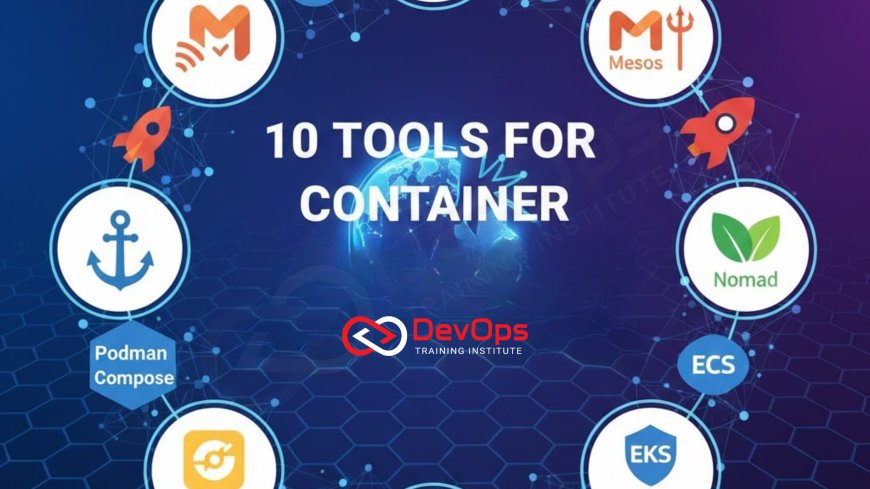
10 Tools for Container Orchestration Beyond Kubernetes
Explore 10 powerful container orchestration tools and platforms that provide viable alternatives to Kubernetes, catering to diverse organizational needs, complexity requirements, and cloud strategies. This detailed guide analyzes lightweight, Docker-native solutions like Docker Swarm, general-purpose schedulers like HashiCorp Nomad, and highly integrated cloud-native services such as AWS ECS, Fargate, and Google Cloud Run. We delve into why organizations choose alternatives—often seeking reduced operational complexity, serverless container execution, or better support for mixed workload environments including legacy systems and virtual machines. Understanding these options, including enterprise distributions like OpenShift and powerful management layers like Rancher, is crucial for designing a resilient, scalable, and cost-effective container strategy that aligns perfectly with specific development workflows. Learn how these tools handle everything from simple basic commands for deployment to complex file system management for persistent storage, offering unique trade-offs in features, ecosystem integration, and operational overhead compared to the Kubernetes standard.
Introduction: Why Look Beyond the Kubernetes Standard?
Kubernetes (K8s) has firmly established itself as the industry standard for container orchestration, offering unparalleled flexibility, a massive community, and a vast ecosystem. However, its immense power comes with corresponding complexity, a steep learning curve, and significant operational overhead, particularly when managing the control plane and configuring its myriad components. For many organizations—especially those with smaller teams, simpler deployment requirements, or strict vendor commitments—Kubernetes can be overkill. Looking beyond K8s allows teams to optimize for factors such as operational simplicity, faster time-to-market, tighter integration with specific cloud services, or the ability to schedule mixed workloads that include both containers and legacy applications. The tools presented here represent crucial alternatives, ranging from lightweight Docker-native options designed for speed to full-fledged enterprise platforms that wrap Kubernetes in a more manageable, feature-rich layer. Choosing the right orchestrator is one of the most consequential architectural decisions, directly impacting team efficiency, infrastructure cost, and overall system resilience, making the landscape of non-K8s tools essential knowledge for modern DevOps practitioners navigating the complexity of cloud-native development.
1. Docker Swarm: The Lightweight, Docker-Native Solution
Docker Swarm is the native clustering and orchestration solution built directly into the Docker Engine, making it perhaps the easiest and fastest orchestrator to adopt, especially for teams already deeply familiar with the Docker workflow. Unlike the intricate setup of a Kubernetes cluster, Docker Swarm can be initialized with a single `docker swarm init` command, instantly creating a manager node ready to schedule services. Its primary appeal lies in its operational simplicity; the entire cluster is managed using the same familiar `docker` command-line interface (CLI) used to manage single containers, significantly reducing the learning curve and time spent on cluster maintenance. This simplicity is achieved by focusing on core orchestration functionalities: automatic load balancing, declarative service definitions (Docker Compose), rolling updates, and scaling. While Swarm doesn't offer the granular control or vast networking options of K8s, its inherent ease of use makes it a perfect fit for smaller deployments, simple microservice architectures, or CI/CD testing environments where quick setup and minimal maintenance are prioritized over advanced scheduling features. Furthermore, because it's built into the Docker Engine, it requires virtually no separate installation or complex configuration, allowing engineers to focus on application deployment rather than infrastructure management. Teams can quickly master the use of basic commands for deploying and managing services, reinforcing the DevOps principle of operational simplicity.
Swarm architecture is straightforward, consisting of manager nodes (which maintain the cluster state and handle scheduling) and worker nodes (which execute the containers). This decentralized design ensures high availability, as multiple manager nodes can tolerate failures without downtime. For security, Swarm utilizes TLS mutual authentication and encryption to secure communications between all nodes by default, providing a strong security baseline right out of the box. Deployment is handled via Stack files, which are extended Docker Compose files that declaratively define the entire multi-service application stack, including networks and volumes, which are then deployed across the Swarm cluster using the `docker stack deploy` command. This methodology maintains the declarative infrastructure as code (IaC) principles common across the cloud-native landscape while remaining accessible. It's an excellent choice for organizations needing a resilient, clustered environment without the computational overhead or administrative complexity required to maintain the Kubernetes control plane. It's a pragmatic choice that delivers essential orchestration capabilities with minimal cognitive load for the engineering team, enabling rapid scaling of existing Dockerized applications.
However, the trade-off for Swarm's simplicity is its smaller feature set and community compared to Kubernetes. Swarm does not natively support advanced scheduling needs like custom schedulers or complex workload isolation policies as K8s does. Its networking model is simpler and primarily focused on internal service discovery and load balancing within the cluster boundary. Despite these limitations, Swarm remains a powerful, fully production-ready orchestrator. It serves as a vital reminder that for a large class of applications—especially stateless web services or simple REST APIs—the complexity of Kubernetes may be an unnecessary burden. It empowers developers and smaller operations teams to fully automate their deployments, managing rolling updates and failover across multiple nodes seamlessly, fulfilling the core promise of container orchestration without requiring specialized K8s expertise. Its minimal resource consumption also makes it highly efficient for constrained environments or edge computing use cases where Kubernetes might be too heavy.
2. HashiCorp Nomad: The Lightweight, General-Purpose Scheduler
HashiCorp Nomad stands out as a unique and powerful alternative, offering a flexible and lightweight scheduler that manages not only containers but also a wide range of other workloads. It champions simplicity and operational ease, running as a single, low-resource binary.
- Workload Agnostic Design: Nomad's core strength is its ability to schedule diverse workload types through different "drivers," including Docker containers, standard operating system processes (binaries), Java virtual machine (JVM) applications, and even virtual machines (QEMU). This makes it highly versatile for hybrid environments containing legacy applications that are difficult to containerize alongside modern microservices, all managed through a single API.
- Simplicity and Footprint: Unlike Kubernetes, which requires multiple components for the control plane (etcd, API server, controller manager, scheduler), Nomad runs with a straightforward client-server architecture. This architectural simplicity translates into a much smaller memory footprint, faster deployment times, and easier troubleshooting, significantly lowering the barrier to entry for orchestration.
- Seamless HashiCorp Ecosystem Integration: Nomad is designed to work natively with other HashiCorp tools: Consul provides service mesh and service discovery capabilities, while Vault handles secure credential management. This ecosystem synergy reduces the need for integrating disparate third-party tools, creating a cohesive, end-to-end platform for infrastructure and application deployment.
- Multi-Region and Multi-Cloud Federation: Nomad offers built-in federation capabilities, allowing a single cluster to span multiple datacenters and geographic regions efficiently. This feature is crucial for achieving true disaster recovery and geographically load-balanced applications, without requiring complex, external tools often necessary to manage multi-cluster K8s deployments.
- Advanced Scheduling Features: Despite its simplicity, Nomad supports advanced scheduling features, including resource-constrained scheduling (ensuring jobs run only where required CPU, memory, or specific hardware resources are available) and bin packing (optimizing resource utilization across the cluster to save on cloud compute costs).
- Declarative Job Specification: Workloads are defined using HashiCorp Configuration Language (HCL) or JSON Job Specifications. These files are clean, human-readable, and allow teams to declare the desired number of instances, resource requirements, update strategies, and networking rules, embracing the IaC paradigm thoroughly.
- Focus on Operational Resilience: Nomad's core focus on simplicity ensures that engineers spend less time managing the orchestrator itself and more time building and deploying applications. Its lightweight nature also aids in faster failover and recovery times compared to heftier alternatives.
3. Amazon Elastic Container Service (ECS): Deep AWS Cloud Native Integration
Amazon ECS is a proprietary, fully managed container orchestration service offered by AWS, representing an extremely compelling alternative for any organization deeply committed to the Amazon Web Services ecosystem. Unlike Kubernetes, which often requires careful setup and management of the underlying cluster components, ECS abstracts much of that complexity. It is designed from the ground up to integrate seamlessly with critical AWS services like IAM (for highly granular authentication and authorization), VPC (for networking), CloudWatch (for monitoring and logging), and Elastic Load Balancing (ELB). This deep native integration significantly simplifies the creation of secure, high-performance container environments. ECS uses a concept called Task Definitions to declare the container image, CPU/memory requirements, networking settings, and IAM roles for the application, making the entire deployment process declarative and easily manageable via the AWS console or CLI. The primary benefit here is the removal of the operational burden associated with managing the orchestration control plane itself; AWS handles the patching, scaling, and maintenance of the scheduler.
ECS offers two primary compute options: ECS on EC2 and ECS on Fargate. When using ECS on EC2, users maintain control over the underlying EC2 instances, allowing for custom configurations, cost optimizations through Reserved Instances, and highly specific requirements regarding the host operating system. This model gives administrators the familiarity of managing VMs while benefiting from the ECS control plane's orchestration capabilities. Conversely, the Fargate launch type (which we cover next) removes the need for any EC2 instance management, providing a true serverless container experience. This choice allows organizations to fine-tune their operational model based on their need for control versus their desire for minimal maintenance. The simplicity of integrating ECS with AWS security policies means that securing applications, granting the correct access rights, and configuring network isolation are straightforward tasks that leverage existing AWS knowledge and tooling, bypassing the complex setup often needed to secure Kubernetes access on a cloud environment.
ECS excels in its performance and speed. Since it is native to AWS, task scheduling and resource allocation are highly optimized for the AWS infrastructure, resulting in fast startup times and highly efficient scaling compared to running third-party orchestrators on EC2 instances. Furthermore, the robust support for features like Service Discovery via AWS Cloud Map and its integration with load management tools means that ECS deployments are ready for production traffic with minimal custom configuration. Teams can focus their efforts on application code and deployment logic without getting bogged down in the intricacies of cluster bootstrapping or component management. For organizations that have already standardized their operational procedures around AWS, ECS offers a powerful, streamlined path to container adoption that provides robust orchestration capabilities without introducing the massive cognitive overhead that often accompanies a full Kubernetes adoption. It’s a compelling example of how cloud-native services simplify complex DevOps tasks while providing enterprise-grade reliability and scalability for critical services.
4. AWS Fargate: The Serverless Compute Engine for Containers
Fargate is not a full orchestrator like Kubernetes or ECS, but rather a serverless compute engine designed to eliminate infrastructure management when running containers. It abstracts the underlying virtual machines entirely.
When deploying an ECS (or EKS) task using Fargate, you define only the CPU and memory requirements, and AWS automatically provisions the necessary compute capacity. This removes the need for server patching, cluster scaling, or managing host post-installation checklist procedures.
Key Serverless Advantage
The major benefit is a drastic reduction in operational toil and cost optimization, as you only pay for the resources consumed by your containers during runtime. The focus shifts entirely to the application container definition itself.
This serverless model is perfect for stateless workloads, development environments, and batch processing jobs that benefit from instant, infinite scaling without incurring the idle costs of pre-provisioned EC2 instances.
Fargate vs. ECS on EC2
Fargate gives up control of the host OS and networking customizations, trading it for maximum simplicity and zero infrastructure maintenance. It's the highest level of abstraction in the container orchestration world.
ECS on EC2 offers more flexibility for cost management and complex host-level configurations, while Fargate is the choice for teams prioritizing speed, agility, and minimal operational effort above all else.
Use Case Simplification
Fargate simplifies the deployment lifecycle, allowing developers to focus solely on containerizing their application and setting the required resource limits. This accelerated development cycle is a huge win for rapid feature delivery.
The service is also inherently more secure, as AWS manages the underlying host patching and applies isolation layers automatically, reducing the attack surface traditionally associated with user-managed infrastructure.
5. Azure Container Instances (ACI): Azure's On-Demand Container Engine
Azure Container Instances (ACI) is Microsoft Azure's offering for running containers in the public cloud without requiring any orchestration framework or virtual machine management, positioning it as a powerful serverless alternative.
- Instant Container Execution: ACI allows containers to be launched in Azure within seconds, providing the fastest way to get containerized workloads running in the Azure cloud. This speed makes it ideal for rapid testing, immediate deployment needs, and simple, transient tasks.
- Simple API: Unlike the multi-layered manifests of Kubernetes, ACI uses a simple API or YAML template to define the container properties, making it highly accessible for developers who need to quickly deploy a background job or a microservice without learning a complex orchestration tool.
- Serverless and Pay-per-Second: ACI is purely serverless; you pay only for the exact duration (per second) that the container is running and the resources (CPU/memory) consumed. This highly granular pricing model makes it exceptionally cost-effective for short-lived, burstable, or intermittent workloads.
- Azure Integration: ACI integrates natively with Azure services, including Azure Virtual Networks (VNet) for secure network isolation, Azure Monitor for centralized metrics and diagnostics, and Azure Key Vault for secure credential management within the Azure ecosystem.
- Simple Scaling: While ACI doesn't handle complex, multi-container scheduling like Kubernetes, it is excellent for horizontal scaling of single, independent container groups (e.g., thousands of workers for parallel processing). Scaling is managed via simple API calls to deploy more instances.
- Security Focus: ACI provides robust container isolation, utilizing hypervisor-level security isolation to ensure each container group runs in its own secure environment, protecting tenant workloads from each other, which is essential in a multi-tenant cloud platform.
- Use in Hybrid Workflows: ACI is often used as a compute component in larger, managed Azure workflows orchestrated by Azure Functions or Azure Logic Apps, providing the ability to execute container logic as a step within a serverless event chain, leveraging its fast start times.
6. Google Cloud Run: Request-Driven Serverless Containers
Google Cloud Run is Google Cloud's fully managed compute platform that allows developers to run stateless containers directly on Google’s infrastructure. Based on Knative, an open-source Kubernetes-based platform, Cloud Run abstracts away all infrastructure management while offering the capability to run virtually any containerized application. Its defining feature is its request-driven scaling model; containers scale instantly up based on incoming HTTP requests or events (such as messages from Pub/Sub) and, crucially, can scale completely down to zero when idle. This auto-scaling-to-zero capability makes Cloud Run incredibly cost-efficient for web services, APIs, and background tasks that experience intermittent traffic, as users only pay for the compute resources consumed while processing requests, avoiding the idle costs associated with pre-provisioned VMs or clusters. Developers define their application as a standard container image, push it to the Google Container Registry (GCR), and then deploy it via a simple Cloud Run command, eliminating the need to write complex Kubernetes YAML files or manage underlying node pools.
Cloud Run provides deep integration with the rest of the Google Cloud ecosystem, offering security via IAM, networking via VPC access connectors, and observability through Cloud Monitoring and Logging. It enforces the constraint that containers must be stateless, simplifying the application deployment model and promoting best practices for microservice architecture, relying on external services like Cloud SQL or Memorystore for persistent state. It maintains a powerful, rapid deployment velocity, allowing developers to continuously update their services without worrying about disruption, as new revisions are automatically deployed alongside the old ones until traffic is fully shifted. This platform represents one of the most streamlined solutions for deploying containers where the primary trigger is a network request or an event, delivering the power of containerization with the economic and operational advantages of a true serverless environment. This combination of flexibility, cost-effectiveness, and operational simplicity makes it an excellent choice for modernizing applications, building APIs, and implementing event-driven architectures without the steep administrative learning curve of a full-fledged orchestration tool.
For managing application persistence, Cloud Run encourages the use of external managed services, though it offers a simple mechanism for temporary local storage. However, complex persistence requirements often involve orchestrating advanced storage options. It is important to contrast this approach with on-premises solutions where robust file system management is often necessary directly on the host machine. By focusing on stateless containers, Cloud Run shifts the responsibility of data persistence to specialized, highly available cloud services, reinforcing the modern cloud-native paradigm. The platform also offers the flexibility to run containers either in a fully managed environment (where Google handles all infrastructure) or on GKE (Google Kubernetes Engine) clusters via Cloud Run for Anthos, providing a consistent serverless development experience across both managed and self-managed Kubernetes environments, effectively bridging the gap between simplicity and the raw power of K8s where needed. This dual deployment model ensures organizations can start simple and seamlessly scale complexity without rewriting their application logic or deployment methods.
7. Red Hat OpenShift: The Enterprise Kubernetes Distribution
While OpenShift is built on Kubernetes, it is a highly opinionated, full-stack platform that adds essential enterprise features, tools, and security layers, making it a distinct alternative to managing vanilla Kubernetes directly.
- Integrated Developer Experience: OpenShift provides an extensive suite of developer-centric tools, including built-in CI/CD pipelines (via Tekton), source-to-image (S2I) capabilities for automating container image creation, and powerful web consoles for managing applications and infrastructure.
- Enhanced Security Model: OpenShift enforces a stricter security posture than standard K8s, including mandatory user management through built-in authentication layers and requiring containers to run as non-root users by default, significantly reducing the attack surface and simplifying compliance.
- Certified and Managed Ecosystem: As a Red Hat product, OpenShift offers a fully tested, commercially supported distribution of K8s. This provides stability, reliability, and guaranteed compatibility across different cloud and on-premises environments.
- Operational Abstraction: OpenShift simplifies complex K8s operations by providing automated cluster installation, patching, and lifecycle management through the OpenShift Cluster Manager and Operators, reducing the day-to-day administrative burden that plagues many raw K8s deployments.
- Simplified Networking: OpenShift includes its own network component, OpenShift SDN, which provides routing and policy enforcement that is seamlessly integrated with the platform's security and authentication models. This offers an immediate, usable networking solution without complex CNI configurations.
- Hybrid and Multi-Cloud Support: OpenShift is explicitly designed for hybrid environments, allowing a consistent operational model across bare metal, virtualization platforms (like VMware), and all major public clouds, facilitating workload portability and mitigating vendor lock-in risks.
- Operator Framework: OpenShift heavily utilizes the Operator pattern—software that packages, deploys, and manages Kubernetes applications—to automate complex tasks like database scaling, application updates, and dependency management.
8. Rancher: Centralized Management for Diverse Kubernetes Clusters
Rancher is an open-source management platform that doesn't replace Kubernetes but provides a critical abstraction layer to unify the management of multiple Kubernetes clusters, regardless of where they are running.
It solves the major operational challenge of managing fleet diversity, offering a single, centralized dashboard to deploy, secure, and monitor clusters across AWS EKS, Azure AKS, Google GKE, and on-premises data centers.
Unified Cluster Provisioning
Rancher simplifies the often-complex process of provisioning a new cluster, providing tools like RKE (Rancher Kubernetes Engine) and connectors for cloud services to deploy certified K8s distributions quickly and consistently across environments.
This ensures that security policies, monitoring configurations, and access controls are applied uniformly across the entire fleet, greatly simplifying governance and compliance reporting across hybrid deployments.
Application and Security Management
Rancher includes built-in application catalog management and provides integrated tools for managing crucial security components like network policies and role-based access control (RBAC) across different clusters.
The platform is particularly valuable for large organizations running different versions of K8s in various public clouds, where centralized visibility and management of SSH keys and access endpoints become critical operational requirements.
Operational Simplicity
By consolidating management, Rancher significantly reduces the cognitive load on operations teams, allowing them to perform common maintenance tasks like upgrades, backups, and monitoring checks from a single pane of glass.
This focus on operational consistency helps teams avoid the fragmentation and sprawl that can occur when K8s adoption grows organically across multiple environments and development teams.
9. Apache Mesos: The Distributed Systems Kernel
Apache Mesos is a powerful, open-source project designed as a distributed systems kernel that provides efficient resource isolation and sharing across distributed applications. While its adoption for containers has largely shifted to Kubernetes, its foundational design remains unique and relevant for specific large-scale use cases.
- Two-Level Scheduling Model: Mesos employs a unique two-level scheduling model. Mesos itself manages the available resources (CPU, memory, disk) and offers them to registered Frameworks (like Marathon for containers, or frameworks for Hadoop/Spark). The Frameworks then decide how to accept and utilize those resources.
- Massive Scale and Resource Isolation: Mesos was built to handle clusters of tens of thousands of nodes and allocate resources efficiently across highly diverse application types. Its core strength lies in robust resource isolation through containerization technologies (like Linux containers), ensuring fair sharing.
- Mixed Workload Environments: Mesos is uniquely well-suited for environments where organizations run massive Big Data processing jobs (Spark, Hadoop) on the same cluster infrastructure as their containerized microservices. It seamlessly manages resource contention between these fundamentally different workloads.
- Legacy Integration: Because Mesos is platform-agnostic, it can efficiently schedule legacy applications (long-running processes) alongside modern Docker containers, offering a powerful consolidation strategy for large, complex enterprises that cannot immediately transition everything to a pure K8s environment.
- Framework Dependency: To run containers on Mesos, you need a dedicated container orchestration framework, historically Marathon or Aurora. This adds a layer of operational complexity compared to an integrated scheduler like Swarm or Nomad, requiring the management of both the Mesos layer and the scheduling framework.
- High Availability: Mesos relies on ZooKeeper for leader election and state management, providing a highly available architecture that can withstand node failures and maintain consistent scheduling decisions across the cluster.
- Enterprise History: Mesos and its derivative, DCOS (Datacenter Operating System), were foundational for many large-scale tech companies (Twitter, Apple) before K8s matured, demonstrating its capability for handling extreme scale and complexity in production environments.
10. VMware Tanzu: Enterprise Application Platform for vSphere Environments
VMware Tanzu is a comprehensive portfolio of products designed to help large enterprises build, run, and manage Kubernetes-based applications, often leveraging their existing investment in VMware vSphere virtualization infrastructure.
- vSphere Integration: Tanzu's primary value proposition is its deep integration with vSphere, allowing IT teams to manage Kubernetes clusters directly from the vSphere management interface. This streamlines resource allocation and infrastructure operations for organizations relying heavily on VMware infrastructure.
- Enterprise Governance and Security: Tanzu provides tools for centralizing governance, security, and user management across multiple clusters. It enforces corporate policies and streamlines compliance by leveraging familiar enterprise security controls.
- Multi-Cloud Operations: The Tanzu portfolio includes tools for consistent operations across any cloud, from vSphere-based private clouds to major public clouds (AWS, Azure, GCP). This ensures uniformity in deployment and management practices regardless of the underlying cloud provider.
- Application Acceleration: Tanzu includes application development components (like Tanzu Application Service, a managed Cloud Foundry distribution) and service mesh capabilities (via Tanzu Service Mesh), accelerating the developer experience for building and deploying microservices.
- Automation of Cluster Lifecycle: Tanzu provides automation for the provisioning, scaling, and upgrading of Kubernetes clusters, significantly reducing the manual effort required to keep clusters healthy and up-to-date, addressing a major operational challenge of raw K8s.
- Operational Consistency with Existing IT: By extending virtualization management to Kubernetes, Tanzu enables traditional IT operations teams to adopt cloud-native technologies without discarding their existing operational knowledge base or management tools.
- Focus on the Full Stack: Tanzu goes beyond simple orchestration, offering solutions for application observability, CI/CD pipeline integration, and security scanning, positioning itself as a complete enterprise platform rather than just an orchestrator.
Orchestrator Comparison: Focus, Complexity, and Deployment Model
| Tool | Primary Focus | Complexity Level (Relative to K8s) | Deployment Model |
|---|---|---|---|
| Docker Swarm | Lightweight, Docker-Native | Lowest | Self-Managed (Integrated) |
| HashiCorp Nomad | Mixed Workload Scheduling | Low | Self-Managed (Simple Binary) |
| Amazon ECS | AWS Ecosystem Integration | Low-Medium | Managed Service (Control Plane Managed) |
| AWS Fargate | Serverless Container Compute | Lowest (Zero Host Management) | Serverless (Compute Engine) |
| Google Cloud Run | Request-Driven Scaling to Zero | Lowest | Serverless (Platform as a Service) |
| Red Hat OpenShift | Enterprise-Grade K8s Platform | Medium-High (Higher Feature Set) | Managed/Self-Managed (Distribution) |
| Apache Mesos | Massive Scale, Resource Isolation | High (Framework Dependency) | Self-Managed (Kernel) |
Conclusion
The container orchestration landscape is rich and diverse, proving that Kubernetes, while dominant, is not a one-size-fits-all solution. The best tool is always the one that most closely aligns with your team's expertise, operational goals, and underlying infrastructure constraints. For teams seeking maximal operational simplicity and minimal learning curves, Docker Swarm or serverless options like AWS Fargate and Google Cloud Run provide rapid deployment velocity without the Kubernetes control plane headache. Organizations deeply vested in a single cloud ecosystem will find proprietary solutions like Amazon ECS offer a superior integration experience and reduced administrative overhead. Meanwhile, enterprises managing complex, heterogeneous environments might opt for the flexibility of HashiCorp Nomad to schedule mixed workloads or choose a robust distribution like Red Hat OpenShift to gain enterprise-grade security and developer tools layered on top of Kubernetes. The key takeaway for any DevOps professional is that the strategic decision lies in correctly assessing the trade-off between flexibility and complexity. By evaluating these 10 tools, you can move beyond a default Kubernetes choice and design an infrastructure that is truly efficient, reliable, and perfectly tailored to your organization's specific needs, whether that means managing massive scale with Mesos or achieving zero-touch infrastructure with Cloud Run.
Frequently Asked Questions
Why do companies choose Nomad over Kubernetes if both are orchestrators?
Companies often choose Nomad when they require simplicity and the ability to handle mixed workloads (containers, VMs, native binaries) from a single scheduler. Nomad has a much smaller operational footprint, runs as a single binary, and integrates seamlessly with other essential HashiCorp tools (Consul, Vault), making it ideal for teams prioritizing operational ease and a unified scheduler for their heterogeneous environments.
What is the main benefit of using a serverless container engine like AWS Fargate?
The main benefit of Fargate is the elimination of server management. Users do not provision, patch, or scale the underlying virtual machines. They simply define the resources (CPU, memory) needed by their container, dramatically reducing operational overhead (toil) and improving security by letting AWS manage the host operating system's compliance and maintenance.
How does Red Hat OpenShift differ from standard, open-source Kubernetes?
OpenShift is an enterprise distribution of Kubernetes that adds significant value layers. It includes integrated developer tools (CI/CD), enhanced security policies (running containers as non-root is enforced), automated operational management (via Operators), and commercial support, providing a complete, ready-to-use platform instead of just the orchestration engine.
Is Docker Swarm still a viable choice for production environments?
Yes, Docker Swarm is still viable for many production use cases, especially those that prioritize simplicity, speed, and existing Docker expertise. While it lacks the advanced features of Kubernetes, it offers reliable clustering, rolling updates, and self-healing for stateless microservices with minimal setup and maintenance burden.
Which of these tools is best for managing persistent data storage?
Tools like Nomad and OpenShift offer robust mechanisms for managing persistent storage (volumes) by integrating with external storage providers or provisioning local volumes. However, any robust orchestration environment requires careful file system management and volume provisioning outside of the orchestrator, often using cloud-native storage services or dedicated storage solutions.
What is the primary trade-off when using a cloud-native service like Amazon ECS?
The primary trade-off is vendor lock-in. While ECS offers superior integration and operational simplicity within AWS, migrating ECS Task Definitions to another cloud provider requires significant retooling, whereas a solution built on pure Kubernetes or Nomad is generally more portable across different cloud environments.
How do these orchestrators simplify network configuration?
Most orchestrators simplify networking by providing built-in service discovery, internal DNS, and software-defined networking (SDN). For example, Docker Swarm and ECS natively handle load balancing and internal traffic routing for services without requiring manual configuration of host rules or complex low-level network setups.
Can Azure Container Instances (ACI) run complex, long-running applications?
ACI is best suited for simple, transient tasks, batch jobs, and event-driven microservices. While it can run long-running applications, it lacks the advanced scheduling, resource management, and self-healing features needed for complex, stateful, or highly regulated applications that are better suited for Kubernetes or a managed ECS cluster.
How is the security of accessing nodes handled in self-managed orchestrators like Nomad or Mesos?
Access to the underlying nodes is typically managed by standard security tools, independent of the orchestrator itself. This often involves defining strict network access policies and using secure authentication mechanisms like centralized SSH keys for engineers, ensuring access is limited and auditable.
What role does Apache Mesos play in modern container strategies?
Mesos's role has diminished in favor of Kubernetes for container-only workloads. However, it remains a powerful solution for organizations that need a massive-scale, multi-framework approach, efficiently scheduling Big Data jobs (Hadoop/Spark) alongside containerized applications on the same physical infrastructure.
What are the implications of using VMware Tanzu if my infrastructure is already virtualized?
If your infrastructure runs on vSphere, Tanzu provides the critical benefit of operational consistency. It allows your IT teams to manage Kubernetes clusters and containers directly alongside your existing VMs, leveraging familiar management tools and streamlining infrastructure, making the transition to cloud-native much smoother.
Do serverless container platforms need specialized monitoring tools?
Yes, while the underlying infrastructure is managed, the containers still need application-level monitoring. Serverless platforms integrate natively with cloud-specific monitoring tools (e.g., CloudWatch for Fargate, Cloud Monitoring for Cloud Run) to provide log management and metrics collection, focusing on application health and performance rather than host-level CPU or memory metrics.
How does Rancher handle security and governance across multiple clouds?
Rancher acts as a single control plane to enforce centralized security policies, including Role-Based Access Control (RBAC) and network policies, consistently across all connected clusters (EKS, AKS, on-premises). This unified management greatly simplifies auditing and ensures organizational standards are met everywhere.
Why are the Firewalld commands less relevant in serverless orchestration models?
Host-level firewalls and their configuration via Firewalld commands are less relevant in serverless models (like Fargate, Cloud Run) because the cloud provider manages the underlying host OS and network isolation. Network security is defined using higher-level constructs like Security Groups or VPC firewall rules, abstracted away from the host OS itself.
Can HashiCorp Nomad effectively handle disaster recovery automation?
Yes, Nomad is highly effective for DR. Its architecture inherently supports multi-region and multi-datacenter federation, allowing workloads to be spread across geographic locations. Coupled with tools like Vault and Consul for state and service discovery, it enables robust, automated failover and recovery strategies using declarative job specifications.
What's Your Reaction?
 Like
0
Like
0
 Dislike
0
Dislike
0
 Love
0
Love
0
 Funny
0
Funny
0
 Angry
0
Angry
0
 Sad
0
Sad
0
 Wow
0
Wow
0

![100+ Azure DevOps Interview Questions and Answers [Updated 2025]](https://www.devopstraininginstitute.com/blog/uploads/images/202509/image_140x98_68c40aa9a3834.jpg)





![Future Scope of DevOps Careers in Pune [Updated 2025]](https://www.devopstraininginstitute.com/blog/uploads/images/202510/image_140x98_68e3a84652312.jpg)