








![Kong Interview Preparation Guide [2025]](https://www.devopstraininginstitute.com/blog/uploads/images/202509/image_430x256_68dbb95326997.jpg)







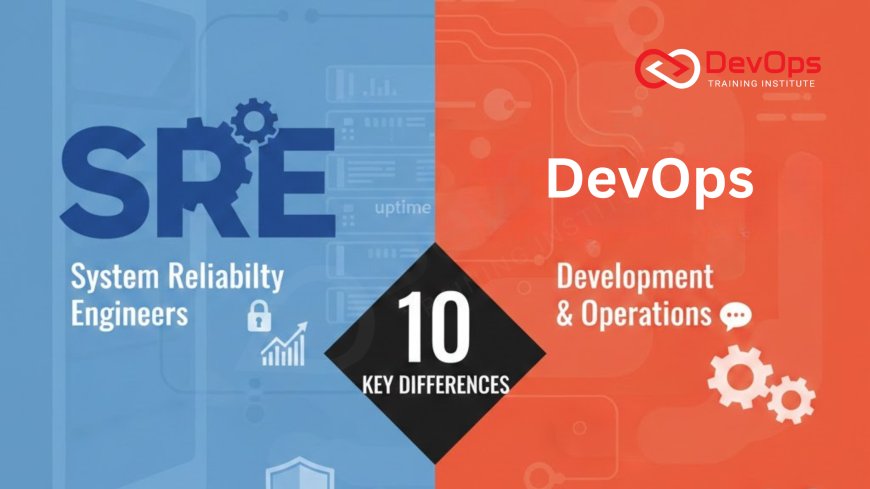
10 Key Differences Between SRE & DevOps
Dive deep into the fundamental differences that distinguish Site Reliability Engineering (SRE) from the DevOps philosophy. While both movements are intrinsically linked and share the ultimate goal of delivering reliable, high-quality software faster, their approaches, team structures, key metrics, and daily responsibilities diverge in crucial ways that are essential for any modern technology professional or organization to understand. This comprehensive guide breaks down the core tenets of each discipline, exploring how SRE often functions as Google's specific implementation of DevOps principles, particularly through its rigorous focus on Service Level Objectives (SLOs) and Error Budgets. We will analyze the cultural shifts, technical mandates, and organizational reporting structures that define SRE and contrast them with the broader, more flexible framework of DevOps. Understanding these distinctions is not merely an academic exercise; it is a critical step for businesses looking to adopt best practices, manage toil effectively, improve system reliability, and accelerate their development lifecycle without compromising the end-user experience. This detailed analysis, perfect for beginners and seasoned professionals alike, ensures clarity on how these two powerful concepts interact and where their primary battlegrounds for system health and operational efficiency lie.
1. Defining Their Core Focus and Primary Goals
The most fundamental difference between SRE and DevOps lies in their primary area of focus, which, while complementary, dictates their daily activities and ultimate goals within an organization. DevOps is best understood as a broad cultural and professional movement that emphasizes collaboration, communication, and the integration of software developers and IT operations professionals to automate the process of software delivery and infrastructure changes. Its main objective is to reduce the time it takes to get an idea from development into production, thereby increasing deployment frequency and decreasing the time to market. Conversely, Site Reliability Engineering (SRE) takes a much more specific, software engineering-centric approach to operations. SRE's central goal is the continuous pursuit of service reliability, often quantified by rigorous, data-driven metrics. An SRE team exists to ensure a service meets a specified level of uptime and performance, codified by Service Level Objectives (SLOs), using engineering practices to solve what were traditionally manual operations problems. Therefore, DevOps aims for speed and flow across the value chain, while SRE acts as a guardrail, ensuring that this acceleration does not compromise the stability and trustworthiness of the system from the end-user's perspective, representing a distinct prioritization within the larger goal of operational excellence.
DevOps emphasizes the breaking down of silos between traditionally separate departments, particularly Development and Operations, fostering an environment where shared responsibility for the entire software lifecycle is paramount. This cultural shift necessitates new processes and tools that facilitate continuous integration, continuous delivery, and comprehensive monitoring across the entire application stack. While automation is a core tenet, the philosophy itself is not prescriptive about how to achieve it; it simply demands that you do. The success of a DevOps initiative is often measured by the DORA metrics, such as deployment frequency, lead time for changes, mean time to recovery (MTTR), and change failure rate, all of which reflect the efficiency and stability of the deployment pipeline. This focus ensures that the entire organization is aligned on delivering value quickly and iteratively, making it a foundational concept that informs how teams collaborate and structure their work, moving away from the old, siloed ways of working.
SRE, on the other hand, is highly prescriptive and was formalized by Google as their unique methodology for managing large production systems at scale. The SRE team's mandate is to spend a significant portion of their time, ideally 50% or more, on engineering work, such as developing new automation, improving monitoring tools, or fixing fundamental reliability issues, rather than simply doing manual operational tasks. This engineering focus is the key differentiator. They are not just managing infrastructure; they are coding solutions to operational problems, thereby preventing future incidents and scaling the system more effectively. The bedrock of SRE is the Service Level Agreement (SLA), the Service Level Indicator (SLI), and the Service Level Objective (SLO), with the Error Budget acting as the crucial mechanism for balancing the need for reliability with the need for development speed. If the system is too unreliable (Error Budget is exhausted), feature development must halt until stability is restored, directly linking reliability to the pace of innovation and providing a non-negotiable metric for the entire organization to follow.
In essence, you can view SRE as a practical, highly engineered implementation of specific DevOps principles, particularly those related to automation, measurement, and the reduction of manual labor, which SRE formally calls 'toil.' While a team can practice DevOps without having a dedicated SRE function, it is increasingly difficult for an SRE team to operate effectively without embracing the core cultural and technical mandates of DevOps, especially collaboration and end-to-end ownership. The relationship is therefore hierarchical but mutually beneficial; DevOps sets the collaborative stage and cultural expectation for high-velocity software delivery, and SRE provides the rigorous, data-driven methodology and the engineering toolkit necessary to ensure that the increased velocity does not lead to catastrophic system failures or an unacceptable user experience. A mature organization often sees SRE as the team responsible for codifying the reliability part of the shared DevOps responsibility, leveraging their unique skillset to maintain operational integrity under constant change and growth.
2. Implementation Strategy: Cultural Shift vs. Engineering Discipline
The difference in implementation strategy highlights a key distinction: DevOps is about changing how people interact, whereas SRE is about changing how technical work is done, using software to solve operations problems.
- DevOps advocates for a top-down, organizational-wide cultural shift, emphasizing a shared mindset of collaboration, transparency, and rapid feedback loops between Development and Operations teams. This involves modifying team structures and incentivizing joint outcomes rather than individual departmental metrics. The implementation is less about specific tools and more about the guiding principles that govern the entire software lifecycle, affecting everything from planning to production monitoring and ensuring everyone feels ownership.
- SRE is implemented through the adoption of specific engineering practices, treating operations tasks as problems to be solved with code, meaning SRE teams must have strong programming skills. The implementation begins with concrete actions like defining SLOs, establishing Error Budgets, and creating tools to automate manual tasks (toil). It is a highly measurable and quantifiable approach to operational sustainability that demands a technical transformation rather than just a cultural one.
- DevOps primarily promotes the use of CI/CD pipelines as the backbone of its implementation, ensuring that code changes are built, tested, and deployed frequently and reliably. The focus here is on the flow of work, making the delivery process predictable and repeatable for all teams involved. It is the mechanism through which the collaborative culture is put into practice, enabling rapid iteration and feedback.
- SRE implements change by enforcing an "Error Budget" that acts as the throttle for feature velocity. If the system exceeds the defined tolerance for failure, the SRE team has the authority to mandate a pause on new deployments, forcing attention back onto stability and reliability work. This mechanism provides a concrete, data-driven way to enforce the balance between change and stability.
- In a DevOps model, automation is strongly encouraged, but the degree and specific approach are flexible, often left up to individual teams. Teams may start with basic scripting and gradually evolve their infrastructure as code practices over time as they mature, recognizing that continuous improvement is an inherent part of the philosophy.
- For SRE, automation is a strict, non-negotiable mandate; SRE teams are typically forbidden from managing systems manually for routine tasks once they reach a certain level of frequency or complexity. This hard requirement is what drives the SRE team to dedicate half their time to engineering, ensuring that systems are scalable and that the team is not constantly burnt out by repetitive manual work, maintaining the commitment to efficiency.
- DevOps relies heavily on shared metrics like Mean Time To Recovery (MTTR) and Lead Time for Changes to track process efficiency across the entire value stream. These metrics measure the health of the process of delivery.
- SRE relies almost exclusively on technical metrics like Service Level Indicators (SLIs) and Service Level Objectives (SLOs), which directly measure the health and user-facing performance of the live system. This focus ensures that all operational activities are directly tied to the end-user experience, providing an unambiguous measure of operational success.
3. The Ideal Talent Profile and Skillset Requirements
The types of engineers best suited for these roles reflect the distinct philosophies of each practice, emphasizing either broad operational knowledge or deep coding expertise.
DevOps Engineer Skillset
The ideal DevOps engineer is often a generalist with a hybrid background, possessing strong scripting and automation skills alongside robust knowledge of infrastructure and application lifecycle management. They bridge the gap between development and operations.
They are characterized by their deep knowledge of the entire toolchain, including CI/CD platforms, configuration management systems, and a cultural affinity for collaboration and process improvement across diverse teams.
SRE Engineer Skillset
The SRE engineer is fundamentally a software engineer who specializes in operational reliability and system scaling, prioritizing coding skills and algorithmic thinking to solve infrastructure problems. They must be experts in distributed systems.
Their skillset requires proficiency in one or more high-level programming languages, deep systems debugging expertise, and a rigorous, quantitative mindset focused on measuring and improving system performance.
Focus on Automation
A DevOps engineer’s automation focus tends to be on the delivery pipeline itself, such as setting up Jenkins or GitLab runners and writing infrastructure as code using tools like Terraform or Ansible. Their goal is efficient deployment.
An SRE’s automation focus is on operational toil, meaning they write custom software to automate away manual tasks like managing system configuration, capacity planning, and complex scaling events to reduce human intervention significantly.
Systems Knowledge Depth
DevOps engineers require broad systems knowledge to integrate and manage various components, from application code to networking configuration, ensuring smooth flow across the environment. They need to understand the big picture.
SREs require deep, granular knowledge of core operating system internals, latency distribution, monitoring systems, and advanced debugging techniques to troubleshoot and fix highly complex, intermittent production issues, often touching low-level components like the file system management layer.
Incident Response Role
In a DevOps model, incident response is a shared responsibility, with developers often participating in on-call rotations alongside operations to fix issues with their own code. This practice reinforces the shared ownership culture.
In an SRE model, the SRE team frequently owns the primary incident response, leveraging their expertise to quickly restore service stability and then meticulously conducting blameless post-mortems to ensure root causes are identified and engineered out of existence.
4. The Role of the Error Budget as a Decision-Making Tool
The concept of an Error Budget is perhaps the most concrete and defining feature that separates SRE from standard DevOps practices, serving as a powerful, non-negotiable mechanism for managing the inherent tension between development speed and system stability. An Error Budget is simply the maximum amount of time a service is allowed to be down or perform poorly within a specific period, derived directly from the SLO. For example, if the SLO for a service is 99.9% availability, the remaining 0.1% of the time is the Error Budget. SRE teams use this budget as a governance tool; if the budget is being rapidly consumed by incidents or poor deployments, it is a clear signal that the system is not reliable enough, and all feature development is automatically halted. This mechanism forces the development team to pivot their focus back to reliability work, debugging issues, and paying down technical debt until the budget is replenished, ensuring that reliability remains a top priority, measured by objective data rather than subjective judgment, providing a strong incentive for stability.
While DevOps certainly values stability and provides metrics like the Change Failure Rate to track the impact of deployments, it does not typically enforce a hard, quantitative stop-work condition like the Error Budget. In a pure DevOps environment, the decision to slow down for stability is often a human judgment call, based on team consensus, escalating incident counts, or management intervention, lacking the automatic, data-driven trigger that SRE provides. The emphasis in DevOps is on ensuring that the pipeline is fast and reliable enough to deploy changes safely and frequently, making it a process-oriented goal. The DevOps perspective is that if deployment frequency and MTTR are improving, the organization is succeeding, but this doesn't explicitly tie feature development directly to production reliability in the same immediate and compelling way that the SRE Error Budget does, highlighting the cultural difference in how risk and stability are managed.
The SRE Error Budget is more than just a metric; it is a contract between the SRE team and the Product/Development team, formalizing the acceptable level of risk. This clear line in the sand removes the emotional or political debate often surrounding stability versus features. By quantifying acceptable failure, SRE allows for a controlled amount of risk-taking, recognizing that achieving 100% uptime is mathematically impossible and prohibitively expensive. The budget ensures that teams are not aiming for perfection (which slows them down) but for a strategically defined, user-centric level of quality that balances innovation with user trust. Furthermore, the Error Budget incentivizes developers to collaborate with SREs to build better instrumentation and more resilient code because consuming the budget directly impedes their primary goal of shipping new features, turning reliability into a shared, critical path dependency. This system creates a healthy tension that benefits the entire organization, leading to more resilient services in the long run.
The lack of a formal, codified Error Budget in many DevOps implementations means that while teams aim for high availability, the push for new features can often dominate the conversation, especially under intense business pressure. DevOps teams might track service uptime, but the absence of a strict budgetary constraint can lead to 'death by a thousand cuts,' where small, non-critical failures accumulate, gradually eroding user trust and system stability until a major incident forces an emergency intervention. The SRE model's proactive, mathematical approach ensures that this gradual decay is monitored and addressed before it becomes catastrophic. Therefore, integrating the Error Budget concept into a DevOps practice is often seen as a sign of maturity, representing one of the most valuable practices adopted directly from the SRE discipline to provide a robust, data-driven governance model for managing the ever-present trade-off between velocity and stability in modern software delivery environments.
5. Distinction in Tooling Focus and Automation Mandates
Both SRE and DevOps heavily rely on automation, but their preferred tools and the philosophical mandate driving their use show significant variation.
- DevOps primarily focuses on tools that facilitate the Continuous Integration/Continuous Delivery (CI/CD) pipeline, such as Jenkins, GitLab CI, or GitHub Actions. These tools automate the build, test, and deployment process, streamlining the path from commit to production.
- SRE teams often focus on building and maintaining custom tooling for operations, including automation for complex tasks like failovers, capacity planning, and advanced incident remediation. They use programming languages (like Python or Go) to write software that acts as an operating system for the infrastructure itself.
- DevOps uses Infrastructure as Code (IaC) tools like Terraform and Ansible to define and manage infrastructure declaratively. The goal is to make infrastructure provisioning repeatable and version-controlled, enabling rapid, consistent deployments across environments.
- SRE mandates not just IaC, but also the automation of responses to system events. This means writing code that can automatically scale a service, throttle traffic during an outage, or trigger self-healing mechanisms without human intervention, ensuring the system can maintain its own SLOs.
- Monitoring in a DevOps context typically involves application performance monitoring (APM) tools (like Dynatrace or New Relic) to track application health and business-level metrics, which is crucial for full-cycle ownership.
- SRE monitoring is much more focused on defining and tracking specific SLIs (e.g., latency, throughput, error rate) that are direct proxies for user happiness, often utilizing highly scalable, time-series databases and custom alerting systems that use sophisticated statistical methods to detect anomalies and trigger immediate action.
- The adoption of new technologies and configuration standards, like configuring secure SSH keys for server access, tends to be shared in a DevOps environment, with Dev and Ops collaborating on security and compliance standards.
- SRE often owns the authoritative source of truth for production configuration and is responsible for ensuring that all services adhere to strict security and reliability standards, often by building compliance and configuration validation directly into the deployment pipeline through code.
- DevOps encourages a broad set of tools that support collaboration, like Slack, Jira, and shared documentation platforms, to facilitate communication and transparency across the delivery lifecycle.
- SRE specifically leverages tools that help manage and reduce cognitive load during incidents, such as automated runbooks, detailed dashboards showing SLIs, and robust post-mortem platforms designed to enforce a blameless culture and track long-term fixes rigorously.
6. Difference in Organizational Reporting and Structure
The placement of these functions within the corporate structure reflects the nature of their mission, showing whether they are a shared function or a dedicated specialty.
DevOps Structural Integration
DevOps is not a team or a title in its purest form, but a set of practices woven into the fabric of existing Development and Operations teams. It is a philosophy that should permeate every team, focusing on cultural alignment.
When a 'DevOps team' does exist, it often acts as a tooling and enablement group, building and maintaining the CI/CD platform and providing consultative support to streamline the workflow for feature teams.
SRE as a Dedicated Team
SRE is explicitly a dedicated engineering team, often reporting up through an executive structure focused on technology or engineering, separate from traditional infrastructure teams. This independence helps ensure their focus remains on reliability.
The SRE team functions as a dedicated guardrail, capable of saying 'no' to deployments if the Error Budget is exceeded, which requires a specific, mandated level of organizational authority and clear reporting lines to be effective.
Shared Responsibility Model
In a mature DevOps organization, the responsibility for maintaining the service in production is shared across all teams, meaning the developer who wrote the code is also on call for it, which strongly reinforces the principle of full-cycle ownership.
In an SRE model, while all teams share responsibility for reliability, the SRE team acts as the owner of the service's SLO and the enforcer of the Error Budget, bearing the primary burden of operational triage, especially for critical, shared infrastructure components like core networking services.
Team Size and Scope
DevOps culture is designed to scale horizontally across the entire technology organization, impacting the practices of every development, quality assurance, and IT team, providing a wide-reaching cultural impact.
SRE teams are often strategically placed to cover the most critical services, such as customer-facing APIs or core databases, usually adhering to a strict limit on the operational work they accept (often a 1:10 ratio of SREs to developers).
Transition and Handoff
DevOps seeks to eliminate the concept of a 'handoff' entirely, ensuring a continuous flow of ownership from idea inception to end-of-life maintenance, advocating for the same team to manage the entire lifecycle.
SRE often defines a formal process for a service to "graduate" from the development team to the SRE team only once it meets a specific set of reliability and operational readiness criteria, often called a "production readiness review," formalizing the transition of operational responsibility.
7. The Absolute Primacy of Service Level Objectives (SLOs)
Service Level Objectives (SLOs) are foundational to SRE, acting as the primary driver for all engineering and operational decisions. Their role in DevOps is more advisory or supplementary.
- For SRE, the SLO is the single most important metric, defining the boundary between acceptable and unacceptable system performance from the perspective of the end-user. Every monitoring alert, automation project, and incident response plan is directly derived from and measured against the SLO.
- In a DevOps context, SLOs are certainly used as key performance indicators (KPIs) to measure service health, but they compete for priority with other metrics like deployment frequency or feature throughput. They are important, but not necessarily the single driving force for every organizational decision.
- SRE teams are directly empowered to enforce SLOs through the Error Budget mechanism. If the SLO is in jeopardy, the SRE team can halt development, providing them with necessary organizational leverage to prioritize stability over features when performance demands it.
- DevOps teams, while striving for high SLOs, rely more on cultural alignment and shared agreement to prioritize reliability work. If the team is falling behind on their SLO, it’s a trigger for a discussion, whereas in SRE, it’s a trigger for an automatic policy enforcement.
- SRE involves rigorous, upfront work to define the Service Level Indicators (SLIs) that will accurately measure the SLO. This includes deeply analyzing what truly affects user experience—e.g., distinguishing between 95th percentile and 99th percentile latency targets to find the right balance.
- DevOps teams may sometimes rely on more generic or out-of-the-box system metrics like CPU utilization or memory usage, which are easier to implement but less direct proxies for the actual customer experience than SRE’s user-centric SLIs.
- The entire SRE planning cycle, including capacity planning and setting performance goals, revolves around anticipating the needs to maintain the SLO, ensuring that the service can reliably handle expected and unexpected load increases while keeping response times within acceptable limits.
- For DevOps, capacity planning is typically one of several infrastructure responsibilities handled by the operations side of the house, focused on provisioning resources efficiently, but often without the explicit, mathematically enforced tie-back to a user-facing SLO that SRE mandates.
8. Philosophical Approach to Toil and Manual Labor Reduction
The way each philosophy addresses 'toil'—the manual, repetitive, tactical work that scales linearly with service growth—is a major differentiator in their operational mandates. SRE has a formal, aggressive stance against toil, treating its reduction as a core engineering discipline, whereas DevOps views toil reduction as an inherent good that contributes to automation, but without the same formal measurement and strict policy enforcement. For an SRE team, any manual operation is considered a failure of automation, and they have a standing goal, a strict policy, to spend no more than 50% of their time on operations work (which includes managing incidents and dealing with manual tasks), meaning the other half of their time must be dedicated to writing code to eliminate this toil. This quantitative mandate is critical because it prevents the SRE team from simply becoming a traditional operations team that gets constantly overwhelmed by the increasing load of a growing service, ensuring they remain an engineering force focused on strategic scaling solutions.
DevOps certainly encourages automation and sees the reduction of manual work as a natural consequence of its core principles, especially the move towards Infrastructure as Code (IaC) and comprehensive CI/CD pipelines, yet it lacks the rigorous SRE definition and measurement of toil. In a DevOps environment, reducing manual work is seen as part of continuous improvement, contributing to faster release cycles and higher job satisfaction for the engineers. However, there is rarely a formal metric tracking the time spent on toil, nor is there a hard organizational policy that dictates a ceiling on operational work. This means that a DevOps team might allow manual tasks to persist longer than an SRE team would, especially if those tasks are deemed "not critical" or if the team is under pressure to deliver new features, creating a risk that the team's time will slowly be consumed by repetitive, non-strategic maintenance tasks, making them less efficient over time.
The SRE classification of toil is very specific: it must be manual, repetitive, automatable, tactical, and have no lasting value, such as rebooting servers, manually logging into systems, or running predefined command sets. The deliberate act of identifying, measuring, and tracking the elimination of these tasks is a structured part of the SRE job description. For example, SREs apply the Pareto principle to toil, identifying the 20% of manual tasks that consume 80% of their time and prioritizing automation projects around those high-impact areas. They actively work to "engineer themselves out of a job" when it comes to operational burden, allowing them to shift their focus to higher-value, strategic, and proactive reliability projects, such as building auto-scaling systems or disaster recovery plans. This disciplined approach ensures that human expertise is spent on complex, novel problems that require deep cognitive engagement, not on rote execution of simple commands that a computer could handle more reliably.
In the absence of a strict toil budget, a DevOps team can easily find themselves stuck in a pattern of reactive operations, where manual fire-fighting and routine maintenance tasks dominate their time, stalling the intended transition to a high-velocity, automated culture. The lack of a formal mechanism to push back against this manual burden makes it difficult for them to invest the necessary time in strategic infrastructure improvements. The SRE model provides the necessary framework to categorize and prioritize this strategic work, ensuring that all team members are consistently contributing to a future state where the systems are easier to operate and require less human intervention. Furthermore, the expertise gained in eliminating toil often leads to a deeper understanding of the systems, helping the SRE team to write better playbooks and improve monitoring, ensuring robust log management practices are in place and operational complexity is kept to a minimum.
9. Contrasting Key Performance Indicators and Success Metrics
The way SRE and DevOps measure success is perhaps the clearest indicator of their divergent priorities, focusing either on user experience or process efficiency.
- DevOps relies heavily on the DORA metrics (Deployment Frequency, Lead Time for Changes, Mean Time To Recovery, and Change Failure Rate) to gauge the effectiveness and health of the software delivery process and organizational performance.
- SRE uses SLIs (Service Level Indicators), SLOs (Service Level Objectives), and the Error Budget, which are technical measurements that directly track the reliability and performance of the live service from the end-user’s perspective.
- A DevOps team strives for a high deployment frequency, believing that smaller, more frequent changes are inherently less risky and lead to faster feedback loops, a key metric for measuring the efficiency of the cultural shift.
- An SRE team’s most crucial success metric is its ability to maintain the SLO without exhausting the Error Budget, proving that the service is running reliably and that the team is successfully automating toil, rather than just focusing on the speed of deployment.
- DevOps often tracks Mean Time To Recovery (MTTR) as a measure of how quickly they can restore service after a failure, a metric that focuses on the response efficiency of the team and the robustness of the rollback/patching process.
- SRE is also concerned with MTTR, but they prioritize the reduction of Mean Time To Acknowledge (MTTA) and focus on reducing the frequency of incidents through root cause analysis and proactive engineering fixes that eliminate whole classes of errors.
- In a DevOps context, one might track business metrics like conversion rates or customer feature usage as part of the feedback loop to align technical work with business value, extending the measurement scope beyond mere technical performance.
- SRE success is measured by the percentage of time spent on strategic engineering work versus reactive toil, often aiming for the 50/50 split. If the team is spending more than 50% on operational tasks, it is considered a sign of systemic failure in reliability engineering.
- The Change Failure Rate (CFR) in DevOps is critical, measuring the percentage of changes that result in a service impairment and incentivizing rigorous testing and quality assurance before deployment.
- SRE uses a metric related to CFR, but it's typically tied back to the Error Budget consumption. A high change failure rate directly and immediately depletes the budget, forcing an organizational shift back to stability, providing a clear, financialized penalty for poor quality.
10. Collaboration Model and Interaction with the Development Team
While both SRE and DevOps champion collaboration, the nature of their relationship with the Development team differs in authority, boundary, and the mechanisms of shared work.
- DevOps strives for seamless, complete collaboration, where Developers and Operations merge into cross-functional teams, blurring the lines of responsibility and encouraging developers to write production-ready code while ops provides the tooling.
- SRE often maintains a distinct boundary. SREs provide expertise and the operational platform, but their core duty is to act as a crucial gatekeeper for production quality, leveraging the Error Budget to enforce reliability standards on the Development team.
- In a DevOps environment, developers are encouraged to own the entire delivery pipeline, from writing code to configuring the deployment process and participating in on-call rotations for their own services. This ownership encourages a proactive approach to operational concerns from the start.
- SRE teams often define the tooling and standards that Development teams must use for deployment, monitoring, and alerting. The SRE team builds the guardrails (the platform), and the Development team must conform to them to get their code into production.
- DevOps encourages a culture of shared experimentation and learning, where failures are treated as opportunities to improve processes, and the focus is on a blameless, continuous improvement cycle across all phases of the development process.
- SRE mandates a formal "blameless post-mortem" process following every significant incident, which is a key engineering output. The post-mortem must result in actionable, measurable follow-up items, often involving the Development team, to ensure the root cause is permanently fixed, frequently by automating the fix.
- Development teams in a DevOps model have significant autonomy over their tech stack and deployment process, as long as they adhere to the CI/CD principles and the overall organizational security and compliance policies.
- Development teams working with SREs may find their choices more constrained by the SRE team's strict production readiness criteria, which can include non-functional requirements such as performance targets, user management protocols, or system architecture review before launch.
- The communication in DevOps is continuous and peer-to-peer, aiming for rapid feedback and iteration throughout the development and deployment process.
- The communication with SREs is often structured around formal reviews (like Production Readiness Reviews) and data (SLOs and Error Budgets), ensuring that interactions are based on objective metrics and formal quality gates rather than informal collaboration alone.
- DevOps encourages all teams to understand basic commands for interacting with system resources and production, broadening the general operations knowledge base across the organization.
- SRE focuses on providing self-service tools that abstract away these basic commands for developers, so the system is operated through codified, centralized SRE-built systems, ensuring consistency and preventing manual errors in production.
SRE vs. DevOps: A Comparative Summary
| Feature | DevOps Philosophy | SRE Implementation |
|---|---|---|
| Core Goal | To increase organizational speed, collaboration, and flow to deliver value faster. | To maintain service reliability at a predefined level (SLO) by applying software engineering to operations. |
| Primary Driver | Cultural change, shared responsibility, and continuous improvement. | Data-driven metrics, specifically SLOs and the Error Budget. |
| Key Metrics | DORA Metrics (Lead Time, Deployment Frequency, MTTR, CFR). | SLIs, SLOs, Error Budget Consumption, Toil Percentage. |
| Toil Stance | Toil reduction is encouraged and a natural outcome of automation. | Toil elimination is a strict, measured mandate (must be <50% of time). |
| Hiring Profile | Generalist, automation/infrastructure engineer with strong collaboration skills. | Software engineer with deep systems knowledge and a focus on reliability. |
| Organizational Role | A philosophy or set of practices adopted by all teams, often enabling. | A dedicated, technical team with explicit authority over production quality. |
| Risk Management | Manually assessed and managed through process improvements. | Quantified and enforced through the automatic Error Budget mechanism. |
Conclusion: SRE is DevOps in Practice, but with a Specific Mandate
While many organizations initially treat Site Reliability Engineering (SRE) and DevOps as competing methodologies, the most constructive view is to see SRE as a highly specific, prescriptive, and rigorous implementation of the core reliability and automation principles espoused by the broader DevOps movement. DevOps provides the essential cultural framework—the 'why'—focusing on collaboration, communication, and shared ownership to accelerate the delivery pipeline. SRE, originating from Google, provides the 'how,' offering a practical, engineering-centric blueprint complete with measurable targets and mechanisms of governance. The key takeaway is the difference in methodology: DevOps relies on cultural buy-in and shared metrics like MTTR and deployment frequency, whereas SRE enforces its mission through the mathematical certainty of Service Level Objectives and the power of the Error Budget, which acts as a non-negotiable throttle on feature velocity when stability is compromised. This distinction allows a mature SRE team to function as the ultimate reliability safeguard for a high-velocity DevOps organization. Rather than choosing one over the other, organizations should strive to embed the collaborative culture of DevOps across all teams and then implement the specific engineering disciplines and governance models of SRE—especially the use of Error Budgets and the elimination of toil—for their most mission-critical services. Successfully merging the cultural foundation of DevOps with the prescriptive engineering rigor of SRE is the hallmark of modern operational excellence, ensuring that speed and stability are mutually supportive goals, not conflicting demands.
Frequently Asked Questions
What is the biggest difference in team structure between SRE and DevOps?
The biggest difference is that SRE is a dedicated, often centralized, team with explicit responsibilities and authority over production health, whereas DevOps is a cultural and professional practice that ideally integrates principles into every team, dissolving the traditional wall between Development and Operations and making reliability a shared goal across the entire engineering organization.
Can an organization be "DevOps" without having a formal SRE team?
Yes, an organization can practice DevOps without having a formal SRE team. DevOps is fundamentally a cultural shift focusing on collaboration, automation, and faster delivery. Many small to medium-sized companies achieve excellent results by implementing CI/CD, automation, and shared on-call responsibilities, even without adopting the full prescriptive framework of SRE, especially for non-hyper-scale services.
Is SRE just a new name for Operations?
No, SRE is fundamentally different from traditional Operations. Traditional Ops teams often focused on manual tasks, ticket resolution, and keeping systems running reactively. SRE teams use software engineering principles to solve operations problems, automating manual work (toil), defining SLOs, and preventing future incidents, with a mandate to spend at least 50% of their time coding.
What is "Toil" and why does SRE focus so much on eliminating it?
Toil refers to manual, repetitive, tactical work that provides no lasting value and scales linearly with service growth, such as manually provisioning resources or running diagnostics. SRE focuses on eliminating it because toil prevents engineers from spending time on strategic, high-value engineering work like scaling and reliability improvements, leading to burnout and stagnating infrastructure.
What is an Error Budget and how does it work?
An Error Budget is the maximum allowed downtime or failure rate a service can incur during a specific period while still meeting its Service Level Objective (SLO). If the service exhausts its Error Budget, feature development is typically halted, and all engineering effort is redirected to reliability and stability work until the budget is replenished, creating a direct, quantifiable link between stability and velocity.
Which is more important: high deployment frequency (DevOps) or high SLOs (SRE)?
Neither is universally more important; the two must be balanced, which is the core challenge both practices address. High deployment frequency is necessary for fast innovation, but high SLOs are necessary for customer trust. The SRE Error Budget is the mechanism designed specifically to manage this trade-off, ensuring that speed never compromises a pre-agreed-upon level of reliability.
Do DevOps engineers need to know how to code as well as SREs?
DevOps engineers require strong scripting skills (e.g., Python, Bash) and fluency in Infrastructure as Code languages (e.g., Terraform, Ansible) to automate the delivery pipeline. SREs, by definition, must be proficient software engineers capable of writing production-grade code to develop operational tooling, making the bar for programming proficiency generally higher and more focused on distributed systems engineering for SRE.
What are the DORA metrics and why are they important to DevOps?
The DORA metrics (named after the DevOps Research and Assessment group) measure the performance of a software delivery team. They are Lead Time for Changes, Deployment Frequency, Mean Time To Recovery (MTTR), and Change Failure Rate (CFR). They are important to DevOps because they provide a quantitative way to measure the culture's impact on process efficiency and stability.
How does SRE handle incident response differently?
SRE standardizes and formalizes incident response through a clear command structure, rigorous runbooks, and a mandatory blameless post-mortem process for every major incident. The focus is not just on restoring service quickly (MTTR), but on ensuring the root cause is identified, documented, and permanently eliminated through engineering work (bug fixes or automation), with specific attention paid to reducing the MTTA.
Should my small startup implement SRE or DevOps first?
A small startup should focus on adopting the foundational basic commands of DevOps first: embracing a culture of collaboration, implementing CI/CD, and prioritizing infrastructure automation. The full SRE framework is typically better suited for organizations with complex, large-scale services where operational costs and failure risk are extremely high, which is generally not a startup's immediate concern.
How does SRE relate to security management?
SRE strongly incorporates security management into its practices, particularly by automating security policy enforcement. They treat security vulnerabilities as a form of service risk that consumes the Error Budget. SRE ensures that security best practices, such as proper firewall management and access controls, are implemented consistently and programmatically across all production environments, reducing the human element of error.
What kind of systems knowledge is expected of a modern SRE?
A modern SRE is expected to have deep, expert-level knowledge of distributed systems, including cloud infrastructure, container orchestration (like Kubernetes), advanced networking concepts, performance tuning of databases, and a strong understanding of operating system internals to efficiently debug complex, multi-layered production failures.
Can a developer also be an SRE?
Absolutely. In fact, many SREs start as software developers. The SRE role requires a developer's skillset (writing production-grade code) applied to the domain of operations and reliability. The best SREs have deep experience writing code and designing robust software systems, which they leverage to build better infrastructure.
Is the goal of SRE to achieve 100% uptime?
No, the goal of SRE is explicitly not to achieve 100% uptime, as that is mathematically impossible and prohibitively expensive, leading to stagnation. The goal is to achieve the agreed-upon Service Level Objective (SLO), which is typically 99.9% or 99.99%. The Error Budget formalizes the understanding that some failure is acceptable, allowing the organization to innovate without paralyzing feature releases.
How do SRE practices influence post-installation checklist procedures?
SRE practices transform traditional post-installation checklist procedures into automated, codified, and testable processes. Instead of a human manually verifying steps, SRE mandates that the checklist becomes a set of automated tests (often part of a Production Readiness Review) that verify system compliance with SLOs, security, and operational standards before a service is accepted into production, essentially turning the checklist into a continuous automated audit.
What's Your Reaction?
 Like
0
Like
0
 Dislike
0
Dislike
0
 Love
0
Love
0
 Funny
0
Funny
0
 Angry
0
Angry
0
 Sad
0
Sad
0
 Wow
0
Wow
0



![100+ Azure DevOps Interview Questions and Answers [Updated 2025]](https://www.devopstraininginstitute.com/blog/uploads/images/202509/image_140x98_68c40aa9a3834.jpg)






![Future Scope of DevOps Careers in Pune [Updated 2025]](https://www.devopstraininginstitute.com/blog/uploads/images/202510/image_140x98_68e3a84652312.jpg)