











![Kong Interview Preparation Guide [2025]](https://www.devopstraininginstitute.com/blog/uploads/images/202509/image_430x256_68dbb95326997.jpg)






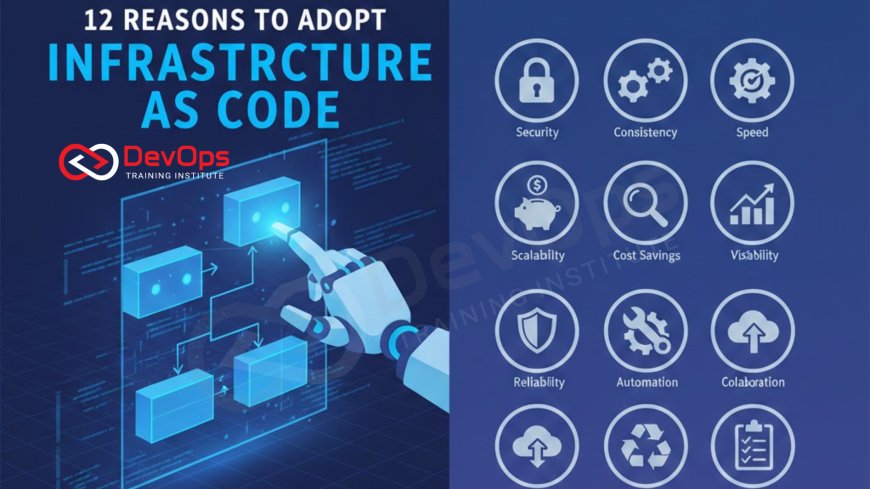
12 Reasons to Adopt Infrastructure as Code
Discover the 12 compelling reasons why Infrastructure as Code (IaC) is non-negotiable for modern DevOps practices, driving speed, consistency, and reliability. This in-depth guide explains how tools like Terraform and Ansible transform manual operations into automated, version-controlled scripts, eliminating configuration drift and dramatically improving team efficiency. Learn the key benefits, including disaster recovery speed, cost optimization, and enhanced security posture through code review. Essential reading for architects, developers, and operations teams looking to modernize their cloud deployment processes and achieve true operational excellence within any cloud environment.
Introduction
In the era of cloud computing and microservices, the complexity of managing infrastructure has exploded. Setting up servers, networks, load balancers, and databases by clicking through web consoles or executing manual scripts is not only slow but inherently fragile. This manual approach is a major bottleneck to achieving the speed and reliability demanded by modern software delivery. Infrastructure as Code (IaC) is the practice that solves this fundamental problem, treating infrastructure configuration files in the same way that application code is treated: they are declarative, versioned, and executed automatically by software tools.
Adopting IaC represents one of the most significant advancements in operational technology since the rise of virtualization. It shifts infrastructure management from a reactive, ticket-driven process to a proactive, engineering discipline. IaC tools such as Terraform, CloudFormation, and Ansible allow organizations to define their entire computing environment—from a simple virtual machine to a complex, multi-region cloud deployment—using code syntax. This move from manual processes to automated, idempotent scripts is foundational to the DevOps philosophy, enabling Continuous Integration (CI) and Continuous Delivery (CD) for the infrastructure itself, ultimately accelerating the entire development lifecycle and ensuring that the operational environment is as robust as the application code it hosts.
Reason One: Eliminating Configuration Drift and Achieving Consistency
One of the most persistent and dangerous problems in traditional IT is "configuration drift." This occurs when changes are manually applied to different servers over time, leading to minor but critical differences in configuration between environments (e.g., Development, Staging, and Production). These inconsistencies lead to the classic "it works on my machine" problem, causing unexpected bugs, deployment failures, and wasted time in troubleshooting. Configuration drift is a direct consequence of manual management and lack of centralized control over the system's state.
IaC directly addresses this by making infrastructure configuration declarative and idempotent. Declarative means you define the desired end-state (e.g., "I need a load balancer with two web servers attached"), not the steps to get there. Idempotent means that running the IaC script multiple times will always result in the same environment configuration, regardless of the starting state. This ensures consistency across all environments, eliminating manual variation and making troubleshooting dramatically simpler. When every environment is built from the exact same version-controlled code, you guarantee that if it works in staging, it will work in production, provided the environment variables are correctly managed, making the entire delivery process more predictable and reliable.
Reason Two: Accelerated Deployment and Time-to-Market
In a competitive market, speed of feature delivery is everything. Manual infrastructure provisioning can take hours or even days, requiring ticketing, manual approval, and sequential execution of multiple console clicks. This process is a massive bottleneck in the deployment pipeline, slowing down the time it takes to get a new feature or service in front of customers. For organizations pursuing Continuous Delivery, this kind of latency is simply unacceptable and actively hinders the business's ability to capitalize on market opportunities.
IaC radically accelerates this process. Once the infrastructure is defined as code, provisioning a new environment—or scaling an existing one—can be done in minutes through a single command execution. This speed allows development teams to rapidly spin up and tear down temporary environments for feature testing, performance testing, or sandbox development without waiting on operations staff. The ability to provision complex environments on demand is crucial for effective CI/CD, as it enables faster feedback loops and reduces the "wait time" inherent in traditional infrastructure management models, allowing teams to deliver value to customers in a fraction of the time, thereby gaining a significant competitive edge.
Reason Three: Enhanced Security and Compliance by Design
Security failures are often traced back to misconfigurations—unsecured ports, incorrect network settings, or overly broad access policies. When infrastructure is managed manually, security controls are applied inconsistently and are prone to human error. IaC transforms security and compliance by moving controls from post-deployment auditing to an integral, automated part of the initial design and review process. Security becomes code.
Because the infrastructure configuration is defined in code, it can be subjected to the same rigorous scrutiny as application code. This means security policies can be enforced automatically. Code review processes can ensure that all S3 buckets are private, all security groups restrict unnecessary ports, and all resources are encrypted by default before they are ever deployed. Furthermore, IaC ensures that user access roles are defined precisely, allowing teams to apply the principle of least privilege consistently across all environments. This programmatic enforcement ensures that security and compliance checks are never skipped, turning security from a bottleneck into a seamless, automated guardrail in the deployment pipeline, creating a foundation for true DevSecOps maturity, ensuring that read, write, and execute permissions are critical for security across all underlying components.
Summary of Core IaC Benefits
| IaC Reason | Key Technical Outcome | Operational Impact | Tooling & Principle |
|---|---|---|---|
| Consistency | Eliminates configuration drift; Idempotent deployment. | Reduced "works on my machine" bugs; Predictable environments. | Declarative Tools (Terraform, CloudFormation) |
| Speed | One-click provisioning and scaling. | Accelerated Time-to-Market; Faster feedback loops. | CI/CD Integration, Automation |
| Version Control | Full history of infrastructure changes in Git. | Complete audit trail; Easy rollback to any previous state. | Git (Source of Truth) |
| Disaster Recovery | Infrastructure definition is stored externally to the environment. | Rapid rebuild capability in a new region or cloud. | Immutability, Cloud Agnosticism |
| Documentation | Code serves as the live, accurate blueprint of the infrastructure. | Eliminates outdated diagrams; Simplifies onboarding and knowledge transfer. | Self-Documenting Code |
| Reusability | Modular code for common components (e.g., security groups, VPCs). | Reduced development time for new projects; Standardized architectures. | Modules, Templates |
| Cost Optimization | Automated teardown; Predictable resource provisioning. | Reduced cloud waste from forgotten resources; Accurate budgeting. | FinOps Principles |
Reason Four: Disaster Recovery Speed and Reliability
In a world where downtime can cost millions per hour, the ability to recover from a catastrophic failure quickly is non-negotiable. Traditional disaster recovery (DR) involved complex, bespoke runbooks that often failed under stress due to human error, outdated instructions, or dependency on specific hardware. IaC fundamentally changes the DR equation, treating the entire infrastructure as disposable and instantly rebuildable.
With IaC, the blueprint for your entire production environment—including all networking, compute, and database configurations—is stored as code in a Git repository. If an entire region or data center fails, the operations team doesn't rely on manual steps. Instead, they execute the IaC code against a new region or cloud provider, and the infrastructure is automatically provisioned and configured identically to the failed environment. This transformation dramatically reduces the Recovery Time Objective (RTO) from days to minutes or hours, making DR a reliable, repeatable, and automated process. The combination of IaC and proven automated backups is the cornerstone of modern, highly resilient systems.
Reason Five: Version Control and Auditability
Managing infrastructure manually means that changes are either logged in disparate ticketing systems or, often, not logged at all. Knowing who made what change, when, and why—and being able to easily reverse it—is almost impossible. IaC solves this by forcing infrastructure definition into a version control system, typically Git, where it is subjected to the same rigorous control as application code.
Every change to the infrastructure, from updating a server size to modifying a security rule, is captured as a code commit, providing a full, granular audit trail and change history. If a deployment causes an issue, a simple Git command can show exactly what lines of infrastructure code were modified, making debugging faster. Furthermore, the entire deployment process can be reversed instantly by reverting the code to a previous, known-good commit and re-running the IaC tool. This level of version control is crucial for compliance and essential for maintaining stability, as it treats the infrastructure as the true source of truth, offering unparalleled visibility and accountability across the entire system. This auditability is also vital for ensuring that user roles and privileged access are strictly managed and tracked.
Reason Six: Increased Reusability and Standardization
A key principle of efficient software development is code reusability, and IaC extends this principle to infrastructure. Instead of creating bespoke configurations for every new service or project, IaC allows teams to build modular, reusable components. These reusable modules, often containing best practices for security, networking, and monitoring, are then shared across the organization, accelerating development and enforcing standardization.
For example, a platform team can create a Terraform module called `production-vpc` that defines the company's approved network topology, complete with hardened security groups, logging, and connectivity rules. Every development team can then use this single module to provision their VPC, ensuring all new projects adhere to corporate standards instantly. This modularity drastically reduces the time needed to spin up new environments, as engineers are leveraging pre-vetted, compliant components rather than building from scratch. This consistency also reduces operational friction, as the operations team only needs to maintain a few standard modules instead of managing countless unique configurations, simplifying group management and access policies across the board.
Reason Seven: Cost Optimization and Financial Governance (FinOps)
One of the hidden costs of manual infrastructure management is waste—paying for resources that are unintentionally left running, oversized, or forgotten after testing. IaC provides the programmatic control necessary to enforce financial governance, a practice often referred to as FinOps.
IaC enables automated teardown: environments used for temporary testing can be instantly and completely decommissioned after a defined period, preventing expensive resources from running idle. Furthermore, by defining resource sizes in code, teams are forced to be explicit about their provisioning choices, facilitating code review and peer pressure to use the minimum necessary capacity (right-sizing). Tools can also be integrated to audit IaC before deployment, checking for non-compliant, overly expensive resources and ensuring that all resources are tagged correctly for accurate cost allocation and chargeback. This level of granular, automated control ensures that cloud spending is optimized and accountable, transforming the cost profile from an uncontrolled burden into a measurable, strategic investment. Ensuring efficient compression formats are used for data archives defined in IaC further reduces long-term storage costs.
Reason Eight: Enabling Immutability and Reducing Operational Risk
Traditional infrastructure management relies on mutable infrastructure, where servers are patched, updated, and reconfigured over time. This process is inherently risky, as an update on one server may behave differently on another due to configuration drift. IaC drives the adoption of immutable infrastructure, a key DevOps secret that drastically reduces operational risk.
Immutable infrastructure dictates that a component, once deployed, is never modified. If a change is needed (e.g., a security patch), a new server or container image is built from scratch using the IaC blueprint, and the old one is replaced entirely. This ensures every deployment starts from a known, clean state, eliminating configuration drift and simplifying the rollback process—to revert, simply destroy the new infrastructure and route traffic back to the old, unchanged components. By using IaC to define the environment and then relying on tools like Docker and Kubernetes for the application, organizations achieve a highly reliable, low-risk deployment model where sudo access and manual configuration changes are virtually eliminated, enhancing security by limiting human interaction with live systems.
Reason Nine: Automated Documentation and Knowledge Transfer
In manual environments, documentation is usually the first thing to become outdated. Hand-drawn diagrams and wiki pages rarely reflect the current, live state of a complex cloud infrastructure, leading to knowledge silos and making onboarding new engineers a time-consuming challenge. IaC solves this by making the code the single source of truth for the infrastructure.
The IaC files themselves, written in HCL, YAML, or JSON, serve as the living, accurate blueprint of the infrastructure. They clearly define the type, size, connectivity, and dependencies of every resource. This self-documenting nature simplifies knowledge transfer and onboarding; new team members can review the Git repository to instantly understand the environment architecture. Furthermore, many IaC tools can generate visual diagrams directly from the code, providing clear, up-to-date documentation that is always synchronized with the production environment. This automated documentation process frees up engineering time and reduces the risk associated with relying on outdated or incomplete documentation for critical operational tasks.
Reason Ten: Simplified Testing and Quality Assurance
Testing infrastructure changes in manual environments is difficult, often involving risky manual changes to a staging environment that may not perfectly reflect production. IaC allows infrastructure to be tested with the same rigor and automation as application code, integrating the infrastructure deployment directly into the CI/CD pipeline.
IaC enables engineers to treat infrastructure changes as code changes. This means they can be tested using various methods: static analysis tools can check the code for security compliance before deployment; linting ensures syntax correctness; and integration tests can provision a small, temporary environment using the IaC code and then run automated acceptance tests against the provisioned services before the environment is automatically torn down. This ability to test infrastructure changes exhaustively and safely in disposable environments drastically reduces the risk of infrastructure failure in production. This practice ensures that the final production deployment is highly reliable, significantly lowering the overall failure rate, and often requires teams to be disciplined about managing special permissions like SUID on critical system binaries.
Reason Eleven: Increased Operational Transparency and Collaboration
In traditional IT, the infrastructure team often operates in a silo, separate from the application development teams. IaC, as a core DevOps enabler, breaks down this barrier by making the infrastructure layer accessible, reviewable, and understandable by everyone in the delivery chain. This shift fosters a crucial sense of shared ownership and collaboration.
By putting infrastructure in Git and integrating its deployment into the CI/CD pipeline, IaC forces developers and operations engineers to collaborate on the same artifacts. Developers can suggest changes to the infrastructure (e.g., a database port opening) via a pull request, and operations engineers can review, approve, and enforce best practices directly in the code, using the standard Git workflow. This transparency allows for rapid communication, shared debugging, and mutual education, leading to better-designed applications and more resilient infrastructure, ensuring that the entire team understands the impact of both the application and the operational code.
Reason Twelve: True Cloud Agnosticism and Portability
While many IaC tools, like AWS CloudFormation, are provider-specific, others, such as Terraform and Pulumi, are designed to be multi-cloud. This capability is increasingly vital for organizations seeking to hedge against vendor lock-in, expand globally using different providers, or support hybrid cloud environments. IaC is the only mechanism that allows the infrastructure blueprint to be portable across different cloud providers with minimal refactoring.
Multi-cloud IaC tools abstract the provider-specific APIs into a common language (e.g., HCL), meaning the conceptual definition of a load balancer or a database remains consistent regardless of whether it's being deployed on AWS, Azure, or GCP. This enables a single engineering team to manage diverse infrastructure portfolios efficiently, maximizing operational efficiency and reducing the need for specialized, vendor-specific training across the entire team. This portability ensures that the organization maintains long-term strategic flexibility in its infrastructure choices, allowing it to adapt to changing market conditions and pricing models across the cloud landscape.
Conclusion
The transition to Infrastructure as Code is not merely an operational luxury; it is a fundamental requirement for achieving true DevOps maturity and competitiveness in the cloud era. The 12 reasons detailed here—from the critical elimination of configuration drift and the acceleration of time-to-market to the enhanced security enforced by code review—illustrate the profound impact IaC has across the entire software delivery lifecycle. IaC transforms manual, error-prone operations into automated, repeatable, and reliable engineering processes, ensuring that the infrastructure is as robust, versioned, and testable as the application code it supports.
Ultimately, IaC empowers teams with speed and confidence. It makes disaster recovery reliable, provides unparalleled auditability through version control, and fosters a collaborative culture by making infrastructure transparent. For leaders, IaC is the key to cost optimization and maintaining compliance by design. Embracing tools like Terraform and Ansible is the crucial, non-negotiable step toward building scalable, resilient systems that can evolve at the speed of business demand, turning infrastructure management from a necessary bottleneck into a powerful enabler of continuous innovation and operational excellence, which can be secured further by using secure sudo access policies across the infrastructure.
Frequently Asked Questions
What is the core difference between IaC and traditional scripting?
IaC is declarative (defines the end-state). Traditional scripting is procedural (defines the steps). IaC tools are idempotent, ensuring consistency every time.
What is "configuration drift" and how does IaC solve it?
Drift is inconsistency between environments. IaC solves it by ensuring all environments are built identically from the single, version-controlled code blueprint.
How does IaC improve disaster recovery time?
It reduces the Recovery Time Objective (RTO) by automating the provisioning of the entire infrastructure in a new region with a single command.
Which IaC tool is best for multi-cloud deployments?
Terraform is often considered best for multi-cloud because it uses a single language (HCL) to interact with various cloud providers' APIs.
How does IaC contribute to cost optimization?
It enables automated environment teardown for temporary resources and facilitates auditing to ensure right-sizing and prevent forgotten, idle resources.
What role does version control play in IaC?
Version control (Git) provides a full audit trail of all infrastructure changes and allows for instantaneous rollback to any previous configuration.
How does IaC enforce security compliance?
Security rules (e.g., network ports) are defined in code, allowing for automated static analysis and code review before deployment, enforcing security by design.
What is meant by "immutable infrastructure"?
It means infrastructure components are never patched; they are replaced with new instances built from a clean, fully configured image using IaC.
How does IaC speed up the delivery pipeline?
It speeds up the pipeline by reducing provisioning time from hours or days to minutes, eliminating the major bottleneck in the CI/CD process.
Can IaC be used to manage on-premises resources?
Yes, many IaC tools, like Ansible, Chef, and Terraform, have providers or modules to manage on-premises virtual machines and networking equipment.
What is the relationship between IaC and automated backups?
IaC defines the necessary infrastructure for backup storage and management, while automated backups ensure that the data is protected within that infrastructure.
Why is IaC crucial for effective testing?
IaC allows the safe, automated creation and destruction of throwaway testing environments that perfectly mimic production, enabling exhaustive integration testing.
How does IaC break down silos between Dev and Ops?
It forces Dev and Ops to collaborate on the same infrastructure code in Git, creating shared ownership and improving mutual understanding of system dependencies.
What is a key benefit of using IaC modules?
Modules enable code reusability for common infrastructure components (like VPCs or security groups), accelerating new project setup and enforcing standardization.
What security risk does manual management of user roles create?
Manual management of user roles often leads to the granting of excessive, broad privileges, violating the principle of least privilege, which IaC helps enforce programmatically.
What's Your Reaction?
 Like
0
Like
0
 Dislike
0
Dislike
0
 Love
0
Love
0
 Funny
0
Funny
0
 Angry
0
Angry
0
 Sad
0
Sad
0
 Wow
0
Wow
0



![100+ Azure DevOps Interview Questions and Answers [Updated 2025]](https://www.devopstraininginstitute.com/blog/uploads/images/202509/image_140x98_68c40aa9a3834.jpg)






![Future Scope of DevOps Careers in Pune [Updated 2025]](https://www.devopstraininginstitute.com/blog/uploads/images/202510/image_140x98_68e3a84652312.jpg)