






























![Kong Interview Preparation Guide [2025]](https://www.devopstraininginstitute.com/blog/uploads/images/202509/image_430x256_68dbb95326997.jpg)











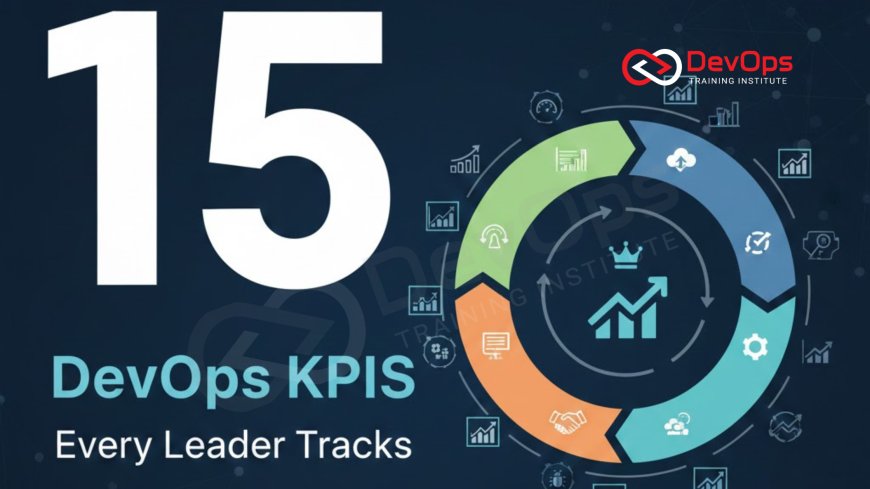
15 DevOps KPIs Every Leader Tracks
Discover the 15 essential DevOps Key Performance Indicators (KPIs) that every technology leader must actively track to measure the effectiveness of their software development and delivery pipeline. This in-depth guide covers the foundational DORA metrics and critical business KPIs, providing clear definitions, calculation methods, and insights into how these measures drive organizational performance. Learn to gauge speed, stability, quality, and business value, enabling data-driven decisions that accelerate feature delivery, enhance system resilience, and improve overall operational efficiency. These metrics are crucial for transforming teams into high-performing units.
Introduction
In the world of technology, what gets measured gets done. This adage is particularly true in the realm of DevOps, where the entire philosophy is centered on continuous improvement and feedback loops. For leaders and managers, Key Performance Indicators (KPIs) are not merely abstract numbers; they are the vital signs of the software delivery organization. These metrics provide objective evidence of operational health, highlight bottlenecks in the development pipeline, and ultimately predict the team's ability to deliver value to the customer quickly and reliably. Tracking the right KPIs ensures that improvement efforts are targeted, effective, and align directly with core business objectives, moving teams away from subjective assessments toward quantifiable success.
A successful DevOps implementation is characterized by a seamless flow of work from idea conception to production deployment, coupled with exceptional system stability. The 15 KPIs discussed in this guide are carefully selected to provide a holistic view of this flow. They cover the four critical areas of performance: Speed (how fast value is delivered), Stability (how reliably the system operates), Quality (how good the delivered product is), and Business Value (the ultimate impact on the organization). By concentrating on these metrics, leaders can make data-driven decisions to optimize their CI/CD pipelines, reduce technical debt, and foster the psychological safety necessary for high-performing teams to thrive. These metrics form the foundation of a modern, efficient, and resilient technology organization.
The Four DORA Metrics: The Foundation of Delivery Performance
Any serious discussion about DevOps metrics must begin with the four key measures identified by the DevOps Research and Assessment (DORA) team. These metrics have been empirically validated as the best predictors of software delivery performance and overall organizational performance. They provide a concise, powerful framework for assessing the technical capabilities and effectiveness of any team or organization. Teams classified as "Elite Performers" consistently excel across all four metrics, demonstrating both high speed and high stability, proving that these goals are not mutually exclusive. Understanding and optimizing these four KPIs is the first step toward achieving excellence in software delivery.
The DORA metrics are typically grouped into two pairs: Speed and Stability. High-performing organizations use these metrics to balance their focus, ensuring that efforts to accelerate delivery (Speed) do not inadvertently compromise the quality and resilience of the production environment (Stability). For instance, a team might initially focus on increasing Deployment Frequency, but if that causes their Change Failure Rate to spike, they must immediately shift focus to improving the Mean Time to Recover. This systematic balancing act, guided by the DORA metrics, is what distinguishes mature DevOps organizations from those merely adopting the toolchain without the underlying philosophical commitment to continuous, data-backed improvement.
By defining a clear target for each of the four DORA metrics and tracking them over time, leaders gain a powerful, objective view of their team's capabilities. These metrics cut across organizational boundaries, forcing Development, QA, and Operations teams to collaborate on shared goals. They create a unified language for discussing performance and potential improvements. Furthermore, they are excellent indicators of the effectiveness of investments in automation, testing, and cloud infrastructure. A sustained improvement in all four metrics is the clearest indicator of a successful DevOps transformation, directly correlating with better business outcomes, higher employee engagement, and superior market performance, solidifying their importance as leading indicators of success.
KPIs for Speed and Flow
Speed KPIs measure the efficiency of the software development pipeline, from the moment a business need is identified to the moment that need is fulfilled and running in production. They focus on minimizing waste and reducing friction points, collectively indicating the organization's "flow" of value. A high degree of speed and flow allows an organization to respond rapidly to changing market conditions, competitive threats, and user feedback, turning innovation into deployed features in the shortest possible time. This agility is a key competitive advantage in the modern digital economy, separating market leaders from followers.
- Deployment Frequency (DORA Speed Metric): Measures how often an organization successfully releases code to production. Elite performers deploy on demand, often multiple times a day. High frequency indicates high levels of automation, small batch sizes, and a high confidence in the quality of the pipeline. A low frequency suggests manual gates, risky, large code merges, or poor confidence in automated testing.
- Lead Time for Changes (DORA Speed Metric): Measures the time it takes for a commit to be successfully running in production. This is often the single most important metric for speed. It encompasses development time, testing, deployment, and release. A shorter lead time indicates an efficient end-to-end flow, small code changes, and highly automated pipelines, minimizing the time to feedback and value delivery.
- Cycle Time: This is often defined similarly to Lead Time for Changes but typically begins when a developer starts working on a task, rather than when the code is committed. Tracking the difference between Cycle Time and Lead Time can pinpoint where most time is spent: if the gap is large, the bottleneck is in the development and design phase; if the gap is small, the bottleneck is likely in testing or deployment.
- Code Commit Frequency: Measures how often developers commit code to the main branch. A high frequency, often multiple times per day per developer, is a strong indicator of Continuous Integration maturity. It shows that teams are working in small batches and are actively avoiding the dangerous practice of long-lived feature branches, thereby reducing integration risk.
KPIs for Stability and Quality
Stability KPIs are arguably the most crucial metrics for any customer-facing application, measuring the reliability, resilience, and quality of the production system. These metrics act as the necessary counterbalance to the Speed KPIs. Without excellent stability, increased speed simply means deploying bad code faster. A focus on stability ensures that when failures inevitably occur in any complex distributed system, the organization is ready to detect, contain, and recover from them quickly, minimizing the impact on the business and the end-user. Leaders prioritize these metrics to build customer trust and ensure service level agreements (SLAs) are met reliably.
- Mean Time to Recover (MTTR) (DORA Stability Metric): Measures the average time it takes for the team to restore service after a failure or incident. A low MTTR indicates a highly resilient architecture, effective monitoring and alerting, and well-rehearsed incident management procedures, all of which are hallmarks of operational excellence. The goal is to shrink this time as much as possible, often down to minutes.
- Change Failure Rate (CFR) (DORA Stability Metric): Measures the percentage of changes released to production that result in a degraded service or require immediate remediation (e.g., a rollback, hotfix, or patch). A low CFR (typically below 15%) is essential for high performance. A high CFR is a red flag, indicating poor testing, ineffective pipeline gates, or risky, large-batch deployments.
- Service Availability / Uptime: Measures the total time the application or service is available and operational, typically expressed as a percentage (e.g., "four nines" is 99.99%). This is a fundamental business-facing metric, often tied directly to SLAs and revenue. The measurement must be accurate, reflecting genuine customer experience, not just internal system checks, and is a key driver for backup recovery best practices.
15 Key DevOps KPIs Overview
| KPI Category | KPI Name | Measurement Focus | Impact on Business |
|---|---|---|---|
| Speed (DORA) | Deployment Frequency | How often code is successfully deployed to production. | Faster response to market needs; smaller, safer releases. |
| Speed (DORA) | Lead Time for Changes | Time from commit to production (end-to-end flow). | Reduced time-to-market for new features and fixes. |
| Stability (DORA) | Mean Time to Recover (MTTR) | Average time to restore service after an incident. | Minimizes service disruption and customer impact. |
| Stability (DORA) | Change Failure Rate (CFR) | Percentage of changes that cause service degradation. | Measures quality of the delivery pipeline and confidence in releases. |
| Quality | Defect Escape Rate | Number of defects found in production per release. | Directly reflects the effectiveness of QA and automated testing. |
| Quality | Test Coverage | Percentage of codebase covered by automated tests. | Predicts future stability and reduces technical debt accumulation. |
| Stability | Service Availability / Uptime | Total time the service is operational, usually in percentage. | Tied directly to SLA compliance and customer trust/revenue. |
| Quality | Security Vulnerability Density | Number of open, critical vulnerabilities per thousand lines of code. | Indicates the team's commitment to DevSecOps and reduces breach risk. |
| Flow | Cycle Time | Time from work start to production deployment. | Measures total team efficiency, including development and waiting time. |
| Stability | MTTA (Mean Time to Acknowledge) | Time from when a system generates an alert until the human team starts investigating. | Indicates effectiveness of alerting, on-call scheduling, and monitoring maturity. |
| Quality | Build Success Rate | Percentage of CI builds that pass all initial tests successfully. | Measures health of the CI process and developer discipline in integration. |
| Business Value | Feature Adoption Rate | Percentage of users utilizing a newly deployed feature. | Validates that released software is actually providing desired user value. |
| Business Value | Cost per Deployment | Total infrastructure/tooling cost divided by deployment frequency. | Ensures operational efficiency and effective use of cloud resources. |
| Flow | Percentage of Time Spent on Unplanned Work | Time spent on fixing production issues/bugs vs. new feature work. | Indicates the size of the operational burden; reduces time for innovation. |
| Flow/Quality | Manual Intervention Ratio | Number of manual steps required in the CI/CD pipeline. | Measures automation maturity; manual steps introduce bottlenecks and errors. |
KPIs for Code Quality and Security
While speed and stability metrics are focused on the pipeline's performance, code quality and security KPIs look inward at the product itself and the underlying processes. These metrics ensure that the features being delivered are not only fast and stable but also maintainable and secure in the long run. Ignoring these quality indicators leads directly to increased technical debt, making future changes slower and increasing the likelihood of catastrophic production failures. Effective DevOps practices integrate these quality checks directly into the CI pipeline, making them an automatic, non-negotiable part of every code change.
The following metrics are crucial for monitoring the health and integrity of the codebase:
- Defect Escape Rate: This is a sharp measure of testing effectiveness, calculated as the number of defects found in production divided by the total number of defects found (pre-production plus production). A high escape rate means your automated tests are missing critical bugs, indicating a need to improve the breadth and depth of your test suite.
- Test Coverage: Measures the percentage of the codebase that is executed by automated tests. While it doesn't guarantee quality (tests can be badly written), a consistently high test coverage (often 80% or more) provides the necessary confidence for high-frequency deployments. Improving this metric is critical for enabling Continuous Deployment and minimizing the need for manual approval gates.
- Security Vulnerability Density: This metric tracks the number of open, critical, or high-severity vulnerabilities per a fixed amount of code (e.g., 1,000 Lines of Code). High density indicates poor coding practices or a failure to implement DevSecOps practices like Static Analysis Security Testing (SAST) in the CI pipeline. Actively tracking and remediating vulnerabilities early is crucial for secure sudo access and reducing the risk of a major breach.
- Build Success Rate: A simple yet powerful indicator of the health of the Continuous Integration process. A low build success rate means developers are constantly dealing with broken builds, leading to frustration, lost time, and a loss of confidence in the CI process itself. Elite teams strive for a consistently high success rate, as a green build is the first step of trust in the pipeline.
KPIs for Flow Efficiency and Operational Burden
Flow efficiency metrics look beyond the technical pipeline to assess how smoothly work moves through the entire organization, often focusing on the time work spends waiting versus the time spent actively being worked on. Operational burden metrics measure the toll that maintaining the system takes on the engineering team, providing insight into system complexity and technical debt. These are crucial metrics for leaders, as they quantify developer burnout, resource drain, and the true cost of running the software. Ignoring these inevitably slows down the ability of teams to innovate, as they are constantly fighting fires rather than building new features.
One key metric is the Percentage of Time Spent on Unplanned Work. This metric compares the time developers spend on planned feature development versus unplanned work, which includes fixing production bugs, responding to alerts, and resolving incidents. A high percentage of unplanned work (often 20% or more) is a clear sign that the system is unstable or that technical debt is consuming excessive resources. Lowering this percentage frees up valuable engineering time for innovation, directly improving the business's ability to compete and enhancing developer satisfaction. This is a powerful metric that ties operational stability directly to business velocity.
Another crucial KPI is Manual Intervention Ratio, which tracks the number of manual steps required within the CI/CD pipeline, from commit to production. Every manual step is a potential bottleneck, a source of human error, and a point of non-auditability. High-performing DevOps teams aim for a ratio of zero, signifying a fully automated pipeline. Tracking this helps leaders identify and prioritize the automation of existing manual procedures, such as manual code reviews for deployments or manual environment provisioning, which dramatically increases deployment speed and reliability. Eliminating manual steps is a prerequisite for achieving Continuous Deployment and reducing organizational friction, directly correlating with lower CFR and MTTR. Furthermore, automating environment management is essential for controlling read, write, and execute permissions across the deployed components, which is critical for security.
KPIs for Business Value and Organizational Impact
The ultimate goal of DevOps is not just to be faster or more stable, but to deliver greater business value. These final KPIs connect the technical performance of the engineering team directly to the bottom line of the organization. They bridge the gap between technical metrics (like Lead Time) and executive concerns (like revenue and customer retention). By focusing on these, leaders ensure that the engineering efforts are correctly prioritized and demonstrate the tangible return on investment (ROI) of adopting DevOps practices and investing in automation.
The most impactful business-aligned metrics include:
- Feature Adoption Rate: Measures the percentage of users who utilize a newly deployed feature within a specific timeframe. If Lead Time is short, but Feature Adoption Rate is low, it indicates the team is building the wrong features quickly, revealing a gap between product development and market needs. This metric ensures that speed is directed toward valuable outcomes, demonstrating that technical velocity is aligned with customer satisfaction and business growth.
- Customer Satisfaction Score (CSAT) or Net Promoter Score (NPS): While not purely a DevOps metric, these scores are strongly influenced by the quality, stability, and speed of the software. Frequent outages, slow feature delivery, or a high defect escape rate directly erode customer trust and negatively impact these scores. Tracking the correlation between improved DORA metrics and improved CSAT/NPS is the most direct way to prove the value of DevOps investments to the entire business, showing that operational excellence translates to market advantage.
- Cost per Deployment: Measures the total operational cost (infrastructure, tooling, cloud spend) divided by the number of successful deployments. While low-frequency deployments may seem cheaper, they are often riskier. High-frequency deployment with low cost per deployment is the sign of an efficient, optimized, and potentially multi-cloud infrastructure. This metric ensures that the team is not only deploying fast but also maintaining compressed files and efficient resource utilization, preventing operational costs from spiraling out of control.
Sustaining High Performance Through Metric-Driven Culture
Achieving elite performance across these 15 KPIs is not a one-time event; it is the result of a sustained, metric-driven culture. This culture is defined by two core principles: transparency and continuous improvement. All relevant KPIs must be easily visible to every team member, often displayed on public dashboards. This transparency creates shared accountability and a clear understanding of the organizational mission. When a metric, such as Change Failure Rate, spikes, the entire team understands the immediate need to prioritize stability, preventing the siloed finger-pointing common in traditional models. The goal is to make data actionable and visible to those who can effect change.
Continuous improvement, or Kaizen, is the operational engine of this culture. Teams use these KPIs not for blame, but for initiating structured, continuous improvement cycles. After every major incident or every quarter, teams review the metrics, conduct blameless post-mortems (especially after high MTTR events), and identify the highest-leverage improvement area. This might mean investing in tar and gzip security practices, improving test coverage, or automating a manual deployment step. By consistently making small, data-backed improvements, the organization avoids the need for disruptive, high-risk "big bang" initiatives. This commitment to small, iterative steps, guided by the 15 KPIs, ensures the organization can maintain its high-performing status indefinitely, turning measurement into measurable advantage and solidifying its position as a market leader.
Conclusion
The 15 KPIs discussed in this guide provide a robust, comprehensive framework for measuring and driving DevOps performance. They transcend basic technical reporting, establishing a holistic view that links speed, stability, quality, and direct business value. The foundational DORA metrics (Deployment Frequency, Lead Time for Changes, MTTR, and CFR) offer the necessary balance between velocity and resilience, proving that high speed and high quality are mutually reinforcing goals. The supplementary metrics, ranging from Defect Escape Rate and Security Vulnerability Density to Feature Adoption Rate and Cost per Deployment, ensure that technical teams are aligned with both operational excellence and strategic business outcomes. For any leader guiding a digital transformation, these metrics are the essential navigational tools.
Tracking these KPIs must become an ingrained part of the organizational culture, fostering transparency and a relentless pursuit of automation and efficiency. By focusing on metrics like reducing the Percentage of Time Spent on Unplanned Work and driving the Manual Intervention Ratio toward zero, leaders empower their teams to shift focus from fire-fighting to innovation. Ultimately, the successful management of these 15 KPIs is the clearest indicator of a mature, resilient, and high-performing DevOps organization, one that is positioned to deliver market-leading software reliably and quickly, turning every code commit into a potential moment of value creation. Implementing these metrics is the final, non-negotiable step in achieving true operational mastery in the current digital landscape.
Frequently Asked Questions
What are the four DORA metrics and why are they important?
DORA metrics are Deployment Frequency, Lead Time, MTTR, and CFR. They are important because they predict organizational performance and balance speed with stability.
What is the difference between Lead Time for Changes and Cycle Time?
Lead Time starts at commit, measuring the pipeline efficiency. Cycle Time starts at work commencement, measuring total developer time.
What does a high Change Failure Rate (CFR) indicate?
A high CFR indicates low confidence in the testing process, poor code quality, or that the deployed changes are too large and risky.
How does Mean Time to Recover (MTTR) relate to system resilience?
A low MTTR means the system and team are highly resilient, capable of quickly containing and recovering from incidents with minimal downtime.
What is the primary goal of tracking Defect Escape Rate?
The primary goal is to measure the effectiveness of the pre-production testing and quality assurance gates in the pipeline.
Why should leaders track the Percentage of Time Spent on Unplanned Work?
It quantifies the operational burden, showing how much engineering time is diverted to fixing production issues instead of building new features.
How can Security Vulnerability Density be reduced in the pipeline?
It can be reduced by integrating automated security scans like SAST and DAST early into the CI/CD pipeline, practicing DevSecOps principles.
Why is tracking the Build Success Rate important for CI?
A high Build Success Rate ensures the CI process is trusted and stable, minimizing developer frustration and lost time due to broken builds.
What is the relationship between Deployment Frequency and stability?
High deployment frequency is associated with higher stability because smaller, more frequent changes are inherently easier to test and rollback, reducing risk.
How do DevOps KPIs help bridge the gap between Dev and Ops?
They create shared, common goals (like MTTR and CFR) that force Development and Operations teams to collaborate on a unified pipeline.
What does the Manual Intervention Ratio track?
It tracks the degree of automation maturity by measuring the number of required human steps in the end-to-end CI/CD process.
How can Cost per Deployment provide business value insight?
It ensures that the operational cost of delivering value remains efficient, tying technology spend directly to deployment efficiency and frequency.
Is Test Coverage a guarantee of high quality?
No, high test coverage is not a quality guarantee, but it is a necessary precondition for enabling high-speed, low-risk Continuous Deployment.
Which KPI is best for measuring customer-focused outcomes?
Feature Adoption Rate is best for measuring customer-focused outcomes, showing if the delivered speed translates into utilized functionality.
How does a leader use the Lead Time metric for improvement?
The leader uses it to identify and eliminate bottlenecks in the value stream, ensuring that automated backups and other non-development tasks are fast and reliable.
What's Your Reaction?
 Like
0
Like
0
 Dislike
0
Dislike
0
 Love
0
Love
0
 Funny
0
Funny
0
 Angry
0
Angry
0
 Sad
0
Sad
0
 Wow
0
Wow
0



![100+ Azure DevOps Interview Questions and Answers [Updated 2025]](https://www.devopstraininginstitute.com/blog/uploads/images/202509/image_140x98_68c40aa9a3834.jpg)






![Future Scope of DevOps Careers in Pune [Updated 2025]](https://www.devopstraininginstitute.com/blog/uploads/images/202510/image_140x98_68e3a84652312.jpg)