


![Kong Interview Preparation Guide [2025]](https://www.devopstraininginstitute.com/blog/uploads/images/202509/image_430x256_68dbb95326997.jpg)


20 DevOps Skills That Pay the Highest in India
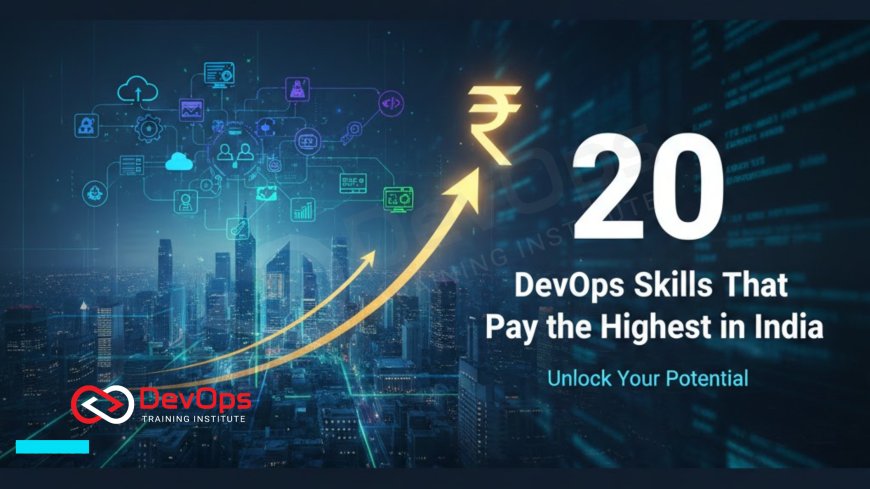
Unlock the secrets to maximizing your career potential with the 20 most highly compensated DevOps skills in the booming Indian IT market. This essential guide details the advanced technical proficiencies that command top salaries in major tech hubs like Bangalore and Pune, spanning deep expertise in cloud architecture, Kubernetes orchestration, Infrastructure as Code (IaC) with Terraform, and crucial Site Reliability Engineering (SRE) practices. Focus your learning on these in-demand areas, including DevSecOps and Python automation, to solidify your position as a specialized, high-value DevOps Engineer capable of building resilient, scalable systems for global enterprises, ensuring maximum income and career trajectory.
Introduction
The Indian IT landscape has transformed dramatically, positioning DevOps professionals at the forefront of digital innovation and securing them some of the most competitive salaries in the technology sector. The immense demand for engineers who can seamlessly blend software development, infrastructure management, and continuous automation has created a significant skills gap, compelling companies—particularly multi-national corporations (MNCs) and large product-based firms—to pay a premium for specialized expertise. Simply knowing a few tools is no longer enough; the highest compensation is reserved for those who possess deep, measurable skills in highly complex, mission-critical domains.
The value of a DevOps Engineer in India is directly proportional to their ability to manage distributed systems at scale, ensure production resilience, and automate security and governance across multi-cloud environments. The skills that command the highest pay are often those that require a strong software engineering background combined with deep operational knowledge of cloud platforms and container ecosystems. The following guide details the 20 most lucrative DevOps skills currently driving top-tier salary packages in India, providing a clear roadmap for where to focus your learning to maximize your career growth and earning potential.
Mastering these skills involves understanding not only the configuration of the latest tools but also the fundamental architectural principles behind them, such as why the Linux operating system remains the core engine of almost all modern cloud infrastructure, driving the design of all subsequent automation and orchestration efforts. This fundamental knowledge ensures that your technical value extends beyond simple execution to solving complex, systemic problems that impact the entire business, often relying on understanding the history of the Linux OS itself.
Domain One: Cloud and Infrastructure as Code Mastery
Deep specialization in cloud infrastructure and the ability to manage it declaratively through code are the absolute highest determinants of DevOps salary in India. Engineers who can architect and optimize cloud environments for cost and performance are irreplaceable strategic assets, making these skills non-negotiable for senior roles. The senior engineer must demonstrate proficiency that extends beyond basic setup to high-level system design and performance tuning, effectively acting as a cloud architect for mission-critical applications.
The primary skills that command a premium here involve managing resources across major providers and understanding the financial implications of every architectural decision. This requires continuous learning and dedication to the provider's specific ecosystem, although cross-cloud portability remains a critical strategic goal for many large firms in India, minimizing reliance on any single vendor. This area of expertise is where engineering rigor meets financial accountability.
- Cloud Provider Expertise (AWS/Azure/GCP): Specialization in at least one major cloud platform (AWS being the market leader) is mandatory. The highest pay goes to those with deep knowledge of advanced services beyond EC2 and S3, including managed databases, serverless compute, and cross-region networking. Multi-cloud expertise commands the highest premium, demonstrating adaptability across different operating models.
- Infrastructure as Code (IaC) with Terraform: Mastery of Terraform, the industry-standard cloud-agnostic IaC tool, is essential. This includes developing robust, reusable, and version-controlled modules, understanding complex state management and locking mechanisms, and integrating it with CI/CD pipelines to enforce governance and compliance across environments.
- Cloud Networking and VPC Design: Deep knowledge of virtual private clouds (VPCs), subnetting, routing tables, network access control lists (NACLs), and load balancing is crucial for building secure and scalable infrastructure. This skill requires understanding how the virtualized cloud network differs from traditional on-premise systems and ensuring optimal traffic flow for microservices.
- Serverless Architecture (AWS Lambda/Azure Functions): Expertise in designing, deploying, and monitoring event-driven applications using FaaS (Function as a Service) platforms is highly compensated, driven by the need to build scalable and cost-efficient cloud-native backends that abstract away the traditional concerns of OS and VM management.
- FinOps (Cloud Cost Optimization): The ability to drive financial accountability and reduce unnecessary cloud spending through automation (e.g., auto-scaling, resource rightsizing, idle resource cleanup) is a strategic skill set that translates directly into business value, commanding a significant salary premium for its measurable impact on the bottom line.
Domain Two: Containerization and Orchestration Excellence
Container technology is the undisputed foundation of microservices architecture, and the skills associated with managing containerized workloads at enterprise scale are the most highly valued in the global DevOps market. Kubernetes orchestration is the single most in-demand technical skill in the landscape, and consequently, in India's top product and tech firms. Expertise here is directly linked to the ability to ensure application portability, resilience, and high availability in production environments, managing complex deployments that are often distributed across multiple clusters and regions.
Mastering this domain requires going beyond simple application deployment. The senior engineer must understand the internals of container runtimes, the security implications of container networking, and the sophisticated governance tools required to manage a fleet of ephemeral workloads. Certifications and hands-on experience in managing high-traffic, production-grade Kubernetes clusters are what justify the highest compensation bands in this specialization, proving competence in a system that is complex and vital to modern cloud applications.
- Kubernetes (K8s) Orchestration Mastery: Deep knowledge of Kubernetes core components, cluster architecture, networking (CNI), security (RBAC, admission control), and management of managed services (EKS, AKS, GKE) is critical. Certifications like CKA or CKAD are strong validators of this high-value skill.
- Container Security and Hardening (Docker/Kubernetes): The ability to write secure Dockerfiles, use image scanning tools (Trivy), and implement runtime security tools (Falco) for proactive threat detection within the cluster is a high-value skill that crosses into the DevSecOps domain.
- Service Mesh Implementation (Istio/Linkerd): Expertise in deploying and managing a Service Mesh to control service-to-service communication, enforce security policies, and manage traffic routing (Canary releases) in complex, distributed microservices architectures is a niche skill that attracts premium compensation in senior roles.
- Helm and GitOps: Proficiency in packaging applications using Helm charts and implementing the GitOps methodology (using tools like Argo CD or Flux) is crucial for ensuring a declarative, auditable, and automated deployment process, which is essential for scaling continuous delivery pipelines reliably.
- Container Runtime (Docker/containerd): While abstracted by Kubernetes, understanding the core container runtime is necessary for advanced troubleshooting, performance tuning, and optimizing image size for faster deployment and reduced cold start times, particularly in production environments.
Domain Three: Reliability, Observability, and Strategy
The highest salaries are paid to engineers who move beyond automation to own the **reliability** of the production system and influence the organization's strategic direction. These skills merge the engineering rigor of SRE with deep system monitoring and cultural leadership, translating technical performance into measurable business outcomes. The senior engineer acts as the guardian of the production environment, ensuring that high velocity does not compromise system stability.
This domain requires the ability to use data—metrics, logs, and traces—to proactively prevent incidents and drive architectural improvements. The engineer is not just a tool operator but a strategist who defines the Service Level Objectives (SLOs) and guides the company’s investment in cloud platforms and monitoring systems. This shift to a value-driven approach is what separates the average engineer from the highest paid technical leader in the DevOps space, ensuring that system resilience is a continuous design goal rather than an operational afterthought.
- Site Reliability Engineering (SRE) Principles: Expertise in SRE practices, including defining and managing Service Level Objectives (SLOs), error budgets, and leading blameless post-mortems, is a marker of a top-tier engineer. The ability to write code (Go/Python) to reduce operational toil is central to this highly paid discipline.
- Advanced Observability (Metrics, Tracing, Logs): Mastery of unified monitoring systems (Prometheus, Grafana, Jaeger/OpenTelemetry) to collect, correlate, and analyze metrics, traces, and logs from distributed applications is vital for rapid incident response and proactive system optimization.
- Python/Go Programming for Automation: Deep fluency in Python (for cloud SDKs, custom tooling, and data manipulation) or Go (for high-performance automation and cloud-native development) is mandatory for senior roles, enabling the automation of complex, multi-system workflows.
- DevSecOps Integration and Policy as Code: Expertise in automating security checks and governance across the CI/CD pipeline using Policy as Code (PaC) tools (e.g., OPA, Sentinel) and security scanners (SAST/DAST) is a high-value specialization that mitigates enterprise risk and speeds up security compliance.
- CI/CD Pipeline Architecture and Governance: The ability to design and manage enterprise-grade CI/CD platforms (Jenkins, GitLab CI, Spinnaker) that incorporate advanced deployment strategies (Canary/Blue-Green) and integrate seamlessly with security and IaC is a senior-level architectural skill.
Domain Four: Foundational and Leadership Skills
The highly valued technical specializations are built upon a bedrock of fundamental operational knowledge and the soft skills required to drive change and lead teams. These foundational competencies ensure that the engineer can troubleshoot anything and mentor others effectively, amplifying their impact across the organization. The mastery of the Linux command line and networking remains an unspoken yet critical requirement for effective troubleshooting in the cloud.
The top DevOps Engineer does not operate in isolation; they must effectively communicate complex technical concepts, influence organizational standards, and mentor junior staff. These leadership skills ensure that the technical expertise scales across the entire engineering department, making the individual an indispensable leader rather than just an individual contributor. This holistic blend of hard and soft skills is crucial for landing the highest-paying roles in Bangalore and other major Indian tech hubs, where global team interaction is commonplace.
| Skill Area | Specialization | Business Value / Impact | Salary Premium Driver |
|---|---|---|---|
| Cloud Architecture | Multi-Cloud / Vendor Specific Expert (AWS/Azure/GCP) | Ensures system resilience, global scalability, and vendor independence. | Highest (Strategic & Architecture) |
| IaC | Terraform / IaC Security PaC (Sentinel, OPA) | Guarantees environment consistency, compliance, and automated governance. | High (Automation & Compliance) |
| Orchestration | Kubernetes orchestration / EKS/AKS/GKE | Enables application portability and management of large-scale microservices. | Highest (Complexity Management) |
Linux Administration and Troubleshooting: Even with containers, deep knowledge of Linux internals is non-negotiable for troubleshooting containers, managing system resources, and hardening host security. An expert knows why different Linux distributions evolved and how to diagnose issues using commands like top, grep, and strace, which is vital when problems arise in the abstracted cloud layer, often requiring an understanding of how the Linux file system is structured for secure configuration and logging.
Advanced Networking and Security Protocols: A senior engineer must understand the core concepts of the OSI and TCP/IP models, how cloud networking components are virtually organized, and best practices for securing communication. This knowledge is essential for configuring WAFs, micro-segmentation, and diagnosing complex connectivity issues between services residing on different cloud networks, ensuring data integrity and fast communication across the distributed system. This level of networking expertise is crucial for any cloud engineer, regardless of the underlying infrastructure vendor.
Continuous Learning and Mentorship: The willingness and ability to quickly master new tools, integrate emerging practices (like AI in DevOps), and mentor junior engineers is a key factor in compensation. Senior roles are expected to drive the team's intellectual growth, multiplying their knowledge across the organization and leading the adoption of next-generation tools and standards, which increases the overall engineering output and maturity, driving significant business impact.
The FinOps and Value-Driven Approach
The highest paying DevOps roles in India are increasingly shifting from purely technical execution to a value-driven approach, often integrating FinOps (Cloud Financial Operations) skills. Companies demand engineers who can directly tie their automation efforts to quantifiable business metrics, suchs as reduced Mean Time to Recovery (MTTR), lower cloud expenditure, and increased deployment frequency. The ability to use observability tools not just for troubleshooting but for strategic optimization—identifying the root cause of slow performance *and* the associated high cost—is the ultimate senior-level skill. By acting as the bridge between engineering performance and financial results, the DevOps Engineer secures a strategic seat at the table, justifying premium compensation and ensuring sustainable cloud usage for the business.
This focus on measurable business value means that skills like managing multi-cloud cost centers, implementing automated resource cleanup scripts, and optimizing Kubernetes cluster usage for cost-efficiency are directly linked to salary growth. Engineers who can translate a complex technical problem (e.g., a high error rate) into a quantifiable business impact (e.g., customer churn and increased spending on unnecessary resources) are highly valued by executive leadership, placing them firmly in a strategic advisory role. This shift emphasizes that modern DevOps is not just about technology, but about running the business on technology as efficiently as possible.
Certifications as Salary Multipliers
While experience is paramount, professional certifications serve as invaluable validators of specialized expertise in the Indian market, often acting as direct multipliers for salary negotiations. Certifications prove specialized, focused knowledge in high-demand areas. The most impactful certifications include:
- AWS Certified DevOps Engineer - Professional: Validates advanced knowledge of CI/CD, automation, governance, and monitoring within the AWS ecosystem.
- Certified Kubernetes Administrator (CKA): Proves deep, hands-on ability to install, configure, and manage production-grade Kubernetes clusters, a non-negotiable skill for high-paying roles.
- HashiCorp Certified: Terraform Associate/Professional: Confirms mastery of the leading IaC tool, essential for managing multi-cloud infrastructure and implementing PaC governance.
- Azure DevOps Engineer Expert (AZ-400): Validates expertise in designing and implementing DevOps strategy using Azure DevOps and the Azure cloud platform, crucial for organizations heavily invested in the Microsoft ecosystem.
- Certified Cloud Security Professional (CCSP): A highly valued certification that confirms deep knowledge of cloud security architecture, governance, and regulatory frameworks, essential for leading DevSecOps initiatives.
These credentials validate the rigorous and specialized training required to handle complex, distributed systems. For instance, an engineer specializing in Kubernetes and cloud platform services demonstrates a commitment to mastering the abstraction layers that separate the application from the underlying operating system and virtualization technologies, ensuring reliability in a complex cloud environment. This specialized knowledge is a direct predictor of success in managing large-scale, high-availability systems, which is why the market rewards these certifications so generously.
Conclusion
The landscape of DevOps skills in India is highly specialized, rewarding deep expertise in complex, mission-critical domains with top-tier salaries. The path to becoming a highly compensated DevOps Engineer requires a relentless commitment to continuous learning, strategically moving from tactical execution to architectural design and reliability ownership. By mastering the 20 skills detailed here—from Kubernetes orchestration and Terraform IaC to SRE principles and DevSecOps governance—you position yourself as a specialized expert capable of delivering high-value business outcomes in cloud resilience, security, and cost-efficiency. This pursuit of specialized knowledge is key to capitalizing on the growth of the open-source movement, which has propelled Linux into cloud dominance, underpinning the entire modern tech stack.
The ultimate goal is to become an indispensable partner to the business, capable of not only writing the automation code but also defining the strategic roadmap for cloud adoption and production reliability. Focus your efforts on deep specialization in Linux-based cloud environments, embrace the rigor of SRE, and champion the necessary cultural shifts in security and collaboration to solidify your position at the top tier of the fastest-growing engineering discipline in India, recognizing that advanced knowledge of system internals is what differentiates expert troubleshooting and ensures that the foundation of the technology stack is stable, regardless of the abstraction layers applied by hypervisors and cloud platforms.
Frequently Asked Questions
Which is the highest paying specialization in DevOps in India?
Specializations in Cloud Architecture, Site Reliability Engineering (SRE), and DevSecOps consistently command the highest salaries due to their direct impact on resilience and risk mitigation.
Is Linux knowledge still essential for DevOps in the cloud?
Yes, deep Linux knowledge is essential, as the kernel forms the foundation for virtually all cloud compute resources and containerization technologies like Docker and Kubernetes.
What is the key difference between Terraform and Ansible?
Terraform provisions cloud infrastructure (IaaS), while Ansible configures the software and OS running inside those resources (Configuration Management).
Why are FinOps skills highly valued?
FinOps skills are highly valued because they directly translate automation efforts into reduced cloud costs and improved financial accountability, impacting the company's bottom line significantly.
What does 'toil' mean in SRE and why should I eliminate it?
'Toil' is manual, repetitive work that scales linearly with growth. Eliminating it through code (automation) frees up engineers for high-value strategic work, increasing team efficiency.
Is a Certified Kubernetes Administrator (CKA) worth the salary investment?
Yes, the CKA is highly valuable, confirming the deep, practical expertise required to manage and troubleshoot production-grade Kubernetes clusters, a non-negotiable skill for high-paying roles.
How does Python automation contribute to high salaries?
Python automation skills contribute to high salaries by enabling the building of custom tools, advanced workflows, and seamless integration with complex cloud APIs and security services.
What is GitOps and what tool is key for its implementation?
GitOps is a declarative operational model using Git as the single source of truth; Argo CD or Flux are key tools for its implementation in Kubernetes.
How does DevSecOps differ from traditional security?
DevSecOps embeds automated security checks and governance into the CI/CD pipeline from the start (Shift Left), making security a continuous, shared responsibility, unlike traditional security gates at the end.
What is the most important Linux skill for senior DevOps?
The most important skill is advanced troubleshooting, using utilities like strace and tcpdump to diagnose complex performance and connectivity issues deep within the system or container runtime.
What is the role of the Service Mesh?
The Service Mesh manages service-to-service communication, traffic routing (Canary), and security policy enforcement in complex, distributed microservices architectures, abstracting network complexity.
Why is multi-cloud architecture a highly paid skill?
Multi-cloud architecture is highly paid because it ensures business resilience, leverages specialized services from different providers, and mitigates vendor lock-in risk, requiring deep strategic and technical knowledge.
How do certifications impact salary negotiations?
Certifications act as official third-party validation of specialized skills, often leading to a 15% to 25% increase in base salary during negotiations, especially for highly complex cloud and orchestration expertise.
What is the value of mastering SRE metrics (SLOs)?
Mastering SLOs is valuable because it translates system performance into measurable customer-centric targets, aligning engineering effort with business outcomes and guiding resource investment decisions.
Why is networking knowledge important even with cloud abstraction?
Networking knowledge is vital for configuring virtual firewalls (Security Groups/NACLs), designing secure VPCs, and troubleshooting connectivity between services in a complex, virtualized cloud environment.
What's Your Reaction?
 Like
0
Like
0
 Dislike
0
Dislike
0
 Love
0
Love
0
 Funny
0
Funny
0
 Angry
0
Angry
0
 Sad
0
Sad
0
 Wow
0
Wow
0


![100+ Azure DevOps Interview Questions and Answers [Updated 2025]](https://www.devopstraininginstitute.com/blog/uploads/images/202509/image_140x98_68c40aa9a3834.jpg)





![Future Scope of DevOps Careers in Pune [Updated 2025]](https://www.devopstraininginstitute.com/blog/uploads/images/202510/image_140x98_68e3a84652312.jpg)