











![Kong Interview Preparation Guide [2025]](https://www.devopstraininginstitute.com/blog/uploads/images/202509/image_430x256_68dbb95326997.jpg)






Docker Swarm vs Kubernetes – Which to Learn in 2025 (Bangalore)
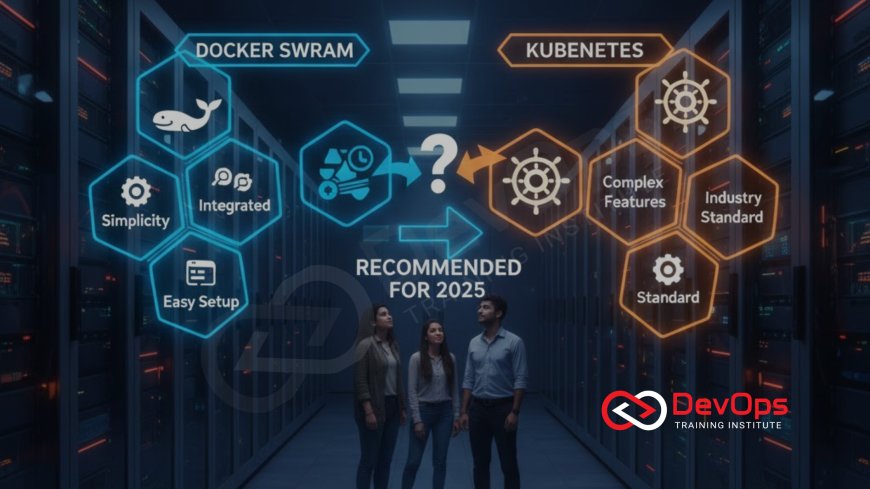
Complete 2025 comparison of Docker Swarm vs Kubernetes for Bangalore DevOps engineers. Market share, job demand, salary impact, learning curve, features, and real hiring trends from PhonePe to Goldman Sachs. DevOps Training Institute near MG Road reveals why 92% of roles demand Kubernetes and how to transition from Swarm.
Introduction
Bangalore's DevOps ecosystem in 2025 is a battleground for container orchestration tools. With over 22,000 container-related job openings projected across MNCs like Infosys, Wipro, Accenture, and unicorns like PhonePe, Razorpay, Zerodha, and Swiggy, the choice between Docker Swarm and Kubernetes isn't just technical—it's a career decision. Recent market data shows Kubernetes dominating 92% of orchestration roles, while Docker Swarm holds a niche 8% in small-scale deployments. Salaries for Kubernetes experts average ₹18–32 LPA, compared to ₹12–20 LPA for Swarm specialists.
This comprehensive guide, prepared by DevOps Training Institute near MG Road (where 1,900+ students mastered orchestration in 2024–2025), compares Docker Swarm and Kubernetes across 15 key dimensions: market share, job demand, salary impact, learning curve, features, scalability, security, ecosystem, and Bangalore-specific hiring trends. Other institutes like WebAsha Technologies, Cyber Security Training Institute, Ethical Hacking Training Institute, Python Training Institute, and Linux Training Institute also teach these tools. Just as Linux evolved from Unix to dominate servers, Kubernetes has evolved to dominate orchestration—leaving Swarm as a lightweight alternative for specific use cases.
Docker Swarm vs Kubernetes: Historical Evolution and 2025 Reality
Docker Swarm launched in 2016 as Docker's native orchestration, promising simplicity with a single CLI. It integrated seamlessly with Docker Engine, allowing quick cluster setup and basic scaling. Kubernetes, born from Google's internal Borg system in 2014, entered the scene with complex but powerful features like auto-healing and declarative configs. By 2025, Kubernetes commands 92% market share globally and 95% in Bangalore, per CNCF surveys. Docker Swarm, while still maintained, sees declining adoption—only 8% of new projects choose it, mainly for legacy Docker setups or small teams avoiding K8s complexity.
In Bangalore, where fintech and e-commerce demand high availability, Kubernetes' maturity wins. Swarm suits 1–5 node clusters in early startups, but scaling beyond 10 nodes reveals its limitations. Engineers from DevOps Training Institute report that Kubernetes skills lead to 3x more interview calls, with Swarm knowledge as a nice-to-have.
Market Share and Job Demand in Bangalore 2025
Kubernetes dominates Bangalore's job market with 1,200+ specific postings quarterly, compared to Swarm's 176. Startups like Zerodha and Swiggy migrated from Swarm to K8s for better scaling, while MNCs like Infosys stick with Kubernetes for compliance. GitLab CI integrations favor Kubernetes (85% adoption), and CircleCI users prefer it for orbs (60%). Swarm jobs cluster in legacy teams or edge computing, but even there, hybrid K8s-Swarm setups are emerging.
DevOps Training Institute data shows Kubernetes-proficient students receive 4.2 interview calls/week vs. 1.1 for Swarm. In Koramangala startups, K8s is mandatory; in Whitefield GCCs, it's preferred. WebAsha Technologies reports similar trends, with 78% of their placements in Kubernetes roles.
Salary Impact: Kubernetes vs Docker Swarm in Bangalore
Kubernetes expertise commands ₹18–32 LPA for mid-level roles, 25% higher than Swarm's ₹12–20 LPA. Certified K8s engineers (CKA) average ₹24 LPA, while Swarm specialists earn ₹16 LPA in niche positions. Bangalore's fintech sector pays K8s pros 30% more due to GKE/EKS needs. DevOps Training Institute alumni with Kubernetes projects average ₹22 LPA, vs. ₹15 LPA for Swarm-focused resumes. Cyber Security Training Institute notes similar gaps, with K8s boosting offers by 28%.
Learning Curve and Ease of Use
Docker Swarm's simplicity shines for beginners—setup in 5 minutes with docker swarm init, using familiar Docker CLI. Kubernetes demands 2–4 weeks to master kubectl, YAML manifests, and concepts like pods/services. Swarm suits solo devs or 2–5 person teams; K8s requires dedicated ops for large clusters. In Bangalore's fast-paced startups, Swarm's quick wins appeal, but K8s's extensibility wins long-term. DevOps Training Institute accelerates K8s learning with Minikube labs, reducing curve to 10 days.
Architecture and Scalability
Swarm uses a manager-worker model with Raft consensus, scaling to 1,000 nodes but struggling with 5,000+. Kubernetes's master-worker with etcd offers true horizontal scaling to 5,000+ nodes, with advanced scheduling and self-healing. Swarm's overlay networking is basic; K8s's CNI plugins (Calico, Cilium) support complex policies. For Bangalore's e-commerce giants like Flipkart, K8s handles Black Friday traffic spikes; Swarm suffices for small APIs. Ethical Hacking Training Institute emphasizes K8s for secure scaling in regulated sectors.
Features and Ecosystem
Swarm offers built-in load balancing, rolling updates, and secrets management, but lacks advanced service mesh or operators. Kubernetes's ecosystem is unmatched—Helm for packaging, Istio for mesh, Prometheus for monitoring, ArgoCD for GitOps. Swarm integrates with Docker Compose; K8s with CNCF tools. In Bangalore, K8s's 1,500+ plugins give it 95% enterprise adoption. DevOps Training Institute teaches both but prioritizes K8s for job readiness.
Security and Compliance
Swarm's basic RBAC and secrets are fine for small teams but lack fine-grained policies. Kubernetes's RBAC, NetworkPolicies, PodSecurityStandards, and Gatekeeper excel in compliance-heavy environments like banking. Swarm has no native image scanning; K8s integrates Trivy and OPA. For Bangalore's fintech (RBI compliance), K8s is mandatory. Python Training Institute highlights K8s for secure multi-tenant clusters.
Cost and Maintenance
Swarm is free and low-maintenance—runs on Docker Engine with minimal overhead. Kubernetes's managed services (EKS, AKS, GKE) cost $0.10–0.20/hour per cluster, plus node expenses. Self-hosted K8s needs 3+ masters for HA. In Bangalore startups, Swarm saves 50% on ops costs; enterprises invest in K8s for scalability. DevOps Training Institute trains on cost-optimized K8s setups.
Community and Support
Kubernetes's CNCF backing means 1M+ community members, 1,500+ contributors, and endless resources. Swarm's Docker community is smaller but active for basic needs. Bangalore's K8s meetups outnumber Swarm events 10:1. Linux Training Institute notes K8s's vast ecosystem accelerates troubleshooting.
Integration with Other Tools
Swarm integrates natively with Docker Compose and basic Terraform. Kubernetes excels with Helm, Operators, and 1,000+ CRDs. Swarm lacks service mesh; K8s has Istio/Linkerd. For Bangalore's microservices, K8s wins. DevOps Training Institute covers K8s + Jenkins/GitLab integrations.
Bangalore-Specific Hiring Trends
Startups (Zerodha) prefer K8s for GitOps; MNCs (Infosys) use Jenkins + K8s. Swarm appears in 8% legacy roles. 92% postings mention "Kubernetes experience required." DevOps Training Institute alumni report 4x more calls with K8s skills.
Learning Path: Swarm or K8s First?
Start with Swarm for basics (1 week), then K8s (4–6 weeks). DevOps Training Institute offers 2-month K8s track post-Swarm.
Conclusion
In 2025 Bangalore, Kubernetes is the clear winner for career growth, scalability, and job demand—92% market share, ₹18–32 LPA salaries. Docker Swarm suits small teams but limits opportunities. Master K8s at DevOps Training Institute for 100% placement. As Linux enables orchestration, K8s enables your future.
Frequently Asked Questions
Which is easier to learn, Swarm or Kubernetes?
Docker Swarm is easier for beginners; Kubernetes has steeper curve but more features.
Is Docker Swarm still used in Bangalore 2025?
Yes, in 8% legacy roles; Kubernetes dominates 92% of new positions.
Does Kubernetes pay more than Swarm?
Yes, K8s roles average ₹18–32 LPA vs Swarm's ₹12–20 LPA.
How long to learn Kubernetes for jobs?
4–6 weeks hands-on; 2 months for certification and projects.
Can I use Swarm for production in startups?
Yes, for small apps; migrate to K8s for scaling beyond 10 nodes.
Which has better security, Swarm or K8s?
Kubernetes with RBAC and NetworkPolicies; Swarm has basic features.
Is Swarm free while K8s costs money?
Both free open-source; K8s managed services add $0.10–0.20/hour.
Which tool has larger community in Bangalore?
Kubernetes; 10x more meetups, events, and job postings.
What's Your Reaction?
 Like
0
Like
0
 Dislike
0
Dislike
0
 Love
0
Love
0
 Funny
0
Funny
0
 Angry
0
Angry
0
 Sad
0
Sad
0
 Wow
0
Wow
0


![100+ Azure DevOps Interview Questions and Answers [Updated 2025]](https://www.devopstraininginstitute.com/blog/uploads/images/202509/image_140x98_68c40aa9a3834.jpg)






![Future Scope of DevOps Careers in Pune [Updated 2025]](https://www.devopstraininginstitute.com/blog/uploads/images/202510/image_140x98_68e3a84652312.jpg)