









50+ Most Asked Alertmanager Interview Questions (2027)
55 Alertmanager interview questions with answers: routing, grouping, inhibition, silences, HA clustering, amtool and receivers, with config examples.
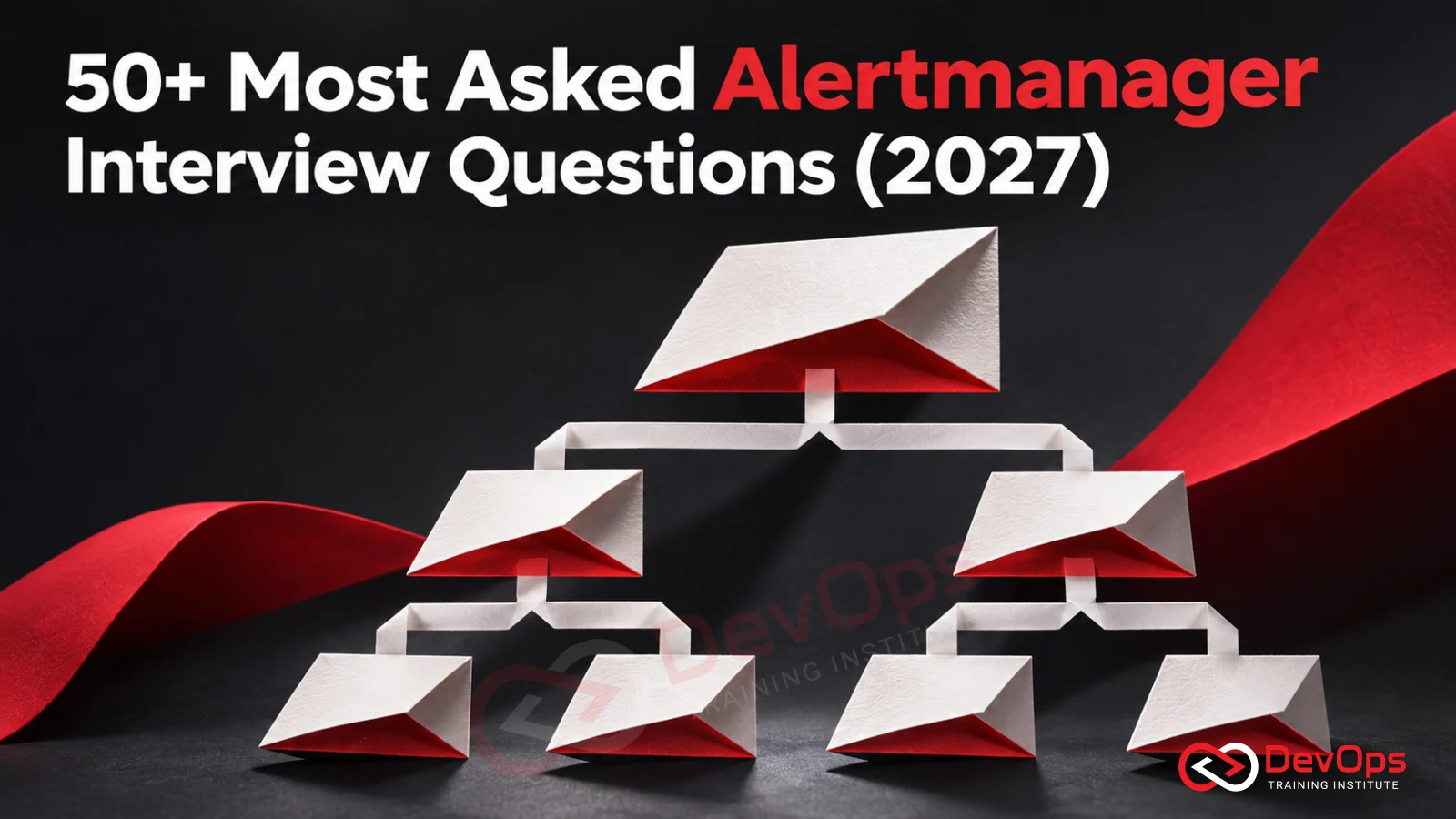
Alertmanager receives alerts from Prometheus, then deduplicates, groups, routes, silences and inhibits them before sending notifications to receivers such as email, Slack or PagerDuty. Interviewers ask most about the routing tree, group_wait and group_interval timing, inhibition rules, silences, and how a high availability cluster avoids duplicate pages. These 55 questions cover all of it.
Alertmanager is the notification layer of the Prometheus stack. If you are still building the monitoring picture around it, start with our guide to observability tools for DevOps monitoring, then come back here. This page lists the questions that come up most often, in the order interviewers usually ask them. The behaviour and defaults were checked against the Alertmanager documentation for release v0.35.0 (published 9 November 2026).
Other posts on this site take a different cut of the same topic: role-based engineer questions, a preparation plan, advanced design questions and scenario questions. This one is the frequency list: the core questions you should be able to answer without notes.
Key takeaways
- Know the pipeline order: Prometheus evaluates rules and sends alerts, Alertmanager dedupes, groups, applies inhibition and silences, then notifies the receiver.
- Memorise the route defaults: group_wait 30s, group_interval 5m, repeat_interval 4h, and the resolve_timeout of 5m.
- Child routes inherit receiver, group_by and the timing settings from the parent. time-interval settings are not inherited.
- Point Prometheus at every Alertmanager instance. Never put a load balancer between them.
- Use
matchersin new configs. The oldermatch,match_re,source_matchandtarget_matchfields are marked deprecated in the docs. - Practise with
amtool: it tests routes, adds silences and validates configuration before you reload.
Alertmanager basics (questions 1 to 14)
1. What does Alertmanager do?
It handles alerts sent by client applications such as Prometheus. It deduplicates them, groups them, routes them to the right receiver, and supports silencing and inhibition. It does not evaluate alert rules itself.
2. Who evaluates the alert rules, Prometheus or Alertmanager?
Prometheus. Alerting rules live in Prometheus rule files and are evaluated on a schedule. When a rule fires, Prometheus pushes the alert to Alertmanager, which decides who is notified and when.
3. What are the alert states in Prometheus?
An alert is inactive, pending or firing. Pending means the expression is true but the for duration has not elapsed. Firing alerts are the ones sent to Alertmanager.
4. What does the for clause do?
It makes Prometheus wait for a duration before a rule changes from pending to firing. This filters short spikes. Without it, an alerting rule becomes active on its first evaluation.
5. What is keep_firing_for?
An optional clause that keeps an alert firing for a set time after its expression stops being true. It reduces flapping, where an alert resolves and re-fires within minutes.
groups:
  - name: api
    rules:
      - alert: HighErrorRate
        expr: sum(rate(http_requests_total{code=~"5.."}[5m])) / sum(rate(http_requests_total[5m])) > 0.05
        for: 10m
        keep_firing_for: 5m
        labels:
          severity: critical
          team: payments
        annotations:
          summary: "5xx error ratio above 5% for 10 minutes"
6. What is a receiver?
A named notification destination plus its integration settings. A receiver can hold several integrations at once, for example slack_configs and pagerduty_configs under one name.
7. Which integrations does Alertmanager ship with?
The configuration reference documents email, PagerDuty, Slack, webhook, Discord, Telegram, Webex, WeChat and several others. For anything else, use webhook_configs and write a small receiver service.
8. What is the default port for Alertmanager?
9093 serves the web UI and the API. The cluster gossip port defaults to 9094, and it needs both TCP and UDP open between peers.
9. How do you reload the configuration without a restart?
Send SIGHUP to the process or send an HTTP POST to /-/reload.
10. Where does the main config file come from?
The --config.file flag. The YAML has these top-level parts: global, templates, route, receivers, inhibit_rules and time_intervals.
11. What does resolve_timeout do?
It is the global fallback for how long Alertmanager waits before marking an alert resolved when the alert carries no end time. The default is 5m. Alerts sent by Prometheus carry their own end time, so this rarely matters in practice.
12. What is the difference between Alertmanager and Grafana alerting?
Alertmanager is a standalone service with the routing tree, inhibition and clustering described here. Grafana has its own alerting engine that can also send to an external Alertmanager. For the wider picture, see using Prometheus and Grafana together.
13. Which API version is current?
APIv2, under the /api/v2 prefix. APIv1 was deprecated in 0.16.0 and removed in 0.27.0, so old scripts that call /api/v1 will fail on current releases.
14. What is amtool?
The command line client for the Alertmanager API, bundled with every release. You use it to query alerts, add and expire silences, check configuration files and test how a label set would be routed.
amtool config routes test --config.file=alertmanager.yml --tree --verify.receivers=oncall-pager severity=critical cluster=prod
amtool silence add alertname=HighErrorRate team=payments --comment="planned migration" --duration=2h
amtool silence query
amtool check-config alertmanager.yml
Routing and grouping (questions 15 to 28)
This is where most interviews spend their time. Be ready to draw the tree on a whiteboard.
route:
  receiver: team-default
  group_by: ['alertname', 'cluster']
  group_wait: 30s
  group_interval: 5m
  repeat_interval: 4h
  routes:
    - matchers:
        - severity="critical"
      receiver: oncall-pager
      continue: false
    - matchers:
        - team="payments"
      receiver: payments-slack
receivers:
  - name: team-default
    email_configs:
      - to: '[email protected]'
  - name: oncall-pager
    pagerduty_configs:
      - routing_key: '<integration-key>'
  - name: payments-slack
    slack_configs:
      - channel: '#payments-alerts'
        api_url: '<webhook-url>'
inhibit_rules:
  - source_matchers:
      - alertname="ClusterDown"
    target_matchers:
      - severity=~"warning|critical"
    equal: ['cluster']
15. What is the routing tree?
A tree of route nodes. Every alert enters at the top-level route, which must match all alerts, then walks the children. The first matching child handles it unless that child sets continue: true.
16. What does continue do?
It lets an alert keep matching later sibling routes after a match. The default is false, so matching stops at the first matching child. Use true when two teams must both be told.
17. What happens if no child route matches?
The alert is handled by the parent node using that node's own receiver and settings. That is why the root route needs a sensible default receiver.
18. Which route settings are inherited?
receiver, group_by, group_wait, group_interval and repeat_interval pass down from the parent when a child leaves them out. Labels merge from parent to child. mute_time_intervals and active_time_intervals are not inherited at all.
19. What is grouping?
Combining alerts of similar nature into one notification. If a hundred instances lose the database, you want one page that lists them, not a hundred separate pages.
20. What does group_by do?
It lists the labels that define a group. Alerts that share the same values for those labels land in one notification. A common choice is ['alertname', 'cluster'].
21. What does group_by: ['...'] mean?
It groups by all labels, which effectively disables aggregation. Each distinct label set becomes its own group. The docs warn it is rarely what you want unless alert volume is low.
22. Explain group_wait.
The time Alertmanager waits after the first alert of a new group arrives before sending the first notification. The default is 30s. It gives related alerts time to join the group so the first page is complete.
23. Explain group_interval.
A recurring timer that starts when group_wait ends. At each tick, Alertmanager checks whether alerts were added or resolved since the last notification and sends an update if so. The default is 5m.
24. Explain repeat_interval.
How long to wait before re-sending a notification for a group that has not changed. The default is 4h. It is checked after each group_interval, so it behaves as a multiple of it.
25. What if repeat_interval is not a multiple of group_interval?
It is rounded up to the next multiple. Setting repeat_interval: 7m with a 5m group_interval gives you 10m in practice.
26. What are the trade-offs of a short or long group_wait?
Short means faster first notification but a higher chance that a half-complete group is sent while related alerts are still arriving. Long means better grouping but slower first contact. Critical routes often use a shorter value than ticket-style routes.
27. How do you route by label?
Add a matchers list to a child route, for example severity="critical" or team=~"pay.*". Regex matchers are anchored on both ends, so pay.* must match the whole value.
28. Why replace match and match_re with matchers?
The docs mark the old equality and regex fields as deprecated, and matchers handles both in one list. New configurations should use only matchers.
Inhibition, silences and time intervals (questions 29 to 40)
29. What is inhibition?
Suppressing notifications for certain alerts while another alert is already firing. Example: if a whole cluster is unreachable, mute every other alert for that cluster so the on-call person sees the root cause only.
30. How do you write an inhibition rule?
Give source_matchers for the alert that inhibits, target_matchers for the alerts to mute, and an equal list of labels that must match between the two. See the sample config above.
31. What does the equal list do?
Source and target alerts must carry the same values for each listed label name, otherwise inhibition does not apply. Without it, a cluster outage in one region could mute alerts in another.
32. What if an alert matches both the source and target side of a rule?
Alertmanager has a safeguard so an alert cannot inhibit itself. The docs still advise choosing matchers so alerts never match both sides, because it is easier to reason about.
33. What is a silence?
A temporary mute for alerts that match a set of matchers, created in the web UI or with amtool. Silenced alerts still exist and stay visible, but no notification goes out for them while the silence is active.
34. How is a silence different from inhibition?
A silence is created by a person for a time window, usually for maintenance. Inhibition is permanent configuration that reacts automatically to another alert being active.
35. How do you create and remove a silence from the CLI?
Use amtool silence add with matchers, a comment and a duration, then amtool silence expire <id> to end it early. amtool silence query lists what is active.
36. Can you limit silences?
Yes. --silences.max-silences caps the total count, including expired ones, and --silences.max-silence-size-bytes caps the size of one silence. Both limits are off by default.
37. What are time intervals used for?
Named windows such as office hours or weekends, defined under time_intervals. A route can then use mute_time_intervals to stay quiet in a window, or active_time_intervals to notify only inside one.
38. Is the top-level mute_time_intervals still current?
The documentation marks the top-level mute_time_intervals as deprecated and tells you to use time_intervals to define windows. The route-level mute_time_intervals and active_time_intervals fields remain the way to apply them.
39. Do muted or inhibited alerts disappear?
No. They remain in the Alertmanager alert list so you can see them. Only the notification is suppressed.
40. How do you stop alert storms for one noisy rule?
Fix the rule first. As a guard, --alerts.per-alertname-limit caps active alerts per alertname, and alertmanager_alerts_limited_total shows how many were dropped.
High availability and operations (questions 41 to 48)
41. How does Alertmanager high availability work?
You run several instances that gossip with each other. Every instance receives every alert independently, while silences and notification state are replicated between peers so the same notification is not sent several times.
alertmanager --config.file=alertmanager.yml \
  --cluster.listen-address=0.0.0.0:9094 \
  --cluster.peer=am-2.example.internal:9094 \
  --cluster.peer=am-3.example.internal:9094
42. Where do you point Prometheus?
At every Alertmanager instance, listed under alerting.alertmanagers. Do not load balance traffic between Prometheus and its Alertmanagers, because each instance expects to see all alerts.
alerting:
  alertmanagers:
    - static_configs:
        - targets:
            - am-1.example.internal:9093
            - am-2.example.internal:9093
            - am-3.example.internal:9093
43. Which ports and protocols does clustering need?
The cluster listen port, 9094 by default, needs both UDP and TCP between peers since version 0.15. Firewalls and container port mappings must allow both.
44. How do you disable clustering?
Set --cluster.listen-address= to an empty string. The instance then stays standalone and does not listen for peers.
45. What is the --cluster.label flag for?
It adds a label to every gossip packet and stream so one cluster never talks to another by mistake, for example when two environments share a network.
46. Can you secure the Alertmanager endpoints?
Yes. The web configuration file supports tls_server_config and basic_auth_users. The docs also note the gossip layer has no built-in encryption or peer authentication, so keep clustering on a trusted network.
47. What metrics do you watch on Alertmanager itself?
Notification failures per integration, cluster member count and health, and the number of active alerts and silences. Alertmanager exposes its own metrics, so Prometheus can scrape and alert on it.
48. How do you validate configuration safely?
Run amtool check-config before reloading, and amtool config routes test to confirm a label set reaches the intended receiver. Keep the file in Git and review changes like code.
Receivers, templates and troubleshooting (questions 49 to 55)
49. How do you customise notification text?
Write Go templates in files listed under templates, then reference them from receiver fields. amtool template render lets you test a template without sending anything.
50. Do all integrations send resolved notifications?
Not by default. send_resolved defaults to true for PagerDuty and webhook but false for email and Slack. Set it explicitly where the team wants a recovery message.
51. A critical alert did not page anyone. Where do you look?
First confirm Prometheus sent it (alerts page and the active alerts in Alertmanager). Then test the route with amtool config routes test, check for a matching silence or inhibition, and read the integration error metrics and logs.
52. You get duplicate pages in a cluster. What do you check?
Whether Prometheus targets every instance directly, whether the peers actually joined the cluster (UDP and TCP on 9094), and whether a load balancer sits in front. A split cluster means each half notifies on its own.
53. Alerts arrive late. What do you check?
The route's group_wait and group_interval, the rule's for duration, and the Prometheus evaluation interval. Slow receivers can also hit the group_interval timeout, which the docs say sets the notification context timeout.
54. What is a good alerting design principle to mention?
Alert on symptoms users feel, route by ownership labels, keep severity labels small and consistent, and make every page actionable. Use inhibition to suppress downstream noise instead of editing rules per team.
55. Where do you go to practise?
Run a three-node cluster locally, break routes on purpose, and use the Prometheus training track in our Prometheus and Grafana course for guided lab work.
Frequently asked questions
What is the main purpose of Alertmanager?
It receives alerts from Prometheus, then deduplicates, groups, routes, silences and inhibits them before sending notifications to receivers such as email, Slack and PagerDuty.
What are the default group_wait, group_interval and repeat_interval values?
group_wait is 30s, group_interval is 5m and repeat_interval is 4h. Child routes inherit these from the parent unless they set their own.
What is the difference between a silence and an inhibition rule?
A silence is a temporary manual mute created in the UI or with amtool. An inhibition rule is permanent configuration that mutes target alerts automatically while a source alert is firing.
Should Prometheus send alerts through a load balancer to Alertmanager?
No. List every Alertmanager instance in the Prometheus alerting configuration. Each instance expects to receive all alerts, and the cluster then avoids duplicate notifications.
Which ports does an Alertmanager cluster use?
9093 for the web UI and API, and 9094 by default for cluster gossip. Gossip needs both TCP and UDP open between peers.
Is APIv1 still available?
No. APIv1 was deprecated in 0.16.0 and removed in 0.27.0. Use the /api/v2 endpoints.
How do I test where an alert will be routed?
Run amtool config routes test with your config file and the labels of the alert. Add --verify.receivers to assert that it reaches the receiver you expect.
What is the quickest way to prepare for an Alertmanager interview?
Build a small routing tree with an inhibition rule, run a two-node cluster, create a silence with amtool, and explain each setting aloud. Hands-on practice answers most follow-up questions.
Official references
What's Your Reaction?
 Like
0
 Dislike
0
 Love
0
 Funny
0
 Angry
0
 Sad
0
 Wow
0