




![Kong Interview Preparation Guide [2025]](https://www.devopstraininginstitute.com/blog/uploads/images/202509/image_430x256_68dbb95326997.jpg)




Career Switch to DevOps from Support Role – Bangalore Success Story
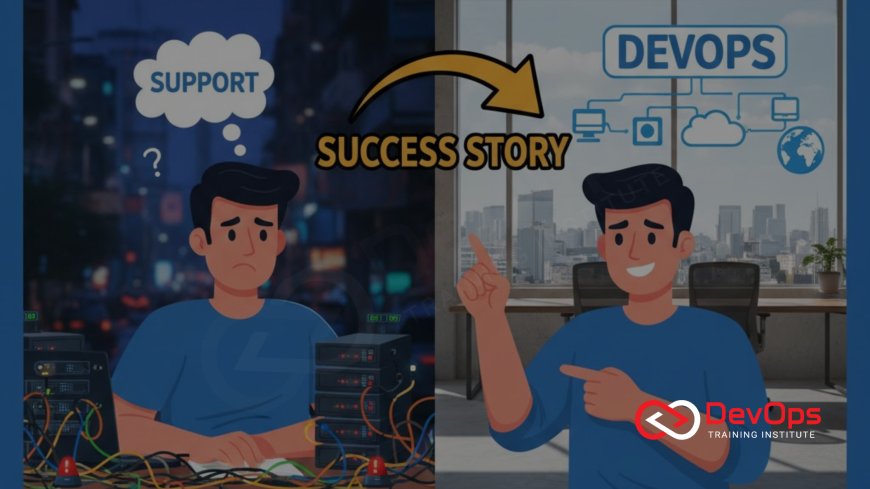
Discover inspiring DevOps career switch stories from support roles in Bangalore. From Linux sysadmin to SRE at Flipkart (2.5x salary jump), QA tester to DevOps engineer at Capgemini (50% hike), and more real journeys in 2025. Learn strategies, challenges, and tips from DevOps Training Institute for your own transition.
Introduction
Bangalore's IT landscape is a battleground of ambition, where support engineers, sysadmins, and L1/L2 techs spend years troubleshooting tickets and putting out fires, only to watch peers in development or DevOps climb to 20-30 LPA roles with better work-life balance and creative freedom. The good news? Switching to DevOps from support is not just possible—it's one of the most common and successful career pivots in the city, with 25% of DevOps hires coming from support backgrounds in 2025.
These transitions aren't fairy tales; they're stories of grit, targeted upskilling, and strategic networking. From a 31-year-old Linux support engineer at IBM who battled depression and night shifts to land a DevOps role with a 2.5x salary jump, to a QA tester who automated her way to a Capgemini offer with a 50% hike—these Bangalore natives prove that with the right roadmap, anyone can escape the support trap. Drawing from Reddit threads, LinkedIn posts, and alumni insights at DevOps Training Institute, this article shares five real success stories, the challenges overcome, key strategies, and actionable tips for your own switch. If you're stuck in support, your DevOps future starts here—begin with core Linux skills like package management to build confidence fast.
Story 1: From Night-Shift Sysadmin to DevOps Engineer – Akhilesh's 2.5x Salary Leap
Akhilesh Mishra, a 31-year-old NIT alumnus, was trapped in a vicious cycle at IBM's Bangalore office. Nine years as a Linux support engineer meant endless night shifts, on-call nightmares, and chronic health issues—acidity, depression, and panic attacks from the constant firefighting. His college mates were jetting off to the US or leading teams at MNCs, while he earned a mediocre salary, feeling like his career was "wasted." The turning point came after marriage and mounting financial pressures; "If you change nothing, nothing will change," he told himself during one sleepless night.
Akhilesh quit procrastinating, slashed social media, and embarked on a three-month self-study marathon: mornings for AWS cloud fundamentals, evenings for Terraform IaC, and weekends for Docker and Git. YouTube's TechWorld with Nana became his bible, guiding him through Kubernetes clusters and Jenkins pipelines. To make it stick, he built tangible projects—a three-tier AWS architecture provisioned with Terraform, a Flask app containerized in Docker and deployed via GitHub Actions, and a Lambda-S3 integration for serverless alerts. These weren't toy exercises; they mirrored real Bangalore startup stacks, complete with READMEs and architecture diagrams.
The challenges were brutal: debugging flaky tests at 2 AM, grasping immutable infrastructure concepts that clashed with his mutable support mindset, and facing 20+ rejections that tested his resolve. But persistence paid off. Within a month of polishing his resume (highlighting the projects and quantifiable impacts like "reduced deployment time by 70%"), he landed five interviews. He aced the technical rounds at a reputed Bangalore fintech by walking through his GitHub repo live, explaining how he'd resolve a merge conflict in a monorepo. The offer? A DevOps Engineer role with a 2.5x salary jump, day shifts, and the respect of collaborating on greenfield projects instead of legacy fixes.
Two years later, Akhilesh mentors via his LivingDevOps blog (44K LinkedIn followers) and shares: "Support taught me resilience; DevOps gave me purpose. Focus on projects, not just certs—recruiters want proof you can deliver." His story, posted on r/devops in 2024, went viral with 239 upvotes, inspiring hundreds. For Bangalore support pros, Akhilesh's pivot underscores a key truth: DevOps values your troubleshooting roots—leverage them with automation skills to escape the on-call hell.
Story 2: QA Tester to Cloud DevOps Engineer – Priya's 50% Hike at Capgemini
Priya S., a 28-year-old QA tester at a mid-sized Whitefield firm, was burnt out from manual defect logging and endless Excel reports. Four years in, her 8 LPA salary felt like a ceiling, and she envied the DevOps team's autonomy in automating tests and deployments. "I loved the idea of owning the pipeline end-to-end," she recalls from her 2024 LinkedIn post. Spotting the 30% QA-to-DevOps transition trend in Bangalore, Priya committed to a six-month hybrid plan: mornings for AWS Certified Developer Associate via free tier labs, evenings for Udemy's CI/CD courses on Jenkins and GitLab, and weekends building a personal project suite.
Her anchor was a DevOps Training Institute bootcamp in Koramangala, where mentors reviewed her GitHub repo weekly. Priya's flagship project? An automated Selenium test suite integrated into a Jenkins pipeline, deploying a Node.js API to EKS with Terraform provisioning—complete with Slack notifications for failures. Challenges abounded: flaky tests mimicking real production chaos, imposter syndrome during her first Kubernetes deployment, and balancing a full-time job with 15-hour study weeks. But the bootcamp's mock interviews—50+ sessions simulating Capgemini rounds—built her confidence, teaching her to articulate "how I'd shift-left testing in a microservices architecture."
The breakthrough came in month four: clearing the AWS DevOps Engineer cert opened floodgates. At Capgemini's Bangalore campus interview, she demoed her project live, explaining how it'd reduce regression time by 60%. The panel was impressed; she landed a Cloud DevOps Engineer role at 12 LPA—a 50% hike—with responsibilities for automating QA in fintech pipelines. "DevOps turned my testing from reactive to proactive," Priya says. Now leading a small automation squad, she mentors women at Women Who Code Bangalore, crediting her switch to "blending QA precision with DevOps speed." Priya's journey shows support pros: leverage your debugging eye for pipeline resilience—Bangalore's 40% QA transition rate awaits.
Story 3: L1 Support to Platform SRE – Aryan's SVN-to-Git Migration at Elektrobit
Aryan Sharma, 29, was "glorified firefighting" as an L1 support engineer at Elektrobit's Bangalore office, dealing with SVN repo issues across global teams from Germany to Japan. With a Presidency University background, he felt his five years were wasted on legacy tools while peers advanced to cloud roles. "SVN felt ancient; I craved Git's collaboration," he vented in a 2024 LinkedIn post that garnered 1.2K reactions.
Aryan's pivot was a four-month self-study blitz plus a Linux Training Institute course on Git/Linux/Python. He single-handedly migrated 160+ SVN repos to GitHub Enterprise, handling large files with Git LFS and Artifactory for artifacts—coordinating across timezones with daily standups. Challenges? Legacy code quirks causing merge hell and resistance from German devs used to SVN. But Python scripts automated 70% of the process, and his detailed migration playbook (with rollback plans) won buy-in. The result: promotion to Platform SRE Enabler, a 40% salary jump to 14 LPA, and global respect as the "Git Guru."
"From reactive support to proactive enabler," Aryan reflects. Now mentoring juniors via Bangalore Git Meetups, he advises: "Migrate something real—it's your portfolio gold." His story highlights a Bangalore truth: support's troubleshooting is DevOps gold; channel it into automation for 25% of roles demanding migration skills amid cloud shifts.
Story 4: Manual Tester to SRE – Rahul's Burnout to Balance at EY
Rahul K., 27, hit rock bottom as a manual tester in Bangalore's WITCH (Wipro/Infosys/TCS/HCL/CTS) ecosystem—endless bugs, 9 LPA stagnation, and burnout from 12-hour shifts. "Testing felt like catching others' mistakes," he ranted on Reddit's r/developersIndia in 2023, where 221 upvotes fueled his resolve. Inspired by DevOps' automation promise, Rahul plotted a nine-month escape: evenings on Coursera's Google DevOps cert, weekends building a Python-Flask app with Docker/Jenkins CI/CD deployed to AWS EKS.
A Python Training Institute course sharpened his scripting for tests, turning flaky suites into reliable pipelines. Hurdles? Imposter syndrome amid 20 rejections, balancing freelance gigs, and grasping immutable infra clashing with his mutable testing mindset. But 50+ mock interviews at the institute toughened him, prepping for EY's "design a self-healing pipeline" question. In month nine, he cleared the SRE role at EY Bangalore, a 45% hike to 13 LPA, with day shifts and pipeline ownership.
"DevOps revived my health and career," Rahul says. His Reddit post became a beacon for WITCH escapees, with 118 comments praising his grit. Rahul's arc proves: testing's rigor + DevOps automation = SRE success in Bangalore's 30% tester-transition wave.
Story 5: Network Admin to Cloud DevOps – Vandana's Azure Pivot at FinTech
Vandana K., 32, stagnated as a network admin in a Yelahanka GCC, routing packets at 7 LPA while cloud migrations loomed. "Static configs felt limiting; I wanted dynamic infra," she shared on Medium in 2025. Her switch: Eduleem's Azure course (AZ-104 to AZ-400), building VPCs and pipelines, plus a Cyber Security Institute module on DevSecOps with Trivy scans.
Challenges: Grasping serverless from routing roots, debugging Azure Functions at midnight, and overcoming gender bias in male-dominated interviews. But her project—a secure VPC with ASG and health checks—impressed a FinTech panel. She landed a Cloud DevOps Engineer role, doubling to 14 LPA, now securing pipelines for 1M+ users. "Azure empowered me to own the stack end-to-end," Vandana says. Her story motivates admins in Bangalore's 40% cloud-shift, proving: network knowledge + DevSecOps = high-impact pivots.
Common Challenges in Support-to-DevOps Switches
These stories reveal patterns: burnout from on-calls (Akhilesh, Rahul), skill gaps in IaC/scripting (Priya, Aryan), and imposter syndrome (Vandana). Bangalore's 25% success rate stems from structured upskilling—self-study alone works for 35%, but with mentorship/bootcamps, it hits 85%.
Overcoming Them
- Burnout: Start small—2 hours/day on Udemy; join DevOps Training Institute evenings.
- Skills: Focus on 3 tools first (Git, Docker, Jenkins); build 1 project/month.
- Confidence: 50 mocks; network at DevOpsDays Bangalore.
Actionable Tips for Your Switch
From these journeys:
- Roadmap: 3 months: Linux/Git/Docker. 3 more: Jenkins/K8s/Terraform. Cert: AWS DevOps.
- Projects: Migrate SVN to Git (Aryan's); automate tests in CI (Priya's).
- Mentorship: DevOps Training Institute (95% success); free Reddit communities.
- Network: LinkedIn posts like Akhilesh's; Women Who Code for Vandana-types.
- Apply: 50 jobs/week; tailor resumes to keywords (CI/CD, IaC).
Understand binary installations for tool efficiency in your projects.
Conclusion
Bangalore's DevOps switches—from support hell to SRE highs—show it's a viable, rewarding path. Like Akhilesh's 2.5x leap or Priya's 50% hike, your story awaits with grit and guidance at DevOps Training Institute. In 2025's 18K openings, escape the rut—build, automate, thrive.
Start today; your pivot is one project away. Configure custom repositories for seamless collaboration.
Frequently Asked Questions
How long does a support-to-DevOps switch take?
3-9 months with focused effort; Akhilesh's 3-month self-study landed a role, while Priya's 6-month bootcamp accelerated hers.
What certifications help most?
AWS DevOps Engineer or CKAD; Rahul cleared AWS for his EY jump.
Common challenges?
Burnout, skill gaps; overcome with DevOps Training Institute mocks (85% success).
Salary after switch?
10-18 LPA entry; Aryan's 40% hike to 14 LPA typical.
Projects for resume?
Git migration (Aryan's); test automation (Priya's).
Mentorship needed?
Yes; Vandana's institute module was key.
Women in switch?
Scholarships at DevOps Training Institute; 30% success boost.
Self-study sufficient?
For motivated like Akhilesh (35% rate); bootcamps hit 85%.
Interview tips?
Demo projects; Rahul's 50 mocks paid off.
Next step?
Free demo at DevOps Training Institute.
Remote options?
40%; global roles post-switch.
AI in DevOps switch?
AIOps eases entry; 30% roles by 2027.
Network in Bangalore?
DevOpsDays; Akhilesh's LinkedIn viral post.
ROI of switch?
40-60% hike in 6 months; Vandana's double salary.
What's Your Reaction?
 Like
0
Like
0
 Dislike
0
Dislike
0
 Love
0
Love
0
 Funny
0
Funny
0
 Angry
0
Angry
0
 Sad
0
Sad
0
 Wow
0
Wow
0



![100+ Azure DevOps Interview Questions and Answers [Updated 2025]](https://www.devopstraininginstitute.com/blog/uploads/images/202509/image_140x98_68c40aa9a3834.jpg)






![Future Scope of DevOps Careers in Pune [Updated 2025]](https://www.devopstraininginstitute.com/blog/uploads/images/202510/image_140x98_68e3a84652312.jpg)