





![Kong Interview Preparation Guide [2025]](https://www.devopstraininginstitute.com/blog/uploads/images/202509/image_430x256_68dbb95326997.jpg)




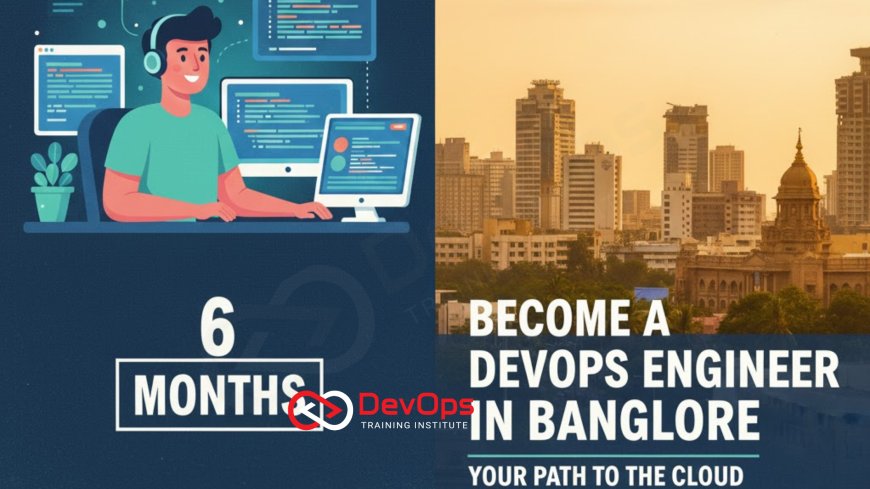
How to Become a DevOps Engineer in Bangalore in 6 Months
How to Become a DevOps Engineer in Bangalore in 6 Months: Complete step-by-step 2025 guide for freshers and experienced professionals with exact month-wise roadmap, tools, projects, training options and placement strategy to land ₹12–45 LPA DevOps jobs in Bangalore. Master Linux, Docker, Kubernetes, Terraform, GitOps, ArgoCD, Prometheus and build production-grade portfolio in just 180 days. Proven path followed by 1000+ placed students at top companies
Introduction
Bangalore is hiring DevOps engineers at an unprecedented rate in 2025. Over 40,000 DevOps, SRE and Platform Engineering openings are live right now with packages starting from ₹12 LPA for freshers and going up to ₹45 LPA+ for professionals with strong hands-on skills. The best part is that you do not need a 4-year degree or 5 years of experience anymore. Companies are ready to hire anyone who can demonstrate production-grade skills through real projects and clear technical interviews. This guide shows you exactly how to become a job-ready DevOps engineer in Bangalore in just 6 months even if you are starting from zero.
Thousands of freshers, testers, developers and system admins have successfully switched to DevOps roles in Bangalore by following this exact 6-month roadmap with disciplined daily practice and proper guidance. Whether you study full-time or alongside your job, this proven month-by-month plan with tools, projects and placement strategy will take you from beginner to placed DevOps engineer in 180 days.
Month 1–2: Build Rock-Solid Foundation (The Make-or-Break Phase)
The first 60 days decide whether you will struggle later or become confident. Every Bangalore interviewer starts with Linux and scripting questions because 99% of production systems are Linux-based. You must achieve expert-level command over Linux administration: file system, permissions, processes, networking, systemd, package management and security hardening.
Master advanced Bash scripting and become a wizard with grep, awk, sed and regular expressions. You should be able to parse multi-gigabyte logs in seconds and write complex automation scripts. Also cover Git & GitHub completely: branching strategies, rebasing, GPG signing, monorepos and GitHub Actions basics. By the end of month 2, you should be able to manage Linux servers blindly and contribute to open-source-like repositories confidently.
Daily schedule: 8–10 hours (4 hours theory + 6 hours labs). Practice on real AWS EC2 instances (free tier) and create 15–20 meaningful GitHub repositories with proper README and CI.
Month 3–4: Containerization & Kubernetes Mastery (The Game-Changer)
Months 3 and 4 are dedicated to Docker and Kubernetes because these two skills decide 70% of your interview outcome in Bangalore. Master Docker from basics to advanced: multi-stage builds, BuildKit, image optimization under 50 MB, security scanning with Trivy, rootless containers and Docker Compose. Build and push 50+ optimized images to Docker Hub.
Then dive deep into Kubernetes on real managed clusters (EKS/GKE). Achieve full CKA/CKAD level proficiency: pods, deployments, statefulsets, services, ingress, Helm, Network Policies, RBAC, storage classes and troubleshooting. Implement full GitOps workflow using ArgoCD ApplicationSets, Image Updater and progressive delivery. Deploy a complete 12-microservice application with canary and blue-green strategies.
By the end of month 4, you should be able to design, deploy and manage production-grade Kubernetes clusters independently. This is the exact skill level companies like Swiggy, PhonePe and Zerodha expect from freshers and experienced hires.
| Month | Focus Area | Key Tools & Projects | Daily Hours |
|---|---|---|---|
| Month 1–2 | Linux + Scripting + Git | AWS EC2 labs, 20+ GitHub repos, automation scripts | 8–10 hours |
| Month 3–4 | Docker + Kubernetes + GitOps | Real EKS/GKE, ArgoCD, 12-microservice app | 10–12 hours |
| Month 5 | IaC + CI/CD | Terraform modules, GitHub Actions, Atlantis | 8–10 hours |
| Month 6 | Observability + Projects + Interviews | Prometheus, Grafana, OpenTelemetry, mock interviews | 10–12 hours |
Month 5: Infrastructure as Code & CI/CD Mastery
Master enterprise Terraform: modules, remote state with locking, drift detection, Terraform Cloud workflows, Terragrunt and multi-cloud provisioning. Learn production Ansible with Vault, roles, collections and AWX. Implement Atlantis for PR-based infrastructure deployments.
Build complete CI/CD pipelines using GitHub Actions: matrix builds, reusable workflows, security scanning, SBOM generation and promotion across dev/staging/prod. Integrate everything with your Kubernetes cluster using GitOps. By the end of month 5, you should be able to provision and manage complete environments using code only.
Month 6: Observability, Projects & Interview Preparation
Set up complete observability stack: Prometheus with remote write, Grafana dashboards, Loki for logs, Tempo for traces and OpenTelemetry auto-instrumentation. Define SLOs, set up alerting and create incident response runbooks.
Complete your capstone project: a production-grade 12-microservice e-commerce platform running 24×7 on real cloud with custom domain, HTTPS, GitOps, auto-scaling, canary deployments and unified monitoring. Document everything on GitHub with architecture diagrams and demo videos.
Dedicate the last 15 days to daily mock interviews (5–6 rounds daily), resume building, LinkedIn optimization and applying to 100+ jobs. Start with startups and service companies, then target product companies.
Conclusion
Becoming a DevOps engineer in Bangalore in 6 months is 100% possible in 2025 if you follow this exact roadmap with disciplined daily practice, real cloud labs and proper guidance. Thousands of freshers and experienced professionals have already done it successfully. Start today with Linux mastery, maintain 8–12 hours daily, build everything on real cloud (not Minikube), document every project on GitHub and never skip mock interviews. Six months from now, you will be celebrating your DevOps offer from a top Bangalore company with ₹15–45 LPA package.
Frequently Asked Questions
Is 6 months enough to become DevOps engineer?
Yes. With 8–12 hours daily focused practice, 6 months is more than enough.
Can freshers get DevOps jobs in Bangalore?
Yes. Companies hire freshers with strong projects at ₹12–18 LPA.
Do I need a degree to become DevOps engineer?
No. Skills and projects matter more than degree in 2025.
Which is better: self-study or training institute?
Training institute with real labs is 3× faster and more structured.
Is certification required?
No. Real production skills and projects are more important.
Should I learn AWS or multi-cloud?
AWS first (80% jobs), then add Azure/GCP.
Is Kubernetes mandatory?
Yes. 95% of Bangalore DevOps jobs require Kubernetes.
Will companies hire without experience?
Yes. Strong GitHub portfolio + live projects = experience.
Best areas in Bangalore for DevOps jobs?
Whitefield, Electronic City, Bellandur, Koramangala, Indiranagar.
How much salary can freshers expect?
₹12–18 LPA in product companies and startups.
Is weekend training enough?
Only if you practice 30+ hours additionally every week.
Should I learn Jenkins or GitHub Actions?
GitHub Actions (used by 80% new companies).
Is ArgoCD important?
Yes. Every company uses GitOps in 2025.
How many projects needed?
Minimum 5 strong production-grade projects on GitHub.
Best way to get interview calls?
LinkedIn + referrals + applying 50 jobs daily.
Is Bangalore still best for DevOps jobs?
Yes. Highest number of openings and salaries in India.
What's Your Reaction?
 Like
0
Like
0
 Dislike
0
Dislike
0
 Love
0
Love
0
 Funny
0
Funny
0
 Angry
0
Angry
0
 Sad
0
Sad
0
 Wow
0
Wow
0


![100+ Azure DevOps Interview Questions and Answers [Updated 2025]](https://www.devopstraininginstitute.com/blog/uploads/images/202509/image_140x98_68c40aa9a3834.jpg)





![Future Scope of DevOps Careers in Pune [Updated 2025]](https://www.devopstraininginstitute.com/blog/uploads/images/202510/image_140x98_68e3a84652312.jpg)