





![Kong Interview Preparation Guide [2025]](https://www.devopstraininginstitute.com/blog/uploads/images/202509/image_430x256_68dbb95326997.jpg)





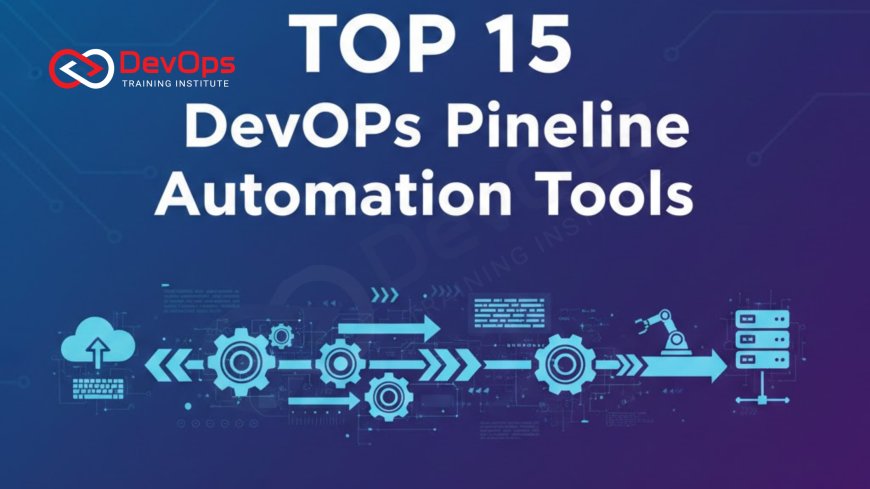
Top 15 DevOps Pipeline Automation Tools
Discover the 15 best DevOps pipeline automation tools in 2025 that leading teams actually use to build, test, deploy, and monitor applications at scale. From GitHub Actions and GitLab CI to Jenkins X, Argo Workflows, Tekton, and Spinnaker, this in-depth guide compares features, pricing, ease of use, Kubernetes integration, security, and real-world adoption so you can choose the perfect CI/CD solution for your team, whether you’re a startup or a Fortune 500 enterprise.
Introduction
The speed and reliability of your software delivery pipeline directly determines how fast you can deliver value to customers. In 2025, the best DevOps teams deploy multiple times per day with near-zero downtime, and they achieve this through powerful, modern automation tools.
This guide ranks and deeply compares the top 15 DevOps pipeline automation tools used today, from open-source classics to cloud-native innovators. Each tool is evaluated on real-world use cases, scalability, Kubernetes support, developer experience, security, and cost so you can make an informed decision for your organization.
1. GitHub Actions – The Default Choice for Most Teams
GitHub Actions has become the most widely adopted CI/CD platform because it’s built directly into GitHub, supports any language and platform, and offers generous free minutes.
- Native marketplace with thousands of actions
- Matrix builds, reusable workflows, OIDC authentication
- Free for public repos, 2,000 minutes/month free for private
- Excellent Kubernetes integration via actions like helm/deploy
- Perfect for open-source and small-to-medium teams
2. GitLab CI/CD – All-in-One DevOps Platform
GitLab offers the most complete built-in CI/CD experience with Auto DevOps, review apps, canary deployments, and built-in S3 + CloudFront container registry.
- Single .gitlab-ci.yml file for entire pipeline
- Powerful include: and rules: for reusability
- Free tier includes 400 CI minutes/month
- Best for teams wanting everything in one platform
3. Jenkins – Still Alive and Strong in Enterprises
Despite being the oldest tool, Jenkins remains dominant in large enterprises thanks to its unmatched plugin ecosystem and flexibility.
- Over 1,800 plugins including Kubernetes, SonarQube, HashiCorp Vault
- Declarative and scripted Pipeline as Code
- Jenkins X brings cloud-native experience (Tekton under the hood)
- Requires significant maintenance unless using Jenkins X or cloud versions
4. Jenkins X – Cloud-Native Jenkins for Kubernetes
Jenkins X automates CI/CD best practices on Kubernetes using Tekton, Helm, and GitOps (ArgoCD/Flux).
- Automatic preview environments for every PR
- Promotion via GitOps, not manual clicks
- Built-in Tekton pipelines and Prow for chatops
- Ideal for teams fully committed to Kubernetes
5. Argo Workflows & Argo CD – The GitOps Power Couple
Argo Workflows is the leading Kubernetes-native workflow engine for complex pipelines (ML, data, batch).
- DAG or steps-based pipelines defined in YAML
- Artifact passing, parameterisation, caching
- Argo Events adds event-driven triggers
- When combined with Argo CD, you get full GitOps delivery
- Used by Adobe, Nvidia, Intuit
6. Tekton – Kubernetes-Native Pipelines Standard
Tekton is the CNCF-graduated standard for building CI/CD pipelines directly on Kubernetes using custom resources.
- Pipelines, Tasks, Triggers as first-class CRDs
- Highly reusable tasks from Tekton Hub
- Powers Jenkins X, OpenShift Pipelines, Google Cloud Build
- Perfect for platform teams building internal developer platforms
7. Harness – Enterprise DevOps Platform
Harness offers AI-powered continuous delivery with built-in verification, canary, and blue-green deployments.
- Zero-touch progressive delivery
- Automatic rollback based on metrics/logs
- First-class Kubernetes, ECS, serverless support
- Strong governance and audit features using OAC vs Signed URLs patterns
8. CircleCI – Developer-Friendly Cloud CI/CD
Known for speed and simplicity, CircleCI pioneered config-as-code with YAML.
- Orbs marketplace for reusable components
- Insights dashboard with performance metrics
- Excellent Docker and Kubernetes support
- Free plan includes 6,000 build minutes/month
9. Spinnaker – Multi-Cloud Continuous Delivery
Originally created by Netflix, Spinnaker excels at complex deployment strategies across multiple clouds.
- Native support for canary, blue-green, rolling updates
- Deep integration with Kubernetes, AWS, GCP, Azure
- Automated canary analysis with Kayenta
- Best for large organizations with complex deployment needs
10. Drone – Container-Native, Open Source CI
Drone is lightweight, Docker-based CI that runs each step in isolated containers.
- Simple .drone.yml syntax
- Excellent plugin system (Slack, S3, CloudFront cache invalidation)
- Self-hosted or cloud version
- Perfect for teams that love simplicity
11. Buildkite – Hybrid CI/CD with Unmatched Scalability
Buildkite combines a beautiful hosted control plane with self-hosted agents you control.
- Unlimited concurrency (run your own agents)
- Pipeline as code with YAML + dynamic pipelines
- Used by Shopify, Airbnb, Intercom
- Excellent for security-sensitive organizations
12. Codefresh – GitOps-First Kubernetes Platform
Codefresh was built from the ground up for Kubernetes and GitOps using Argo under the hood.
- Visual pipeline builder + YAML mode
- Built-in image scanning, DORA metrics
- Progressive delivery with Argo Rollouts
- Free startup plan available
13. TeamCity – Powerful Enterprise Solution from JetBrains
TeamCity offers deep integration with JetBrains IDEs and strong enterprise features.
- Excellent Kotlin DSL for pipelines
- Built-in vulnerability scanner
- Powerful agent pool management
- Free for up to 100 build configurations
14. Bamboo – Atlassian’s Enterprise CI/CD
Tightly integrated with Jira, Bitbucket, and Confluence.
- Great for teams already in Atlassian ecosystem
- Deployment projects separate build from release
- Strong permissions and audit trail
15. Flux CD – Lightweight GitOps Engine
While not a full CI tool, Flux excels at the CD part with Kustomize and Helm support.
- Declarative, pull-based GitOps
- Multi-tenancy and policy enforcement
- Used with GitHub Actions or GitLab CI for complete flow
Comparison Table: Top 15 DevOps Pipeline Tools
| Tool | Hosting | Kubernetes Native | Free Tier | Best For |
|---|---|---|---|---|
| GitHub Actions | Cloud | Strong | Generous | Most teams |
| GitLab CI | Both | Excellent | Yes | All-in-one platform |
| Argo Workflows | Self-hosted | Native | Free | Complex workflows |
| Tekton | Self-hosted | Native | Free | Platform teams |
| Harness | Cloud | Excellent | Limited | Enterprise |
Conclusion
There is no single “best” DevOps pipeline tool in 2025, only the best tool for your team’s specific needs. Startups and open-source projects love GitHub Actions and GitLab CI for their simplicity and generous free tiers. Kubernetes-first organizations are moving to Argo Workflows, Tekton, and Jenkins X. Large enterprises often choose Harness, Spinnaker, or stay with battle-tested Jenkins.
The winning strategy most successful companies follow is: use a modern tool that supports pipeline-as-code, integrates natively with Kubernetes, and empowers developers without sacrificing security or governance. Pick one from this list, invest in reusable templates, and combine it with SNS notifications, Lambda alerts, FIFO queues for ordering, and dead-letter queues for reliability, and you’ll be shipping production-grade software faster than ever.
Frequently Asked Questions
Which CI/CD tool is most popular in 2025?
GitHub Actions has the highest adoption, followed closely by GitLab CI and Jenkins.
Should I use Jenkins in 2025?
Yes, especially in enterprises. For new projects, consider cloud-native alternatives first.
Is Argo better than Jenkins?
Different use cases. Argo Workflows excels at Kubernetes-native workflows; Jenkins at general-purpose CI.
Do I need both CI and CD tools?
Many modern tools (GitHub Actions, GitLab) cover both. Separate CD tools shine for complex strategies.
Which tool is best for Kubernetes?
Tekton, Argo Workflows, and Jenkins X are the most Kubernetes-native.
Are free tools secure enough for enterprise?
Yes. GitHub Actions and GitLab CI have enterprise-grade security features and SOC2 compliance.
Can one tool handle ML pipelines too?
Argo Workflows and Tekton are excellent for data and ML workflows.
What about Windows and .NET support?
Azure DevOps, TeamCity, and GitHub Actions (Windows runners) have the best support.
Is Spinnaker still relevant?
Yes for complex multi-cloud deployments, though many are moving to Argo Rollouts + Flux/ArgoCD.
How do I choose between self-hosted and cloud?
Cloud for speed of setup and maintenance; self-hosted for data control and unlimited scale.
What's Your Reaction?
 Like
0
Like
0
 Dislike
0
Dislike
0
 Love
0
Love
0
 Funny
0
Funny
0
 Angry
0
Angry
0
 Sad
0
Sad
0
 Wow
0
Wow
0


![100+ Azure DevOps Interview Questions and Answers [Updated 2025]](https://www.devopstraininginstitute.com/blog/uploads/images/202509/image_140x98_68c40aa9a3834.jpg)





![Future Scope of DevOps Careers in Pune [Updated 2025]](https://www.devopstraininginstitute.com/blog/uploads/images/202510/image_140x98_68e3a84652312.jpg)