


![Kong Interview Preparation Guide [2025]](https://www.devopstraininginstitute.com/blog/uploads/images/202509/image_430x256_68dbb95326997.jpg)




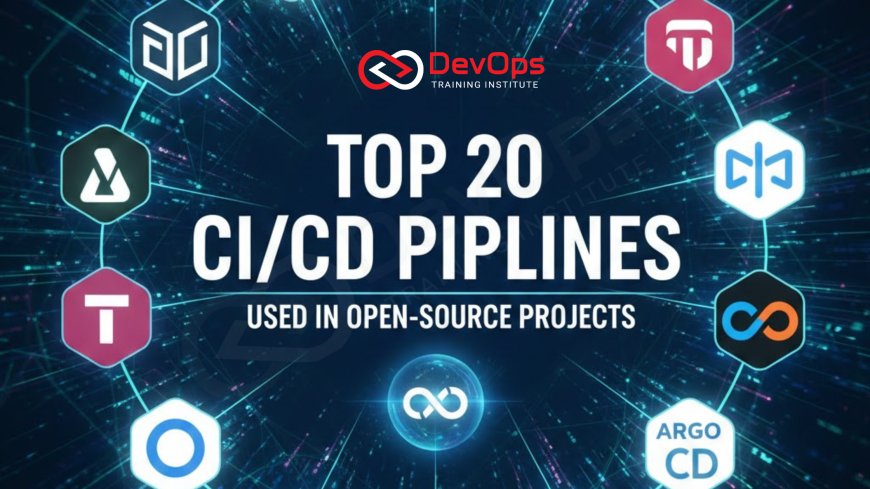
Top 20 CI/CD Pipelines Used in Open-Source Projects
Explore the top 20 CI/CD pipelines and tools dominating the open-source landscape, revealing the platforms developers trust to ensure code quality and continuous delivery. This essential guide covers highly flexible self-hosted solutions like Jenkins and cloud-native integrated platforms like GitHub Actions and GitLab CI/CD. Learn the strategies behind open-source success, emphasizing fast feedback loops, free tiers for public projects, and deep integration with version control systems. Discover how Kubernetes-native tools like Argo CD and Tekton are defining the future of cloud-native development within the open-source community, making continuous integration accessible to everyone.
Introduction: The Backbone of Open Source
The success of the open-source movement—from the foundational operating system like Linux itself to cutting-edge cloud-native projects under the Cloud Native Computing Foundation (CNCF)—is fundamentally reliant on robust, automated Continuous Integration and Continuous Delivery (CI/CD) pipelines. In an environment where hundreds or even thousands of developers globally contribute code changes daily, a manual testing and release process is simply unfeasible. The CI/CD pipeline acts as the objective, automated gatekeeper, ensuring that every code contribution is immediately built, tested, and validated against the project's standards, allowing maintainers to merge contributions with confidence and maintain a stable master branch.
For open-source projects, the choice of a CI/CD tool is often dictated by factors far more critical than cost (as many offer free tiers for public repositories): the need for fast feedback loops, deep integration with version control (typically GitHub), and the ability to test across multiple operating systems and programming language versions easily. These projects serve as the ultimate proving ground for CI/CD tools, pushing them to their limits in terms of scalability, concurrent execution, and community adoption. By examining the top 20 pipelines used in this ecosystem, we gain a clear insight into the platforms that truly deliver efficiency and reliability at the engineering frontier.
The widespread adoption of these tools within the open-source community has directly contributed to the advancement of technology itself. The collaborative nature of the movement, fueled by efficient CI/CD, is largely responsible for the cloud's current shape and the dominance of platforms like Linux in enterprise environments, demonstrating how the open source ethic has propelled technological progress globally.
The Titans of Open Source CI/CD
Several tools have achieved legendary status in the open-source community, largely due to their early adoption, robust feature sets, and, crucially, their accessible pricing models for public repositories. These platforms are used by projects of all sizes and complexities, forming the most recognized and influential segment of the CI/CD landscape.
- Jenkins: The veteran open-source automation server remains widely popular due to its immense flexibility and vast plugin ecosystem. Since it is self-hosted, projects that require highly specific, non-standard, or resource-intensive build environments often choose Jenkins, running it on their own dedicated infrastructure. Its "Pipeline as Code" feature (using the Groovy-based Jenkinsfile) allows the pipeline definition to be version-controlled alongside the application code.
- GitHub Actions: This cloud-native solution has rapidly become a favorite, especially for projects hosted on GitHub (the dominant platform for open source). GitHub Actions offers a generous free tier for all public repositories, enabling automation right where the code lives. Its primary strength lies in its simplicity, native integration with GitHub events (pull requests, issues, commits), and a massive marketplace of reusable actions, making it incredibly fast and easy to set up sophisticated workflows using simple YAML files.
- GitLab CI/CD: As a unified DevOps platform, GitLab CI/CD offers deep integration with its version control system, making it an excellent all-in-one solution for teams seeking minimal tool sprawl. Open-source projects on GitLab benefit from native features like built-in security scanning, a container registry, and auto-scaling runners, all defined via a simple .gitlab-ci.yml file, enforcing a unified development, security, and operations workflow within a single interface.
- CircleCI: Known for its speed, simplicity, and excellent cloud-based performance, CircleCI is highly popular among open-source projects that prioritize quick build times. It offers free access to its platform for public projects, featuring powerful parallelization, smart caching, and support for running jobs across various environments (Docker, Linux, macOS, Windows), providing the flexibility needed for multi-platform projects.
- Travis CI: One of the first cloud-based CI services offered specifically for open-source projects, Travis CI built its reputation on its deep integration with GitHub and its simple, YAML-based configuration. While newer tools have emerged, Travis CI remains a recognized and reliable choice, particularly for older, established projects due to its historical presence and straightforward setup process, supporting many languages and build matrices.
Kubernetes-Native and GitOps Orchestrators
The shift towards cloud-native architecture, dominated by containers and Kubernetes, has led to the emergence of CI/CD tools designed specifically to run *on* and deploy *to* Kubernetes clusters. These tools adopt the GitOps model, using Git as the single source of truth for the desired state of both the application and the infrastructure, providing unparalleled auditability and automated deployment accuracy for complex microservices architecture.
6. Argo CD: A flagship open-source project and CNCF Graduated project, Argo CD is the quintessential GitOps continuous delivery tool for Kubernetes. It is not a traditional CI tool but focuses purely on the CD side, automating the synchronization of the live cluster state with the desired state defined in a Git repository. Many large, complex open-source projects use Argo CD to manage multi-cluster deployments declaratively, ensuring consistency, automated drift detection, and providing a visual interface for application status and health.
7. Tekton: Another CNCF project, Tekton is an open-source framework designed to create flexible, reusable, and cloud-native CI/CD pipelines that run natively on Kubernetes. By leveraging Kubernetes Custom Resource Definitions (CRDs), Tekton allows developers to define pipeline tasks and steps as reusable components, making it highly modular and scalable. It is often chosen by projects looking to build a vendor-neutral, highly customizable pipeline solution that runs entirely within their container orchestration layer.
8. Spinnaker: While often associated with large enterprises, Spinnaker is an open-source, multi-cloud continuous delivery platform that originated at Netflix. It is widely used by open-source projects that require advanced deployment strategies like automated canary and blue/green releases, and need to deploy across different environments or cloud providers. Its powerful release orchestration and built-in safety features make it essential for projects prioritizing high velocity with minimal risk, managing the entire CD flow.
Specialized and Hybrid Solutions
Beyond the major players, several specialized and hybrid solutions cater to specific needs within the open-source ecosystem, such as supporting highly customized infrastructure, prioritizing speed, or focusing on mobile development platforms. These tools demonstrate the diverse range of needs that require automation in the modern development environment.
9. Buildkite: A popular hybrid CI/CD platform that allows open-source projects to run builds on their own infrastructure (self-hosted agents) while leveraging Buildkite's centralized, cloud-based orchestration and visualization dashboard. This offers projects the security and control of self-hosting, ensuring custom or sensitive build environments are managed internally, combined with the convenience of a modern, centralized CI platform.
10. Drone: A simple, open-source CI/CD system built on Docker. Drone executes every stage of the pipeline inside isolated Docker containers, guaranteeing that every build is clean, repeatable, and consistent. Its simplicity and native container integration make it a fast, minimalist choice for open-source projects and companies focused entirely on Docker and containerized deployment patterns, minimizing external dependencies and configuration complexity.
Pipeline Tools Comparison for Open Source
Selecting the ideal CI/CD pipeline for an open-source project requires a careful balance between features, community support, cost structure, and hosting model. The tools below summarize the key attributes of the top 20 choices, highlighting their primary use case within the collaborative, non-commercial environment that drives the movement forward.
| Pipeline Tool | Key Strength for Open Source | Hosting Model | Configuration Language |
|---|---|---|---|
| GitHub Actions | Native integration with GitHub and large Marketplace of reusable actions. | Cloud-Hosted (Free for Public Repos) | YAML |
| Jenkins | Unmatched customization, extensibility, and legacy system integration via plugins. | Self-Hosted | Groovy (Jenkinsfile) |
| GitLab CI/CD | All-in-one DevOps platform with integrated SCM, security scanning, and CI/CD. | Cloud / Self-Hosted | YAML (.gitlab-ci.yml) |
| CircleCI | High speed, performance, and strong support for multi-OS builds (Linux/macOS/Windows). | Cloud-Hosted (Free for Public Repos) | YAML |
| Argo CD | Kubernetes-native, declarative continuous delivery tool leveraging the GitOps model. | Self-Hosted (on K8s) | YAML/Git |
| Travis CI | Historical choice, known for simple setup and deep integration with GitHub for small projects. | Cloud-Hosted | YAML (.travis.yml) |
| Tekton | CNCF project focused on building reusable, modular, cloud-native pipelines that run natively on K8s. | Self-Hosted (on K8s) | YAML (CRDs) |
| Spinnaker | Open-source, multi-cloud CD platform for advanced deployment strategies (Canary/Blue-Green). | Self-Hosted | JSON/YAML |
The Open Source Ethos and Tooling
The open-source community's preference for certain CI/CD tools reflects not just technical capability but adherence to core values like transparency, customizability, and community-driven evolution. Many of these tools, like Jenkins, Tekton, and Argo CD, are themselves open-source projects, reinforcing the ecosystem. The spirit of collaboration that drives developers to contribute code globally is mirrored in the CI/CD pipeline's function: immediate feedback, shared standards, and automation that facilitates quick iteration on the core product.
The success of the open-source movement, which led to the proliferation of operating systems like Linux in data centers and the cloud, is fundamentally linked to the tools that automate distribution. Efficient CI/CD pipelines allow maintainers to trust code submitted from thousands of contributors they have never met. This trust is achieved through continuous testing and automated quality gates, ensuring that the final binary or library distributed globally is stable, secure, and compliant with project standards. This continuous validation process is the engine of the rapid innovation cycle that characterizes projects hosted on platforms like GitHub.
Kubernetes and the Cloud-Native Revolution
The landscape of open-source CI/CD is increasingly defined by the cloud-native computing movement. Tools like Argo CD and Tekton signify a shift away from traditional, centralized CI servers (like Jenkins masters) towards decentralized pipelines that run as native resources within Kubernetes. This paradigm ensures that the pipeline itself benefits from the elasticity, resilience, and horizontal scaling capabilities of the container orchestrator, aligning perfectly with the scalable nature of modern open-source projects.
The emphasis on GitOps, driven by tools like Flux (a competitor to Argo CD) and integrated solutions like GitLab CI/CD's deployment management, treats the Git repository as the single source of truth for the entire application and its infrastructure. This not only makes deployments easily auditable but also allows any maintainer to quickly understand the running state of the application simply by inspecting the version-controlled manifests, facilitating easier collaboration and transparent operations for a globally distributed team. The philosophy of treating operations as code is now mandatory for any serious cloud-native endeavor.
Securing the Open Source Supply Chain
Given the global focus on software supply chain security, CI/CD tools used by open-source projects must integrate robust scanning and governance features, especially since the quality of contributions can vary widely. Pipelines are now expected to include mandatory steps for dependency checking, ensuring that known vulnerabilities are not introduced. Tools like GitLab CI/CD and external scanners integrated into GitHub Actions workflows automatically check for Common Vulnerabilities and Exposures (CVEs) in application code and container base images before the artifact is built and released to the community. This continuous security validation is vital for the integrity of the ecosystem.
The history of open source shows that security has always been a key concern, driving developers to constantly test and patch core systems. The widespread adoption of Linux, often managed by system administrators, reinforced the value of transparency and community oversight. Today's CI/CD pipelines extend this scrutiny into the automated delivery process, ensuring that the final product is not only functional but also continuously verified against evolving threat landscapes, protecting the reputation and stability of foundational projects.
The Role of Code Hosts: GitHub, GitLab, and Bitbucket
The rise of integrated CI/CD platforms is largely tied to the dominance of the major code hosts. For open-source projects, the choice of platform (GitHub, GitLab, or Bitbucket) often dictates the immediate choice of CI/CD tool, as native solutions offer the simplest setup and deepest integration with events, secrets, and collaboration features. The free tiers offered by these platforms for public repositories are what make enterprise-grade automation accessible to individual developers and non-commercial projects, fostering innovation globally.
GitHub Actions and GitLab CI/CD are the current leaders in the open-source space because they provide an end-to-end experience where code, review, and continuous deployment are managed within a single system, streamlining the process of accepting and validating community contributions. Even platforms that require self-hosting, like Jenkins, maintain robust plugins to trigger pipelines based on webhooks from these major code hosts, demonstrating that strong integration with the source code repository is the absolute starting point for any effective open-source CI/CD workflow.
Conclusion
The top 20 CI/CD pipelines used in the open-source world are characterized by their commitment to automation, speed, transparency, and deep integration with the source control system. Whether a project relies on the legacy flexibility of Jenkins, the native simplicity of GitHub Actions, the unified power of GitLab CI/CD, or the cloud-native rigor of Argo CD and Tekton, the common denominator is a relentless focus on automated testing and continuous delivery. These tools are the unseen engine that powers the world's innovation, allowing a globally distributed community to collaborate safely and efficiently.
The long-term trend points towards fully containerized, Kubernetes-native pipelines managed via the GitOps model, reinforcing the principles of declarative configuration and auditability that underpin resilient software delivery. By choosing a solution from this proven list, any open-source project can ensure high code quality, accelerate its release cycle, and confidently grow its contributor base, furthering the collaborative spirit that has defined the movement since its earliest days and enabling the continued evolution of platforms like the Linux kernel.
Frequently Asked Questions
Why are CI/CD pipelines free for open-source projects?
Many providers offer free tiers for public open-source projects to promote adoption, encourage community use, and contribute back to the technology ecosystem's evolution.
What is the biggest advantage of using GitHub Actions for open source?
The biggest advantage is its native, seamless integration with GitHub repositories, secrets, and events, simplifying setup and deployment for developers already using the platform.
How does Jenkins compare to GitLab CI/CD for open source?
Jenkins offers more customizability and plugins, while GitLab CI/CD offers a more streamlined, integrated, all-in-one DevOps platform experience with built-in features.
What is the main role of Argo CD?
The main role of Argo CD is continuous delivery, automating the synchronization of the live Kubernetes cluster state with the desired configuration defined in a Git repository using GitOps principles.
Why is automated testing so critical in open-source CI/CD?
Automated testing is critical because it acts as the primary quality gate for contributions from potentially thousands of unknown developers, ensuring code stability before merging.
What is the primary benefit of using the Tekton framework?
The primary benefit is building modular, reusable, and cloud-native pipelines that run natively on Kubernetes, leveraging its scalability and resilience capabilities.
How does CI/CD relate to the growth of Linux?
Efficient CI/CD pipelines are essential for continuously testing and deploying new versions of the Linux kernel and its distributions, ensuring stability and rapid evolution within the open-source community.
What is the purpose of a multi-OS build matrix?
A multi-OS build matrix allows a project to automatically build and test its code across different operating systems (Linux, macOS, Windows) and language versions simultaneously.
Which CI/CD tool is known for its Value Stream Map (VSM)?
GoCD is the tool known for its VSM, providing a clear visualization of the entire pipeline, from code commit through to final deployment.
What is the benefit of using a hybrid tool like Buildkite?
Hybrid tools like Buildkite offer the control and security of running build agents on custom, self-hosted infrastructure while providing a centralized, cloud-based orchestration dashboard.
How does the open-source movement affect cloud platforms?
The open-source movement strongly influences cloud platforms by providing essential foundational technologies like Linux, Kubernetes, and Terraform, accelerating adoption and ensuring vendor neutrality.
What is the difference between Travis CI and GitHub Actions?
Travis CI is a separate cloud service, while GitHub Actions is integrated directly into the GitHub platform, making its setup and workflow execution more seamless for GitHub users.
What is the significance of the CNCF in CI/CD?
The CNCF hosts and governs many of the foundational cloud-native projects (like Kubernetes, Tekton, and Argo CD), driving standardization and enterprise readiness for CI/CD technologies.
Why are container-native pipelines (like Drone) popular in open source?
Container-native pipelines are popular because they guarantee a clean, consistent, and reproducible build environment by executing every job step inside an isolated Docker container.
How does the open-source culture relate to CI/CD?
The open-source culture of collaboration, transparency, and continuous improvement is mirrored in the principles of CI/CD, which enforce shared standards and continuous feedback loops on all contributions.
What's Your Reaction?
 Like
0
Like
0
 Dislike
0
Dislike
0
 Love
0
Love
0
 Funny
0
Funny
0
 Angry
0
Angry
0
 Sad
0
Sad
0
 Wow
0
Wow
0

![100+ Azure DevOps Interview Questions and Answers [Updated 2025]](https://www.devopstraininginstitute.com/blog/uploads/images/202509/image_140x98_68c40aa9a3834.jpg)





![Future Scope of DevOps Careers in Pune [Updated 2025]](https://www.devopstraininginstitute.com/blog/uploads/images/202510/image_140x98_68e3a84652312.jpg)