











![Kong Interview Preparation Guide [2025]](https://www.devopstraininginstitute.com/blog/uploads/images/202509/image_430x256_68dbb95326997.jpg)







10 Benefits of Continuous Security Testing
Discover the transformative advantages of integrating continuous security testing into your development lifecycle. This comprehensive guide explains how persistent vulnerability scanning and automated security checks protect your digital assets from evolving threats. Learn how to bridge the gap between rapid software delivery and robust protection while enhancing team collaboration and regulatory compliance. Explore the essential benefits of identifying risks early to ensure your applications remain secure, reliable, and trustworthy in a competitive technological landscape.
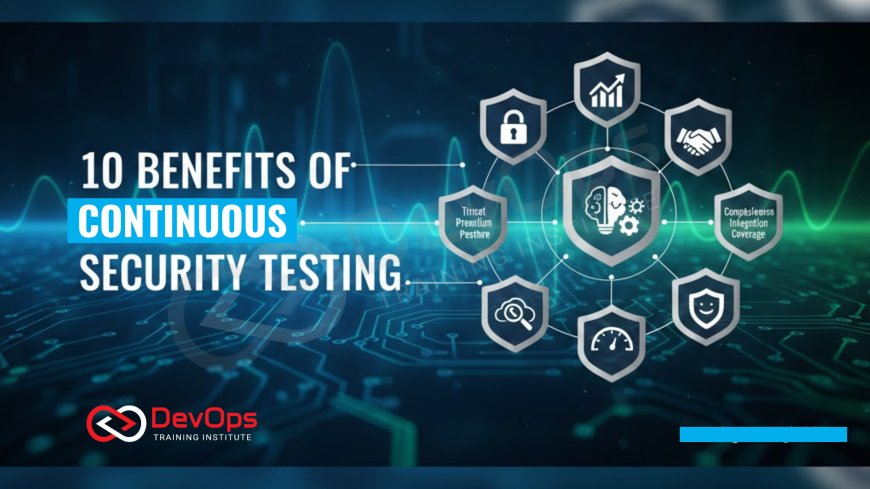
Introduction to Modern Security Testing
In the traditional software development world, security was often treated as a final hurdle. Developers would build an entire application and then hand it over to a security team for a single, massive audit right before release. This approach frequently led to significant delays and expensive late stage fixes. As businesses move toward faster delivery cycles, this old fashioned method has become a major bottleneck that can no longer keep up with the pace of modern technology.
Continuous security testing is a modern approach that weaves safety checks into every single step of the development process. Instead of waiting until the end, security happens constantly, much like how a modern car monitors its engine health while you drive. By automating these checks, organizations can find and fix vulnerabilities as soon as they are introduced. This proactive mindset is essential for any company that wants to balance high speed innovation with the absolute necessity of protecting sensitive user data and maintaining system integrity.
Early Vulnerability Detection and Prevention
One of the most significant advantages of this approach is the ability to catch flaws at the very moment they are created. When a developer writes a piece of code that contains a common security mistake, an automated test can flag it immediately. This immediate feedback loop allows the programmer to fix the issue while the code is still fresh in their mind, preventing the mistake from ever reaching the production environment where it could be exploited.
This concept is a core part of a critical strategy for modern teams. By moving security to the beginning of the cycle, companies avoid the "firefighting" mode that occurs when a critical bug is found just days before a major launch. It turns security into a manageable, daily task rather than a terrifying emergency. This shift not only protects the application but also builds a culture of quality where everyone feels responsible for the safety of the final product.
Cost Reduction Through Proactive Fixing
Fixing a security hole after an application has been deployed is incredibly expensive. You have to investigate the breach, develop a patch, test it under pressure, and then explain the situation to your customers. In contrast, fixing that same hole during the initial coding phase costs almost nothing. Continuous testing acts as a financial safeguard, ensuring that small errors do not snowball into multi million dollar liabilities or devastating data breaches that could sink a company.
By automating these checks, organizations also reduce the need for massive, manual penetration testing sessions which are often slow and very costly. While manual testing still has its place for complex logic, the bulk of repetitive security work is handled by the system. This allows the organization to focus its human expertise on more creative tasks, such as designing better architecture or exploring how cloud spend can be optimized without sacrificing the protective layers that keep the infrastructure safe from hackers.
Enhanced Collaboration and Shared Responsibility
Continuous testing breaks down the walls between developers, operations, and security specialists. In the past, these groups often worked in silos, sometimes even viewing each other as obstacles. When security is integrated into the daily workflow, it becomes a shared language. Developers gain better insights into secure coding practices, and security experts gain a better understanding of how the application actually functions in a real world environment.
This collaborative spirit is at the heart of how security integrates into modern pipelines. It ensures that security is no longer "someone else's problem." When the automated tools provide clear, actionable reports directly to the people writing the code, the friction between teams evaporates. This unity leads to a more resilient organization that can respond to new threats with agility and confidence, knowing that every team member is pulling in the same direction to keep the system secure.
Table: Key Components of Continuous Security
| Testing Phase | Tool Type | Primary Focus | Frequency |
|---|---|---|---|
| Code Commit | SAST (Static Analysis) | Scanning source code for vulnerabilities. | Every code push. |
| Build Stage | SCA (Software Composition) | Checking third party libraries for bugs. | During every build. |
| Deployment | DAST (Dynamic Analysis) | Testing the running app for flaws. | Before every release. |
| Infrastructure | IaC Scanning | Ensuring cloud configs are safe. | Daily/On config change. |
Real Time Monitoring and Faster Response
Security is not a "set it and forget it" task because the threat landscape changes every day. New vulnerabilities in popular libraries are discovered constantly. Continuous testing includes real time monitoring that watches your production environment for any signs of trouble. This allows your team to react in minutes rather than days if a new threat emerges that targets your specific stack or configuration.
This high level of awareness is a major part of observability in modern systems. When you have a deep understanding of your system's normal behavior, it becomes much easier to spot an anomaly that might indicate a breach. Automated alerts can trigger self healing mechanisms or immediately notify the on call team, significantly reducing the "mean time to repair." This rapid response capability is often the difference between a minor incident and a front page news disaster.
Regulatory Compliance and Audit Readiness
Many industries, such as finance and healthcare, are governed by strict rules regarding data safety. Maintaining compliance with standards like SOC2, GDPR, or HIPAA can be an administrative nightmare if done manually. Continuous security testing simplifies this by automatically generating logs and reports that prove your security controls are functioning as intended. It turns the stressful yearly audit into a routine verification of existing data.
With automated checks, you can ensure that every change to your environment follows the rules set by your compliance department. This is where infrastructure automation proves its worth, as it allows for policy as code. If someone tries to deploy a server with an open, insecure port, the system can automatically block the change and log the event. This constant state of audit readiness gives the business peace of mind and builds significant trust with partners and customers alike.
Strengthening System Resilience
Continuous testing does more than just find bugs; it helps build a more robust architecture that can withstand unexpected shocks. By constantly poking and prodding the system, you discover hidden weaknesses that might not be obvious during normal operation. This strengthens the overall foundation of the software, making it harder for any single failure to bring the entire service down or expose sensitive information to the public.
Teams can even go a step further by using chaos engineering to intentionally inject security failures into a safe environment. This allows the team to practice their response and verify that their automated security layers work as expected under pressure. The result is a system that is not just "safe" in a static sense, but truly resilient in the face of the chaotic and unpredictable nature of the internet, ensuring that service remains available even during an ongoing attack.
Safe and Confident Continuous Delivery
The ultimate goal of many modern teams is to release updates several times a day. This is impossible if every release requires a week long security review. Continuous security testing provides a "green light" that allows teams to deploy with confidence. If the code passes the automated security suite, the team knows it meets the organization's safety standards, allowing them to hit the release button without fear of introducing a major vulnerability.
- Automated scans ensure that no known high risk bugs reach the live users.
- Testing environments are kept identical to production to catch environmental flaws early.
- Security checks are run in parallel with functional tests to save time.
- The system can automatically rollback a change if security anomalies are detected post launch.
This confidence enables advanced techniques like canary releases where new code is tested on a tiny fraction of users before a full rollout. Because security is verified at every step, the risk associated with these rapid updates is minimized. It transforms security from a department that says "no" into a system that says "yes, safely," empowering the business to innovate at the speed of thought while keeping the digital doors locked tight against intruders.
Conclusion
In conclusion, continuous security testing is no longer a luxury for top tier tech firms; it is a necessity for any organization that operates in the digital space. By moving security from a final check to a constant companion, businesses can enjoy faster delivery cycles, significantly lower costs, and much higher levels of protection. We have seen how it fosters team collaboration, ensures compliance, and builds the kind of system resilience that is required to survive in today's threat heavy environment. Most importantly, it provides the confidence to innovate rapidly, knowing that a robust automated safety net is always in place. As you look to the future, remember that security is a journey of constant improvement rather than a destination. Embracing these ten benefits will not only safeguard your code but also protect your brand's reputation and ensure the long term trust of your users. By making safety a core part of your engineering identity, you create a foundation for success that is as secure as it is ambitious, proving that in the modern world, the fastest way to move is to move safely.
Frequently Asked Questions
What is continuous security testing?
It is the practice of automatically and constantly checking for security vulnerabilities throughout every stage of the software development process.
How does it differ from traditional security testing?
Traditional testing happens at the very end of development while continuous testing happens constantly as the code is being written.
Do I need to be an expert to start?
No many modern tools are designed to be beginner friendly and provide clear instructions on how to fix found issues.
Can continuous security testing replace manual pentesting?
It handles repetitive tasks and common bugs but manual testing is still valuable for finding complex and unique logic flaws.
Does it slow down the development process?
While it adds a few seconds to builds it actually speeds up the overall project by preventing long delays at the end.
What is SAST in security testing?
SAST stands for Static Application Security Testing which means scanning the source code itself without actually running the application.
What is DAST in security testing?
DAST is Dynamic Application Security Testing which tests the application while it is running to find flaws like a hacker would.
How does it help with compliance?
It automatically creates the logs and reports needed to prove to auditors that your security rules are always being followed.
Is it expensive to implement?
The initial setup has a cost but it saves huge amounts of money by preventing expensive breaches and late stage fixes.
What is Software Composition Analysis?
SCA is a tool that checks the third party libraries and open source packages you use for known security vulnerabilities.
Can it prevent all hacks?
No security tool is perfect but continuous testing significantly reduces the risk by closing the most common and dangerous doors.
How does it fit into DevOps?
It turns DevOps into DevSecOps by making security a core part of the automated pipeline rather than an outside process.
Should small startups use it?
Yes even small teams benefit because one security breach can be much more devastating for a young company with limited resources.
What are some common tools?
Popular options include SonarQube for code analysis Snyk for libraries and various cloud native scanners from providers like AWS or Azure.
How do I know if it is working?
You will see fewer security bugs reaching production and your team will spend less time fixing emergencies and more time building.
What's Your Reaction?
 Like
0
Like
0
 Dislike
0
Dislike
0
 Love
0
Love
0
 Funny
0
Funny
0
 Angry
0
Angry
0
 Sad
0
Sad
0
 Wow
0
Wow
0






![100+ Azure DevOps Interview Questions and Answers [Updated 2025]](https://www.devopstraininginstitute.com/blog/uploads/images/202509/image_140x98_68c40aa9a3834.jpg)






![Future Scope of DevOps Careers in Pune [Updated 2025]](https://www.devopstraininginstitute.com/blog/uploads/images/202510/image_140x98_68e3a84652312.jpg)