

![Kong Interview Preparation Guide [2025]](https://www.devopstraininginstitute.com/blog/uploads/images/202509/image_430x256_68dbb95326997.jpg)


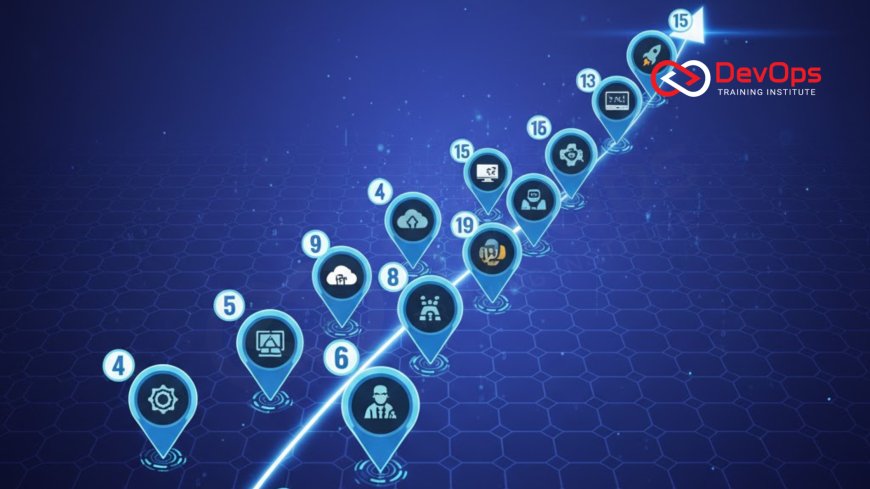
15 DevOps Roadmap Milestones Every Engineer Should Hit
Master the fifteen essential DevOps roadmap milestones for twenty twenty six to accelerate your career from a foundational learner to a senior platform architect. This extensive guide provides deep insights into mastering Linux, cloud native architectures, AI augmented automation, and advanced site reliability engineering. Discover how to hit critical benchmarks in CI CD optimization, security integration, and cluster management while staying ahead of emerging industry trends. Whether you are a beginner or a professional looking to level up, these proven milestones will help you build a resilient and high performing technical foundation to lead digital transformation in today’s demanding global software market.
Introduction to the 2026 DevOps Journey
The role of a DevOps engineer in twenty twenty six has evolved into a multi disciplinary position that requires a balance of software development, systems engineering, and strategic automation. No longer is it enough to simply "know some tools"; modern engineers must navigate complex cloud native ecosystems and integrate artificial intelligence into their daily workflows. A roadmap serves as a vital guide through this landscape, providing clear milestones that mark your progress from foundational concepts to advanced architectural mastery. These milestones are designed to ensure that you build a well rounded skill set that is both technically deep and practically relevant.
Hitting these benchmarks allows you to transition from manual, reactive tasks toward a model of proactive, automated system governance. Each milestone represents a significant step in your professional development, enabling you to take on more complex challenges and drive measurable impact within your organization. This guide outlines fifteen critical stages of the DevOps journey, offering beginner friendly insights into why each milestone matters and how to achieve it. By following this roadmap, you are positioning yourself as a leader in a field that continues to define the future of how technology is built and delivered globally.
Milestone One: Foundational Linux and OS Proficiency
Despite the high levels of abstraction in modern cloud services, Linux remains the foundational operating system of the DevOps world. Your first milestone is achieving deep proficiency in the Linux command line, process management, and file systems. You should be able to troubleshoot system performance, manage users and permissions, and navigate the shell with speed and precision. Understanding how the OS interacts with hardware and networking is essential for debugging the complex deployment pipelines you will eventually build and manage in production.
This stage also involves mastering basic text processing tools like grep, awk, and sed, which are invaluable for log analysis and automation scripting. Hitting this milestone ensures that you have the "systems first" mindset necessary for everything that follows. Most DevOps tools run on Linux, and being comfortable in this environment is a prerequisite for managing containers and virtualized infrastructure. It is the bedrock upon which your entire technical career will be built, providing the confidence to peek under the hood of any cloud service and understand what is truly happening at the kernel level.
Milestone Two: Mastering Version Control with Git
In twenty twenty six, code is the primary interface for managing everything from application logic to infrastructure settings. Consequently, mastering Git is a mandatory milestone for every DevOps professional. You must go beyond simple commits and pushes to understand complex branching strategies, merge conflict resolution, and the nuances of rebasing. Git acts as the single source of truth for your team, and your ability to manage this history effectively is what enables safe and collaborative software development at an enterprise scale.
Hitting this milestone also means becoming proficient in using platforms like GitHub or GitLab to facilitate peer reviews and collaborative workflows. You should understand how to use pull requests as a quality gate and how to leverage Git hooks to automate local validation checks. By treating your configuration and infrastructure files with the same respect as your application code, you set the stage for continuous synchronization across your environments. Mastering Git is not just a technical skill; it is a foundational habit that ensures your work is always auditable, reversible, and ready for team collaboration.
Milestone Three: Scripting and Automation with Python
Automation is the core "engine" of DevOps, and Python has emerged as the leading language for building that engine. Your third milestone is becoming comfortable enough with Python to write custom automation scripts that interact with cloud APIs, parse data, and manage system tasks. You don't need to be a full stack developer, but you must understand data structures, exception handling, and how to use libraries like Boto3 for cloud orchestration. Python's readability and vast ecosystem make it the perfect "glue" to connect your various DevOps tools.
As you hit this milestone, you will begin to see opportunities to eliminate manual "toil" everywhere in your daily routine. Whether it is a script to clean up old Docker images or a tool to audit security groups, your ability to code solutions will dramatically increase your productivity. This stage also prepares you for the world of AI augmented devops, where you will use scripts to train and deploy intelligent monitoring models. Python is the key that unlocks the door to high level technical autonomy, allowing you to build the very platforms that your developers will use to ship their own code faster.
Milestone Summary: From Foundations to Mastery
| Milestone Phase | Core Skill | Primary Tool | Career Impact |
|---|---|---|---|
| Foundations | Linux & Shell | Bash / Zsh | Entry-Level Ops |
| Automation | Git & Scripting | Git / Python | DevOps Engineer |
| Cloud Native | Containers & K8s | Docker / Kubernetes | Cloud Architect |
| Governance | IaC & Security | Terraform / Snyk | Senior SRE |
| Leadership | AI & Platform Eng. | AIOps / Backstage | Platform Lead |
Milestone Four: Cloud Provider Mastery (AWS/Azure/GCP)
By twenty twenty six, almost every major enterprise has standardized on at least one major cloud provider. Your next milestone is achieving a deep understanding of cloud networking, identity management, and core compute services within AWS, Azure, or Google Cloud. You should be able to design high availability architectures that span multiple regions and understand the nuances of cloud storage and database services. This involves moving beyond the web console and learning how to provision resources through the CLI and specialized SDKs.
Understanding the "shared responsibility model" for security is also a key part of this milestone. You must know how to configure IAM policies, VPC flow logs, and encryption at rest to protect your organization's data. This expertise allows you to select the right architecture patterns for scalability and cost efficiency. Whether you choose to specialize in one provider or become a multi cloud expert, this milestone marks your transition into a true cloud architect capable of managing complex, global infrastructures with technical precision and fiscal responsibility.
Milestone Five: Containerization with Docker and Beyond
Containers are the unit of delivery for modern applications, and Docker has become the standard tool for creating them. Your fifth milestone is mastering the container lifecycle, from writing efficient Dockerfiles to managing multi container applications with Docker Compose. You should understand how to optimize image sizes, manage volumes for persistent data, and secure your containers against common vulnerabilities. This milestone ensures that your applications run identically in every environment, eliminating the "it worked on my machine" problem for your entire team.
As you progress, you will also need to understand the shift toward alternative runtimes and tools. Knowing when it is better to use containerd instead of the full Docker daemon is a sign of technical maturity. This milestone is the gateway to orchestration; without a solid understanding of how containers behave, you cannot effectively manage them at scale within a Kubernetes cluster. It is about creating immutable, portable artifacts that serve as the building blocks for your organization's microservices strategy and automated delivery pipelines.
Milestone Six: Kubernetes Orchestration and Cluster Management
Kubernetes is the "operating system" for the cloud in twenty twenty six, and mastering it is one of the most challenging and rewarding milestones on the roadmap. You must understand cluster architecture, pod networking, and how to manage persistent storage in a distributed environment. This involves learning how to use kubectl to manage resources and Helm to package complex applications for deployment. Hitting this milestone means you can ensure high availability and self healing for your applications, allowing your team to release software with unprecedented speed and confidence.
Beyond basic deployments, you should learn how to implement advanced features like autoscaling, service meshes, and ingress controllers. Understanding how to manage cluster states using declarative manifests is critical for maintaining consistency across your environments. By hitting this milestone, you become the primary guardian of your organization's production stability. You will be able to lead the cultural change toward cloud native development, providing the orchestration power needed to handle massive bursts of user traffic while maintaining a seamless and reliable user experience at all times.
The Remaining Milestones for DevOps Leadership
- Milestone Seven: Infrastructure as Code (IaC): Mastering tools like Terraform or Pulumi to manage your entire cloud environment through versioned configuration files.
- Milestone Eight: CI/CD Pipeline Optimization: Building and tuning automated pipelines that incorporate testing, security, and verification at every stage.
- Milestone Nine: DevSecOps and Security Integration: Utilizing secret scanning tools and admission controllers to secure your cluster and code repositories.
- Milestone Ten: Deep Observability and Monitoring: Transitioning from basic alerts to deep visibility using distributed tracing, structured logs, and metrics.
- Milestone Eleven: Incident Handling and SRE: Developing the incident handling expertise needed to lead blameless post mortems and reduce system MTTR.
- Milestone Twelve: AI-Augmented DevOps (AIOps): Learning to leverage AI augmented devops tools for predictive maintenance and automated troubleshooting.
- Milestone Thirteen: Platform Engineering: Building internal developer platforms that abstract away complexity and improve the overall developer experience.
- Milestone Fourteen: FinOps and Cost Optimization: Implementing strategies to monitor and optimize cloud spend without sacrificing performance or system scalability.
- Milestone Fifteen: Technical Leadership and Mentorship: Reaching a level where you guide the technical roadmap and mentor the next generation of DevOps engineers.
Progressing through these final milestones requires a focus on both technical depth and broader business alignment. As you move toward leadership, you will find yourself spending more time on policy as code and strategic planning rather than manual configuration. Hitting all fifteen milestones is a multi year journey that demands a commitment to continuous learning and a passion for solving complex, large scale engineering problems. By staying focused on these goals, you ensure that your career remains resilient to the changes in the tech industry and that you remain a vital asset to any high growth organization in the digital age.
Conclusion: Your Roadmap to Mastery
In conclusion, hitting these fifteen DevOps roadmap milestones is more than just a checklist of skills; it is a transformative journey that shapes you into a world class technical leader. From the foundational precision of Linux to the advanced orchestration of Kubernetes and the predictive power of AI, each milestone provides a critical piece of the puzzle. By mastering these areas, you empower your organization to build software that is faster, more secure, and infinitely more scalable. The roadmap is your guide, but your curiosity and dedication are the engines that will carry you to the finish line.
As you move forward, remember that the goal is not just to collect tools but to solve real business problems and improve the lives of your developers and users. Use ChatOps techniques to foster better collaboration and transparency within your team. Stay informed about continuous verification to ensure your deployments are always meeting the highest standards. The future of DevOps is bright, and by hitting these milestones today, you are preparing yourself to lead the next generation of digital innovation with confidence and excellence. Start with milestone one, and don't stop until you've reached the top.
Frequently Asked Questions
What is the first milestone I should hit in my DevOps journey?
The first milestone is always mastering Linux fundamentals and the command line, as they form the bedrock of almost all modern DevOps tools and cloud servers.
Do I need a degree to become a DevOps engineer in 2026?
While a degree can help, many employers value hands-on experience, certifications, and a strong portfolio of projects more than traditional academic credentials in this field.
Which programming language is best for a DevOps beginner?
Python is widely considered the best language for beginners due to its simplicity, readability, and massive collection of libraries for cloud and infrastructure automation.
What is the difference between Docker and Kubernetes?
Docker is used to create and run individual containers, while Kubernetes is an orchestration platform used to manage and scale thousands of containers across a cluster.
How long does it take to hit all 15 milestones?
Hitting all fifteen milestones is typically a three to five year journey of continuous learning and professional growth within high-performing engineering organizations and teams.
Are certifications really important for hitting these milestones?
Certifications from AWS, Azure, or Kubernetes (CKA) are excellent for validating your knowledge and can serve as clear markers of progress for your roadmap milestones.
What is GitOps and why is it on the roadmap?
GitOps uses Git as the source of truth for your infrastructure, ensuring that your live environment always matches the configuration stored in your code repositories.
Can I skip the Linux milestone if I only use managed services?
It is highly discouraged to skip Linux, as you will still need to debug containers, manage serverless runtimes, and understand underlying networking and security protocols.
What role does AI play in the modern DevOps roadmap?
AI is used for predictive maintenance, automated log analysis, and optimizing CI/CD pipelines, making it a critical milestone for senior-level DevOps engineers in 2026.
What is platform engineering vs traditional DevOps?
Platform engineering focuses on building internal tools that help developers self-serve their needs, whereas traditional DevOps focuses more on the integration of development and operations.
How can I practice Kubernetes without an expensive cloud account?
You can use tools like Minikube, Kind, or K3s to run a full Kubernetes cluster on your local computer for free and practice your orchestration skills.
What are the most important metrics to track for DevOps success?
Key metrics include deployment frequency, lead time for changes, mean time to recovery (MTTR), and the change failure rate for all production releases.
How does security fit into the DevOps roadmap milestones?
Security must be integrated at every stage, a practice called DevSecOps, ensuring that code and infrastructure are scanned for vulnerabilities from the very start.
What is "Infrastructure as Code" and why does it matter?
IaC allows you to define and manage your entire cloud environment using configuration files, ensuring your infrastructure is reproducible, versioned, and easy to scale.
What is the best way to stay updated on new milestones?
Follow industry blogs, participate in open-source projects, attend tech conferences, and dedicate time each week to experimenting with emerging tools in your lab.
What's Your Reaction?
 Like
0
Like
0
 Dislike
0
Dislike
0
 Love
0
Love
0
 Funny
0
Funny
0
 Angry
0
Angry
0
 Sad
0
Sad
0
 Wow
0
Wow
0


![100+ Azure DevOps Interview Questions and Answers [Updated 2025]](https://www.devopstraininginstitute.com/blog/uploads/images/202509/image_140x98_68c40aa9a3834.jpg)





![Future Scope of DevOps Careers in Pune [Updated 2025]](https://www.devopstraininginstitute.com/blog/uploads/images/202510/image_140x98_68e3a84652312.jpg)