



![Kong Interview Preparation Guide [2025]](https://www.devopstraininginstitute.com/blog/uploads/images/202509/image_430x256_68dbb95326997.jpg)


10 Best Feature Flags Tools for DevOps Rollouts
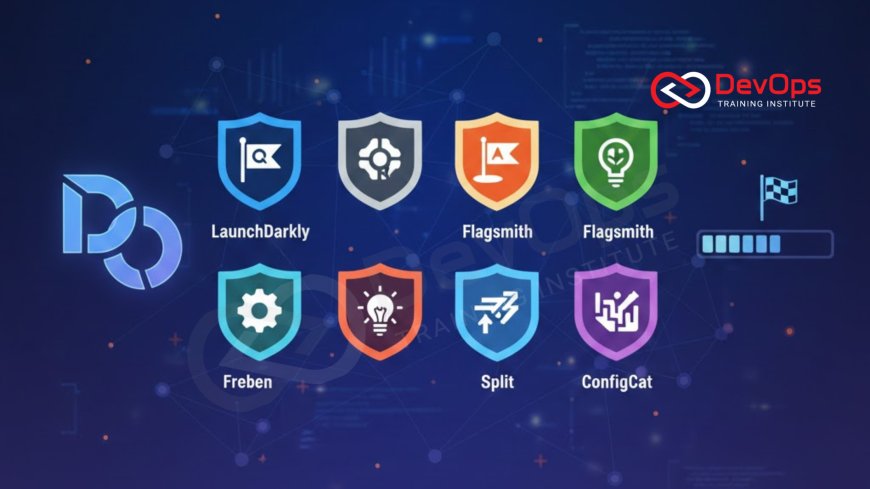
Explore the 10 best feature flags tools that empower DevOps teams to decouple deployments from releases, minimizing risk and enabling progressive delivery strategies like canary releases and A/B testing. This guide covers the leading enterprise platforms, such as LaunchDarkly and Split, alongside powerful open source alternatives like Unleash and Flagsmith. Learn how to select the right feature flag platform based on factors like SDK support, real-time control, governance needs, and experimentation capabilities to achieve true operational agility across client-side and servers-side applications in any complex system.
Introduction Decoupling Deploy from Release
Feature flags, also known as feature toggles, are one of the most transformative practices adopted by high-performing DevOps teams. They represent a fundamental shift in software delivery philosophy: the ability to deploy code to production at any time, independently of when that feature is actually released to users. By wrapping new or experimental code in a conditional statement (the flag), teams gain real-time, dynamic control over feature visibility. This decoupling eliminates the "big-bang" release, replacing it with a low-risk, controlled rollout process, which is critical for maintaining stability and accelerating continuous delivery.
The power of feature flags extends far beyond simple on/off switches. They are the engine behind progressive delivery strategies, enabling controlled rollouts to specific user segments, geographical regions, or internal QA teams (canary releases). Furthermore, they serve as the foundation for A/B testing and experimentation, allowing product teams to gather data on feature performance before committing to a full launch. Crucially, they act as an instant "kill switch," allowing teams to disable a problematic feature immediately upon detecting an incident, thereby minimizing Mean Time to Recovery (MTTR) without requiring a full code rollback.
Choosing the right feature flag tool is paramount, as the platform acts as the central control plane for all feature visibility across your entire application system. The tool must be highly available, offer low-latency flag evaluation, provide robust SDK support for both client-side and servers-side code, and integrate seamlessly into your existing CI/CD and observability stack. The following list details the ten best tools, ranging from enterprise powerhouses to flexible open source solutions, that drive confidence and safety in modern software rollouts.
The Enterprise Powerhouses Integrated Platforms
For large organizations, reliability, governance, and advanced integration capabilities are non-negotiable. The leaders in this space provide more than just a toggle dashboard; they offer full-fledged feature management platforms with built-in audit trails, security certifications, sophisticated targeting logic, and the scale to handle billions of flag evaluations daily. These tools often integrate deep analytics and experimentation frameworks to tie feature rollouts directly to business key performance indicators (KPIs).
These commercial solutions are typically delivered as SaaS, utilizing global Content Delivery Networks (CDNs) or proprietary streaming architectures to ensure near-instantaneous flag updates and low-latency evaluation, a necessity for a smooth user experience. While they often come with a higher price tag, the savings gained from reduced downtime, accelerated experimentation, and built-in compliance features quickly justify the cost for organizations operating mission-critical applications across various environments and geographic regions.
Tool 1 LaunchDarkly
LaunchDarkly is the most established and widely recognized enterprise feature management platform. It specializes in large-scale feature flag implementation, offering advanced targeting capabilities that allow teams to segment users based on virtually any custom attribute (e.g., subscription level, geographical region, device type). Its strength lies in its superior security, compliance certifications, and highly scalable architecture, which handles trillions of flag evaluations daily with sub-millisecond latency. LaunchDarkly also excels in complex governance, providing approval workflows and audit logs required by regulated industries.
Tool 2 Split (Harness)
Split, now fully integrated into the Harness platform, is distinguished by its strong emphasis on experimentation and data-driven delivery. Split treats every feature rollout as a controlled experiment, allowing teams to instantly convert a feature flag into an A/B test. Its platform includes sophisticated statistical analysis and impact measurement tools, automatically correlating feature usage with performance metrics and business outcomes. This makes Split an ideal choice for product-led growth organizations that require deep observability into the user impact of every feature release across the application system.
Tool 3 Harness Feature Flags
Harness Feature Flags is positioned as a cohesive element within the broader Harness Continuous Delivery platform. Its primary advantage is its tight integration with the CI/CD pipeline, linking flag status directly to deployment status. This allows for automated canary rollouts and automatic flag kill switches based on performance alerts from monitoring tools like Datadog or Prometheus. Harness provides a robust solution for organizations already utilizing its CD tools, offering superior management and a seamless, unified workflow for deploying, verifying, and controlling feature releases, regardless of the underlying infrastructure.
The Open Source and Developer-Focused Alternatives
For teams prioritizing customization, cost control, and data privacy, open source and developer-focused solutions offer tremendous flexibility. These tools allow organizations to self-host the feature flag management platform, giving them complete control over their infrastructure, data, and security compliance, which is often mandatory for privacy-sensitive industries. Furthermore, the community-driven nature of these projects ensures rapid development and broad integration with open source technologies like Kubernetes and Prometheus.
- These platforms are excellent for developers who want transparency in the flag evaluation logic and require SDKs for many diverse programming languages running on different flavors of the operating system.
- Self-hosting requires internal DevOps resources for scaling, maintenance, and reliability, but it eliminates vendor lock-in and high usage-based pricing models common with commercial SaaS offerings.
Tool 4 Unleash
Unleash is widely regarded as the leading open source feature management platform. It is built for developers and excels in deployment flexibility, offering both cloud-hosted and self-hosted options. Unleash provides robust features such as gradual rollouts, kill switches, and advanced user segmentation strategies. Its strength lies in its dedicated focus on core feature flagging, offering strong support for privacy-sensitive organizations that need to maintain strict control over their data and wish to avoid third-party cloud dependencies, making it a reliable solution for any polyglot system.
Tool 5 Flagsmith
Flagsmith provides a highly versatile solution with both an open source core and a managed SaaS offering. It supports granular feature control across web, mobile, and server-side applications, making it ideal for cross-platform teams. Flagsmith allows for real-time remote configuration management, enabling teams to update application parameters dynamically without requiring a code redeploy. Its transparent pricing and flexible deployment model (cloud, on-premise, or self-hosted in a private virtualization environment) appeal to a wide range of organizations, from startups to mid-sized enterprises.
Feature Flag Tool Comparison Overview
The choice between tools often boils down to a fundamental trade-off between enterprise governance (SaaS) and deployment control (open source). The table below summarizes the key differentiators for five of the leading platforms, highlighting their primary strength and target user base.
| Tool Name | Type/Model | Primary Strength | Best For |
|---|---|---|---|
| LaunchDarkly | SaaS | Enterprise Governance, Scale, and Reliability | Large organizations with complex audit and compliance needs. |
| Unleash | Open Source / Self-Hosted | Data Privacy, Full Control, Open Source Transparency | Privacy-sensitive or regulation-heavy companies needing self-hosting options. |
| Split (Harness) | SaaS | Integrated Experimentation and Impact Analysis | Product-led teams focused on data-driven A/B testing and statistical rigor. |
| GrowthBook | Open Source / Experimentation | Integrates Feature Flags with Data Warehouse for Analytics | Teams already using a data warehouse that want deep, integrated experimentation. |
| Flagsmith | Open Source / Versatile SaaS | Flexible Deployment, Remote Configuration Management | Teams needing versatile deployment options and simple management with an open source core. |
Experimentation-Focused Platforms
These tools are distinguished by building their feature flag capabilities around a core experimentation platform. They provide integrated dashboards for statistical analysis, allowing product managers and data scientists to move beyond simple on/off decisions to statistically rigorous A/B and multivariate testing. For organizations where feature optimization and user experience are primary drivers, these platforms offer the best pathway to data-driven product decisions.
Tool 6 GrowthBook
GrowthBook positions itself as an open source experimentation platform with feature flags baked in, rather than the other way around. It is celebrated for its statistical rigor, supporting advanced analysis techniques like Bayesian and sequential testing. Its key differentiating feature is its deep integration with your existing data warehouse (e.g., Redshift, BigQuery), allowing teams to define metrics and measure experiment impact using their own trusted data sources. This flexibility is invaluable for teams with existing, high-volume data management infrastructure.
Tool 7 Optimizely
Optimizely is a veteran in the digital experience platform space, offering sophisticated feature flagging and A/B testing capabilities. It is often favored by marketing and product teams for its ability to test experiences across the entire user journey, including mobile and front-end applications. Optimizely's strengths lie in its visual editors and enterprise-grade support for multivariate testing, enabling complex experimentation that goes beyond simple feature toggles and integrates tightly with broader digital marketing and content strategies.
Specialized and Community-Driven Tools
The final set of tools represents specialized offerings that solve unique problems, such as integrating with centralized management systems, simplifying the developer experience, or adhering to emerging industry standards. They demonstrate the variety of solutions available for teams with specific architectural or compliance needs.
Tool 8 ConfigCat
ConfigCat focuses on simplicity, predictable pricing, and high reliability, making it an excellent choice for small to mid-sized companies that need a dependable solution without excessive complexity or opaque usage-based costs. ConfigCat utilizes a global CDN (Content Delivery Network) for low-latency flag delivery and provides straightforward SDKs for a broad range of client-side and servers-side applications. Its emphasis on predictability in both performance and cost makes it a low-stress option for reliable feature management.
Tool 9 FeatBit
FeatBit is an emerging open source platform that combines feature flags and experimentation capabilities. It offers both self-hosted and managed cloud models, providing flexibility for growing teams. FeatBit supports multivariate flags and has solid SDK coverage, but its main appeal is its active community and continuous development, offering an evolving alternative for mid-sized teams that value both control and integrated experimentation features within a single system.
Tool 10 Flagd (OpenFeature Standard)
Flagd is less a feature management platform and more a reference implementation of OpenFeature, a CNCF (Cloud Native Computing Foundation) open source specification. Flagd provides a vendor-agnostic API for feature flagging. Its importance lies in the fact that it allows teams to avoid vendor lock-in at the code level. By adopting the OpenFeature standard and using Flagd as a provider, organizations can swap out the feature flag backend (e.g., moving from LaunchDarkly to Unleash) without refactoring application code, greatly improving architectural agility and making management easier.
Conclusion Selecting the Right Control Plane
Feature flags are the control plane of modern software delivery, transforming risky deployments into controlled, strategic rollouts. The 10 tools highlighted demonstrate that there is a solution for every organizational need, whether the priority is the deep governance and scale of LaunchDarkly, the open source control and privacy offered by Unleash, or the statistical rigor of Split and GrowthBook. The selection process must align the tool’s core strength with the organization’s most pressing need: is it compliance, experimentation, cost control, or full stack integration?
By leveraging these platforms, DevOps teams achieve the holy grail of software delivery: continuous integration and continuous deployment without continuous risk. The ability to toggle features in real-time, target specific user segments, and instantly roll back a problematic feature—all without a single redeploy—is the defining characteristic of elite performance and ensures a stable, high-quality user experience across the entire system.
Frequently Asked Questions
What is the primary purpose of a feature flag?
A feature flag decouples code deployment from feature release, enabling safer rollouts, A/B testing, and instant kill switches without a redeploy.
How do feature flags reduce Mean Time to Recovery (MTTR)?
If a deployed feature causes an incident, the corresponding flag can be instantly disabled, solving the problem without the time delay of a full rollback.
What is the main advantage of an open source feature flag tool?
Open source tools offer full control over data, configuration, and deployment, eliminating vendor lock-in and potentially lowering costs for large servers users.
What is the risk of using an old, non-standard operating system?
Using an old operating system on the application servers can limit the compatibility and security of the required SDKs for modern feature flag management systems.
How does LaunchDarkly ensure real-time updates?
LaunchDarkly uses a proprietary streaming architecture and global CDN to ensure that flag changes are propagated to connected clients in milliseconds.
What is the goal of OpenFeature and tools like Flagd?
The goal is to provide a vendor-agnostic standard (OpenFeature) so teams can switch feature flag backends without changing application code.
What is a "kill switch" in feature flagging?
A kill switch is an open source or commercial flag that can be instantly disabled to turn off a feature causing a production problem, minimizing downtime.
How do feature flags enable A/B testing?
They allow teams to segment users and expose different user groups to different code paths or feature variations simultaneously for statistical measurement.
What is remote configuration in this context?
Remote configuration allows teams to change the value of variables (e.g., button colors, API endpoints) without modifying the source code or redeploying the application.
Which tool is best for highly data-driven A/B experimentation?
Split (Harness) and GrowthBook are highly focused on integrated analytics, statistical rigor, and advanced multivariate experimentation capabilities.
Why do some enterprises prefer self-hosting feature flags?
Self-hosting is preferred for environments with strict data governance, privacy, and compliance requirements, granting full control over the system infrastructure.
What is the difference between LaunchDarkly and Harness Feature Flags?
LaunchDarkly is a pure feature management platform, while Harness is an integrated CI/CD platform where feature flags are one component of the larger delivery pipeline.
How does virtualization relate to feature flag deployment?
Feature flag servers and services are often deployed inside containers and virtualization platforms like Kubernetes to ensure high availability and scalability.
What is the role of an SDK in a feature flag system?
The SDK integrates into the application code to communicate with the management server, evaluate flag status, and apply the correct feature logic at runtime.
What does it mean to decouple deploy from release?
It means code is deployed to production (deploy) but remains hidden from users until the feature flag is manually activated (release) by the product team.
What's Your Reaction?
 Like
0
Like
0
 Dislike
0
Dislike
0
 Love
0
Love
0
 Funny
0
Funny
0
 Angry
0
Angry
0
 Sad
0
Sad
0
 Wow
0
Wow
0

![100+ Azure DevOps Interview Questions and Answers [Updated 2025]](https://www.devopstraininginstitute.com/blog/uploads/images/202509/image_140x98_68c40aa9a3834.jpg)





![Future Scope of DevOps Careers in Pune [Updated 2025]](https://www.devopstraininginstitute.com/blog/uploads/images/202510/image_140x98_68e3a84652312.jpg)