




![Kong Interview Preparation Guide [2025]](https://www.devopstraininginstitute.com/blog/uploads/images/202509/image_430x256_68dbb95326997.jpg)




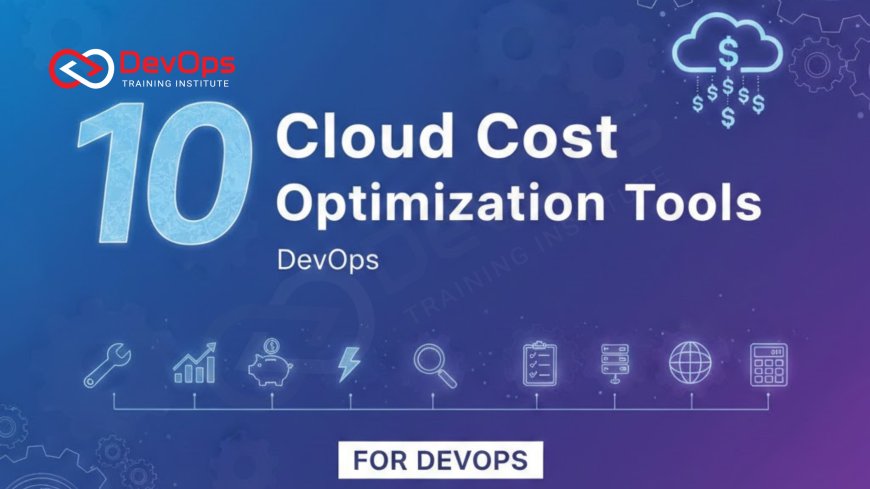
10 Cloud Cost Optimization Tools for DevOps
Discover the 10 best cloud cost optimization tools for DevOps teams in 2025. From native AWS, Azure, and GCP solutions to third-party platforms like CloudHealth, Harness, and CloudZero, this guide compares features, pricing, automation capabilities, real-time alerts, and FinOps best practices. Learn how to cut cloud waste, right-size resources, automate savings, and maintain full visibility while keeping your infrastructure reliable and performant.
Introduction
Cloud spending has become one of the largest line items in most technology budgets. The flexibility of pay-as-you-go sounds great until you discover that the average organization wastes 30–35% of its cloud budget on idle resources, over-provisioned instances, forgotten development environments. In 2025, leading engineering organizations treat cost the same way they treat security and performance: as a first-class metric owned by the teams building and running the systems.
DevOps teams are perfectly positioned to drive cost optimization because they control the actual consumption patterns through infrastructure as code, CI/CD pipelines, container orchestration, and serverless deployments. This comprehensive guide walks you through the ten most effective cloud cost optimization tools available today, from completely free native offerings to powerful third-party platforms that can pay for themselves many times over through automation.
1. AWS Cost Explorer & AWS Budgets
AWS provides a surprisingly complete set of cost management tools at no additional charge.
- Cost Explorer with granular filters, saved reports, and forecasting
- Budgets and budget alerts delivered via email, Slack, or SNS
- Cost Anomaly Detection powered by machine learning
- Rightsizing recommendations across EC2, RDS, Lambda, and more
- Savings Plans and Reserved Instance utilization dashboards
Every AWS user should enable these immediately — they form the foundation of any serious cost program.
2. Azure Cost Management + Billing
Microsoft has invested heavily in making Azure’s cost tools competitive with AWS.
- Deep integration with Power BI for custom dashboards
- Cost analysis by tags, resource groups, subscriptions
- Azure Advisor recommendations for reservations and right-sizing
- Scheduled exports and anomaly detection
- Free for all Azure customers
Particularly strong in enterprises already using Microsoft 365 and Power Platform.
3. Google Cloud Billing & Cost Tools
GCP’s billing experience is clean and developer-centric.
- BigQuery export for unlimited custom analysis
- Realtime budget alerts and programmatic budgeting
- Committed Use Discount recommendations
- Labels and cost allocation reports
Best when you want to combine cost data with logs and metrics in BigQuery.
4. CloudHealth by VMware
One of the original multi-cloud cost management platforms, now part of Broadcom/VMware.
- Unified reporting across AWS, Azure, GCP, Oracle, Snowflake
- Policy engine to automatically stop or resize resources
- Chargeback/showback for business units
- Reservation and Savings Plan optimization
Enterprise favorite for governance-heavy organizations.
5. Harness Cloud Cost Management
Harness uniquely combines CI/CD with built-in cost intelligence — a true DevOps-native approach.
- Cost visibility directly inside your pipelines and dashboards
- AutoStopping rules for idle CI runners, dev environments, databases
- Cost per team, service, environment, or feature flag
- Integration with Kubernetes, ECS, Lambda
Perfect if you already use or plan to use Harness for delivery.
6. CloudZero
CloudZero pioneered “cost per unit” thinking — showing you the true cost of serving a customer or deploying a feature.
- Ingestion of cost + usage + engineering telemetry
- Cost per deployment, per microservice, per tenant
- Anomaly alerts with full context
- Strong Kubernetes and serverless support
Best for product-led companies that want to tie engineering spend to revenue.
7. Spot by NetApp
Spot automates the use of spot/preemptible instances and intelligent scaling.
- Elastigroup, Ocean (EKS/AKS/GKE), Eco for commitments
- Predictive scaling and automated fallbacks
- Savings typically 70–90% on compute
- Zero performance impact SLA
Excellent for batch processing, CI/CD runners, and stateless workloads.
8. Kubecost
The gold standard for Kubernetes cost visibility and optimization.
- Real-time cost per namespace, deployment, pod, label
- Alerts on inefficient or idle workloads
- Daily savings recommendations
- Free open-source version; paid for multi-cluster and governance
Every Kubernetes team should run Kubecost — it pays for itself instantly.
9. Cast AI
AI-powered Kubernetes optimization that automates bin packing, spot instances, and right-sizing.
- Connects in minutes, starts saving immediately
- Typical 60–80% reduction in K8s spend
- Read-only analysis mode for zero risk
- Supports EKS, AKS, GKE
Hands-off savings for teams that want to “set it and forget it”.
10. Yotascale
Engineering-focused cost intelligence with dynamic allocation.
- Cost attribution by team, feature, customer, environment
- Predictive budgeting and anomaly detection
- Automated recommendations with one-click actions
- Slack, Jira, PagerDuty integrations
Great for fast-growing startups that need granular ownership.
Comparison Table
| Tool | Clouds Supported | Automation Level | Kubernetes Focus | Pricing |
|---|---|---|---|---|
| AWS Native | AWS only | Medium | Basic | Free |
| Azure Native | Azure only | Medium | Good | Free |
| GCP Native | GCP only | High | Good | Free |
| CloudHealth | Multi-cloud | High | Medium | Enterprise |
| Harness CCM | Multi + K8s | Very High | Excellent | Free / Paid |
| CloudZero | Multi-cloud | High | Excellent | % of spend |
| Spot by NetApp | AWS/Azure/GCP | Very High | Excellent | Pay for savings |
| Kubecost | Kubernetes | High | Best-in-class | Free / Paid |
| Cast AI | Kubernetes | Very High | Best-in-class | Pay for savings |
| Yotascale | Multi-cloud | High | Strong | % of spend |
Conclusion
Cloud cost optimization has evolved from quarterly finance reviews to real-time engineering practice. Start with the free native tools for immediate visibility, then layer on automation with Kubecost/Cast AI if you run Kubernetes, or Harness/CloudZero for broader coverage. The highest-performing teams achieve sub-10% waste through a combination of tooling, culture, and incentives.
When working with serverless, always design with AWS Lambda limits in mind and use cost tools to catch runaway functions early. The result is predictable budgets, faster innovation, and engineering teams that own their financial impact — exactly what modern DevOps is all about.
Frequently Asked Questions
What percentage of cloud spend is usually wasted?
Industry reports consistently show 30–35% waste. Leading teams reduce this to under 10%.
Should developers care about cloud costs?
Absolutely — developers make thousands of micro-decisions daily that directly affect the bill. Giving them visibility turns cost into a cost center into a value driver.
Are native cloud cost tools sufficient?
For single-cloud and small teams, yes. Multi-cloud, Kubernetes, or advanced automation requires third-party tools.
How quickly can I see real savings?
Stopping idle resources and right-sizing: same week. Spot instances and reservations: 1–3 months for full effect.
Which tool offers the fastest ROI for Kubernetes?
Kubecost and Cast AI routinely deliver 50–80% savings within the first 30 days.
Do cost optimization tools hurt performance?
Modern tools are intelligent — they only downsize when safe and use spot instances with guaranteed fallback.
How do I monitor serverless costs effectively?
Use CloudZero or native dashboards with per-function granularity and set up CloudWatch alerts on invocations and duration.
What’s the role of tagging in cost optimization?
Tags are essential for allocation. Tools cannot attribute costs without consistent tagging strategies.
Can these tools help with sustainability goals?
Yes — most now show carbon footprint, and reducing compute directly lowers emissions.
How do I get engineering buy-in?
Show cost per team in standups, add budget badges to PRs, and publicly celebrate savings wins.
Is it worth paying for a third-party tool?
If you spend more than $50K/month on cloud, the automation and insights easily justify the cost.
How does cost optimization work with GitOps?
Tools like Kubecost and Harness show cost impact of every PR and deployment.
What’s the biggest mistake teams make?
Treating cost as a finance-only problem instead of an engineering metric.
Will AI eventually automate all cost optimization?
AI is already doing it — Cast AI, Spot, and CloudZero use machine learning for recommendations and auto-actions.
Where should I start today?
Step 1: Enable detailed billing and alerts. Step 2: Install Kubecost if you run Kubernetes. Step 3: Schedule your first cost review meeting.
What's Your Reaction?
 Like
0
Like
0
 Dislike
0
Dislike
0
 Love
0
Love
0
 Funny
0
Funny
0
 Angry
0
Angry
0
 Sad
0
Sad
0
 Wow
0
Wow
0

![100+ Azure DevOps Interview Questions and Answers [Updated 2025]](https://www.devopstraininginstitute.com/blog/uploads/images/202509/image_140x98_68c40aa9a3834.jpg)




![Future Scope of DevOps Careers in Pune [Updated 2025]](https://www.devopstraininginstitute.com/blog/uploads/images/202510/image_140x98_68e3a84652312.jpg)