














![Kong Interview Preparation Guide [2025]](https://www.devopstraininginstitute.com/blog/uploads/images/202509/image_430x256_68dbb95326997.jpg)









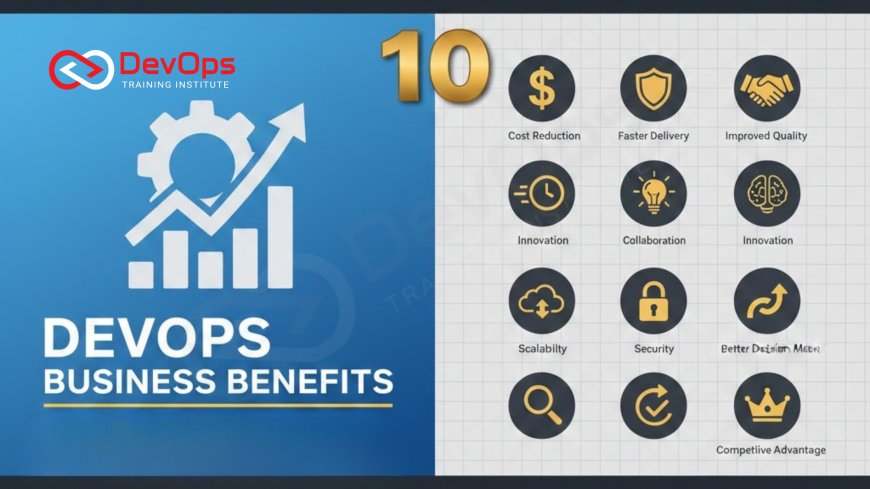
10 DevOps Business Benefits for Enterprise Growth
Unlock the strategic value of the DevOps methodology with the 10 most impactful business benefits driving enterprise growth and market leadership. This guide explains how continuous collaboration, automation, and measurement translate into tangible business results, including faster time-to-market, significantly improved system reliability, enhanced security compliance, and lower operational costs. Learn how adopting a DevOps culture minimizes deployment risk, frees engineering talent to focus on innovation, and fundamentally transforms the organization's responsiveness to customer needs, securing a sustainable competitive advantage in today's rapid-fire digital economy and ensuring long-term financial health.
Introduction: Connecting DevOps to the Bottom Line
In the modern enterprise, the adoption of the DevOps methodology has moved far beyond a technical trend; it has become a critical business mandate. While many associate DevOps primarily with technical outcomes—such as automated deployments and faster pipelines—its true value lies in its profound impact on business growth, market competitiveness, and financial performance. For executives and business leaders, the decision to invest in a DevOps culture and toolchain is a strategic choice, directly linked to accelerating the delivery of customer-facing features, improving service quality, and minimizing the immense financial risks associated with system downtime and security breaches. When implemented correctly, DevOps transforms IT from a cost center into a powerful engine for innovation and revenue generation, providing a sustainable advantage over competitors.
The transition requires breaking down traditional organizational silos between Development, Operations, and business units, fostering a culture of shared responsibility and continuous improvement. This cultural shift, supported by the principles of automation and measurement, allows organizations to operate with unprecedented agility and confidence. Understanding the clear, quantifiable benefits that DevOps delivers—from optimizing cloud expenditure to driving higher customer satisfaction—is essential for justifying the necessary investment and successfully steering the entire enterprise toward sustained operational excellence and market leadership. This guide outlines the top 10 most significant business benefits that enterprises realize through a mature adoption of DevOps practices, proving that the technical endeavor is fundamentally a strategic business endeavor.
1. Accelerated Time-to-Market (Speed)
The most immediate and tangible benefit of implementing DevOps is a dramatic reduction in Time-to-Market (TTM). By automating the entire software delivery pipeline—from code commit through building, testing, and deployment—organizations eliminate the manual bottlenecks, handoffs, and waiting periods that characterize traditional waterfall or siloed release processes. This acceleration is crucial in today's rapid-fire digital economy, where being the first to market with an innovative feature or product can capture significant market share and provide an early lead over competitors.
Continuous Integration/Continuous Delivery (CI/CD) pipelines enable small, frequent releases instead of risky, monolithic quarterly updates. This means that features and bug fixes reach the customer within hours or days, not weeks or months. This high deployment frequency allows the business to rapidly test market hypotheses, quickly adapt to customer feedback, and maintain product relevance, transforming the software team into a responsive growth engine that directly serves the needs of the marketplace. Accelerating the delivery of value is the foundation upon which all other business benefits are built, guaranteeing market responsiveness and sustained customer engagement.
2. Significantly Improved System Reliability and Stability
System reliability is the foundation of customer trust and operational financial health. DevOps achieves significantly improved stability by baking quality assurance and operational rigor into every stage of the pipeline, rather than relying on reactive troubleshooting in production. The two primary mechanisms driving this benefit are automated testing and immutable infrastructure practices, which ensure the predictability of every single deployment across all environments.
- Reduced Change Failure Rate: Automated testing (unit, integration, performance, security) runs on every code commit, catching integration failures and bugs immediately—when they are cheapest to fix. This drastically reduces the likelihood of introducing defects into the production environment. Furthermore, the use of small, frequent changes ensures that when a failure does occur, the scope of the problem is minimal, and the source is instantly identifiable, which minimizes the service impact.
- Faster Recovery (Low MTTR): DevOps teams, often integrating SRE principles, prioritize engineering systems that can rapidly recover from failure. By implementing automated rollback mechanisms (via Terraform or CI/CD tools) and advanced deployment strategies (Canary/Blue-Green), teams can quickly revert to a last known good state. This focus on low Mean Time to Recovery (MTTR) minimizes service downtime, safeguarding customer experience and reducing the severe financial penalties associated with extended outages.
3. Enhanced Security and Compliance (DevSecOps)
Security is now an intrinsic, automated part of the software delivery process, a concept known as DevSecOps. By integrating security controls from the beginning—the "Shift Left" approach—organizations gain continuous, verifiable compliance and risk mitigation that is impossible to achieve with traditional, end-of-cycle audits.
The automation of security checks ensures that policies are consistently enforced across the organization:
- Automated Vulnerability Scanning: Tools scan application code (SAST/DAST) and container dependencies (Trivy/Clair) automatically during the CI phase. This prevents vulnerable code and components from ever making it into the production environment, reducing the overall attack surface and ensuring security is built-in.
- Policy as Code (PaC) and Governance: Infrastructure as Code (IaC) tools and policy engines (OPA/Sentinel) automatically enforce security policies (e.g., no public S3 buckets, mandatory encryption) when infrastructure is provisioned. This guarantees continuous compliance with standards like HIPAA or PCI DSS, simplifying audits and protecting the enterprise from the massive fines and reputational damage associated with security breaches. For more on this, check how security fits in the DevOps pipeline.
4. Lower Operational Costs (FinOps)
Although DevOps requires initial investment in tooling and training, it leads to significant long-term reductions in operational expenditure (OpEx) through continuous resource optimization and the elimination of manual effort. This financial benefit is crucial for enterprise growth, as it maximizes the available budget for core product innovation.
The primary cost-saving mechanisms include:
Automation of Toil: Automating manual, repetitive tasks—such as patching, monitoring, routine maintenance, and environment provisioning—frees up expensive, high-value engineering time. This allows engineers to focus 80% of their time on innovation and features, rather than spending 50% on operational firefighting, directly increasing engineering ROI. The manual, low-value work is replaced by efficient code, increasing overall organizational automation and efficiency.
Resource Optimization and FinOps: Continuous monitoring and automated resource scaling (HPA/VPA in Kubernetes) ensure that cloud resources are precisely matched to real-time demand, automatically scaling down during low usage (Scale to Zero) and eliminating idle waste. This active management, often guided by the principles of FinOps, significantly reduces unnecessary cloud expenditure, transforming cloud consumption into a predictable and cost-effective operational expense.
| # | Business Benefit | Key Metric Impacted (DORA) | Source of Value (Technical Practice) |
|---|---|---|---|
| 1 | Accelerated Time-to-Market | Lead Time for Changes (Reduced) | End-to-End CI/CD Automation |
| 2 | Improved System Reliability | Mean Time to Recovery (Reduced) | Immutable Infrastructure & Automated Rollbacks |
| 3 | Enhanced Security & Compliance | Change Failure Rate (Reduced by security flaws) | Shift Left Security (DevSecOps) & Policy as Code |
| 4 | Lower Operational Costs | Toil Hours / Cloud Spend (Reduced) | Automation of Toil & FinOps Resource Optimization |
| 5 | Increased Customer Satisfaction | Service Uptime / Feature Velocity | Fast Feedback Loops & High Service Availability |
5. Increased Customer Satisfaction and Retention
In the digital age, customer experience is defined by software performance and feature velocity. The core benefits of DevOps directly translate into superior customer outcomes, driving increased satisfaction and retention rates. Faster releases mean customers get requested features and bug fixes sooner, while higher reliability ensures an uninterrupted and predictable user experience, minimizing frustration caused by unexpected downtime or glitches.
Fast Feedback Loops: DevOps pipelines and observability tools establish continuous feedback mechanisms, linking production data (performance, errors, usage patterns) directly back to the development team. This immediate insight allows the enterprise to understand how features are actually being used and quickly address pain points, enabling highly targeted iterative improvements that ensure the product remains perfectly aligned with customer needs and expectations, which is crucial for long-term viability.
High Quality and Predictable Service: By utilizing SRE principles and deep monitoring, enterprises can maintain extremely high Service Level Objectives (SLOs), guaranteeing uptime and low latency. This predictable, high-quality service builds customer trust and reduces churn, as users come to rely on the application's stability. For organizations in competitive markets, this ability to deliver flawless service consistently is a powerful differentiator, converting passive users into loyal advocates and securing market position against disruptive competitors.
6. Enhanced Organizational Agility and Resilience
Organizational agility—the ability to respond quickly to market threats, regulatory changes, or sudden shifts in customer demand—is a major strategic advantage. DevOps fosters this agility by making the entire technology stack flexible and easily mutable. Immutable infrastructure, managed via IaC, means environments can be reliably recreated, updated, or repurposed in minutes, not days.
This structural resilience allows the organization to take calculated risks on innovation, knowing that failure is non-catastrophic and easily recoverable. Since the entire infrastructure is defined as code and versioned in Git, an enterprise can quickly stand up a new environment for a proof-of-concept, test a major regulatory change in a production-like clone, or rapidly migrate workloads between different cloud providers, securing the flexibility needed for future strategic maneuvering. This deep architectural flexibility ensures that the enterprise is prepared for any external challenge, whether technical or market-based.
7. Stronger Collaboration and Employee Morale
At its core, DevOps is a cultural and human transformation. By breaking down the adversarial silos between Development, Operations, and Security teams, it fosters a single, collaborative environment based on shared goals, accountability, and empathy. The elimination of the "throw it over the wall" mentality, coupled with the automation of repetitive, stressful tasks ("toil"), directly improves the work environment and engineering efficacy.
When engineers spend less time fighting production fires and more time innovating and building new features, job satisfaction and retention rates dramatically increase. A culture that promotes blameless post-mortems—focusing on systemic process failure rather than individual error—encourages psychological safety, knowledge sharing, and continuous learning, transforming errors into system improvements. This human element is often overlooked, but a highly collaborative and positive DevOps culture is the key to sustained innovation and engineering talent retention.
8. Data-Driven Decision Making and Continuous Improvement
DevOps mandates that all actions be measured and tied to observable data, moving the enterprise away from intuition-based decisions to a scientific approach to software delivery. This systematic measurement ensures that improvements are targeted, verifiable, and continuously sustained across the organization.
The practice relies on tracking key performance indicators (KPIs) like the four DORA metrics (Deployment Frequency, Lead Time for Changes, Change Failure Rate, and Mean Time to Recovery). By constantly monitoring and analyzing this data, leadership can pinpoint bottlenecks in the value stream—whether they are slow testing environments, integration issues, or manual approval gates—and strategically allocate resources to eliminate them. This continuous improvement cycle, backed by verifiable metrics and data, ensures that the organization is always getting demonstrably faster and more reliable, guaranteeing that investment in technology yields measurable business returns.
Conclusion: The Strategic Engine for Digital Transformation
Adopting DevOps is not a mere technical upgrade; it is a profound strategic decision that re-architects the business for the digital age. The 10 benefits outlined—from unparalleled speed and system reliability to cost efficiency and enhanced security—all coalesce to provide the enterprise with the necessary foundation for sustainable growth and market leadership. By automating the mundane, embedding security, and fostering a collaborative culture focused on continuous delivery, organizations transform their relationship with technology, turning their IT operations from a potential liability into their most powerful competitive advantage.
The successful modern enterprise recognizes that its ability to scale, pivot, and innovate is directly proportional to the maturity of its DevOps methodology. Investing in this transformation is the single most effective way to minimize operational risk, maximize engineering talent ROI, and ensure the entire organization is aligned to deliver superior customer experiences faster and more reliably than the competition, ensuring long-term success in the demanding digital marketplace.
Frequently Asked Questions
What are the four key DORA metrics used in DevOps?
Deployment Frequency, Lead Time for Changes, Change Failure Rate, and Mean Time to Recovery (MTTR) are the four key metrics.
How does DevOps reduce operational costs?
It reduces costs by automating manual toil, eliminating waste, and optimizing cloud resource consumption through FinOps practices and automatic scaling.
What does "Shift Left" mean for security in business terms?
It means finding and fixing security vulnerabilities earlier (left in the timeline), which is exponentially cheaper and faster than fixing them in production, reducing financial risk.
How does faster time-to-market help enterprise growth?
Faster TTM allows the enterprise to introduce new features, capture market share, and respond to customer feedback quicker than competitors, driving revenue growth.
What is the role of immutable infrastructure in reliability?
Immutable infrastructure ensures that environments are never modified in place, making deployments predictable, reducing drift, and guaranteeing faster, reliable rollbacks.
How do SRE principles relate to business reliability?
SRE applies engineering practices to define and meet Service Level Objectives (SLOs) for uptime and latency, which directly translates to high customer satisfaction and retention.
What is FinOps?
FinOps is the cultural practice of bringing financial accountability to the variable spending model of the cloud, aligning engineering decisions with business value and optimizing costs.
Why is culture more important than tools in DevOps?
Culture (collaboration, shared responsibility) is more important because tools only automate processes, but culture determines whether teams use the tools effectively and continuously strive for improvement.
How does DevOps improve employee morale?
It improves morale by eliminating manual, stressful "toil," promoting collaboration, and fostering a blameless culture focused on learning and continuous process improvement.
What is the risk of having slow deployment frequency?
Slow deployment frequency increases the risk of large, complex releases, slows feature delivery, and delays critical security and bug fixes, hurting competitiveness.
How is security testing integrated in a DevOps pipeline?
Security is integrated through automated Static Analysis Security Testing (SAST) and dynamic scanning tools that run automatically during the build and testing phases.
What is the purpose of a blameless post-mortem?
Its purpose is to analyze systemic failures to learn and improve processes, rather than assigning personal fault, which increases psychological safety and promotes honest feedback.
How does an engineer's Linux skill help in cost optimization?
Deep Linux knowledge allows engineers to precisely configure container resource requests (CPU/Memory), preventing over-provisioning and ensuring cost efficiency in cloud compute resources.
Does DevOps work for companies outside of the tech industry?
Yes, DevOps is successfully implemented across finance, healthcare, retail, and manufacturing industries wherever software is a critical component of operations.
What specific technical practice is key to organizational agility?
Infrastructure as Code (IaC) is key, as it makes the entire technology stack declarative and disposable, allowing environments to be rebuilt and repurposed instantly for rapid pivoting.
What's Your Reaction?
 Like
0
Like
0
 Dislike
0
Dislike
0
 Love
0
Love
0
 Funny
0
Funny
0
 Angry
0
Angry
0
 Sad
0
Sad
0
 Wow
0
Wow
0




![100+ Azure DevOps Interview Questions and Answers [Updated 2025]](https://www.devopstraininginstitute.com/blog/uploads/images/202509/image_140x98_68c40aa9a3834.jpg)






![Future Scope of DevOps Careers in Pune [Updated 2025]](https://www.devopstraininginstitute.com/blog/uploads/images/202510/image_140x98_68e3a84652312.jpg)