










![Kong Interview Preparation Guide [2025]](https://www.devopstraininginstitute.com/blog/uploads/images/202509/image_430x256_68dbb95326997.jpg)







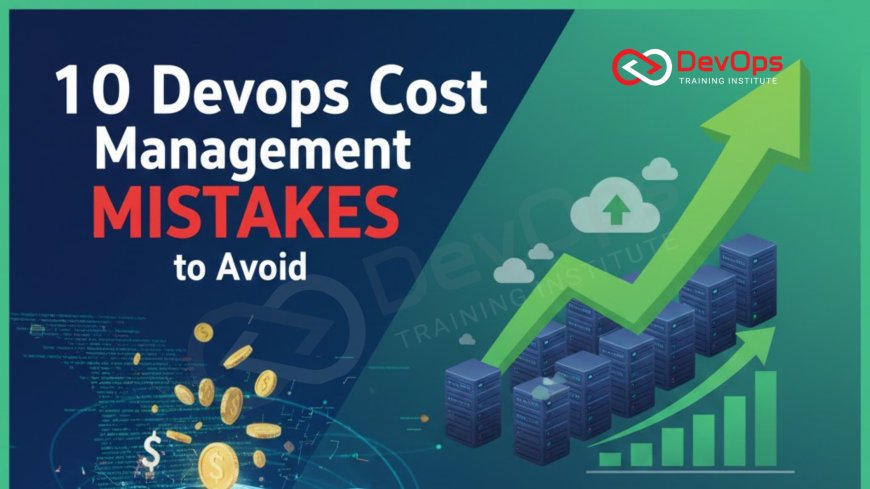
10 DevOps Cost Management Mistakes to Avoid
Managing cloud expenses is a critical challenge for modern engineering teams. This comprehensive guide explores the top ten DevOps cost management mistakes to avoid, providing actionable insights into optimizing cloud spend and improving financial accountability. Learn how to prevent budget overruns by addressing issues like orphaned resources, over-provisioning, and lack of visibility, ensuring your organization achieves maximum value from its digital transformation initiatives while maintaining high performance and system reliability.
Introduction to DevOps Cost Management
In the early days of cloud adoption, the primary focus was on speed and agility. Teams were encouraged to provision resources as quickly as possible to meet development deadlines. However, as cloud environments have grown in complexity and scale, the financial implications of these rapid deployments have become impossible to ignore. Many organizations now find that their cloud bills are among their largest operational expenses, often exceeding initial forecasts by significant margins due to inefficient management practices.
DevOps cost management is not just about cutting expenses; it is about achieving the best possible value for every dollar spent on infrastructure. It requires a fundamental shift in how engineers and finance professionals collaborate. By understanding the common pitfalls that lead to wasted spending, teams can implement smarter strategies that balance performance with fiscal responsibility. This blog will delve into the critical mistakes that frequently lead to budget overruns, helping your team build a more cost-aware culture that supports sustainable long-term growth in the cloud.
Ignoring Orphaned and Unused Resources
One of the most common and easily avoidable mistakes in cloud management is leaving behind orphaned resources. This occurs when an engineer spins up a virtual machine for testing, attaches a storage volume, and then deletes the machine but forgets to remove the storage. Over time, these unattached disks, unused load balancers, and idle elastic IP addresses accumulate, quietly draining the company budget. Because these individual items often cost only a few dollars a month, they frequently go unnoticed until the total waste reaches a substantial amount.
To combat this, teams should implement automated cleanup scripts and regular resource audits. Using modern cloud architecture helps by ensuring that resources are lifecycle-managed correctly. When resources are defined as code, it becomes much easier to track their existence and ensure they are destroyed when no longer needed. A proactive approach to identifying and removing these digital ghosts can result in immediate and significant savings, allowing those funds to be redirected toward more productive engineering initiatives.
Over-provisioning for Peak Load Instead of Scaling
In traditional data centers, engineers had to buy enough hardware to handle the highest possible traffic peaks, even if those peaks only lasted for an hour a year. A common mistake in the cloud is carrying over this old mindset by over-provisioning resources to stay "safe." Many teams run large, expensive server instances 24 hours a day to handle a load that only exists for a small fraction of the time. This results in massive waste, as the servers sit mostly idle for the majority of their operational life.
The solution lies in embracing automated scaling. By configuring systems to add capacity when demand increases and remove it when demand drops, organizations can align their costs perfectly with their actual usage. This shift requires a change in cultural change within the organization, where engineers are encouraged to trust automation rather than manual over-provisioning. Utilizing small, modular components instead of massive monoliths makes this scaling more efficient and cost-effective, ensuring high performance without the high price tag of unused capacity.
Lacking Tagging and Cost Allocation Strategies
Without a proper tagging strategy, a cloud bill is just a large, confusing number. A major mistake is failing to assign tags to resources that indicate which department, project, or environment they belong to. When costs spike, the finance team has no way of knowing which specific team is responsible for the increase. This lack of accountability makes it impossible to perform accurate budget forecasting or to identify which projects are generating the most value relative to their operational costs.
A professional tagging policy should be mandatory from day one. Every resource should be tagged with identifiers like owner, environment, and cost center. This data allows for the creation of detailed dashboards that provide granular visibility into spending. When engineers can see exactly how much their specific projects are costing the company in real-time, they are more likely to make cost-conscious decisions. This transparency is the foundation of a successful FinOps practice, where financial data is used to drive better engineering and business outcomes across the entire organization.
Table: Common Cloud Cost Leaks and Fixes
| Resource Type | Common Mistake | Financial Impact | Recommended Fix |
|---|---|---|---|
| Storage Volumes | Unattached disks left after VM deletion. | Continuous monthly drain. | Automate deletion with VM termination. |
| Compute Instances | Using On-Demand for stable workloads. | 30 to 70 percent higher cost. | Use Reserved Instances or Savings Plans. |
| Development Env | Running instances 24/7. | Wasted cost during nights/weekends. | Schedule automatic shutdowns after hours. |
| Snapshots | Keeping unlimited historical copies. | Ever-increasing storage costs. | Set up automated retention policies. |
| Data Transfer | Moving data across regions unnecessarily. | Unexpected "egress" fees. | Keep related services in the same zone. |
Neglecting Reserved Instances and Savings Plans
Cloud providers offer significant discounts for customers who commit to using specific resources over a long period. A frequent mistake is relying entirely on "On-Demand" pricing for workloads that are stable and predictable. While On-Demand offers the most flexibility, it is also the most expensive way to consume cloud resources. For production databases or core services that run 24/7, failing to use Reserved Instances or Savings Plans is essentially leaving money on the table every single month.
By analyzing your historical usage, you can identify which resources are "always on" and commit to them for a one or three-year term. This can lead to savings of up to 70 percent compared to standard pricing. This strategy requires coordination between engineering and finance to ensure that the commitments match the long-term technical roadmap. It is also important to use continuous verification to ensure that as your architecture evolves, your reserved capacity still aligns with your actual needs, preventing the purchase of commitments that go unused.
Failing to Monitor Data Transfer and Egress Costs
Data transfer costs are often the most difficult to predict and manage. A common mistake is moving large amounts of data between different cloud regions or out to the internet without considering the associated fees. Many teams are surprised to find that while storing data is cheap, moving it is very expensive. These egress costs can quickly spiral out of control if you are running multi-region architectures or if your applications are communicating frequently with external third-party services.
To optimize these costs, engineers should design their systems to keep data movement within a single availability zone or region whenever possible. Using content delivery networks and local caching can also significantly reduce the amount of data that needs to be transferred out of the cloud. By making egress costs visible in your monitoring dashboards, you can identify inefficient data flows early. This is particularly important when choosing release strategies that involve moving data across multiple environments for testing or validation purposes.
Running Non-Production Resources Around the Clock
Development, testing, and staging environments are essential for a healthy delivery pipeline, but they do not need to run all the time. A major source of waste is leaving these non-production environments running during nights and weekends when no developers are using them. If a team works from 9 to 5, the company is paying for 16 hours of unused compute time every single day, plus the entire weekend. This can account for more than 60 percent of the total cost for those specific environments.
Automating the "start and stop" of these environments is one of the simplest ways to see immediate cost improvements. Modern teams use scheduling tools to automatically shut down development clusters at the end of the business day and restart them before the team arrives in the morning. This practice can be further refined by using gitops to spin up temporary environments on demand and destroy them once the testing is complete. This "ephemeral environment" approach ensures that you only pay for compute power when it is actively providing value to the development process.
Underutilizing Spot Instances for Batch Jobs
Spot instances allow you to use spare cloud capacity at a fraction of the normal cost, often with discounts of up to 90 percent. The catch is that the cloud provider can reclaim these instances with very short notice. A common mistake is avoiding spot instances entirely due to fear of interruption. While they are not suitable for critical production web servers, they are perfect for batch processing, CI/CD builds, and background jobs that can be easily restarted or resumed without impacting the user experience.
- Use spot instances for automated testing phases where a restart won't cause data loss.
- Implement background processing queues that can handle interrupted workers gracefully.
- Leverage spot fleets that automatically mix different instance types to improve availability.
- Combine spot instances with auto-scaling groups to minimize cost while maintaining baseline performance.
By designing your applications to be fault-tolerant, you can take full advantage of these massive discounts. This approach requires engineers to think about their workloads in terms of priority and resilience. If a task can wait ten minutes to be resumed, there is no reason to pay full price for it. Embracing this level of flexibility allows organizations to scale their data processing and testing capabilities significantly without a corresponding increase in their monthly infrastructure budget.
Mistakes in Storage Lifecycle Management
Storage costs can be deceptive because they often grow slowly and steadily. A significant mistake is using high-performance SSD storage for data that is rarely accessed, such as old logs or historical backups. Every major cloud provider offers multiple storage tiers, from high-speed local disks to "cold" archive storage that costs a tiny fraction of the price. Failing to move old data to these cheaper tiers is a primary driver of long-term cost growth for many teams.
Implementing automated lifecycle policies is essential for managing this growth. These policies can automatically move files to cheaper storage after 30 days and delete them entirely after a year. This ensures that your most expensive storage is always reserved for your most active and important data. This discipline should also extend to database snapshots and container images. For instance, when deciding when is it better to use containerd, teams should also consider the storage footprint of their container registries and how often old, unused images are purged from the system.
Inadequate Security and Credential Management
While security is usually seen as a separate concern, poor security practices can lead to massive financial losses. A single leaked API key with administrative permissions can allow an attacker to spin up thousands of expensive mining instances in your account. Organizations often wake up to "bill shocks" in the tens of thousands of dollars because they failed to implement basic guardrails and monitoring around their cloud credentials. This type of mistake is both a security breach and a financial disaster.
Protecting your account requires a combination of strict access controls and automated scanning. Professionals use secret scanning tools to ensure that no credentials are ever committed to code repositories. They also set up billing alerts that trigger immediately if spending exceeds a certain hourly threshold. By limiting the permissions of development accounts and requiring multi-factor authentication, you can prevent the unauthorized resource creation that leads to these catastrophic financial impacts. Security is not just about protecting data; it is about protecting the company's financial stability from malicious resource exploitation.
Conclusion
Effective DevOps cost management is a journey of continuous improvement rather than a one-time fix. By avoiding the ten common mistakes we have discussed, organizations can significantly reduce their cloud waste while actually improving the quality and speed of their delivery. We have explored the importance of resource visibility through tagging, the value of automated scaling over manual over-provisioning, and the critical need for automated resource cleanup. We also looked at strategic financial decisions like using reserved instances and spot capacity, as well as the importance of securing your environment against accidental or malicious overspending. The key to success is building a culture where cost is treated as a first-class engineering metric, just like performance and uptime. When engineers are empowered with the right data and tools, they can make informed decisions that benefit both the technology stack and the business budget. As you move forward, continue to audit your environment, automate your governance, and keep the lines of communication open between your engineering and finance teams for the best results.
Frequently Asked Questions
What is FinOps in DevOps?
FinOps is an operational framework and cultural practice which brings financial accountability to the variable spend model of cloud computing.
How do I find orphaned cloud resources?
You can use cloud-native tools or open-source scripts that scan for unattached volumes, idle load balancers, and unused elastic IP addresses.
Why is over-provisioning bad?
Over-provisioning leads to high costs for resources that are not being used, wasting company budget that could be spent on innovation.
What are cloud tags used for?
Tags are metadata labels that allow you to categorize and track costs by department, project, environment, or specific owner.
How much can I save with Reserved Instances?
Depending on the term and the resource type, you can save between 30 and 72 percent compared to standard On-Demand pricing.
What is a Spot Instance?
A Spot Instance is spare compute capacity offered at a discount, which can be reclaimed by the provider with very short notice.
When should I not use Spot Instances?
Avoid Spot Instances for mission-critical production workloads that cannot handle any interruption or do not have high availability configurations.
How do egress fees impact my bill?
Egress fees are charged for moving data out of a cloud region or to the internet and can become very expensive.
Can I automate the shutdown of dev environments?
Yes, you can use simple scripts or managed services to schedule the shutdown of resources during non-working hours to save costs.
What is storage tiering?
Storage tiering is the practice of moving data to cheaper, slower storage classes as it becomes older and less frequently accessed.
How does tagging help with budgeting?
Tagging provides the data needed to see exactly which teams or projects are driving costs, allowing for fair and accurate budget allocation.
Why are billing alerts important?
Billing alerts notify you immediately if spending spikes, allowing you to catch errors or security breaches before they cause massive financial damage.
What is a zombie resource?
A zombie resource is an active, billable resource that is no longer serving any functional purpose in your current application architecture.
Is it better to use Savings Plans or Reserved Instances?
Savings Plans offer more flexibility across different instance types and regions, while Reserved Instances can sometimes offer slightly higher discounts for specific resources.
How do secret scanning tools help with costs?
By preventing credential leaks, secret scanning tools prevent attackers from using your account to run expensive unauthorized resources at your expense.
Would you like me to help you create a specific cost-savings checklist based on these mistakes, or perhaps draft a tagging policy for your team?
What's Your Reaction?
 Like
0
Like
0
 Dislike
0
Dislike
0
 Love
0
Love
0
 Funny
0
Funny
0
 Angry
0
Angry
0
 Sad
0
Sad
0
 Wow
0
Wow
0



![100+ Azure DevOps Interview Questions and Answers [Updated 2025]](https://www.devopstraininginstitute.com/blog/uploads/images/202509/image_140x98_68c40aa9a3834.jpg)






![Future Scope of DevOps Careers in Pune [Updated 2025]](https://www.devopstraininginstitute.com/blog/uploads/images/202510/image_140x98_68e3a84652312.jpg)