




















![Kong Interview Preparation Guide [2025]](https://www.devopstraininginstitute.com/blog/uploads/images/202509/image_430x256_68dbb95326997.jpg)










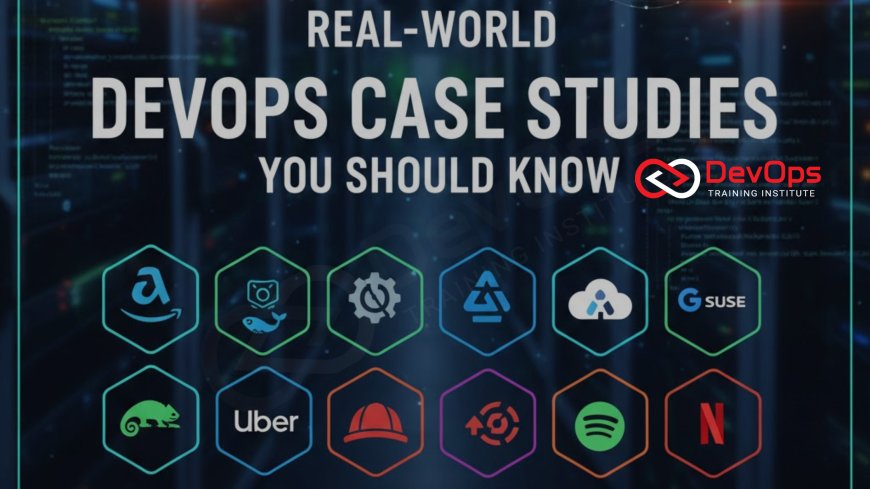
10 Real-World DevOps Case Studies You Should Know
Explore 10 powerful real-world DevOps case studies from Netflix, Amazon, Etsy, Capital One and more. Learn proven strategies, tools, and results that transformed software delivery and business outcomes in 2025.
Introduction
Real-world DevOps success stories prove that the combination of culture, automation, and the right tools can completely transform organizations. These ten companies faced massive scaling, security, or legacy challenges and solved them with DevOps way. From streaming giants handling millions of concurrent viewers to banks meeting strict compliance, each case shows measurable results. Beginners can copy the patterns while experts refine them. The best part? Many of these journeys started small and scaled fast. Cloud storage services like Amazon S3 often played a quiet but critical role in storing build artifacts, logs, and backups across these pipelines.
1. Netflix – Inventing Chaos Engineering
- Moved from monolith to thousands of microservices
- Created Chaos Monkey to randomly kill production instances
- Built Spinnaker for multi-cloud continuous delivery
- Canary analysis and automated rollbacks
- Full ownership model: you build it, you run it
- Now handles 200+ million subscribers with 99.99% uptime
2. Amazon – Two-Pizza Teams & API-First Culture
Amazon’s legendary “two-pizza teams” (small enough to feed with two pizzas) and mandatory API-first design forced early DevOps thinking. Every service must be consumable via APIs, enabling true ownership and one-click deployments.
Result: thousands of teams deploy independently, powering AWS and the world’s largest e-commerce platform.
3. Etsy – From “Deploy Friday” Fear to 50 Deploys/Day
- Used to have terrifying Friday deployments
- Introduced feature flags and dark launches
- Created Deployinator – their open-source deployment tool
- Adopted blameless post-mortems culture
- Teams now use S3 event notifications to trigger instant alerts
- Went from 1 deploy/week to 50+ per day
- Improved site performance and developer happiness
4. Capital One – Banking Meets Cloud-Native DevOps
One of the first banks to go “all-in” on AWS. Migrated thousands of apps, built mobile banking features faster than fintech startups, and maintained strict regulatory compliance.
Automated security and compliance checks in every pipeline became their secret weapon.
5. Target – Surviving Black Friday with Kubernetes
- Legacy systems crashed during peak shopping events
- Massive lift-and-shift to containers and Kubernetes
- Built internal developer platform for self-service
- Automated on-prem to S3 data migration
- Predictive scaling with machine learning
- Now handles 10× traffic spikes with zero downtime
- Reduced infrastructure costs by 35%
6. Walmart – Beating Amazon at E-Commerce Speed
Walmart rebuilt its entire e-commerce stack using microservices, Node.js, and one of the world’s largest OpenStack private clouds, then migrated to Azure. DevOps culture helped them go from 1 release every few months to multiple releases per day.
Online sales grew over 70% year-over-year after the transformation.
7. ING Bank – Spotify Model at Enterprise Scale
- Reorganized 3,500 IT staff into squads, tribes, and chapters
- Standardized on GitLab CI/CD
- Automated everything from testing to compliance
- Monitoring S3 usage with CloudWatch became standard
- Reduced time-to-market by 50%
- Improved employee satisfaction dramatically
- Now launches features faster than many fintech startups
8. Daimler – Predictive Maintenance for Trucks
Connected truck telemetry to AWS IoT and built real-time analytics pipelines. DevOps practices enabled rapid iteration on predictive maintenance models.
Result: 30% reduction in unplanned downtime across global fleets.
9. JAMF – Scaling Apple Device Management
- Explosive growth in managed Apple devices
- Adopted Atlassian suite + Bamboo CI
- Containerized services for consistency
- Used S3 cost optimization best practices
- Automated quality gates and compliance
- Increased release velocity by 40%
- Now manages millions of devices securely
10. NBCUniversal – Streaming Media at Scale
Modernized video processing and content delivery pipelines using IBM Cloud and microservices. Automated transcoding, packaging, and distribution workflows.
Achieved 50% cost reduction and dramatically faster time-to-air for new content.
Conclusion
These ten DevOps case studies prove one thing: when culture, automation, and ownership align, extraordinary results follow. Start where these giants did — break silos, automate ruthlessly, measure everything, and learn from every failure. Whether you’re in retail, finance, media, or manufacturing, the same principles apply. Pick one practice from this list today (many teams start with blameless post-mortems or feature flags) and watch your delivery speed and reliability soar.
Frequently Asked Questions
Which company started chaos engineering?
Netflix invented Chaos Monkey and made resilience a core competency.
Why did Etsy succeed where others failed?
They focused on culture first — blameless post-mortems and psychological safety.
Can banks really do DevOps?
Yes. Capital One and ING proved compliance and speed can coexist.
What’s the most common first step in these journeys?
Automating deployments and introducing feature flags.
Do I need Kubernetes to succeed?
No. Etsy and Amazon thrived for years without it. Start with culture and automation.
What's Your Reaction?
 Like
0
Like
0
 Dislike
0
Dislike
0
 Love
0
Love
0
 Funny
0
Funny
0
 Angry
0
Angry
0
 Sad
0
Sad
0
 Wow
0
Wow
0




![100+ Azure DevOps Interview Questions and Answers [Updated 2025]](https://www.devopstraininginstitute.com/blog/uploads/images/202509/image_140x98_68c40aa9a3834.jpg)






![Future Scope of DevOps Careers in Pune [Updated 2025]](https://www.devopstraininginstitute.com/blog/uploads/images/202510/image_140x98_68e3a84652312.jpg)