







![Kong Interview Preparation Guide [2025]](https://www.devopstraininginstitute.com/blog/uploads/images/202509/image_430x256_68dbb95326997.jpg)






10 Kubernetes Architecture Mistakes to Avoid
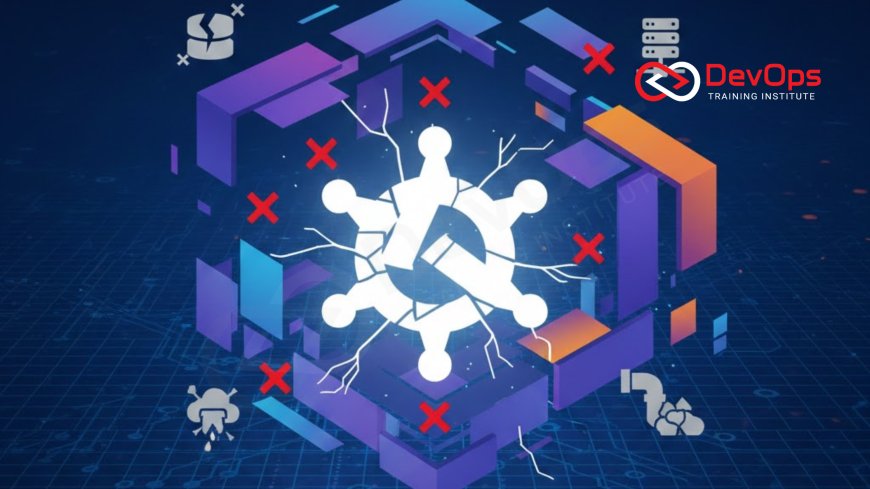
Scaling applications on Kubernetes requires architects to sidestep critical mistakes that lead to instability, security vulnerabilities, and operational chaos. This comprehensive guide details the 10 most common Kubernetes architecture mistakes, from mismanaging the critical etcd data store and ignoring NetworkPolicy to treating stateless Pods as persistent. Learn how to design a resilient cluster by enforcing robust security via RBAC, mandating resource limits, and ensuring high availability for the control plane. Avoiding these pitfalls is key to achieving true cloud-native scale, minimizing downtime, and securing your distributed applications effectively against internal and external threats.
Introduction
Kubernetes has become the de facto operating system for the cloud, providing a powerful, extensible platform for deploying, scaling, and managing containerized applications. However, its immense complexity and sheer number of configuration options mean that organizations frequently make fundamental architectural mistakes when implementing and managing clusters in a production environment. These missteps, often rooted in traditional infrastructure thinking, can lead to chronic instability, catastrophic security breaches, excessive operational toil, and crippling vendor lock-in. Unlike errors in application code, architectural flaws in Kubernetes can compromise the availability and security of the entire distributed system, affecting dozens or even hundreds of deployed services simultaneously. This necessitates a proactive understanding of where the structural weak points typically emerge.
Successfully running Kubernetes at scale requires a cultural shift toward cloud-native principles, embracing automation, immutability, and declarative configuration. The focus must transition from managing individual servers to managing the collective state of the cluster, treating infrastructure with the same rigor as application code. The ten mistakes detailed in this guide are not minor configuration issues; they are systemic flaws that fundamentally undermine the resilience and security guarantees that Kubernetes is designed to provide. By identifying these pitfalls early, architects and engineers can design a robust foundation that is scalable, secure, and manageable, guaranteeing the stability and predictability of the software delivery pipeline.
Control Plane and Core Component Failures
The Control Plane is the brain of the Kubernetes cluster, responsible for maintaining the desired state, scheduling workloads, and handling API requests. Failures in this layer are fatal to the entire cluster's operations. These mistakes often stem from underestimating the security and availability requirements of core components, particularly the critical data store that holds the entire cluster's state. Ignoring the resilience of these components is a direct threat to the availability of all hosted applications, making proper configuration mandatory for production environments.
1. Not Backing Up or Securing etcd: The etcd key-value store holds the entire cluster state, including all application definitions, secrets, configurations, and network settings. If etcd data is corrupted or lost, the cluster is irrecoverable, leading to a massive service outage. The mistake is failing to implement automated, verified backups of the etcd cluster and not encrypting communication to and from it. Solution: Implement regular, verifiable snapshot backups of etcd, store backups securely outside the cluster, and strictly enforce TLS encryption for all etcd peer and client communication. The etcd store is the most sensitive asset in the cluster, and its failure mode is catastrophic.
2. Running the Control Plane Without High Availability (HA): Deploying the Control Plane (API server, scheduler, controller manager) on a single machine. While acceptable for development or testing, this creates a single point of failure (SPOF) for production, meaning a simple machine failure or network outage will halt all scheduling, scaling, and API functions. Solution: Always deploy the Control Plane across at least three (or five) separate zones or fault domains for redundancy. Cloud providers offer managed Kubernetes services (EKS, AKS, GKE) that automatically handle HA and health checking for these critical components. Ensuring HA is the simplest way to guarantee that core cluster functionality remains online even during hardware failure.
Networking Exposure and Service Access Blunders
Networking mistakes in Kubernetes can lead to either complete application isolation or, worse, unintended public exposure and severe security vulnerabilities. The challenge is that Kubernetes abstracts traditional network concepts, requiring architects to think in terms of logical services and policies rather than fixed IP addresses. Misconfigurations often compromise the boundary between internal cluster traffic and external traffic, creating easily exploitable pathways that bypass standard firewall protection. These mistakes require a deep understanding of network layers, including how packets are routed across cloud infrastructure, which differs significantly from traditional on-prem networks.
3. Using NodePort for Production Services: Exposing an application service by configuring it as a NodePort type opens a fixed port on every node in the cluster, routing external traffic directly to the service. This method creates unnecessary security risks by bypassing the cloud provider's managed load-balancing features and exposes applications on potentially unintended ports. Solution: Always use a LoadBalancer service type (which provisions a cloud-managed external load balancer) or an Ingress Controller to manage Layer 7 (application-level) traffic routing. This provides better security, centralized TLS termination, and more robust traffic management, ensuring that public access is controlled and managed efficiently. Furthermore, configuring load balancing requires careful attention to TCP and UDP traffic handling for various application types, using the appropriate service type for real-time or connection-oriented communication.
4. Ignoring NetworkPolicy Defaults: The mistake of deploying applications without implementing strict NetworkPolicy objects, which leaves all Pods open to communication with all other Pods and namespaces by default. This "flat network" design is a severe security vulnerability, allowing an attacker who compromises one Pod to easily traverse the entire cluster (lateral movement). Solution: Adopt a default-deny security posture by implementing NetworkPolicy objects in every namespace. This micro-segmentation approach explicitly defines which Pods are allowed to communicate with which, restricting access based on logical labels rather than physical addressing (which is abstracted in the cloud). This provides essential defense against lateral attacks, confining potential breaches to a specific application boundary.
Security and Authorization Gaps
Security is a shared responsibility in Kubernetes. The cluster administrator must secure the control plane, but application developers must ensure their workloads run with minimal necessary privileges. Mistakes in Role-Based Access Control (RBAC) are especially dangerous because they can grant attackers, or careless users, the power to destroy entire applications or namespaces, or compromise system-level functions. These flaws often involve over-permissioning users and system components, leading to an unnecessarily high-risk security profile for the entire application ecosystem.
5. Granting Over-Privileged RBAC: Granting developers, CI/CD pipelines, or service accounts excessive permissions, often by binding them to the cluster-admin role or granting broad wildcard permissions (). This violates the Principle of Least Privilege, meaning a single compromised credential or CI/CD server could gain complete control over the entire cluster, allowing attackers to exploit common ports or infrastructure resources. Solution: Rigorously define ClusterRole and Role objects to grant only the exact permissions needed for a specific task or namespace. Audit all bindings, especially ClusterRoleBindings, and ensure that only administrative users have cluster-wide privileges. Engineers should also understand the OSI and TCP/IP models to properly segment and secure network traffic, ensuring that RBAC policies align with network access controls.
6. Treating Pods as Persistent: Assuming that a Pod's assigned IP address or its existence is permanent. Pods are inherently ephemeral; they can be evicted, rescheduled, or destroyed at any time by the scheduler or during node failures. Treating them otherwise leads to application failures when services fail to reconnect or persistent data is lost. Solution: All stateless applications must be managed by Deployments, and stateful applications must use StatefulSets paired with Persistent Volume Claims (PVCs) to manage external, durable storage. Never rely on Pod IPs; instead, always use Services to provide a stable, load-balanced DNS endpoint for application communication.
| # | Architecture Mistake | Primary Impact | Recommended Solution |
|---|---|---|---|
| 1 | Not Backing Up etcd | Total cluster loss / Irrecoverable state. | Automate verified, encrypted etcd backups and store them securely outside the cluster. |
| 3 | Using NodePort for Production | Security risk / Bypassing cloud load balancers / Uncontrolled public access. | Use LoadBalancer or Ingress Controllers for external access and proper traffic management. |
| 5 | Over-Privileged RBAC | Massive security risk (potential cluster takeover if credentials are compromised). | Enforce the Principle of Least Privilege; audit all ClusterRoleBindings. |
| 7 | Ignoring Resource Requests/Limits | Scheduler instability / Node thrashing / Unpredictable application performance. | Mandate strict CPU/Memory Requests (guaranteed resource) and Limits (max usage) for all Pods. |
| 9 | Ignoring Health Probes | Serving bad traffic / Slow recovery time / Unnecessary downtime during startup. | Mandate Liveness and Readiness probes for all production Pods, ensuring traffic is only routed to healthy instances. |
Resource Scheduling and Application Stability Errors
These mistakes directly impact the stability, performance, and recoverability of the applications running on the cluster. They stem from a failure to properly inform the Kubernetes scheduler about the application's actual resource needs or its lifecycle requirements, leading to poor density, wasted cloud budget, and applications that fail to recover quickly or correctly during a service incident. Proper configuration in this area is essential for meeting Service Level Objectives (SLOs) and maximizing the return on investment in cloud compute resources.
7. Ignoring Resource Requests/Limits: Deploying Pods without defining mandatory CPU and Memory Requests and Limits. The Requests inform the scheduler of the guaranteed minimum resources the Pod needs, affecting placement, while the Limits cap the maximum resources the Pod can consume, preventing one rogue application from crashing the entire worker node (the "noisy neighbor" problem). Solution: Mandate the use of Resource Requests (guaranteed QoS) and Limits (safety ceiling) for all containers in production. This practice stabilizes the worker nodes, prevents resource starvation, and allows for much better utilization and density planning within the cluster, optimizing cloud costs.
8. Ignoring Health Probes (Liveness/Readiness): Deploying applications without mandatory Liveness and Readiness probes. The Liveness probe detects if an application is running but unhealthy (e.g., deadlocked) and triggers an automatic restart by the Kubelet. The Readiness probe signals whether the Pod is ready to serve traffic, preventing the Service load balancer from routing traffic to a Pod that is still initializing or failing. Solution: Mandate the use of both probe types for all production applications. This practice significantly improves service reliability by ensuring traffic is never routed to unhealthy instances and dramatically speeds up the cluster's self-healing capabilities.
Operational Visibility and Monitoring Gaps
In a microservices architecture, troubleshooting a single failure often requires correlating data across dozens of components (Pod logs, node metrics, network traces). A fragmented or missing observability stack is a critical architectural mistake that translates directly into painfully slow Mean Time to Recovery (MTTR), costing the business significant revenue during outages. The complexity of the cluster environment demands a unified approach to monitoring.
The solution is to mandate a unified observability stack that tracks all aspects of the running cluster:
- Metrics: Deploy a standardized time-series database (like Prometheus) and visualization tool (like Grafana) to scrape performance data (CPU, memory, network latency) from all Kubernetes components (cAdvisor, Kubelet, API Server) and application endpoints.
- Logging: Implement centralized logging agents (like Fluentd/Fluent Bit) as DaemonSets across all worker nodes to reliably capture, standardize, and stream container logs off-cluster to a search engine (like Elasticsearch or Splunk) before the Pods are destroyed.
- Tracing: Utilize distributed tracing (like Jaeger or OpenTelemetry) to track a single user request across multiple microservices and network boundaries, which is essential for diagnosing performance bottlenecks and complex service-to-service communication failures across the network, which often involves understanding how to secure different ports and protocols.
- Alerting: Configure intelligent alerting that triggers actionable notifications based on Service Level Objectives (SLOs) rather than simple resource thresholds, ensuring the operations team is notified only when a problem impacts the end-user experience.
9. No Centralized Observability (Logs/Metrics): Relying on viewing local container logs (via `kubectl logs`) or fragmented cloud provider metrics. The ephemeral nature of Pods means local logs are lost immediately upon crash or restart, making root cause analysis impossible. Solution: See the bullet points above. A unified observability pipeline is a mandatory architectural component, not an optional add-on, ensuring comprehensive data collection from every layer of the cluster, from the network interfaces to the application code itself.
Infrastructure Management and Scalability Pitfalls
The final set of mistakes involves treating the cluster as a static entity or failing to properly isolate core functions from transient workloads. These mistakes ultimately compromise the long-term maintainability, auditability, and security of the cluster, leading to operational friction that hinders the organization's ability to scale resources and manage the cluster lifecycle over time. Solving these requires strict process enforcement and commitment to infrastructure automation.
10. Manual Cluster Management (Ignoring IaC): Provisioning or modifying the cluster (e.g., adding nodes, changing networking, upgrading control plane) via manual cloud console clicks or bespoke scripts. This anti-pattern introduces configuration drift, lacks auditability, and makes recovery from disaster slow and unreliable. Solution: Mandate Infrastructure as Code (IaC) for all cluster lifecycle management, using tools like Terraform, CloudFormation, or Pulumi. All cluster definitions must live in Git, ensuring every change is reviewed, auditable, and repeatable. This process aligns the cluster management with the CI/CD pipeline, guaranteeing consistency.
11. Exposing Sensitive Ports/Services: Failing to secure or restrict internal cluster endpoints, such as the Kubernetes API Server, Kubelet, and certain internal services. While some internal cluster traffic must flow freely—requiring an understanding of how traffic is routed and which ports and protocols are necessary—leaving these sensitive components open to external or overly broad internal access is a massive vulnerability, allowing an attacker to potentially compromise the cluster through known attack vectors. Solution: Implement strict network security policies (Firewall rules, Security Groups) to limit API server access only to trusted networks/users, and enforce TLS for all cluster communication, significantly reducing the attack surface. Furthermore, security policies must strictly define which Pods are allowed to connect to these endpoints, mitigating the ability of a compromised application to gather privileged information or exploit common ports to gain escalated access.
Conclusion: Building Resilience by Design
Running Kubernetes reliably in production is an exercise in meticulous planning and disciplined process enforcement. The 10 common architectural mistakes outlined here—from the catastrophic risk of an unsecured etcd backup and the instability caused by ignoring resource limits, to the security vulnerability of flat networking and over-privileged RBAC—represent the critical failures that undermine the resilience and security of enterprise-grade deployments. Successfully navigating this landscape requires architects to adopt a cloud-native mindset from day one, prioritizing immutability, automation, and the principle of least privilege in every configuration.
The goal is to design a self-healing cluster that is auditable via IaC, observable via a unified monitoring stack, and secure by default through granular RBAC and NetworkPolicy. By avoiding these foundational pitfalls, organizations ensure that their Kubernetes clusters are reliable, scalable foundations for innovation, rather than chronic sources of operational pain and security risk, ultimately transforming the container orchestrator from a complex tool into a dependable engine for continuous software delivery.
Frequently Asked Questions
What is the greatest risk of ignoring etcd security?
The greatest risk is the complete loss or compromise of the entire cluster state, making the cluster wholly unrecoverable without recent backups.
What is the purpose of a Liveness Probe?
The Liveness Probe detects if a running container is unhealthy (e.g., deadlocked) and tells the Kubelet to automatically restart it, aiding self-healing.
Why should NodePort be avoided in production?
NodePort should be avoided because it creates unnecessary security risks by exposing services on high-numbered ports across all cluster nodes.
How does RBAC enhance Kubernetes security?
RBAC enhances security by defining and enforcing strict permissions on users and services, ensuring they only have the absolute minimum access required for their tasks.
What is the core difference between Requests and Limits?
Requests guarantee the minimum resource allocated by the scheduler, while Limits cap the maximum resource consumption to prevent node thrashing.
How do you secure traffic that might exploit common ports?
You secure it by enforcing network security policies (e.g., NetworkPolicy or firewall rules) to block access to exploit common ports and protocols used by attackers.
What is the goal of adopting NetworkPolicy?
The goal is to enforce a default-deny micro-segmentation approach, restricting lateral communication between Pods within the cluster for better security.
Why is centralizing logs essential for Kubernetes?
Centralizing logs is essential because Pods are ephemeral; local logs are lost upon crash or restart, making external storage necessary for troubleshooting.
Why is the use of LoadBalancer services preferred over NodePort?
LoadBalancer is preferred as it provisions a managed cloud load balancer, providing external access with proper security, TLS termination, and traffic management.
What is the biggest risk of manual cluster management?
The biggest risk is configuration drift, making the cluster unrepeatable, difficult to audit, and slow to recover from a disaster due to the lack of version-controlled IaC.
How does Kubernetes networking differ from traditional on-prem networks?
Kubernetes networking is based on software-defined networking, creating virtual overlays where every Pod gets its own IP address, abstracting the physical hardware.
What is the importance of a Readiness Probe?
The Readiness Probe ensures that traffic is only routed to a Pod once it is fully initialized and ready to handle incoming requests, preventing 503 errors during startup.
How are security policies related to the OSI model?
Security policies (like NetworkPolicy) control traffic at Layer 3/4, making it necessary to understand how lower layers affect traffic flow and port utilization.
How should persistent data be managed in Kubernetes?
Persistent data should be managed using StatefulSets paired with Persistent Volume Claims (PVCs), which connect the Pods to external, durable storage systems.
How does the Principle of Least Privilege apply to RBAC?
It means granting users and services the absolute minimum set of API permissions required for their specific tasks, preventing high-risk, broad access.
What's Your Reaction?
 Like
0
Like
0
 Dislike
0
Dislike
0
 Love
0
Love
0
 Funny
0
Funny
0
 Angry
0
Angry
0
 Sad
0
Sad
0
 Wow
0
Wow
0


![100+ Azure DevOps Interview Questions and Answers [Updated 2025]](https://www.devopstraininginstitute.com/blog/uploads/images/202509/image_140x98_68c40aa9a3834.jpg)






![Future Scope of DevOps Careers in Pune [Updated 2025]](https://www.devopstraininginstitute.com/blog/uploads/images/202510/image_140x98_68e3a84652312.jpg)