
















![Kong Interview Preparation Guide [2025]](https://www.devopstraininginstitute.com/blog/uploads/images/202509/image_430x256_68dbb95326997.jpg)











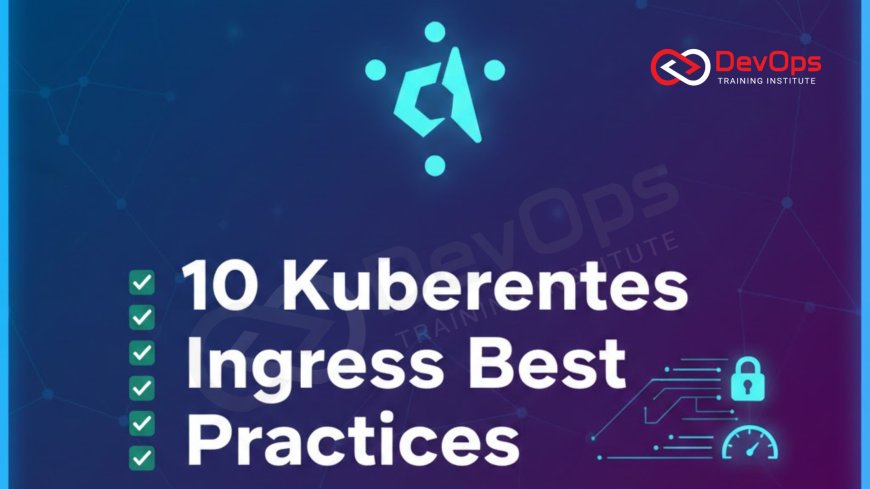
10 Kubernetes Ingress Best Practices
Optimize your Kubernetes application exposure and traffic management with the 10 essential Ingress best practices every platform and DevOps engineer must implement. This comprehensive guide details strategies for robust security, high performance, advanced traffic routing, and resilient controller deployment. Learn how to secure your endpoints with mandatory TLS, leverage annotations for custom rules, deploy multiple controllers for separation of concerns, and ensure high availability. Implementing these rules is crucial for creating a scalable, reliable, and secure entry point for all API traffic entering your Kubernetes cluster, enhancing operational efficiency and application stability.
Introduction
Kubernetes Ingress is the fundamental resource that defines how external traffic should be routed to the services running inside your cluster. It acts as the intelligent Layer 7 entry point, governing HTTP and HTTPS traffic, handling hostname-based routing, path-based routing, and SSL/TLS termination. While the Ingress resource itself is a set of rules, the heavy lifting is performed by an Ingress Controller (such as NGINX, Traefik, or HAProxy), which watches the Ingress object and configures the underlying load balancer. Properly configuring and deploying this component is arguably the most critical operational task for any production-grade Kubernetes cluster, as it is the point where the outside world meets your internal services.
However, deploying a basic Ingress is often insufficient for the demands of modern, high-traffic microservices environments. To achieve enterprise-level performance, security, and resilience, organizations must adopt a set of battle-tested best practices. These practices transform the Ingress from a simple router into a sophisticated traffic management and security enforcement layer. This comprehensive guide outlines the 10 must-know Kubernetes Ingress best practices, categorized by their primary focus on security, architecture, and operational efficiency. Implementing these rules will dramatically improve the robustness and manageability of your cluster's external exposure, allowing your teams to deliver features faster and with higher confidence, ensuring the integrity of your entire cloud-native system.
Security Best Practices for Ingress
Because the Ingress layer is the exposed edge of your entire application stack, security must be the number one priority. A single misconfiguration here can expose sensitive data or leave the entire cluster vulnerable to denial-of-service or malicious traffic. Adopting a DevSecOps mindset means embedding these security checks directly into your Ingress configuration and deployment pipeline, treating security as an automated, non-negotiable gateway. The practices related to security are often the easiest to overlook but carry the highest risk when mismanaged, and thus must be foundational to your Ingress strategy.
- Mandate TLS Termination at the Edge: Every production endpoint must use HTTPS. Terminating TLS (SSL/TSL) at the Ingress controller is highly efficient, as it decrypts traffic once and allows internal network traffic to potentially remain unencrypted (though internal encryption is a recommended defense-in-depth strategy). The best practice is to automate certificate management using Cert-Manager, which watches Ingress resources and automatically provisions and renews certificates from providers like Let's Encrypt or your internal CA, ensuring no certificate ever expires and causes an outage.
- Implement Strong Header Security: Your Ingress controller should enforce security-enhancing HTTP headers globally. These include `Strict-Transport-Security` (HSTS) to force HTTPS usage on future requests, `Content-Security-Policy` (CSP) to mitigate cross-site scripting (XSS), and `X-Content-Type-Options` (`nosniff`). Many Ingress controllers allow you to configure these via global settings or annotations, centralizing the security policy and reducing the burden on individual microservices.
- Restrict Access Using Network Policies and CIDR Blocks: While Ingress provides L7 routing, you must use L4 and L3 security controls. If your Ingress Controller exposes a LoadBalancer service, use the cloud provider's firewall features or Kubernetes Network Policies to restrict access to the Ingress controller's external port (typically 80/443) only from trusted sources or specific CIDR ranges, ensuring that only expected public traffic can reach the ingress. This practice aligns perfectly with the need for strong read, write, and execute permissions management, applying granular security at the network edge.
Architectural Best Practices for Resilience
A production environment must be designed for resilience, meaning it must tolerate failures without impacting service availability. The Ingress layer, as a single point of entry, must be highly available and capable of handling sudden traffic spikes. Architectural best practices focus on ensuring the Ingress controller itself is deployed correctly for fault tolerance, and that the services it routes to are accessible reliably. These practices involve strategic deployment methods and intelligent use of Kubernetes Service abstractions to maintain continuous operation regardless of underlying node or zone failures.
A key strategy for resilience is deploying the Ingress controller in a highly available configuration. This means running multiple replicas of the controller Pods across different availability zones (if your cluster supports multi-zone topology) and configuring the underlying cloud load balancer to distribute traffic evenly across these replicas. Running multiple replicas of the controller ensures that if one node fails, the load balancer automatically redirects traffic to the healthy replicas, preventing a service disruption. Furthermore, the health check configuration of the underlying LoadBalancer must be meticulously set up to accurately reflect the readiness of the controller Pods. This is a crucial element for ensuring application uptime.
Another strong architectural best practice is to separate internal and external traffic using multiple Ingress Controllers. Use one controller, exposed to the public internet, to handle all external user traffic, and use a separate, internal-only Ingress controller to manage traffic from other internal tools or APIs. This separation of concerns simplifies security policies (you don't need public-facing WAF rules on the internal router) and prevents internal services from competing with high-priority external services for the same routing resources. It adds a layer of defense-in-depth, preventing internal threats from easily accessing the external routing path and vice versa, which is a major benefit in complex, multi-tenant environments.
Operational Best Practices for Traffic Management
Operational best practices focus on optimizing the day-to-day management of Ingress, enabling advanced deployment strategies, and maximizing performance. This involves leveraging the custom features of your chosen Ingress controller via annotations and integrating with external DNS systems for automated routing updates. Efficient traffic management allows development teams to execute sophisticated, low-risk deployments like canary releases, which are essential for continuous delivery and reducing the change failure rate, thereby directly supporting the goals of a mature DevOps organization.
A fundamental operational practice is to leverage Ingress Annotations for Advanced Routing. Standard Kubernetes Ingress resources only support basic path and host routing. However, all major Ingress controllers (NGINX, Traefik, etc.) offer custom features exposed through annotations defined on the Ingress object. These annotations can enable powerful capabilities such as:
- Client IP hashing for session affinity (sticky sessions)
- Rate limiting policies to protect against traffic surges and abuse
- Custom header injection or modification for tracing and security
- Fine-grained traffic splitting for canary deployments (e.g., routing 5% of traffic to a new version)
This allows the platform team to provide advanced routing capabilities to application teams without modifying the core controller configuration, enabling decentralized, flexible traffic control specific to each application's needs.
Another crucial operational best practice is the Automated DNS Management (external-dns). Manually creating and updating A records in your DNS provider every time a new Ingress is deployed is slow and error-prone. Tools like external-dns watch Kubernetes Ingress and Service objects and automatically create corresponding records in external DNS providers (like AWS Route 53 or Google Cloud DNS). This practice dramatically reduces the lead time for changes related to service exposure and eliminates the risk of human error in DNS configuration. It is an essential piece of the CI/CD pipeline, ensuring that the deployment of a new service automatically makes it publicly resolvable within minutes, enabling true continuous deployment to the edge and requiring careful user management to control the access of the external-dns ServiceAccount.
Table: Best Practices Summary and Implementation
| Practice Area | Best Practice | Primary Benefit | Key Tool/Implementation |
|---|---|---|---|
| Security | Mandate TLS Termination at the Edge | Ensures all external traffic is encrypted; prevents plain text communication. | Cert-Manager, Ingress TLS spec, Secret management. |
| Architecture | Deploy Controller in High Availability (HA) | Prevents the Ingress layer from becoming a single point of failure. | Multiple replicas, multi-zone deployment, robust LoadBalancer health checks. |
| Operational | Automated DNS Management | Reduces time-to-market and eliminates manual DNS configuration errors. | external-dns, cloud provider DNS (e.g., Route 53). |
| Security | Implement Strong Header Security | Mitigates common web vulnerabilities like XSS and clickjacking via HSTS/CSP. | Controller annotations/config for HSTS, CSP, etc. |
| Architecture | Use Multiple Ingress Controllers (Internal/External) | Separation of concerns; isolates internal traffic from external security risks. | Two distinct controller deployments, different LoadBalancer services. |
| Operational | Leverage Ingress Annotations for Advanced Routing | Enables granular traffic splitting, rate limiting, and session affinity. | Controller-specific annotations (e.g., NGINX or Traefik annotations). |
| Operational | Use Dedicated Ingress Classes | Clearly defines which controller implements which Ingress resource, preventing conflicts. | ingressClassName field (Kubernetes 1.18+), IngressClass resource. |
| Security | Implement DDoS/Rate Limiting | Protects backend services from traffic overload and malicious attacks. | Controller-level configuration, cloud WAF integration. |
| Architecture | Monitor Ingress Metrics Extensively | Provides insights into latency, error rates, and traffic patterns for proactive troubleshooting. | Prometheus, Grafana, built-in controller metrics endpoint. |
| Operational | Minimize and Review Default Backend | Ensures all unmatched traffic is handled safely, usually by a custom 404/security page. | Dedicated default backend service and deployment. |
Advanced Traffic Routing for CI/CD
A core promise of microservices and DevOps is the ability to deploy changes frequently and safely. The Ingress layer plays a vital role in enabling advanced deployment patterns that mitigate risk, such as canary and blue/green deployments. These strategies allow a new version of an application to be tested against a small subset of live traffic before a full rollout, ensuring that any bugs or performance issues are caught before they impact the general user base, dramatically reducing the change failure rate. Implementing these advanced routing capabilities requires treating the Ingress configuration itself as part of the CI/CD pipeline, subject to the same version control and automation as the application code.
The practice of Canary Deployments involves simultaneously running two versions of a service: the stable old version (90-99% of traffic) and the new version (1-10% of traffic). The Ingress controller is configured to split the traffic based on weights, headers, or client IP addresses. Tools built around Ingress, or often the controller itself (e.g., NGINX Ingress with custom annotations or Istio's Gateway/VirtualService), allow for this dynamic traffic shifting. Continuous monitoring of the performance (latency, error rates) of the new version is essential; if the new version's error rate exceeds a threshold, the traffic split is immediately reverted to 100% stable version, automating the rollback process. This is the safest way to deploy high-risk changes and is a hallmark of elite DevOps teams, ensuring that the Change Failure Rate remains exceptionally low.
Blue/Green Deployments provide another high-safety deployment method. Here, two identical environments (Blue is stable, Green is new) are maintained. The Ingress controller initially points all traffic to Blue. When Green is fully tested, the Ingress is atomically switched to point all traffic to Green. This rapid switch is low-risk but requires double the resources momentarily. Implementing this requires the Ingress definition to be easily swappable, often through a separate Service object for Blue and Green, with the Ingress pointing to a third service that uses the label selector to choose Blue or Green. This is a deployment method that heavily relies on well-defined system changes and a fast, reliable configuration update mechanism in the Ingress controller to ensure an instantaneous and reliable switchover.
Performance Tuning and Load Balancing
Beyond security and routing, the Ingress controller must be tuned for optimal performance to handle high throughput and low latency. The default settings for many Ingress controllers are often generalized and require specific configuration adjustments to handle the particular workload profile of a large-scale application. Performance tuning focuses on optimizing the controller's resource utilization and enhancing the efficiency of its underlying load balancing algorithms, ensuring that client requests are processed and forwarded to the backend services as quickly as possible, even under peak load conditions.
One critical tuning practice is Controller Resource Optimization. The Ingress controller Pods should have appropriate CPU and memory requests and limits defined (Quality of Service guarantees). Ingress controllers are CPU-intensive due to TLS decryption, regex matching for routing, and complex request processing. Insufficient CPU requests can lead to throttling and increased latency, while excessive limits waste cluster resources. Monitoring the utilization of the controller Pods and adjusting these limits is an ongoing operational task, crucial for maintaining predictable performance during traffic surges. This ties directly into the need for granular Linux file management and resource allocation policies at the node level to ensure efficiency.
Another performance best practice is to Optimize HTTP Caching and Compression. The Ingress controller can be configured to cache static content (like images, CSS, or JavaScript files) before they ever reach the backend application Pods, significantly reducing load and improving latency for clients. Similarly, enabling GZIP or Brotli compression at the Ingress layer can drastically reduce the size of the data sent over the network, improving performance for all users. These settings are often controlled via configuration files or annotations specific to the controller (e.g., NGINX configuration maps) and provide an immediate and impactful performance boost without requiring any changes to the backend application code, proving the value of centralized traffic processing at the cluster edge.
Separation of Concerns with Multiple Ingress Classes
As clusters grow and host diverse workloads, using a single, monolithic Ingress controller to handle everything quickly becomes unmanageable. This leads to a crucial architectural best practice: Using Multiple Ingress Controllers via Ingress Classes. Different applications have different needs: a low-latency gRPC service needs a specialized controller, while a simple marketing website needs only basic HTTP routing. Mixing these workloads on a single controller often results in a complex, fragile configuration that is difficult to secure and optimize for all use cases, creating a single point of failure and contention. The introduction of the `IngressClass` resource in Kubernetes provides the mechanism to officially solve this problem.
The IngressClass resource allows a platform team to define and advertise different routing capabilities within the cluster. For example, you might define three classes: nginx-public (for external, high-traffic APIs with WAF enabled), traefik-internal (for internal east-west communication), and gloo-edge-graphql (for specialized GraphQL routing). Application teams then specify which controller should process their Ingress resource by setting the `ingressClassName` field in their Ingress definition. This clear separation of concerns ensures that a misconfiguration or resource exhaustion issue in the `traefik-internal` controller does not affect the critical `nginx-public` controller, enhancing both security and resilience, and supporting the needs of multiple application teams with minimal group management in Linux administrative overhead.
This practice also allows the platform team to choose the right tool for the job. You can use the high-performance, open-source NGINX controller for most web traffic, a commercial solution like NGINX Plus or Kong for premium APIs requiring extensive plugin capabilities, and a lightweight Traefik instance for simple, automated routing in development namespaces. Each controller operates independently, running its own Pods, its own Service, and often its own cloud LoadBalancer. This architectural partitioning eliminates the "one size fits all" problem and allows security and performance tuning to be applied specifically to the controller that needs it, maximizing both efficiency and isolation.
Monitoring, Alerting, and Observability
You cannot manage what you do not measure. For the Ingress layer, robust observability is a non-negotiable best practice. Because the Ingress handles every external request, it is the best single source of truth regarding application traffic, latency, and error rates. Without comprehensive monitoring, troubleshooting issues becomes a nightmare, often requiring platform engineers to scramble through fragmented application logs to piece together what went wrong. Effective monitoring ensures issues are detected automatically and resolved quickly, driving down the Mean Time to Recover (MTTR), a critical DevOps performance metric.
The practice of Extensive Ingress Metrics Collection involves scraping metrics from the Ingress controller's built-in Prometheus endpoint. Most controllers expose vital metrics such as:
- Request throughput (requests per second)
- Latency (p95, p99 request times)
- HTTP error codes (4xx and 5xx response rates)
- Backend health check status
- Resource usage (CPU/Memory of the controller Pods)
These metrics should be visualized in dashboards (e.g., Grafana) and paired with clear, actionable alerts. For example, an alert should fire if the 5xx error rate from a specific Ingress rule exceeds 1% for five consecutive minutes, triggering an immediate incident response and providing the first indication that a backend service may be struggling. This is a classic example of proactive monitoring that is essential for maintaining application stability and reliability.
Furthermore, the Ingress controller should be configured to integrate with Distributed Tracing systems (like Jaeger or Zipkin). The controller can inject trace headers (like `x-request-id`) into the request before forwarding it to the backend Service. This allows the tracing system to follow the request as it hops between multiple microservices, providing end-to-end visibility into latency and failure points across the entire application stack. By combining metrics, logs (captured at the Ingress Pod level), and traces, platform teams gains the holistic observability necessary to confidently manage the complexity of modern microservices, ensuring that every issue, from a client timeout to a slow database query, can be quickly isolated and addressed without lengthy manual investigation.
Conclusion
The Kubernetes Ingress layer is the vital conduit connecting your microservices to the outside world. Adopting these 10 best practices transforms the Ingress from a simple routing mechanism into a highly secure, resilient, and performant API gateway. The principles are clear: security must be mandatory (TLS and strong headers), architecture must be resilient (HA deployment and multiple controllers), and operations must be automated (DNS management and advanced traffic splitting). By embracing GitOps principles to manage Ingress configurations and leveraging sophisticated tooling like Cert-Manager and external-dns, organizations can significantly reduce operational risk and accelerate their feature delivery velocity, ensuring the integrity of the cluster.
The continuous optimization of the Ingress, guided by extensive monitoring and performance tuning, is not a one-time project but an ongoing commitment to operational excellence. Leaders must ensure that their teams move beyond the basic Ingress resource definition and fully utilize the advanced capabilities provided by their chosen controller, especially for enabling low-risk deployment strategies like canary and blue/green. Implementing these rules will not only fortify the cluster's perimeter but also empower developers with the agility they need to release software faster and more safely, ultimately translating into better stability, higher customer satisfaction, and a stronger competitive position in the cloud-native landscape. Mastering these practices is the ultimate proof of a mature Kubernetes platform team.
Frequently Asked Questions
What is the main function of an Ingress Controller?
The Ingress Controller watches the Ingress rules and configures an underlying load balancer to route external HTTP/HTTPS traffic to internal services.
Why is mandating TLS at the Ingress edge considered a best practice?
It ensures that all external communication is encrypted, protecting data in transit from eavesdropping and maintaining a high level of security.
How does using multiple Ingress Controllers improve resilience?
It isolates traffic types, ensuring that a failure or misconfiguration in one controller, like the internal one, does not affect the external, public-facing traffic.
What is the primary benefit of using Ingress Annotations?
Annotations expose advanced, controller-specific features like rate limiting, custom headers, and granular traffic splitting that are not in the standard Ingress API.
What is the risk of a single point of failure in the Ingress layer?
The risk is complete application downtime, as a failure in the controller Pod or node would prevent all external traffic from reaching the backend services.
How does an Ingress Controller support a canary deployment?
It supports canary deployments by using weighted routing rules, sending a small percentage of live traffic to the new version for testing.
Why must the Ingress Controller be optimized for performance?
It is optimized because it handles CPU-intensive tasks like TLS termination and complex regex matching, which must be fast to maintain low application latency.
What is the purpose of the `external-dns` tool in an Ingress pipeline?
It automatically creates and updates external DNS records to match the new Ingress hostnames, automating a critical manual step for system administrators.
How do security headers like HSTS mitigate risks at the edge?
HSTS forces client browsers to use HTTPS for future requests, mitigating man-in-middle attacks and protecting against accidental use of HTTP.
Why is monitoring Ingress error rates so important for operations?
Monitoring error rates (like 5xx errors) provides the earliest and clearest signal of an application stability problem in the backend service.
What is the difference between Ingress and the Kubernetes Service resource?
Ingress handles L7 routing (HTTP/HTTPS host/path), while the Service handles L4 routing (TCP/UDP) and load balancing among application Pods.
What is the best practice for setting CPU/Memory limits on Ingress Controller Pods?
The best practice is to set requests and limits based on monitored usage and anticipated peak load to prevent throttling and ensure predictable performance.
How does proper Ingress configuration reduce Mean Time to Recover (MTTR)?
It reduces MTTR by providing centralized logs, granular metrics, and fast traffic shifting capabilities for quick issue isolation and automated rollback.
When is it best to use path-based routing in an Ingress rule?
Path-based routing is best used when different microservices share the same hostname but handle traffic based on the URL path (e.g., `/api` vs `/static`).
Why should the archive files of Ingress configuration be kept in Git?
Keeping configuration in Git ensures version control, auditability, and the ability to easily revert to a previously stable, secure state if an issue occurs.
What's Your Reaction?
 Like
0
Like
0
 Dislike
0
Dislike
0
 Love
0
Love
0
 Funny
0
Funny
0
 Angry
0
Angry
0
 Sad
0
Sad
0
 Wow
0
Wow
0





![100+ Azure DevOps Interview Questions and Answers [Updated 2025]](https://www.devopstraininginstitute.com/blog/uploads/images/202509/image_140x98_68c40aa9a3834.jpg)






![Future Scope of DevOps Careers in Pune [Updated 2025]](https://www.devopstraininginstitute.com/blog/uploads/images/202510/image_140x98_68e3a84652312.jpg)