



![Kong Interview Preparation Guide [2025]](https://www.devopstraininginstitute.com/blog/uploads/images/202509/image_430x256_68dbb95326997.jpg)





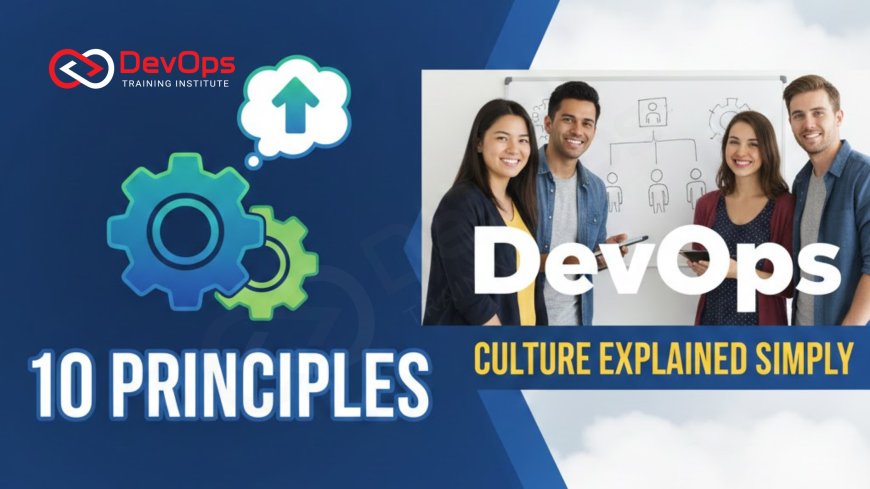
10 Principles of DevOps Culture Explained Simply
Unlock the secrets to building a thriving, efficient, and collaborative technology team by understanding the 10 core principles of DevOps culture. This beginner-friendly guide breaks down complex concepts like automation, continuous feedback, and infrastructure as code into simple, actionable steps. Learn how embracing this cultural shift can drastically improve software delivery speed, reliability, and quality across your organization, moving beyond just tools to foster a genuine partnership between development and operations teams for sustainable success in the modern digital landscape. Discover why security and learning are integral parts of this transformative methodology.
Introduction
DevOps is much more than a collection of tools or a set of technical practices; at its heart, it is a cultural and professional movement that stresses communication, collaboration, and integration between software development and IT operations teams. The primary goal of adopting a DevOps mindset is to shorten the systems development life cycle while delivering features, fixes, and updates frequently in close alignment with business objectives. This paradigm shift requires a fundamental change in how people work together, moving away from traditional silos where teams often operated in isolation, leading to misunderstandings and slow deployment processes, toward a shared sense of ownership for the entire software delivery pipeline and its long-term health.
The success of any DevOps initiative ultimately hinges on embracing specific cultural principles that guide daily interactions and decision-making. These principles act as a blueprint for transforming an organization's work environment, encouraging trust, transparency, and a relentless pursuit of improvement across all departments involved in product delivery. Understanding these core tenets is the critical first step for anyone looking to implement or even just understand the immense power of DevOps, as they provide the philosophical foundation upon which all technical practices, like the use of specific DevOps tools, are built and sustained over time. Without this cultural alignment, the mere adoption of tools will yield only minimal, short-lived improvements.
1. Collaboration and Communication (C)
This is arguably the most important principle and the very foundation of the DevOps philosophy, directly addressing the historical divide between the Development and Operations teams. Collaboration means fostering a joint environment where developers and operations staff feel comfortable working together from the initial coding phase all the way through to production deployment and maintenance. This requires breaking down organizational silos, ensuring that both teams share the same goals, understand each other's challenges, and communicate transparently and consistently about their respective tasks and progress. The continuous exchange of information is vital to prevent assumptions and miscommunications that often lead to critical errors or significant delays later in the delivery cycle.
Effective communication goes beyond just formal meetings; it involves creating shared digital spaces, using common collaboration platforms, and establishing lightweight processes that encourage frequent, informal interactions. When teams actively communicate, developers gain insight into the production environment's stability and operational concerns, while operations teams better understand the intended functionality and complexity of the code they are deploying. This unified approach replaces the traditional "throw it over the wall" mentality with a sense of shared responsibility, leading to faster problem resolution and higher-quality releases. It’s the human element that drives the entire DevOps engine forward efficiently.
2. Automation of Everything (A)
Automation is the technical backbone of DevOps, focusing on eliminating manual, repetitive, and error-prone tasks throughout the software delivery lifecycle. This principle advocates for automating everything possible, from code compilation and testing to infrastructure provisioning and application deployment. The primary benefit of automation is consistency; automated processes execute the same steps every time, drastically reducing the risk of human error that often plagues manual procedures. This consistency is essential for building confidence in the deployment process and achieving reliable, repeatable results, regardless of the deployment frequency or the complexity of the underlying systems.
By automating tasks, teams free up valuable time for engineers to focus on more complex and high-value work, such as innovation, architectural improvements, and addressing novel challenges. Key areas of automation include Continuous Integration (CI), where code changes are automatically tested and merged, and Continuous Delivery (CD), which ensures that validated code can be released to production at any time. Furthermore, infrastructure should be managed using code, a concept known as Infrastructure as Code (IaC), allowing environments to be reliably built and rebuilt on demand. This commitment to automation accelerates the pace of delivery while simultaneously improving the overall stability of the deployed software.
3. Continuous Integration and Continuous Delivery (CI/CD)
Continuous Integration (CI) and Continuous Delivery (CD) are crucial technical practices that directly implement the principles of collaboration and automation, forming the automated pipeline that moves code from development to production. CI involves developers merging their code changes into a main branch frequently, often several times a day, which is then automatically built and tested to detect integration errors as quickly as possible. This rapid feedback mechanism is key; finding and fixing bugs early is significantly cheaper and less disruptive than doing so later in the cycle, preventing large, painful integration events just before a scheduled release.
Continuous Delivery (CD) extends CI by automatically preparing the validated code for release, meaning that software is always in a deployable state. In true CD, every change that passes the automated tests can be deployed to production with a minimal, often single-click, manual step. When taken a step further to Continuous Deployment, the process is fully automated, and every change that passes all checks is released to users without human intervention. This capability allows organizations to release small, incremental updates much more frequently, which reduces the risk associated with each release and makes rolling back changes, if necessary, a much simpler operation. This rapid iteration is what enables a business to respond quickly to market needs.
4. Infrastructure as Code (IaC) and Version Control
Infrastructure as Code (IaC) is a fundamental principle in DevOps that involves managing and provisioning computing infrastructure, such as networks, virtual machines, load balancers, and connection topology, using machine-readable definition files instead of relying on manual hardware configuration or interactive configuration tools. By treating infrastructure setup like application code, it can be stored in a version control system, subjected to the same rigorous testing and review processes, and deployed consistently. This approach solves the problem of "configuration drift," where production, staging, and development environments gradually become different from one another over time, leading to frustrating and difficult-to-diagnose bugs.
The practice of using version control for infrastructure files is paramount; it provides a complete history of changes, allowing teams to track who made which configuration change and when. This audit trail is invaluable for debugging, auditing, and ensuring compliance, as any previous state of the infrastructure can be reliably and quickly recreated. Tools like Terraform, Ansible, and Puppet are widely used to implement IaC, enabling the environment to be self-documenting and making it possible to tear down and provision new environments instantly for testing or disaster recovery purposes. This ability to manage environments programmatically is a cornerstone of operational efficiency in DevOps.
5. Measurement and Monitoring (M)
The principle of Measurement and Monitoring emphasizes the need to collect, analyze, and act upon data gathered from every stage of the software delivery pipeline and the production environment. If you cannot measure it, you cannot improve it. This goes beyond simply tracking server uptime; it involves gathering comprehensive metrics on everything from the health and performance of the application (e.g., latency, error rates, throughput) to the efficiency of the team's processes (e.g., deployment frequency, lead time for changes, mean time to recovery). Monitoring tools provide real-time visibility into the system's current state, allowing teams to proactively detect and address issues before they significantly impact the user experience.
Effective monitoring should be implemented in a way that provides fast, actionable feedback to the teams responsible for the code and infrastructure. This means setting up appropriate alerts that notify the correct people immediately when key performance indicators (KPIs) cross defined thresholds. Moreover, this data should be used not just for firefighting, but for continuous improvement, informing decisions about where to invest resources for optimization. By focusing on critical metrics, organizations can ensure that their DevOps efforts are directly translating into better business outcomes, proving the value of the methodology and pinpointing areas for further streamlining and automation. Understanding which metrics matter is a key skill.
| Principle | Simple Explanation | Key Practice / Tooling Focus |
|---|---|---|
| Collaboration | Getting Dev and Ops to work together from start to finish on shared goals. | Shared tools, cross-functional teams, transparency. |
| Automation | Using tools to perform repetitive tasks automatically for consistency and speed. | Scripting, CI/CD pipelines, automated testing. |
| CI/CD | Continuously integrating code and preparing it for release automatically. | Jenkins, GitLab CI, GitHub Actions, automated unit/integration tests. |
| IaC | Managing servers and cloud environments using code files, not manual clicks. | Terraform, Ansible, Chef, Puppet. |
| Monitoring | Tracking system health, performance, and user experience in real time. | Prometheus, Grafana, ELK Stack, application performance monitoring (APM) tools. |
6. Feedback Loops (F)
A fast, continuous feedback loop is vital for the DevOps cultural success, ensuring that information flows quickly in all directions: from the production environment back to the developers, and from customers back to the entire product team. This principle ensures that the consequences of every action, whether it is a code change or a new deployment, are known immediately, enabling quick corrections. For instance, if a new feature causes an increase in server latency, monitoring tools should instantly alert the development team responsible, allowing them to fix the issue before it escalates into a major incident. This rapid response capability drastically minimizes the Mean Time to Repair (MTTR) and improves overall system reliability.
Feedback is not limited to technical issues; it also includes gathering direct and indirect input from end-users about feature usability and performance. Integrating user feedback into the planning cycle ensures that the product remains aligned with market demands and customer needs. By prioritizing the collection and analysis of this diverse feedback, the organization transforms into a learning system, where every deployment, incident, and user interaction becomes an opportunity to improve the product and the process. This creates a cycle of constant refinement, moving the team from reactive problem-solving to proactive, data-driven decision-making, which is a core feature of a successful DevOps methodology.
7. Small, Frequent Changes
The principle of making small, frequent changes is a direct result of implementing CI/CD and automation, and it is a key driver of risk reduction in software delivery. Instead of implementing large, complex, and high-risk releases that bundle months of development work, DevOps encourages breaking down work into the smallest possible units that can be independently built, tested, and deployed. A small change is inherently easier to understand, test exhaustively, and verify in a production environment, meaning the chances of introducing a major bug are significantly lower. This small batch size approach makes the entire process more manageable and predictable.
When an issue does occur with a small change, it is much easier to identify the source of the problem and either quickly fix it or instantly roll back the single, small change that caused the disruption. This contrasts sharply with the "big bang" release model, where rolling back is often a traumatic and time-consuming event that impacts many features at once. By releasing frequently and in small increments, the risk is spread out over time, and the team gains confidence in their deployment process, ultimately enabling a faster response to competitive pressures and changing user demands. It’s the constant, gentle push that replaces the stressful, infrequent shove.
8. Security as a Shared Responsibility (Shift Left)
DevSecOps, the integration of security into DevOps, is a core cultural principle often summarized by the phrase "Shift Left." This means moving security practices, traditionally performed only at the end of the development cycle (just before deployment), much earlier into the planning, coding, and testing phases. Security is not a separate gatekeeping function; it becomes the shared, non-negotiable responsibility of everyone on the team, from developers writing the initial code to operations configuring the infrastructure. This early integration drastically reduces the cost and effort of fixing vulnerabilities, as they are found and remediated at the source rather than late in the process.
Implementing Shift Left security involves automating security testing within the CI/CD pipeline, including static and dynamic application security testing (SAST/DAST), dependency scanning for known vulnerabilities, and using security-focused Infrastructure as Code practices. By treating security risks like any other bug, the team ensures that security checks are a constant, automatic part of the development flow, not a last-minute scramble. This proactive approach not only results in more robust and compliant software but also fosters a culture where security is viewed as an enabler of speed, not a blocker, which is a key reason developers are shifting toward this mindset.
9. Customer-Centric Action
Although many DevOps principles focus on internal process improvements, the ultimate goal is always to deliver value faster and more reliably to the end user or customer. This principle emphasizes that every process, every automated test, and every deployment decision must be driven by an understanding of the impact on the customer experience and the business value being delivered. Teams should always ask: how does this change improve the product or service for our users? This aligns development and operations efforts directly with commercial objectives, moving beyond simply delivering code to delivering tangible business outcomes.
The practice of continuous feedback loops (Principle 6) feeds directly into customer-centric action, allowing teams to quickly validate assumptions and adjust the product based on real-world usage data. Features are often released as Minimum Viable Products (MVPs) and iteratively improved based on user metrics and direct feedback, ensuring development effort is focused on what the customer actually values. This close alignment with the customer perspective ensures that the speed and efficiency gained through DevOps automation are not just technical achievements but are converted into competitive advantages and increased customer satisfaction. This focus on value creation elevates DevOps from a technical practice to a business strategy.
10. Continuous Learning and Experimentation (L)
The final, yet critically important, principle of DevOps culture is Continuous Learning. The technology landscape is constantly evolving, requiring teams to be adaptive and committed to continuous skill development and process refinement. This principle encourages a "blameless culture," where when an incident or failure occurs, the focus is not on finding who to blame but on understanding the systemic and process failures that allowed the problem to happen. Post-mortem reviews should be conducted transparently to document what went wrong and, more importantly, to identify and implement concrete actions to prevent recurrence.
Experimentation is the active side of learning, which encourages teams to try new tools, processes, and architectures in a controlled, low-risk manner. This is facilitated by the rapid feedback and automated infrastructure provided by other DevOps principles. By treating failures as opportunities for learning and improvement, the organization builds resilience and agility. This culture of constant questioning and refinement ensures that the organization’s processes do not stagnate and that the teams are always getting better, making the practice of DevOps sustainable for the long term. This philosophical commitment to improvement completes the transformative journey of the DevOps cultural framework.
Conclusion
The 10 Principles of DevOps culture represent a profound shift in organizational thinking, transforming the process of software delivery from a series of disjointed, siloed handoffs into a seamless, collaborative flow of value. By focusing on Collaboration, Communication, Automation, CI/CD, Infrastructure as Code, Measurement, Feedback Loops, Small Changes, Shift Left Security, Customer-Centric Action, and Continuous Learning, organizations can move beyond merely talking about DevOps to actually embodying its transformative power. These principles ensure that technological speed is matched by cultural agility, leading to highly reliable systems and faster innovation cycles.
Adopting this culture is an evolutionary journey, not a revolution, and it requires persistent effort and commitment from leadership down to every individual contributor. The payoff, however, is substantial: significantly reduced risk, improved product quality, enhanced organizational resilience, and the ability to deliver business value with unprecedented speed and confidence. Ultimately, DevOps is about optimizing the entire value stream to better serve the customer, making it an essential practice for any organization aiming to thrive in the modern, rapid-fire digital economy.
Frequently Asked Questions
What is the single most important principle of DevOps?
Collaboration and communication are the most important as they enable all the technical practices to function effectively.
What is "Shift Left" in the context of DevOps?
Shift Left means moving activities, especially security testing, earlier in the software development lifecycle.
How does automation reduce risk in software deployment?
Automation reduces risk by eliminating human error, ensuring processes are consistent, and making rollbacks easier.
What does Infrastructure as Code (IaC) mean simply?
IaC is the practice of managing and provisioning IT infrastructure using machine-readable code files instead of manual setup.
What is the main purpose of Continuous Integration (CI)?
The main purpose of CI is to frequently merge code and run automated tests to find and fix integration issues early.
How are small, frequent changes better than large ones?
Small changes are easier to test, debug, and safely deploy, dramatically reducing the risk associated with each release.
What is a "blameless culture" in DevOps?
It's a culture where failures are treated as systemic learning opportunities, not as a chance to assign personal blame.
What are the four key metrics for DevOps success?
Deployment Frequency, Lead Time for Changes, Mean Time to Recovery, and Change Failure Rate are the key metrics.
What is the difference between CD and Continuous Deployment?
Continuous Delivery means the code is ready to deploy; Continuous Deployment means it automatically deploys to production.
How do feedback loops improve the DevOps process?
Feedback loops provide rapid information flow from production and users back to the team for quick course correction.
Is DevOps only about Development and Operations teams?
No, DevOps is a cultural movement that includes all stakeholders, including Security, QA, and Business teams.
What is the role of version control in DevOps?
Version control tracks all code and infrastructure changes, providing history, auditability, and rollback capability.
Why is customer-centric action important in DevOps?
It ensures that all technical speed and efficiency directly translate into tangible and valued business outcomes for users.
How do the principles support continuous improvement?
They create a data-driven environment of measurement and learning, ensuring the process is always being refined and optimized.
Do I need all 10 principles to start with DevOps?
You can start with a few core principles, but achieving full benefit requires gradual adoption and mastery of all ten.
What's Your Reaction?
 Like
0
Like
0
 Dislike
0
Dislike
0
 Love
0
Love
0
 Funny
0
Funny
0
 Angry
0
Angry
0
 Sad
0
Sad
0
 Wow
0
Wow
0

![100+ Azure DevOps Interview Questions and Answers [Updated 2025]](https://www.devopstraininginstitute.com/blog/uploads/images/202509/image_140x98_68c40aa9a3834.jpg)






![Future Scope of DevOps Careers in Pune [Updated 2025]](https://www.devopstraininginstitute.com/blog/uploads/images/202510/image_140x98_68e3a84652312.jpg)