













![Kong Interview Preparation Guide [2025]](https://www.devopstraininginstitute.com/blog/uploads/images/202509/image_430x256_68dbb95326997.jpg)








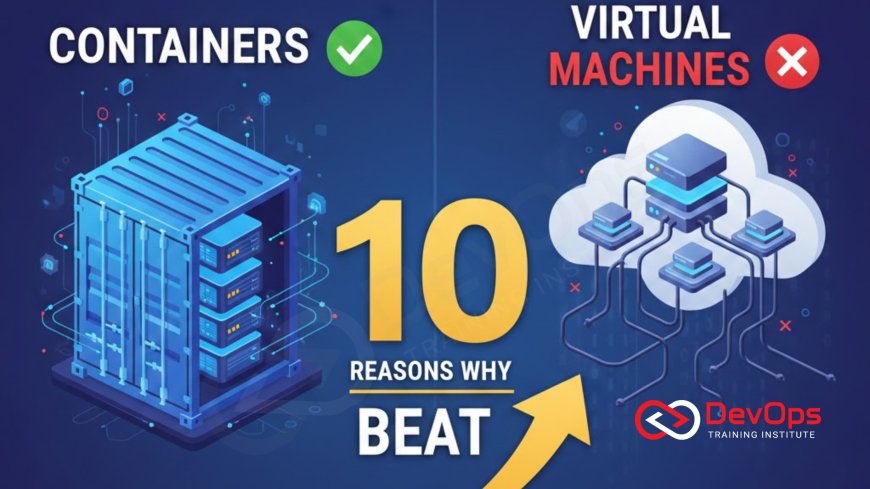
10 Reasons Why Containers Beat Virtual Machines
Dive into the fundamental reasons why containerization, spearheaded by Docker and Kubernetes, has largely superseded traditional Virtual Machines (VMs) in modern software development and deployment workflows. This comprehensive guide explores the 10 critical advantages of containers, including unparalleled portability, efficiency, faster startup times, and enhanced resource utilization. Understand how containers drive DevOps methodology, facilitate microservices, and ensure environmental consistency from development to production, making them the preferred choice for building scalable, resilient, and cost-effective cloud-native applications across any major cloud platform today.
Introduction
For decades, Virtual Machines (VMs) were the undisputed champions of server virtualization, offering unprecedented resource utilization and isolation compared to physical servers. They revolutionized data centers, allowing multiple operating systems and applications to run concurrently on a single piece of hardware. However, a newer, even more agile technology has risen to prominence, fundamentally reshaping how software is developed, deployed, and managed: containers. While VMs remain essential for specific use cases, containers, primarily popularized by Docker, have become the de facto standard for cloud-native applications, driven by their inherent advantages that align perfectly with the speed and agility demands of the DevOps methodology.
The shift from VMs to containers represents a paradigm change, focusing on optimizing the application layer rather than virtualizing the entire hardware stack. This fundamental difference unlocks significant benefits in terms of efficiency, portability, and development speed. Understanding these advantages is crucial for any modern DevOps Engineer, architect, or developer seeking to build scalable, resilient, and cost-effective applications in today's dynamic cloud environments. This guide delves into the top 10 compelling reasons why containers have largely surpassed traditional VMs as the preferred deployment unit, highlighting the transformative impact they have had on the entire software delivery lifecycle, making them the cornerstone of any efficient cloud-first strategy, driving both innovation and operational excellence.
While both technologies offer isolation, the way they achieve it—and the overhead involved—is vastly different. VMs abstract the hardware, each running its own full operating system. Containers, on the other hand, abstract the operating system, sharing the host OS kernel and only packaging the application and its dependencies. This seemingly small distinction has profound implications for performance, resource consumption, and the entire Continuous Integration/Continuous Delivery (CI/CD) pipeline, allowing for unprecedented speed and consistency in application deployment, especially in highly distributed microservices architectures. This fundamental difference is key to understanding the superior operational efficiency and development agility that containers provide over traditional virtualization.
1. Superior Resource Utilization and Efficiency
One of the most immediate and impactful advantages of containers over VMs is their significantly higher resource efficiency. VMs require a dedicated guest operating system (OS) for each instance, which includes its own kernel, libraries, and binaries, leading to substantial overhead in terms of CPU, RAM, and disk space. This overhead adds up quickly, especially when running dozens or hundreds of VMs.
Containers, by contrast, share the host operating system's kernel. They only package the application code and its specific dependencies, libraries, and configuration files. This "lightweight" approach means:
- Less Disk Space: Container images are much smaller than VM images, as they don't contain a full OS.
- Less RAM Consumption: No separate OS kernel for each container means less memory is consumed overall.
- Faster Boot Times: Containers start in seconds (or even milliseconds) because they don't need to boot an entire OS.
- Higher Density: More containers can run on a single host compared to VMs, maximizing hardware utilization.
This translates directly into reduced infrastructure costs and a smaller carbon footprint, making containers the economically sensible choice for large-scale, cloud-native deployments, often yielding significant savings in operational budgets, making them incredibly attractive for organizations looking to optimize their cloud spend and environmental impact.
2. Unparalleled Portability and Consistency
The infamous "it works on my machine" problem has plagued software development for decades. Containers, particularly Docker, solve this by encapsulating an application and all its dependencies into a single, immutable unit. This container image can then run consistently across any environment that has a container runtime, whether it's a developer's laptop, a testing server, a staging environment, or a production cloud instance (AWS, Azure, GCP).
VMs, while offering some portability, still involve migrating entire OS images, which can be cumbersome and lead to compatibility issues if the underlying hypervisor or hardware differs significantly. Containers, however, provide true "write once, run anywhere" capability. This consistency from development to production eliminates environment-related bugs, drastically speeds up the CI/CD pipeline, and empowers DevOps teams to deploy with confidence, knowing that their application will behave predictably across all stages of the software delivery lifecycle, which is a cornerstone of modern development practices and a driving force behind rapid innovation.
3. Faster Startup Times and Deployment Cycles
The time it takes to provision and start an instance directly impacts the speed of a CI/CD pipeline and the agility of an application to scale up or down. Traditional VMs can take minutes to boot a full operating system, install dependencies, and start an application. This lengthy startup time creates bottlenecks in development, testing, and scaling operations, limiting responsiveness to demand spikes.
Containers, leveraging the host OS kernel, can start in seconds or even milliseconds. This rapid startup capability has several profound implications for the DevOps methodology:
- Accelerated CI/CD: Faster spin-up of test environments means quicker feedback loops for developers, leading to more frequent code commits and deployments.
- Dynamic Scaling: Applications can scale horizontally much faster in response to fluctuating user demand, as new container instances can be brought online almost instantly to handle increased traffic.
- Ephemeral Environments: It's feasible to create and destroy entire application environments on demand for feature branches, testing, or debugging, fostering a culture of rapid experimentation and reducing the overhead of maintaining long-lived, complex test infrastructures.
This responsiveness is critical for modern cloud-native applications that demand high elasticity and continuous delivery, which is exactly what containers were designed to enable, ensuring that every deployment is efficient and adaptable to ever-changing user demands and resource requirements.
4. Microservices Architecture Enablement
Containers are the perfect fit for the microservices architectural style, where complex applications are broken down into small, independent, and loosely coupled services. Each microservice can be developed, deployed, and scaled independently in its own container, using its preferred language and framework. VMs, while capable of hosting microservices, are too heavy for this granular level of deployment.
The lightweight nature and isolation of containers allow each microservice to have its own dedicated runtime environment without the overhead of a full VM. This enables:
- Independent Development: Teams can work on specific microservices without impacting others.
- Independent Scaling: Only the necessary microservices experiencing high load need to be scaled, optimizing resource usage.
- Fault Isolation: A failure in one microservice (and its container) is less likely to affect the entire application, enhancing overall system resilience.
This architectural alignment is a primary reason for the widespread adoption of containers, facilitating agility and resilience in large-scale distributed systems, making complex applications easier to manage and evolve over time, ultimately accelerating the pace of innovation within the enterprise and minimizing critical system outages in production environments.
5. Immutable Infrastructure and Consistency
Containers promote an "immutable infrastructure" paradigm, where servers (or in this case, container images) are never modified after they are deployed. Instead, if a change is needed (e.g., a security patch or an application update), a new container image is built with the changes, thoroughly tested, and then deployed to replace the old one. This contrasts sharply with VMs, which are often "pets" that are patched and manually configured over time, leading to configuration drift and inconsistent environments.
The benefits of immutable containers include:
- Reliability: Every deployment starts from a known, consistent state, eliminating configuration drift issues.
- Rollback Simplicity: If a new container version has issues, rolling back is as simple as deploying the previous, known-good image, enhancing system stability.
- Reproducibility: Any environment (development, staging, production) can be spun up from the exact same container image, ensuring consistency across the entire SDLC.
This approach drastically reduces the risk of environment-specific bugs and simplifies the entire release process, which is a cornerstone of modern DevOps methodology, ensuring that every deployment is predictable and reliable, a crucial factor in maintaining system uptime and customer satisfaction in today's fast-paced digital world.
| Feature | Containers (e.g., Docker) | Virtual Machines (e.g., VMware, KVM) | Advantage |
|---|---|---|---|
| Resource Utilization | Share host OS kernel, lightweight runtime. | Each has a full guest OS (kernel, binaries, libraries). | Containers (higher density, less overhead). |
| Startup Time | Seconds/milliseconds. | Minutes. | Containers (faster scaling, CI/CD). |
| Portability | Highly portable (write once, run anywhere on any Docker host). | Portable but heavier (migrate entire OS images). | Containers (true environmental consistency). |
| Isolation Level | Process-level (Linux Cgroups & Namespaces). | Hardware-level (hypervisor). | VMs (stronger, but often overkill). |
| Typical Use Case | Microservices, cloud-native apps, CI/CD. | Legacy apps, full OS isolation, different OS kernels. | Context-dependent; Containers for modern apps. |
6. Simplified Software Dependencies and Environment Setup
Setting up development environments and ensuring all required software dependencies are met can be a complex and time-consuming process with VMs. Developers often spend significant time configuring their local machines or provisioning specialized VMs to match the production environment, which still doesn't guarantee full consistency due to underlying OS differences. This is especially true for complex applications with numerous external library requirements.
Containers drastically simplify this. A single Dockerfile precisely defines all the necessary components, operating system libraries, application code, and runtime configurations needed for an application. This makes the entire setup process repeatable and consistent:
- "Dependency Hell" Avoided: All dependencies are bundled with the application, preventing conflicts between different applications or services on the same host.
- Onboarding Efficiency: New developers can spin up a fully configured development environment in minutes by simply pulling a Docker image, reducing onboarding time significantly.
- Version Control of Environments: The Dockerfile itself is version-controlled, meaning the entire environment definition evolves alongside the application code, ensuring that all environments remain synchronized and auditable, which is critical for compliance and for debugging complex interactions.
This focus on self-contained, reproducible environments accelerates development cycles and fosters collaboration within and between DevOps culture teams, leading to faster feature delivery and higher code quality by minimizing the "works on my machine" problem, which is a significant barrier to efficient team dynamics.
7. Enhanced Developer Experience and Productivity
For developers, the shift to containers represents a huge leap in productivity and an overall improved experience. The ability to package their application with all its specific dependencies, and then test it locally in an environment identical to production, empowers them to deliver higher quality code faster. This self-contained unit eliminates many of the "ops" concerns that traditionally fell outside the developer's purview, allowing them to focus more on core application logic.
This includes:
- Local Production Parity: Developing and testing in a containerized environment locally mirrors production, reducing surprises during deployment.
- Rapid Iteration: Changes can be quickly built into new container images and tested, accelerating the development feedback loop.
- Simplified Tooling: With tools like Docker Compose, multi-service applications can be easily defined and run locally with a single command, making complex development environments accessible.
By abstracting away the underlying infrastructure complexities, containers enable developers to be more self-sufficient and productive, pushing the "Shift Left" mentality where operational concerns are addressed earlier in the development lifecycle, which is a foundational principle of the modern DevOps methodology, ensuring that code is production-ready from its inception.
8. Optimized for Cloud-Native and Elastic Scaling
Modern cloud environments are designed for elasticity: rapidly scaling resources up or down to meet demand. Containers, with their lightweight nature and fast startup times, are perfectly suited for this dynamic scaling model. VMs, with their slower boot times and heavier resource footprint, are less agile in comparison. This is particularly evident in serverless computing, where container technology, in the form of Firecracker microVMs, is often used under the hood to provide isolated, fast-starting execution environments.
This optimization for cloud-native elasticity means:
- Efficient Auto-Scaling: Container orchestrators like Kubernetes can quickly spin up new container instances on demand, making applications highly responsive to traffic spikes.
- Cost-Effectiveness: By utilizing resources more efficiently and scaling dynamically, cloud costs are optimized, as you only pay for the resources actively being used, reducing idle resource waste.
- Resilience: The ability to quickly replace failed containers or rebalance workloads across a cluster enhances the overall fault tolerance and reliability of the application, which is crucial for maintaining high availability in distributed systems, ultimately leading to greater customer satisfaction.
Containers are fundamentally aligned with the economic and operational models of public clouds, making them the default choice for building applications that need to be highly scalable, resilient, and cost-effective, driving the adoption of cloud-first strategies in enterprises worldwide and enabling true pay-as-you-go infrastructure models.
9. Enhanced Isolation and Security (with Orchestration)
While VMs offer stronger hardware-level isolation, containers provide robust process-level isolation through Linux kernel features like Cgroups (for resource limiting) and Namespaces (for isolating processes, networks, and file systems). This means that each container runs in its own isolated environment, preventing applications from interfering with each other or accessing unauthorized resources on the host system.
When combined with orchestrators like Kubernetes and enhanced security practices (e.g., strong network policies, vulnerability scanning of images), containers offer a secure and segmented environment that is often sufficient for most applications. In fact, the granular isolation provided by containers:
- Limits Blast Radius: A compromise within one container is less likely to spread to others on the same host, containing potential security breaches.
- Enables DevSecOps: Security scanning tools can be easily integrated into the container build pipeline, ensuring images are free of known vulnerabilities before deployment, adhering to the "Shift Left" principle of modern security.
- Resource Control: Cgroups prevent a single misbehaving container from consuming all host resources, ensuring the stability of other applications.
This combination of isolation features and integrated security tooling makes containers a highly secure and manageable option for deploying diverse applications, simplifying the security posture for complex microservices by making each component independently auditable, which is a major benefit for organizations with strict compliance requirements, as it provides a clear and enforceable security boundary.
10. Simplicity in Versioning and Rollbacks
Managing different versions of applications and performing quick rollbacks in VMs can be complex, often involving snapshotting entire OS images or relying on heavy configuration management tools to revert changes. This process can be slow and resource-intensive, increasing the downtime risk during critical updates. This often becomes a bottleneck in development and deployment cycles, directly impacting the speed and reliability of releases.
Containers fundamentally simplify versioning and rollbacks:
- Image-Based Versioning: Every new build of a containerized application creates a new, immutable image (e.g., `myapp:v1.0.0`, `myapp:v1.0.1`). These images are stored in a registry (like Docker Hub or AWS ECR) and are inherently versioned.
- Instant Rollbacks: If a new deployment introduces issues, rolling back is as simple as instructing the orchestrator (e.g., Kubernetes) to deploy the previous known-good image version. This process is fast, safe, and entirely automated, minimizing downtime and user impact, which is a critical feature for maintaining high availability in production systems.
- Atomic Deployments: Deployments are atomic; either the entire new version is deployed successfully, or the old version remains untouched, preventing inconsistent states.
This streamlined approach to versioning and deployment enhances operational stability and provides a safety net for rapid iterations, making containers a superior choice for environments that demand continuous integration and continuous delivery (CI/CD) with minimal risk, which is a cornerstone of modern DevOps methodology.
Conclusion
While Virtual Machines retain their importance for specific use cases like running legacy applications, different operating system kernels, or tightly coupled monolithic systems, containers have unequivocally emerged as the superior technology for modern cloud-native development and deployment. Their inherent advantages in resource utilization, portability, faster startup times, and seamless fit with microservices architecture make them indispensable for any organization embracing DevOps methodology and continuous delivery.
By leveraging containers, especially with powerful orchestrators like Kubernetes, enterprises can achieve unprecedented levels of agility, efficiency, and reliability in their software delivery pipelines. The shift from VMs to containers is not just a technological choice; it's a strategic move that enables faster innovation, reduced operational costs, and a more resilient, scalable application ecosystem, ultimately driving business success in the competitive digital landscape by providing a robust and flexible foundation for all modern application workloads.
Frequently Asked Questions
What is the main difference between containers and VMs?
VMs virtualize hardware, each with its own guest OS. Containers share the host OS kernel, packaging only the application and its dependencies, making them much lighter.
Do containers offer the same level of isolation as VMs?
VMs offer hardware-level isolation. Containers provide robust process-level isolation through Linux kernel features like Cgroups and Namespaces, sufficient for most modern applications.
Why are containers more efficient than VMs?
Containers are more efficient because they don't carry the overhead of a full guest OS, leading to less disk space, RAM, and CPU consumption per application instance.
How do containers speed up CI/CD pipelines?
Containers speed up CI/CD by offering faster startup times (seconds vs. minutes for VMs), allowing for quicker testing, deployment, and feedback loops in the pipeline.
What is "immutable infrastructure" in the context of containers?
Immutable infrastructure means container images are never modified after deployment. Instead, new versions are built and deployed to replace old ones, ensuring consistency and simplified rollbacks.
Are containers always the better choice?
Not always. VMs are better for running different OS kernels (e.g., Windows on Linux host), legacy applications, or when extremely strong hardware-level isolation is a strict security requirement.
What is the role of Docker in containerization?
Docker popularized container technology, providing the tools (like Docker Engine and Dockerfiles) to easily build, package, share, and run containers efficiently.
How do containers benefit microservices architecture?
Containers are ideal for microservices because their lightweight and isolated nature allows each small service to be independently developed, deployed, and scaled without affecting others, enhancing modularity.
What does it mean for containers to be "portable"?
Portability means a containerized application, once built into an image, can run consistently and predictably across any environment (developer machine, testing server, any cloud) with a compatible container runtime.
How do containers help with "dependency hell"?
Containers help by bundling all application dependencies directly into the container image, ensuring that the application always runs with its exact required libraries and versions, preventing conflicts.
What Linux kernel features enable container isolation?
Linux Cgroups (Control Groups) for resource limiting and Namespaces for isolating processes, networks, and file systems are the core kernel features enabling container isolation.
How do containers optimize cloud costs?
Containers optimize cloud costs through higher resource utilization (more applications per host) and faster, more granular scaling, reducing idle resource waste and enabling pay-as-you-go efficiency.
What is a Dockerfile used for?
A Dockerfile is a text file containing instructions for building a Docker image, specifying the base OS, dependencies, application code, and runtime configuration.
How do hypervisors compare to container runtimes?
Hypervisors like KVM virtualize hardware to run multiple guest OSes. Container runtimes (e.g., containerd) manage containers on a single host OS, abstracting the OS layer.
What is the primary orchestrator for containers?
Kubernetes is the primary orchestrator for containers, managing their deployment, scaling, networking, and high availability across clusters, automating the operational complexity at scale.
What's Your Reaction?
 Like
0
Like
0
 Dislike
0
Dislike
0
 Love
0
Love
0
 Funny
0
Funny
0
 Angry
0
Angry
0
 Sad
0
Sad
0
 Wow
0
Wow
0





![100+ Azure DevOps Interview Questions and Answers [Updated 2025]](https://www.devopstraininginstitute.com/blog/uploads/images/202509/image_140x98_68c40aa9a3834.jpg)






![Future Scope of DevOps Careers in Pune [Updated 2025]](https://www.devopstraininginstitute.com/blog/uploads/images/202510/image_140x98_68e3a84652312.jpg)