







DevOps Training in Bangalore: Live Online Program Guide
DevOps training for Bangalore via live online classes: Linux, Git, Jenkins, Docker, Kubernetes, Terraform, AWS, labs and career support. No job guarantee.

DevOps Training Institute teaches Bangalore learners through live online classes only; the classroom batch runs in Kharadi, Pune. The program covers Linux, Git, CI/CD with Jenkins, Docker, Kubernetes, Terraform, Ansible, AWS and monitoring through instructor-led sessions and hands-on labs, with general career support such as resume reviews and mock interviews. No job or placement is guaranteed.
This page explains how the live online program works for someone in Bangalore: what you learn in each module, how a typical week looks, what you need before you start, and what career support does and does not include. If you are still comparing options, read our comparison of DevOps training institutes in Bangalore first.
Key takeaways
- Bangalore learners join live online batches. There is no Bangalore classroom; the only classroom is in Kharadi, Pune.
- The syllabus follows the tools most DevOps job descriptions ask for: Linux, Git, Jenkins, Docker, Kubernetes, Terraform, Ansible, AWS, Prometheus and Grafana.
- Labs and project work matter more than slides. Expect to build pipelines and clusters yourself.
- Career support means help preparing (resume, LinkedIn, mock interviews, interview question practice). Getting hired depends on your skills, effort and the job market, so no institute can honestly promise a job.
- Check the course page for the current syllabus, batch dates and fees before you enrol.
Why this page no longer talks about a "job guarantee"
Earlier versions of this page used "100% job assured" language. We removed it. Hiring decisions belong to employers, and any promise of a job, a salary range or a placement percentage would not be honest. What a training program can control is the quality of teaching, the labs, the feedback you get and how well it prepares you for interviews. That is what this page describes.
Be careful with any institute, in Bangalore or elsewhere, that promises guaranteed placement. Ask for the written terms, read the refund conditions and check whether the "placement" is a real job or an unpaid internship. Our post on job-oriented DevOps training lists questions worth asking any provider.
How live online training works from Bangalore
| Item | How it works |
|---|---|
| Mode | Live, instructor-led online sessions; no Bangalore classroom |
| Classroom option | Kharadi, Pune only, for learners who can travel there |
| Labs | Hands-on exercises on your own machine and cloud accounts, reviewed by the trainer |
| Questions | Asked live during class and in follow-up sessions |
| Batch timings, duration and fees | Listed on the course page and confirmed by the admissions team; they change by batch |
Live online classes suit Bangalore well. Commuting across the city can take longer than the class itself, and working professionals can join evening or weekend batches without leaving home. The trade-off is discipline: you need a quiet place to work, a reliable connection and the habit of doing labs between sessions. If you are deciding between batch types, our weekend versus weekday training comparison applies to online batches too.
What you need before you start
- A laptop with at least 8 GB of RAM (16 GB is more comfortable for running local Kubernetes and several containers).
- A stable internet connection and a headset.
- Basic computer skills. Programming experience helps but is not required; you will write shell scripts and read YAML during the course.
- A cloud account for labs. AWS offers a Free Tier; check its current terms on the AWS site and set a billing alert before you start.
- About 8 to 10 hours a week outside class for labs and revision. This is a guide, not a rule; more practice helps.
Course modules
The exact order and depth can change between batches, so treat this as an outline. The DevOps training course page has the current syllabus.
1. Linux and shell scripting
Most DevOps work happens on Linux servers. You learn the file system, users and permissions, processes, package management, systemd services, networking commands and log files, then write Bash scripts to automate routine tasks.
2. Networking basics
DNS, IP addressing, subnets, ports, HTTP and TLS, load balancers and firewalls. These come up in every troubleshooting session and in most interviews.
3. Git and collaboration
Commits, branches, merges, rebases, pull requests and resolving conflicts. You also look at branching strategies such as trunk-based development and how they affect CI/CD.
4. Continuous integration and delivery with Jenkins
Installing Jenkins, writing declarative pipelines in a Jenkinsfile, connecting to Git, running tests, building artifacts and deploying. You also compare Jenkins with GitHub Actions and GitLab CI so you can work with whichever tool an employer uses.
pipeline {
  agent any
  stages {
    stage('Build') { steps { sh 'make build' } }
    stage('Test')  { steps { sh 'make test' } }
    stage('Image') { steps { sh 'docker build -t app:${BUILD_NUMBER} .' } }
  }
}
5. Docker and containers
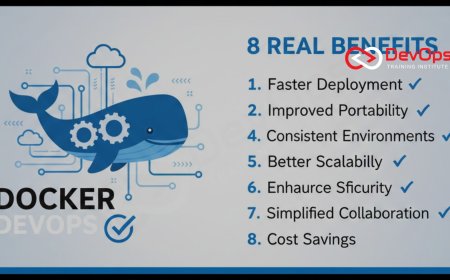
Images, containers, Dockerfiles, volumes, networks and registries. You write Dockerfiles for real applications, keep images small and run multi-container apps with Docker Compose.
6. Kubernetes
Cluster architecture, Pods, Deployments, Services, Ingress, ConfigMaps, Secrets, persistent volumes, Helm and basic troubleshooting with kubectl. This module is the base for the CKA and CKAD exams if you want to go further.
7. Infrastructure as code with Terraform
Providers, resources, variables, modules and remote state. You provision a network, servers and a managed Kubernetes cluster on AWS from code, then destroy it cleanly.
8. Configuration management with Ansible
Inventories, playbooks, roles and idempotent tasks to configure servers and deploy applications.
9. AWS for DevOps
IAM, VPC, EC2, S3, load balancers, auto scaling, EKS and CloudWatch, with attention to cost and security basics such as least-privilege IAM policies.
10. Monitoring and observability
Metrics, logs and alerts with Prometheus and Grafana: writing alert rules, building dashboards and using them to find the cause of a problem.
11. DevSecOps basics
Secret handling, dependency and image scanning in pipelines, and why security checks belong early in the workflow. Learners who want to go deeper can take a separate DevSecOps course.
12. Project work
You put the modules together in an end-to-end project: application code in Git, a CI pipeline that tests and builds a container image, infrastructure created with Terraform, deployment to Kubernetes, and monitoring with alerts. You should be able to explain every part of it in an interview, because interviewers will ask.
A typical week in the online program
| Activity | What happens |
|---|---|
| Live sessions | The trainer explains a topic and demonstrates it on screen |
| Guided lab | You repeat the demo on your machine, with help when you get stuck |
| Assignment | A task that changes the demo (a new pipeline stage, a different app) so you cannot copy it |
| Review | Questions, common mistakes and fixes from the assignments |
What career support includes
Career support helps you present your skills and prepare for interviews. It typically covers:
- Resume review focused on projects and tools you have actually used.
- LinkedIn profile and GitHub portfolio suggestions.
- Mock technical interviews with feedback.
- Interview question practice on Linux, Git, Docker, Kubernetes, AWS and CI/CD.
- Guidance on job titles to search for and how to read job descriptions.
- Sharing relevant openings when they come to the team's notice.
It does not include a guaranteed job, interview or salary. Your results depend on your practice, your project work and the job market. Our 200 DevOps interview questions guide is a good place to start practising.
Who the program suits
- Freshers with a computer science or IT background who want to start in cloud or DevOps roles. Our post on DevOps career options for freshers in Bangalore explains realistic entry roles.
- Support, testing and system administration professionals moving into DevOps, who already know part of the stack.
- Developers who want to own their deployments and infrastructure.
If your interest is mainly reliability and on-call work, see our post on SRE training in Bangalore. If you are researching employers, read DevOps employers in Bangalore for freshers.
Certifications you can work towards
The course is not an exam-prep program for any single certification, but its modules cover ground that overlaps with several well-known exams. Exam names, objectives and prices are set by the certifying bodies, so check their pages:
- Certified Kubernetes Administrator (CKA) and Certified Kubernetes Application Developer (CKAD) from the Linux Foundation and CNCF.
- HashiCorp Certified: Terraform Associate.
- AWS certifications such as AWS Certified Solutions Architect (Associate) and AWS Certified DevOps Engineer (Professional).
Dedicated courses are available for some of these, for example CKA training.
How to choose a DevOps course in Bangalore
| Question to ask | Why it matters |
|---|---|
| Can I see the full syllabus and a sample class? | Shows depth and teaching style before you pay |
| How much time is hands-on lab work? | Interviews test what you can do, not what you watched |
| Who teaches, and what have they worked on? | Practical experience shapes how topics are taught |
| What exactly does career support include? | Get it in writing; be wary of guarantees |
| What happens if I miss a class? | Recordings or repeat sessions help working professionals |
| What are the full fees and refund terms? | Avoid surprises later |
Frequently asked questions
Is there a DevOps Training Institute classroom in Bangalore?
No. Bangalore learners join live online batches. The only classroom batch runs in Kharadi, Pune, for learners who can travel there.
Does the DevOps program guarantee a job?
No. No job, interview, salary or placement percentage is guaranteed. Career support helps you prepare with resume reviews, mock interviews and interview practice, but hiring decisions are made by employers.
What tools does the DevOps course cover?
Linux and shell scripting, networking basics, Git, Jenkins, Docker, Kubernetes, Terraform, Ansible, AWS, Prometheus and Grafana, DevSecOps basics, and an end-to-end project. Check the course page for the current syllabus.
Can I learn DevOps online from Bangalore while working?
Yes. Live online batches suit working professionals, especially evening or weekend batches. Plan for regular lab practice between sessions in addition to class time.
Do I need coding experience to join?
Programming experience helps but is not required. You will learn shell scripting and work with YAML and configuration files during the course.
How long is the course and what does it cost?
Duration, batch timings and fees change by batch. The course page and the admissions team give current details.
What does career support include?
Resume and LinkedIn review, GitHub portfolio advice, mock technical interviews, interview question practice and guidance on job searching. Relevant openings may be shared when the team hears of them.
Which certifications does the course help with?
The modules overlap with CKA, CKAD, HashiCorp Terraform Associate and AWS certifications. Check each certifying body's site for exam objectives and prices.
References
What's Your Reaction?
 Like
0
 Dislike
0
 Love
0
 Funny
0
 Angry
0
 Sad
0
 Wow
0