

![Kong Interview Preparation Guide [2025]](https://www.devopstraininginstitute.com/blog/uploads/images/202509/image_430x256_68dbb95326997.jpg)




12 Key Differences Between CI vs CD Explained
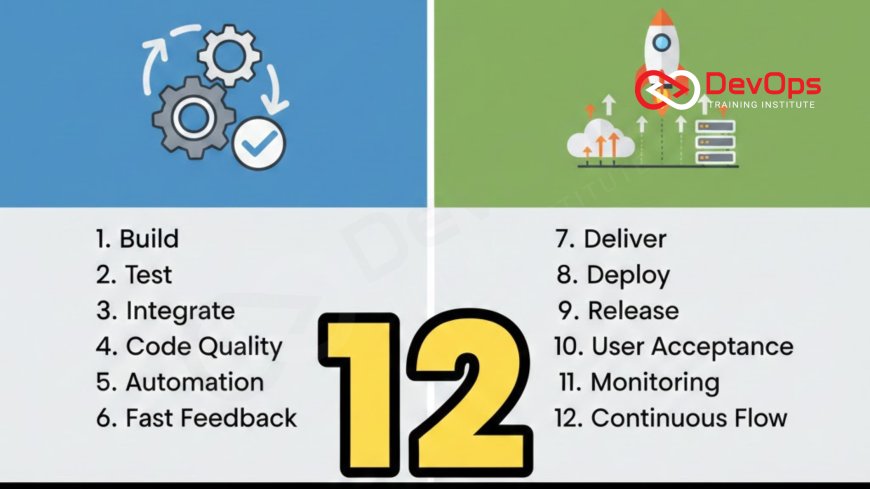
Unlock the foundational concepts of modern software delivery by understanding the 12 key differences between Continuous Integration (CI) and Continuous Delivery/Deployment (CD). This beginner-friendly guide clarifies the distinct goals, tool usage, ownership, and risks associated with each stage of the DevOps pipeline. Learn how CI focuses on code quality and early error detection, while CD automates the journey to production, enabling rapid and reliable releases. Mastering the separation of CI and CD is crucial for DevOps Engineers and development teams seeking to optimize their release process, accelerate time-to-market, and achieve true operational excellence in any cloud environment.
Introduction
In the world of DevOps and agile software development, the terms Continuous Integration (CI) and Continuous Delivery (CD) are constantly used, often in the same breath, leading many newcomers and even seasoned professionals to mistakenly view them as interchangeable concepts. While they are inextricably linked—forming the essential two-part foundation of the modern software delivery pipeline—they represent distinct phases with unique goals, responsibilities, and technical requirements. Understanding the precise relationship and clear differences between CI and CD is not just an exercise in semantics; it is crucial for successfully optimizing the software lifecycle, minimizing risk, and achieving the high-velocity releases that define successful, modern technology companies.
At its core, CI is about developers, ensuring that their daily code merges don't break the build and that the code is always in a tested, stable state. In contrast, CD is about operations, guaranteeing that this stable, tested code can be moved safely and reliably into various environments (staging, production) at any moment, accelerating the time-to-market for new features and bug fixes. The failure to clearly separate the concerns and responsibilities of these two phases can introduce confusion, bottlenecks, and instability into the release process, directly undermining the primary goals of the DevOps methodology. This comprehensive guide will break down the 12 key differences that define the CI vs. CD dynamic, providing a clear map of the entire automated delivery process.
For a DevOps Engineer, mastering this distinction means designing a pipeline where the transition from CI to CD is seamless, automated, and governed by strict quality gates. The effectiveness of the entire automated system, which often runs on Linux servers and deploys to containerized environments, hinges on maintaining clear boundaries and responsibilities between these two phases, ensuring that code quality is prioritized early and deployment is industrialized for safety and speed.
1. Primary Goal and Focus
The goals of CI and CD are fundamentally distinct, reflecting different priorities within the development and operations sides of the business. While both contribute to the overall speed of software delivery, they target different parts of the problem domain. CI focuses inward on the code itself, ensuring its structural integrity, while CD focuses outward on the infrastructure and the process of value delivery to the end user.
Continuous Integration (CI) Goal: The primary goal of CI is to detect integration errors as early and quickly as possible, ensuring that the codebase remains healthy, stable, and consistently shippable. CI focuses exclusively on the integration of code written by multiple developers into a single, shared main branch. The core philosophy is "fail fast," meaning that if a new code change breaks functionality, the team knows within minutes, not weeks, allowing for cheap and rapid resolution before the code propagates through the system. This relentless pursuit of early quality is what keeps the development machine running smoothly.
Continuous Delivery/Deployment (CD) Goal: The primary goal of CD is to ensure that the validated artifact from the CI stage can be released to any environment (staging, production) in a safe, repeatable, and automated manner. CD focuses on release readiness and environment consistency. It automates the orchestration of deployment, configuration management, and infrastructure provisioning, ensuring that the time it takes for a tested change to reach the user is minimized, directly optimizing time-to-market and accelerating the delivery of business value.
2. Automation Scope and Activities
The activities automated by CI and CD are fundamentally different, though both use tools like Jenkins, GitLab, or GitHub Actions. The distinction lies in *what* these tools are instructed to automate. CI focuses on tasks performed before the artifact is created, while CD focuses on tasks performed after, leading to completely separate job stages within the automated pipeline.
- CI Automation Scope: CI automation is focused on the build and test lifecycle.
- Code compilation and dependency resolution (e.g., Maven, npm).
- Automated Unit Tests and Integration Tests (running thousands of tests in parallel).
- Static code analysis (checking code structure and quality).
- Creating the final deployable artifact (e.g., Docker image, JAR file, binary).
- CD Automation Scope: CD automation is focused on deployment and environment management.
- Provisioning the target infrastructure (using Terraform).
- Deployment orchestration to the target environment (e.g., Kubernetes, Cloud VMs).
- Configuration management of running application instances (e.g., Ansible).
- Post-deployment validation, smoke tests, and automated monitoring configuration.
3. The Artifact and the Output
A key difference between the two phases is the output of the process. CI produces the package that is ready to be delivered, whereas CD is the delivery and management of that package into a running state. The relationship between the two is sequential, with the output of CI serving as the crucial input for the CD process, ensuring that the integrity of the code is checked before any deployment activities are initiated in the live infrastructure.
CI Output: The definitive output of the Continuous Integration process is a versioned, immutable, deployable artifact. This artifact—which could be a Docker image pushed to a registry, a compiled binary in an artifact repository, or a bundled web application package—is guaranteed to have passed all required code compilation, unit, and integration tests. This artifact is the single item that gets promoted through all subsequent environments (Staging, Production), ensuring that the code tested is the code shipped.
CD Output: The definitive output of the Continuous Delivery/Deployment process is a running, validated, and monitored service or application in a target environment (e.g., Staging, Production). CD consumes the CI artifact and orchestrates all the necessary steps to make it live and functional, including updating network settings, configuring load balancers, and ensuring the application is correctly registered with monitoring and logging platforms. The final output is measurable business value delivered to the end-user.
4. Ownership and Responsibility
The CI/CD pipeline, by its very nature, spans the traditional organizational boundaries of Development and Operations, which is the core cultural shift of DevOps. However, accountability for the success and health of each specific stage still rests primarily with one of the respective teams, reflecting their domain expertise and focus area. Clear ownership is essential for rapidly diagnosing and fixing pipeline failures, maintaining overall stability.
CI Ownership: Continuous Integration is primarily owned and driven by the Development Team. Developers are responsible for code quality, writing comprehensive unit and integration tests, and ensuring that their code changes do not break the continuous build. They must fix CI failures immediately upon introduction. The CI system is designed to provide immediate feedback to the developer, allowing them to iterate quickly on the application's internal structure and functionality.
CD Ownership: Continuous Delivery and Deployment are primarily owned by the Operations or DevOps Team (specifically, the Platform or SRE group). This team is responsible for managing the stability of the target environments (Cloud, Kubernetes clusters), securing the deployment process, and ensuring the deployment orchestration tools (Spinnaker, Argo CD) function correctly. Their responsibility is focused on the reliability, security, and scalability of the infrastructure where the code finally runs, often integrating deeply with configuration management and infrastructure security.
5. Key Differences Table: CI vs CD
This table summarizes the 12 most important distinctions between Continuous Integration and the two forms of Continuous Delivery, providing a clear comparison of their strategic focus, technical components, and end result. Understanding this matrix is key to mastering the software delivery lifecycle.
| # | Feature | Continuous Integration (CI) | Continuous Delivery (CD) |
|---|---|---|---|
| 1 | Primary Goal | Ensure code stability and artifact readiness ("Is the code ready?"). | Ensure release readiness and environment reliability ("Can we ship it safely?"). |
| 2 | Trigger Event | Every single code commit or merge request/pull request. | Successful CI artifact creation; often manual approval or scheduled time. |
| 3 | Key Output | Immutable, tested artifact (e.g., Docker Image, JAR file). | Deployed and running application in a target environment. |
| 4 | Primary Ownership | Development Team and QA. | Operations/Platform/SRE Team. |
| 5 | Core Activity | Building, Unit Testing, Static Code Analysis, Container Image Creation. | Deployment Orchestration, Infrastructure Provisioning (IaC), Configuration Management. |
| 6 | Testing Focus | Internal Functionality (Unit/Integration Testing). | External Service Health (Smoke/Acceptance Testing, Performance Testing). |
| 7 | Target Environment | Isolated Build Server / CI Runner. | Staging, Production, QA, or Pre-Production Environments. |
| 8 | Tool Focus | Build & Test Engines (e.g., Maven, PyTest, SonarQube). | Orchestrators & Provisioners (e.g., Spinnaker, Argo CD, Terraform). |
| 9 | Security Phase | Code/Vulnerability Scanning (SAST/Trivy). | Secrets Injection (Vault), IAM Policy Enforcement, Network Configuration. |
| 10 | Risk Profile | Low Risk (only breaks the build pipeline, no customer impact). | High Risk (potential to break live production service or expose data). |
| 11 | Final Gate | All Automated Tests Must Pass (Zero human decision). | Optional Manual Approval to Production (Continuous Delivery) OR Zero Human Decision (Continuous Deployment). |
| 12 | Deployment Target | No external deployment target; target is the artifact repository itself. | External Cloud or On-Premise Runtime Environment (VMs, Containers, Serverless). |
6. The Distinction: Delivery vs. Deployment
Even within the CD phase, a critical distinction exists between Continuous **Delivery** and Continuous **Deployment**. While both rely on the automated capabilities established by the CI and CD pipelines, the final step—the release to the end user—is governed by a deliberate choice regarding human involvement, which carries significant implications for risk, governance, and organizational velocity. This distinction marks the difference between simply being ready to release and automatically doing so.
Continuous Delivery (CDL): This means that every change that passes all automated tests and quality gates is automatically *prepared* for release and placed in a state where it *could* be deployed to production at any time. However, the final push to production remains a manual, human-controlled step, often requiring approval from a release manager, QA lead, or executive before the final button is pressed. This approach is preferred in highly regulated industries (finance, healthcare) where compliance mandates a human sign-off as the final audit step, balancing rapid deployment capability with necessary oversight and governance.
Continuous Deployment (CDP): This is the fully automated extreme of CD. Every change that passes all tests and automated security checks is automatically released and deployed into the production environment without any human intervention whatsoever. The trust in the automation and observability platform is absolute, and the only "gate" is the automated monitoring that triggers an instant rollback if performance metrics drop immediately post-deployment. This provides the fastest possible time-to-market and is the model used by high-velocity tech giants like Netflix and Amazon, requiring massive investment in resilience and automated testing to ensure stability.
7. The Role of Testing in CI and CD
Testing is a shared activity across both CI and CD, yet the nature and purpose of the tests conducted in each phase are fundamentally different. CI tests focus on internal integrity, while CD tests focus on external behavior and environmental validation. This layered approach ensures that code is functional before deployment and that the deployment is successful within the real-world infrastructure.
CI Testing (Internal Focus): This phase concentrates on tests that verify the application's internal correctness, functionality, and performance in an isolated environment.
- Unit Tests: Verify small, isolated blocks of code or functions.
- Integration Tests: Verify that different application components (e.g., two internal classes, application connecting to a mocked database) work correctly together.
- Static Analysis: Scans code for security flaws and stylistic errors without executing the program.
CD Testing (External Focus): This phase focuses on validating the application's behavior and performance within a live, production-like environment, often involving full-stack components.
- Smoke/Sanity Tests: Quick tests run immediately after deployment to ensure the application starts and basic functionalities are accessible (e.g., the homepage loads).
- Acceptance/End-to-End Tests: Verify the entire user flow across the deployed environment, simulating real user behavior.
- Performance/Load Tests: Verify that the deployed application and underlying infrastructure can handle expected (or peak) user traffic and concurrent connections without degradation.
- Canary/Blue-Green Verification: Using live production traffic and monitoring to automatically validate the stability and performance of the new version before a full rollout.
8. Tooling Ecosystem: CI vs CD Tools
While many commercial platforms (like GitLab and Azure DevOps) offer unified CI/CD solutions, the core difference between the specialized tools remains clear. CI tools excel at fast, high-volume code compilation and execution, while CD tools specialize in the orchestration and governance of infrastructure provisioning and deployment targets. The modern pipeline often sees the integration of best-of-breed tools, where a high-performance CI tool feeds a powerful, feature-rich CD orchestrator.
Common CI-focused platforms and engines include Jenkins (the highly extensible open-source CI server), CircleCI (known for speed and parallelism), and AWS CodeBuild (for managed CI within the AWS ecosystem). These tools excel at reading code, running tests fast, and packaging artifacts reliably. They are inherently tied to the source code repository.
Common CD-focused orchestrators and provisioning tools include Spinnaker (for multi-cloud advanced deployment), Argo CD (for Kubernetes GitOps), and Infrastructure as Code tools like Terraform (for provisioning the environment itself). These tools are inherently tied to the operational infrastructure and deployment targets, often interacting with network components and low-level system administration capabilities that require a deep understanding of concepts from the Linux file system hierarchy and system utilities.
9. Security Integration and Risk Profile
Security is the ultimate shared responsibility, but the specific security activities and the nature of the risk involved differ greatly between CI and CD. Both phases must implement the "Shift Left" philosophy, but they handle different types of security vulnerabilities and governance mandates, ensuring continuous protection from code to cloud runtime.
CI Security Focus (Code Risk): CI integrates security testing focused on the internal structure and dependencies of the application code. This includes Static Application Security Testing (SAST) to find coding errors and dependency scanning (using tools like Trivy or SonarQube) to check for known vulnerabilities in open-source libraries. The risk here is low-level code contamination, which is prevented by failing the build pipeline immediately if a critical vulnerability is discovered, preventing the artifact's creation.
CD Security Focus (Deployment Risk): CD integrates security focused on environment configuration, deployment integrity, and access control. This includes policy as code (PaC) checks on Terraform configurations, dynamic secrets injection (using Vault), and setting up network security groups (firewalls). The risk here is high-level production breach or service failure due to misconfigured cloud resources or exposed credentials. This phase directly manages access to live customer data and critical infrastructure components.
10. Conclusion
Continuous Integration (CI) and Continuous Delivery/Deployment (CD) are the two inseparable, yet fundamentally distinct, engines driving high-velocity software delivery in the modern DevOps methodology. CI is the developer-centric engine focused on integrating code changes frequently and maintaining quality by creating a tested, immutable artifact. CD is the operations-centric engine focused on automating the safe and repeatable delivery of that artifact to production, leveraging tools like Terraform and advanced orchestration to manage risk and ensure environment consistency.
Mastering these 12 key differences allows organizations to design highly efficient pipelines, assign clear responsibilities, and accelerate their time-to-market while maintaining rigorous standards for code quality and security. The synthesis of CI's focus on internal health and CD's focus on external readiness creates the powerful feedback loop and continuous flow necessary for true operational excellence. This clarity is the crucial starting point for any team striving to build resilient, high-performing software delivery systems.
Frequently Asked Questions
Can you have Continuous Integration without Continuous Delivery?
Yes, you can have CI without CD. This means code is integrated and tested frequently, but the process of deploying to any environment remains manual.
What is the difference between Continuous Delivery and Continuous Deployment?
Delivery requires a manual approval gate for production release, while Deployment is fully automated, releasing to production without any human intervention.
Which phase is primarily responsible for creating the Docker image?
The Continuous Integration (CI) phase is primarily responsible for building and creating the versioned, immutable Docker image artifact.
What tool is typically used in the CD phase for infrastructure setup?
Infrastructure as Code (IaC) tools like Terraform are typically used in the CD phase to provision and manage the target cloud environments automatically.
What kind of testing is performed in the CI phase?
CI focuses on automated Unit Tests, Integration Tests, and static code analysis to verify the internal functionality and health of the code being merged.
Which team owns the ultimate success of the CD process?
The Operations, Platform, or SRE Team primarily owns the success of the CD process, as they manage the stability and security of the deployment environments.
What security activity belongs to the CI phase?
Code and vulnerability scanning (SAST and dependency checks) belongs to the CI phase, preventing flawed code from becoming a deployable artifact.
What is the risk profile of a CI failure?
The risk profile of a CI failure is low, as it only breaks the pipeline and prevents a merge, having no immediate impact on the live, customer-facing production service.
What is the output of the CI process?
The key output is a versioned, immutable artifact (e.g., a Docker image, JAR file) stored in a repository, ready for delivery to any environment.
Does CD manage physical network devices?
CD manages virtual network components like cloud Security Groups, load balancers, and virtual private cloud (VPC) configurations, often defined using Terraform.
What is the value of automated rollbacks in CD?
Automated rollbacks minimize the impact of deployment failures by quickly reverting the system to the last known stable state, drastically reducing the time required to recover from an incident.
What is the purpose of static analysis in the CI phase?
Static analysis checks the code for style, complexity, and security flaws without actually executing the program, ensuring code quality and compliance early in the cycle.
How does CD ensure environment consistency?
CD ensures consistency by using IaC (Terraform) and configuration management tools to define and provision all environments (Staging, Production) from the same version-controlled code.
What is the final gate in Continuous Deployment?
The final gate in Continuous Deployment is automated monitoring and observability tools that check performance post-deployment, triggering an automated rollback if necessary.
What is the importance of frequent commits in CI?
Frequent commits in CI ensure that integration issues are found when the change is small and simple, preventing large, difficult-to-resolve merge conflicts.
What's Your Reaction?
 Like
0
Like
0
 Dislike
0
Dislike
0
 Love
0
Love
0
 Funny
0
Funny
0
 Angry
0
Angry
0
 Sad
0
Sad
0
 Wow
0
Wow
0

![100+ Azure DevOps Interview Questions and Answers [Updated 2025]](https://www.devopstraininginstitute.com/blog/uploads/images/202509/image_140x98_68c40aa9a3834.jpg)






![Future Scope of DevOps Careers in Pune [Updated 2025]](https://www.devopstraininginstitute.com/blog/uploads/images/202510/image_140x98_68e3a84652312.jpg)