

![Kong Interview Preparation Guide [2025]](https://www.devopstraininginstitute.com/blog/uploads/images/202509/image_430x256_68dbb95326997.jpg)

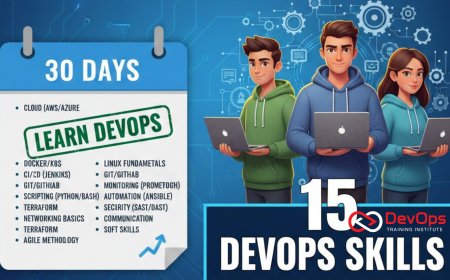
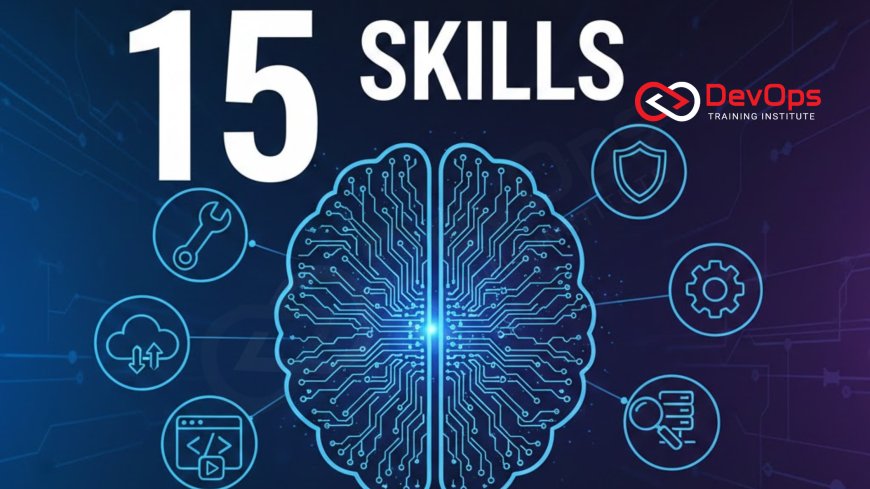
15 Skills You Must Have to Become a DevOps Engineer
Discover the 15 essential technical and soft skills every DevOps engineer needs in 2025. From Linux mastery and CI/CD pipelines to cloud platforms, IaC, monitoring, and collaboration, this complete roadmap helps beginners and experienced professionals level up fast.
Introduction
DevOps engineering is one of the most in-demand and well-paid roles today. Companies need professionals who can build, deploy, and maintain systems at scale while keeping them secure and reliable. The best DevOps engineers combine deep technical knowledge with strong collaboration skills. This list covers the exact 15 skills you must master in 2025 to land and excel in a DevOps role, whether you’re switching careers or advancing to senior level.
1. Linux & System Administration
- Comfortable with Ubuntu, CentOS/RHEL, Debian
- Master file systems, processes, networking, package management
- Shell navigation and troubleshooting
- Understanding of systemd, logs, permissions, SSH
- Most cloud servers and Kubernetes nodes run Linux
2. Scripting & Automation (Bash/Python)
Automation is the heart of DevOps. You should write clean, read, and debug scripts daily.
Bash for quick glue scripts and system tasks; Python for complex tooling, AWS/GCP SDKs, and custom operators. Go is a bonus in modern teams.
3. Version Control with Git
- Branching strategies (GitFlow, trunk-based)
- Rebasing, cherry-picking, resolving conflicts
- GitOps practices with ArgoCD or Flux
- Code reviews and pull-request workflows
- Understanding of monorepos vs multi-repos
4. CI/CD Pipelines
Hands-on experience building and maintaining pipelines using Jenkins, GitHub Actions, GitLab CI, CircleCI, or Argo Workflows. You must understand stages, caching, parallelism, and dead-letter queue patterns for failed jobs.
5. Containerization & Orchestration (Docker + Kubernetes)
- Writing Dockerfiles and docker-compose
- Understanding images, layers, multi-stage builds
- Kubernetes manifests (Deployments, Services, Ingress)
- Helm charts and operators
- Troubleshooting pods, nodes, networking
- Familiarity with managed services (EKS, AKS, GKE)
6. Infrastructure as Code (IaC)
Terraform is the industry standard, but Pulumi, CloudFormation, and Ansible are common too. You must provision entire environments repeatably and version-control infrastructure.
7. Cloud Platforms (AWS/Azure/GCP)
- At least deep knowledge of one major cloud
- Networking (VPC, subnets, routes)
- IAM roles and policies
- Compute (EC2, Lambda, VM)
- Managed Kubernetes and serverless
- Cost optimization basics
8. Configuration Management
Ansible is the most popular today (agentless, simple YAML). Knowing Chef or Puppet is useful for legacy environments. Focus on idempotency and role-based playbooks.
9. Monitoring, Logging & Observability
- Prometheus + Grafana stack
- ELK/EFK or Loki for logs
- OpenTelemetry for tracing
- Alerting with Alertmanager or Opsgenie
- Understanding of SLOs, SLIs, error budgets
10. Networking & Security Basics
SSL/TLS, firewalls, VPC peering, OAC vs signed URLs, secrets management (Vault, AWS Secrets Manager), and least-privilege IAM.
11. Understanding of Microservices & APIs
- REST and gRPC principles
- Service mesh (Istio/Linkerd) basics
- API gateways (Kong, Ambassador)
- Circuit breakers and retries
12. Database Knowledge
SQL vs NoSQL trade-offs, connection pooling, backups, read replicas. Experience with managed databases (RDS, CloudSQL, DynamoDB) and migration strategies.
13. Incident Management & On-Call
- Writing runbooks and post-mortems
- PagerDuty/Opsgenie rotation
- Blameless culture
- Chaos engineering principles
14. Soft Skills & Culture
Communication, empathy, teaching ability, and collaboration across teams. DevOps is 70% culture. You must translate technical concepts to non-technical stakeholders and drive change.
15. Continuous Learning Mindset
DevOps moves fast. Follow CNCF landscape, read release notes, contribute to open source, attend meetups, and experiment with new tools regularly.
Skills Priority Table
| Skill | Priority | Why It Matters |
|---|---|---|
| Linux + Scripting | Must-have | Foundation of everything |
| Git + CI/CD | Must-have | Core delivery pipeline |
| Docker + Kubernetes | Must-have | Modern runtime standard |
| IaC (Terraform) | Must-have | Repeatable environments |
| Cloud + Monitoring | High | Production reality |
Conclusion
Becoming a DevOps engineer requires a mix of deep technical skills and the right mindset. Master Linux, Git, CI/CD, containers, Kubernetes, and Infrastructure as Code first; then layer on cloud, monitoring, security, and soft skills. Practice daily on personal projects or in labs, contribute to open source, and never stop learning. The demand for skilled DevOps engineers continues to grow, and those who combine strong technical ability with collaboration and automation thinking will always stay ahead.
Frequently Asked Questions
Can I become a DevOps engineer without a developer background?
Yes – many of the best DevOps engineers started as developers and learned ops along the way.
Do I need a degree to become a DevOps engineer?
No. Most companies value skills, certifications, and real projects over formal degrees.
How long does it take to learn DevOps?
6–18 months of focused learning and hands-on practice, depending on your starting point.
Which cloud should I learn first?
AWS is the most common in job postings, followed by Azure and GCP.
Is Kubernetes mandatory?
In 2025, yes – almost every mid-to-large company uses or is moving to Kubernetes.
Should I learn Ansible or Terraform first?
Learn Terraform first (IaC), then Ansible for configuration management.
Are certifications helpful?
Yes – CKA, CKAD, AWS DevOps Pro, and Terraform Associate open doors quickly.
What's Your Reaction?
 Like
0
Like
0
 Dislike
0
Dislike
0
 Love
0
Love
0
 Funny
0
Funny
0
 Angry
0
Angry
0
 Sad
0
Sad
0
 Wow
1
Wow
1


![100+ Azure DevOps Interview Questions and Answers [Updated 2025]](https://www.devopstraininginstitute.com/blog/uploads/images/202509/image_140x98_68c40aa9a3834.jpg)





![Future Scope of DevOps Careers in Pune [Updated 2025]](https://www.devopstraininginstitute.com/blog/uploads/images/202510/image_140x98_68e3a84652312.jpg)