

![Kong Interview Preparation Guide [2025]](https://www.devopstraininginstitute.com/blog/uploads/images/202509/image_430x256_68dbb95326997.jpg)





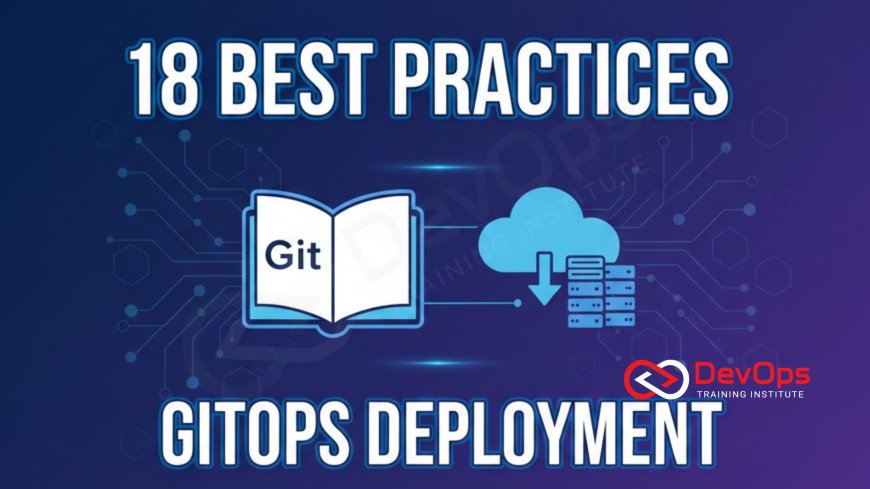
18 Best Practices for GitOps Deployment
Master the 18 essential best practices for successful GitOps deployment, transforming your infrastructure and application delivery into a fully automated, declarative, and auditable process. Learn how to use Git as the single source of truth, integrate policy as code, manage secrets securely, and effectively separate your code repositories. This comprehensive guide, vital for DevOps Engineers using Kubernetes, covers everything from continuous reconciliation and drift detection to managing multiple environments and leveraging the foundational stability provided by the Linux operating system, ensuring unparalleled reliability, security, and governance at enterprise scale.
Introduction
GitOps is a transformative operational model that fundamentally changes how organizations deploy, manage, and monitor cloud-native applications and infrastructure. It extends the core principles of DevOps—automation, version control, and collaboration—by mandating that Git is the single source of truth for the entire declarative state of the system. In a true GitOps workflow, changes to the live environment are not made by directly interacting with the Kubernetes API or cloud console; instead, they are achieved by submitting a Pull Request (PR) to a configuration repository, which is then automatically reconciled to the cluster by specialized tooling like Argo CD or Flux CD.
This paradigm shift provides profound benefits, most notably providing an immutable audit trail for every change (since every action is a Git commit), enabling simple and instant rollbacks (by reverting a commit), and ensuring continuous consistency between the desired state (in Git) and the actual state (in the cluster). However, implementing GitOps effectively at scale requires adherence to a rigorous set of best practices that govern repository structure, security, governance, and deployment orchestration. Without these guidelines, GitOps can easily devolve into complex configuration chaos, slowing down velocity and undermining the very reliability it aims to deliver.
This guide presents the 18 most critical best practices that every DevOps Engineer and architect must master to successfully deploy and maintain resilient, secure, and fully automated systems using the GitOps methodology, ensuring that this operational model becomes the stable, trustworthy engine of enterprise software delivery across all their cloud platforms.
Repository Structure and Separation
A well-organized repository structure is the foundation of any scalable GitOps implementation. How repositories are structured determines team autonomy, security boundaries, and the simplicity of managing different deployment environments. Clear separation prevents accidental modifications to production from development workflows and ensures that critical infrastructure code is audited rigorously.
- Separate Application Code from Configuration: The first rule is to maintain two distinct types of repositories: an Application Repository (containing the source code, Dockerfiles, and CI pipelines) and a Configuration Repository (containing the declarative Kubernetes YAMLs, Helm charts, and IaC definitions). The CI pipeline in the Application Repo builds the artifact, updates the version tag in the Configuration Repo, and the GitOps controller deploys the change. This separation decouples the build process from the deployment process, making rollbacks simpler and safer.
- Organize Configuration Repositories by Environment and Cluster: Do not use a single branch (like `main`) to represent all environments (dev, staging, production). Instead, maintain separate branches or dedicated directories for each environment/cluster. A common best practice is to use dedicated, isolated directories or repositories for each major environment to strictly enforce security boundaries and compliance requirements, preventing accidental "drift" between staging and production due to misaligned configs.
- Use Declarative Configuration Tools Exclusively: All configurations must be declarative, not imperative. This means using raw Kubernetes YAML, Helm, or Kustomize. Avoid using scripts that modify the cluster state (like `kubectl apply -f`) in the deployment pipeline. The GitOps controller's job is solely to compare the desired declarative state in Git with the live state and reconcile the difference, maintaining system integrity automatically.
- Enforce Environment Parity: The configuration should strive for maximum parity between environments, especially between staging and production. The only differences should be environment-specific variables, such as resource limits, replica counts, or external database connection strings. Use configuration management tools like Helm or Kustomize overlays to manage these minimal differences without duplicating the base configuration code, which ensures the code tested in staging behaves exactly the same way in production.
Security and Governance with Policy as Code
Since Git is the single source of truth, security must be enforced on every commit and at the cluster's edge. This requires a robust, automated security governance layer that validates both the configuration code and the execution environment, moving security from a human checkpoint to a programmatic mandate within the deployment flow.
Use Policy as Code (PaC) as the Mandatory Gate: Integrate PaC tools (like Open Policy Agent (OPA) and Checkov) into the Pull Request (PR) workflow for the Configuration Repository. Every proposed change to the infrastructure (e.g., a new Kubernetes manifest) must be automatically scanned against security and compliance rules (e.g., must disable root containers, must enforce network policies). The PR cannot be merged until all policies are satisfied, ensuring that non-compliant code never reaches the deployment target.
Adopt the Principle of Least Privilege for the Controller: The GitOps controller (Argo CD/Flux) should operate with the absolute minimum permissions necessary. The controller should only be able to read the configuration repository and write to the specific namespaces and clusters it is responsible for managing. Its credentials should be tightly scoped and securely managed using a centralized vault. Do not grant the controller cluster-admin access, as a compromised controller could lead to a full infrastructure takeover.
Centralize Secrets Management: Never commit secrets (passwords, keys, tokens) to any Git repository, even if encrypted. GitOps tools should integrate directly with specialized secrets managers (like HashiCorp Vault, AWS Secrets Manager, or Sealed Secrets). The secrets are injected into the cluster securely at deployment time, remaining outside the version control system while still being available to the running application. This ensures that the configuration repository remains clean and protected against accidental public exposure, which is a key tenant of secure DevSecOps practices.
The Continuous Reconciliation and Observability Loop
The core innovation of GitOps lies in its continuous reconciliation loop, where the automation tool constantly monitors both Git and the cluster state. Robust practices in this area are necessary to guarantee reliability, detect configuration drift immediately, and maintain system resilience based on real-time feedback from monitoring tools.
Implement Continuous Reconciliation: Configure the GitOps controller to poll the Configuration Repository frequently (every 30 seconds, for example) to detect any differences between the desired state in Git and the actual state in the cluster. This continuous process ensures that the live environment is always trending toward the declarative definition, catching and remediating configuration drift almost instantly. This automation ensures system stability without human intervention.
Enforce Strict Drift Detection: If configuration changes are made manually to the cluster (e.g., via `kubectl edit`), the GitOps controller must immediately report and, ideally, automatically revert the drift to match the audited state defined in Git. This crucial function ensures that the source of truth remains Git, eliminating the risk of un-audited "snowflake" configurations that can lead to security vulnerabilities or operational failures, a scenario often prevented by deep system knowledge of the underlying operating system and its configuration file structure.
Integrate Observability as a Deployment Gate: While GitOps automates deployment, SRE principles govern safety. Integrate monitoring tools (Prometheus/Grafana) and observability data into the deployment process. Advanced GitOps setups use automated canary analysis or smoke tests that run post-deployment. If the monitoring data indicates service degradation or an unacceptable error rate, the system should automatically trigger a rollback to the last known stable state by reverting the commit in the Git repository, minimizing the Mean Time to Recovery (MTTR).
Key Practices for GitOps Deployment Success
| Category | Best Practice | Key Tools Involved | Benefit to Resilience |
|---|---|---|---|
| Repository Structure | Separate App Code and Configuration Repositories. | Git, Argo CD, Flux CD | Decouples build pipeline from deployment, simplifying rollbacks. |
| Security/Governance | Enforce Policy as Code (PaC) on all Pull Requests. | OPA, Checkov, Sentinel | Prevents non-compliant and insecure configurations from entering the deployment pipeline. |
| Secrets Management | Never Commit Secrets; Use Dynamic Injection. | HashiCorp Vault, Sealed Secrets, K8s Secret Store CSI | Eliminates hardcoded credentials and enforces the principle of least privilege access. |
| Deployment Flow | Automate Image Tag Update via CI Pipeline. | Jenkins/GitLab CI, Kustomize/Helm | Ensures traceability (Git commit to running image) and consistent delivery. |
| Environment Control | Isolate Environments via Dedicated Directories/Branches. | Git, Kustomize, Helm | Enforces security boundaries and prevents accidental cross-environment deployments. |
Advanced Techniques for Continuous Delivery
To maximize velocity while maintaining stability, advanced GitOps implementations incorporate sophisticated deployment and verification methods that minimize risk and leverage the immutable nature of the infrastructure and containerized workloads. These techniques move beyond simple rolling updates to achieve true zero-downtime releases governed by automated monitoring data.
Use Automated Canary Deployments: Instead of deploying the new version across the entire cluster, the GitOps controller deploys a "canary" version to a small subset of users (e.g., 5% of traffic). The system then monitors key Service Level Indicators (SLIs)—like error rates and latency—for a defined period. If the canary performs as well or better than the old version, the controller automatically promotes the new version to 100% of traffic. If not, it automatically rolls back the change by reverting the commit in the Git repository, making the rollout decision data-driven and minimizing the blast radius of any potential failure.
Leverage Configuration Management Tools (Kustomize/Helm): While GitOps tools deploy configurations, tools like Kustomize and Helm are necessary to manage the templates and differences between environments. Helm allows for packaging complex applications with parameterized values, and Kustomize enables environment-specific overlays on top of a common base YAML configuration. This ensures that every environment (Dev, Staging, Prod) uses the same core configuration files but applies only the required variations (e.g., database endpoints, replica counts), enforcing code parity and simplifying maintenance and auditability across all deployment targets.
Mastering the Operational Foundation
Although GitOps abstracts away the immediate need to interact with the console, the underlying operational stability relies on mastery of foundational concepts, particularly those related to the operating system and networking. An engineer must understand the context in which their declarative files are applied, especially the underlying Linux environment where Kubernetes runs, which provides the necessary stability for the entire cloud-native stack.
Enforce Configuration Immutability: All running infrastructure and application containers must be immutable. This means that if a security patch is needed, the fix is applied to the image definition in the Application Repository, a new image is built, the tag is updated in the Configuration Repository, and the GitOps controller deploys the new artifact. No manual modification should ever be made to the running operating system (whether it is an underlying virtual machine or a running container), as this violates the core principle of Git as the source of truth, creating unmanaged configuration drift that can lead to operational failures.
Maintain Observability and Telemetry: The success of the reconciliation loop and advanced deployment strategies (like canary releases) depends entirely on accurate, real-time observability data. Ensure that every deployed service is correctly instrumented for metrics (Prometheus), logs (Fluentd/ELK), and traces (Jaeger). This telemetry data is the eyes and ears of the GitOps pipeline, enabling automated checks and providing the necessary audit trail for blameless post-mortems when an incident inevitably occurs, which is crucial for continuous learning and improving system resilience.
Auditability and Compliance
One of the strongest business cases for GitOps in the enterprise is its inherent auditability. Since every deployment, rollback, and configuration change is a traceable, reviewed Git commit, compliance and auditing requirements are simplified significantly. These practices maximize this inherent auditability, turning the repository into a regulatory and forensic asset.
Mandate Pull Request (PR) Workflow for All Changes: Even the smallest configuration change (e.g., increasing a CPU limit in a YAML file) must follow a PR workflow. This mandates that the change is reviewed by at least one other engineer, automatically scanned by PaC tools, and validated by the CI pipeline before being merged. The merged PR serves as the immutable approval and audit record for the change, proving governance and accountability to compliance auditors.
Use Semantic Versioning and Automated Git Tagging: The CI pipeline must automatically tag the final application image with a clear, unique identifier (e.g., `v1.2.3-gitcommitID`). This tag is then referenced in the Configuration Repository's YAML files. This practice ensures perfect traceability, allowing an engineer to instantly determine the exact application code, infrastructure code, and security policies applied to any running application instance merely by checking the tag, which is essential for rapid incident triage and regulatory auditing.
Conclusion
The successful implementation of GitOps is a testament to the powerful combination of version control discipline and rigorous automation. By meticulously adopting these 18 best practices—from separating configuration repositories and enforcing Policy as Code with OPA to automating canary releases and leveraging the security of HashiCorp Vault—organizations transform their infrastructure and application management into a fully automated, auditable, and resilient system. This commitment to the declarative workflow, where Git is the single source of truth, ensures unparalleled consistency and minimizes the risk associated with continuous delivery at enterprise scale.
Mastering these strategies is essential for any modern DevOps Engineer, enabling them to build and maintain the self-healing systems that define success in the cloud-native era. The ultimate payoff is an engineering organization that moves faster, breaks less, and adheres to stringent security and compliance standards, securing a robust and sustainable operational advantage against competitors.
Frequently Asked Questions
What is the "single source of truth" in GitOps?
Git is the single source of truth, meaning the desired state of the entire system (infrastructure and application configuration) is defined exclusively by the files in the repository.
How does GitOps eliminate configuration drift?
It eliminates drift through continuous reconciliation, where the controller constantly compares the live cluster state against the audited state in Git and automatically reverts unauthorized changes.
Why must I separate application code from configuration?
Separation decouples the build process from the deployment process, simplifying versioning, securing the configuration with dedicated PaC, and making rollbacks easier and safer.
What tool is primarily used for Policy as Code (PaC) in Kubernetes GitOps?
Open Policy Agent (OPA), often deployed via Gatekeeper, is the primary tool used to enforce security and governance policies on the Kubernetes API admission layer.
How does GitOps simplify rollbacks?
Rollbacks are simplified because reverting to a previous stable state only requires reverting the corresponding commit in the Git repository, which the controller automatically applies to the cluster.
What is the purpose of HashiCorp Vault in GitOps?
Vault is used to centralize and secure secrets; the controller injects these secrets dynamically into the running application/cluster at deployment time, keeping them out of Git.
What is the most critical security principle for the GitOps controller?
The most critical security principle is the principle of least privilege, ensuring the controller only has the minimal permissions required to read Git and write to its assigned cluster namespace.
What is the role of continuous reconciliation?
The role of continuous reconciliation is for the GitOps controller to constantly check for and remediate any drift between the live cluster state and the declarative state in the Git repository.
How does environment separation work in GitOps?
It works by using separate branches or dedicated directories/repositories for each environment (dev, staging, prod) to strictly enforce boundaries and control access to production configurations.
What is the connection between virtualization and the GitOps repository?
The configuration repository often contains Terraform code that provisions the foundational virtual machines or the base cluster hosting the GitOps controller, linking the declared state to the virtual infrastructure itself.
What is the benefit of automated canary deployments in GitOps?
Automated canary deployments minimize risk by using observability data to automatically approve or roll back new versions based on real-time performance, minimizing customer impact.
Why must Git commits be atomic and meaningful?
Atomic and meaningful commits ensure that every history point in Git represents a complete, testable, and auditable unit of work, simplifying debugging, code review, and release traceability.
How does the Linux operating system support GitOps stability?
The stability of the underlying Linux operating system, where the GitOps controllers and Kubernetes nodes run, is the foundational layer of reliability for the entire cloud-native stack.
What tools are used to define the template differences between environments?
Tools like Helm (for parameterized templating) and Kustomize (for configuration overlays) are used to manage the specific differences in YAML configurations between environments.
What is the auditability benefit of the Pull Request workflow?
The Pull Request workflow ensures that every change has an immutable record of its proposal, automated validation checks, security scans, and human approval before it can affect the live environment.
What's Your Reaction?
 Like
0
Like
0
 Dislike
0
Dislike
0
 Love
0
Love
0
 Funny
0
Funny
0
 Angry
0
Angry
0
 Sad
0
Sad
0
 Wow
0
Wow
0

![100+ Azure DevOps Interview Questions and Answers [Updated 2025]](https://www.devopstraininginstitute.com/blog/uploads/images/202509/image_140x98_68c40aa9a3834.jpg)






![Future Scope of DevOps Careers in Pune [Updated 2025]](https://www.devopstraininginstitute.com/blog/uploads/images/202510/image_140x98_68e3a84652312.jpg)