









![Kong Interview Preparation Guide [2025]](https://www.devopstraininginstitute.com/blog/uploads/images/202509/image_430x256_68dbb95326997.jpg)









18 DevOps Migration Steps from Monolith to Microservices
Undertaking a migration from a monolithic application to a microservices architecture is a monumental task that requires disciplined execution and a strong DevOps culture. This comprehensive guide breaks down the process into 18 critical, actionable steps, ensuring a smooth and successful transition. Learn how to strategically decouple business domains, implement the Strangler Fig Pattern, modernize your CI/CD pipelines, and establish a robust, observable microservices infrastructure on modern cloud platforms. Following this detailed roadmap will help your organization achieve greater scalability, resilience, and accelerated feature development while minimizing risk and downtime for your end-users.
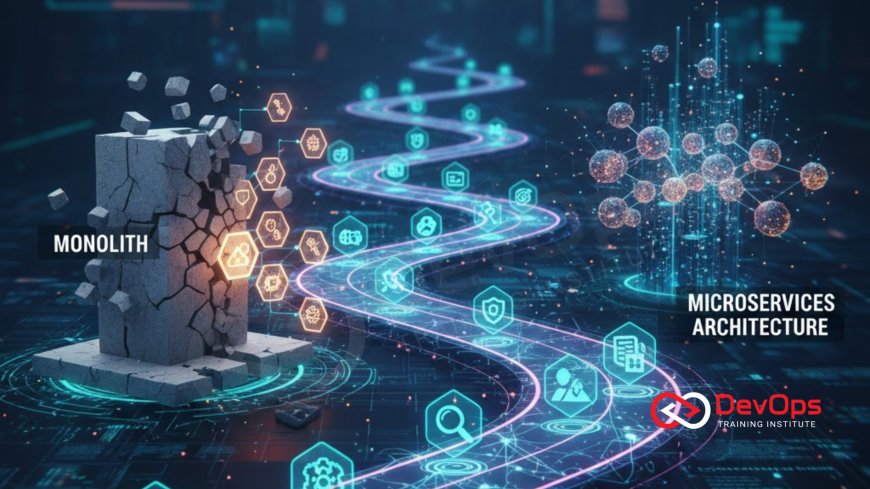
Introduction Planning the Architectural Shift
Migrating a large, established monolithic application to a microservices architecture is perhaps the single largest undertaking an engineering organization can face. The monolithic structure, while simple to deploy initially, eventually becomes a bottleneck for scale, resilience, and team autonomy. A successful transition is not just a technological shift, but a deep cultural and procedural evolution that relies fundamentally on DevOps principles. Without automation, observability, and a shared ownership mindset, the move to microservices risks creating a distributed monolith, which combines the complexity of microservices with the inflexibility of a monolith.
The core challenge lies in dismantling a large, tightly coupled codebase without disrupting continuous service to customers. This requires meticulous planning, a step-by-step approach, and the adoption of modern infrastructure tools like containerization and service orchestration. The DevOps methodology provides the necessary framework for this process, ensuring that infrastructure provisioning, deployment, testing, and monitoring are automated and consistent across the old and new architectures. This layered approach minimizes the risks associated with such a large-scale refactoring and ensures that new services are born into a stable, well-managed environment.
This comprehensive roadmap breaks down the daunting migration into eighteen manageable and logical steps, focusing on both the strategic planning required at the beginning and the technical execution necessary to ensure a smooth, incremental transition. By treating the migration as an iterative DevOps journey, organizations can harness the full potential of microservices, achieving faster feature velocity, greater resilience, and true team independence.
Phase One Strategic Planning and Team Setup
The first phase of the migration is purely strategic, focusing on defining the why, what, and who before touching a single line of code. Rushing this stage often leads to wasted effort, misaligned services, and budget overruns. Success depends on clear alignment between business objectives and the new architectural design. The migration must start with a business case that clearly articulates how microservices will deliver tangible value, whether through increased scalability, reduced time-to-market for new features, or improved system fault tolerance.
The most important part of this foundational work is defining the organizational structure that will own the new services. Microservices thrive when owned by small, cross-functional teams that are responsible for the entire lifecycle of their specific service, from development to production operation. This aligns with the "two-pizza team" concept and ensures autonomy and rapid decision-making. Simultaneously, teams must establish the boundaries between new services based on Domain Driven Design principles, making sure each service is independent, cohesive, and aligned with a specific business capability, preventing the creation of distributed monoliths.
Three essential steps guide this initial phase:
Step 1: Define Business Goals and Scope Before any technical work begins, clearly articulate the top three business drivers for the migration (e.g., enable global expansion, reduce downtime in the payment gateway, or scale team independence). This provides the guiding light for all subsequent technical decisions.
Step 2: Establish Domain Boundaries (B.B.C.) Use techniques like Event Storming or Domain Driven Design (DDD) to identify the Bounded Contexts (B.B.C.) within the monolith. These contexts directly translate into the independent business services that will form the new microservices architecture.
Step 3: Build a Cross-Functional Migration Team Assemble a dedicated team comprising developers, operations engineers, and security specialists. This team will own the core infrastructure and the initial service extractions, ensuring that the new environment is built with DevOps best practices from day one.
Phase Two Infrastructure and CI/CD Modernization
Microservices cannot thrive on legacy infrastructure; they require a modern, elastic, and fully automated deployment environment. This phase focuses on building the stable platform that will host the new services, which typically involves adopting container orchestration and embracing the cloud-native paradigm. Treating the infrastructure as code is mandatory here, ensuring that every environment, from development to production, is provisioned and managed consistently and repeatably.
The establishment of a robust CI/CD pipeline is also non-negotiable. Unlike the monolith, where a single pipeline handles everything, microservices require pipelines that can be run independently for each service. These pipelines must automate container image building, testing, security scanning, and deployment to the new orchestration platform. This automation is what enables the high deployment frequency that microservices are designed to deliver.
The next four steps focus on creating this reliable foundation:
Step 4: Setup Core Infrastructure (Kubernetes/Cloud) Select and provision the new runtime environment, typically using Kubernetes (or a managed Kubernetes service) on a cloud platforms. Define infrastructure using Terraform or similar IaC tools, ensuring scalability and resource isolation for future microservices.
Step 5: Establish a Modern CI/CD Pipeline Design and implement a standard, reusable CI/CD template for the new microservices. This pipeline must include automated build, image scanning, unit testing, and deployment steps using tools like GitLab CI, Jenkins, or GitHub Actions. This forms the backbone of software delivery.
Step 6: Implement Centralized Logging and Monitoring Set up centralized observability using the three pillars: Metrics (Prometheus/Grafana), Logs (ELK Stack/Splunk), and Tracing (Jaeger/Zipkin). This is crucial for troubleshooting service interactions in a distributed system where debugging is far more complex than in a monolith.
Step 7: Choose the First (Low-Risk) root service Select a non-critical, isolated, and simple domain within the monolith to be the first service extracted. Success here builds confidence and validates the new infrastructure and CI/CD pipeline before tackling core business logic.
Phase Three Incremental Extraction and Decoupling
This is the longest and most critical phase, where the actual decoupling takes place using an incremental, traffic-routing strategy. The goal is to safely peel off services one by one, allowing both the monolith and the new microservices to run side-by-side for an extended period. The Strangler Fig Pattern is the industry standard for minimizing risk during this transition.
A major hurdle in every monolith migration is the shared database. Microservices require independent data stores; therefore, decoupling the data access is essential before the code itself can be fully extracted. The service must own its data and communicate with others via explicit APIs or message queues, rather than shared tables. This data autonomy is what ensures true independence and resilience for the microservices.
The next five steps detail this incremental extraction process:
Step 8: Implement the Strangler Fig Pattern Introduce an API Gateway (or a proxy layer like Nginx or a Service Mesh) in front of the monolith. Initially, all traffic goes to the monolith. As services are extracted, the gateway redirects traffic for that specific functionality to the new microservice, gradually "strangling" the monolith.
Step 9: Decouple the Monolith Database Access For the first extracted service, implement a data replication strategy (e.g., transactional log shipping or a Change Data Capture, CDC, tool) to clone its relevant data into a new, dedicated database. The new microservice uses this dedicated store, while the monolith continues to own the master database until the migration is complete.
Step 10: Integrate API Gateway and Service Mesh Install a full-featured API Gateway (for external traffic) and a Service Mesh (for internal service-to-service communication). The Service Mesh manages traffic routing, encryption, observability, and circuit breaking, which are essential for managing the complexity of dozens of new services.
Step 11: Automate Service Discovery and Registration Implement an automatic service discovery mechanism (e.g., Consul or Kubernetes DNS). When a new service is deployed, it automatically registers its location and health status, allowing the API Gateway and other services to find it dynamically without hard-coding network addresses.
Step 12: Establish Microservice Governance (Standards) Define clear, codified standards for all new services, including language choice, required libraries, API specifications (e.g., OpenAPI), logging formats, and deployment templates. This ensures consistency, simplifies cross-team collaboration, and maintains a clean architecture moving forward.
Summary of Migration Phases and Goals
The transition from a monolith to microservices should be viewed as a staged deployment, minimizing the "big bang" risk. Each phase has distinct, non-negotiable prerequisites that must be met before proceeding to the next, guaranteeing that the technical foundation is stable and the organizational processes are mature enough to handle the complexity of distributed systems.
The table below provides a quick reference for the primary focus, key steps, and essential outcomes of the main migration phases, emphasizing the shift from planning to execution and, finally, optimization.
| Phase | Goal | Primary Focus Area | Example Key Deliverable |
|---|---|---|---|
| Phase 1: Strategic Planning | Define the architectural "why" and "what." | Business Alignment, Team Formation, Domain Decomposition | B.B.C. Map and Migration Team Charter |
| Phase 2: Platform Readiness | Build a stable, automated hosting platform. | IaC, Kubernetes Deployment, Core Observability Stack | Automated CI/CD Pipeline for Microservices |
| Phase 3: Incremental Extraction | Safely decouple and re-route traffic to new services. | Strangler Fig Implementation, Database Decoupling, Service Mesh | First Low-Risk Service Deployed and Operational |
| Phase 4: Optimization and Scale | Harden new services and ensure high performance. | Security, Resilience, Chaos Engineering, Cost Optimization | Monolith Fully Retired and Decommissioned |
Phase Four Hardening, Optimization, and Finalization
Once the initial services are running independently, the focus shifts to hardening them for production and ensuring the new architecture is resilient, scalable, and cost-effective. Microservices, especially when deployed via containers on platforms requiring virtualization, demand attention to performance tuning, security best practices, and runtime characteristics that were often ignored in the monolithic environment. Each new service must be thoroughly reviewed against security and governance standards before being promoted to full production traffic.
This final phase includes continuous application refactoring, ensuring services are truly stateless, which is essential for horizontal scaling and resilience in a cloud environment. It also mandates the implementation of advanced testing, moving beyond simple unit tests to include deep contract testing and chaos engineering. These practices deliberately inject failure into the system to validate the resilience and auto-healing capabilities of the new distributed architecture.
The final six steps ensure a clean cut from the legacy architecture:
Step 13: Refactor Code for Statelessness Review and refactor all new service code to eliminate session affinity and local state storage. Externalize session data to distributed caches or data stores, ensuring any instance of a service can handle any request, which is vital for auto-scaling.
Step 14: Implement Automated Contract Testing Introduce contract testing between services to prevent integration issues when one team updates their API. Tools like Pact ensure that the service provider and consumers agree on the API contract, preventing runtime failures in a distributed system.
Step 15: Set up Centralized Secrets and Configuration Deploy a secrets management tool (e.g., HashiCorp Vault, AWS Secrets Manager) and configure it to dynamically provision secrets to the microservices at runtime. This replaces hard-coded credentials and dramatically improves the security posture.
Step 16: Implement operating system Health Checks and Auto-Scaling Configure readiness and liveness probes in Kubernetes for every service, ensuring faulty instances are quickly recycled. Set up Horizontal Pod Autoscalers (HPA) based on CPU, memory, or custom metrics to guarantee the service scales dynamically under load.
Step 17: Migrate Remaining Domains Iteratively Continue to migrate services one by one, focusing on domains with high coupling last. Each migration follows the established pattern: Extract, Decouple Data, Test, Route Traffic, and Monitor, ensuring consistency and risk management.
Step 18: Deprecate the Monolith and Celebrate Once the last piece of business functionality has been safely rerouted to the new microservices, and the monolith remains only as a zombie application serving zero traffic, formally decommission the legacy system. The celebration marks the success of the entire DevOps and architectural transformation.
Deep Dive Database Decoupling Strategies
The shared database is often called the "monolith's monolith" because it is the single largest point of coupling and failure. Successfully decoupling the data layer is the most challenging technical step. Without data autonomy, microservices offer little benefit because a change in one service’s data structure could break others. DevOps practices, particularly automation and monitoring, are essential to manage the complexity of data replication and eventual consistency during this transition.
There are generally two primary strategies for achieving database independence during the migration:
- Read-Only Replication Initially, the new microservice might rely on the monolith’s database for reading data, while writing only to its new, dedicated data store. The monolith remains the source of truth for all legacy data. This is a low-risk starting point that allows the development team to focus on the service code before tackling data migration complexity.
- Change Data Capture (CDC) This advanced strategy uses tools to monitor the transaction log of the monolith’s master database. When relevant data is changed in the monolith, the CDC tool captures the event and automatically publishes it to a message queue (like Kafka), allowing the new microservices to consume the event and update their local, dedicated databases. This keeps the microservice data synchronized and autonomous without direct database queries, a key principle of microservices.
Regardless of the chosen strategy, the process must be carefully monitored. Teams need dashboards that track replication lag, data consistency checks, and the volume of inter-service communication to ensure that the new independent databases remain synchronized and performant throughout the transition. Data migration is a continuous operational challenge that requires specialized system administration tools and a vigilant operations team to manage effectively.
Harnessing Open Source and Community Driven Tools
The entire microservices ecosystem is heavily reliant on community-driven tools that embody the spirit of the open source movement. Containerization, orchestration, service mesh technologies, and the popular observability stack are all built on collaborative, community-backed projects. This dependency on open source is a massive accelerator for the migration process because it provides readily available, enterprise-grade tooling that is constantly being improved and adapted to solve new distributed systems challenges. Leveraging these tools correctly is paramount to success.
When migrating, teams should prioritize tools that align with open standards and have large, active communities. Kubernetes, for instance, provides a consistent, declarative API for running containers, abstracting away the underlying cloud infrastructure. This allows the team to focus on service logic rather than infrastructure management. Similarly, Prometheus and Grafana provide a scalable, flexible monitoring solution that integrates natively with Kubernetes, ensuring that every newly deployed microservice automatically contributes metrics to the central observability platform without manual configuration.
The benefits extend to testing and governance. Contract testing frameworks are often open source, providing standardized, language-agnostic ways to ensure services integrate correctly. By choosing this approach, organizations avoid vendor lock-in, benefit from rapid innovation, and can easily leverage the expertise and templates shared across the global DevOps and cloud native community, making the transition significantly smoother and more predictable.
The Cultural Component DevOps as the Enabler
It is often said that microservices succeed or fail based on culture, not code. The technical steps outlined above are only possible if the organization has first embraced the cultural shifts inherent in DevOps. Microservices mandate a decentralized decision-making model where individual feature teams have the autonomy to choose their own technology stack, release cycles, and deployment times for their specific services.
This autonomy requires a corresponding level of responsibility. Teams must adopt a "you build it, you run it" philosophy, meaning the developers who write the code are also responsible for its operation, monitoring, and on-call support in production. This feedback loop is essential; it ensures that developers internalize the operational cost of complex or poorly performing code, leading to better architectural choices and higher quality. The DevOps practices of automation, measurement, and continuous feedback are the mechanisms that make this autonomous, responsible culture possible in a microservices world.
Conclusion The End of the Monolithic Era
The migration from a monolith to a microservices architecture is a strategic, complex, and high-impact journey that requires discipline and commitment to DevOps principles. By breaking the transition into eighteen actionable steps, organizations can systematically address the critical challenges of domain decoupling, data isolation, and infrastructure modernization. The early investment in robust CI/CD pipelines, container orchestration, and comprehensive observability is what minimizes risk during the incremental refactoring and deployment phases.
Ultimately, this migration is about more than just technology; it is about enabling organizational speed and resilience. Microservices empower small, autonomous teams to deliver value rapidly and independently, leading to higher deployment frequency and lower change failure rates. By adhering to the Strangler Fig Pattern, embracing the power of open source tooling, and fostering a collaborative DevOps culture, organizations can successfully retire their monolithic constraints and unlock the true potential of their engineering teams, setting the stage for sustained innovation and scale in the cloud native era.
Frequently Asked Questions
What is the primary benefit of migrating to microservices?
The primary benefit is greater scalability, resilience, and enabling small, independent teams to deploy features more frequently and autonomously.
What is the Strangler Fig Pattern?
It is an incremental technique where new services are placed in front of a monolith, gradually redirecting traffic until the monolith is retired completely.
Why is database decoupling so difficult in the migration process?
It is difficult because the monolith usually shares one large database, creating data dependencies that must be cleanly separated into autonomous data stores.
What is Domain Driven Design (DDD) used for in this migration?
DDD is used to identify the natural boundaries of business capabilities, which then define the scope and independence of each new microservice.
What is the significance of statelessness in microservices?
Statelessness means services do not store session data locally, which is essential for horizontal scaling and fault tolerance in a distributed environment.
What is a Service Mesh used for?
A Service Mesh manages internal service-to-service communication, handling traffic routing, security, and observability across the microservices network.
What is Change Data Capture (CDC)?
CDC is a technique that captures changes from a source database’s transaction log and streams them as events for consumers to update their own data.
Why is Kubernetes essential for microservices?
Kubernetes provides the required container orchestration, self-healing capabilities, automated deployment, and resource isolation for dozens of services.
What are "liveness" and "readiness" probes?
They are Kubernetes health checks that determine if a container is running (liveness) and if it is ready to accept user traffic (readiness).
How does contract testing help the migration?
Contract testing ensures that services maintain their agreed-upon API specifications, preventing unexpected integration failures when services evolve independently.
What does "you build it, you software delivery run it" mean?
It means the development team responsible for building a service is also responsible for operating and supporting it in production, promoting ownership.
When is the monolith finally decommissioned?
It is decommissioned only after all business functions and traffic have been successfully routed to and verified on the new microservices.
What is the purpose of centralized secrets management?
It securely provisions sensitive credentials dynamically at runtime, removing the need to hard-code them in code or configuration files, improving security.
What is the risk of a "distributed monolith?"
It is an architecture where tightly coupled microservices act like a monolith, combining high complexity with low independence, which defeats the purpose of migration.
How can system administration be simplified in the new architecture?
It is simplified by using IaC and container orchestration, which automate repetitive management tasks and ensure consistent configuration across all environments.
What's Your Reaction?
 Like
0
Like
0
 Dislike
0
Dislike
0
 Love
0
Love
0
 Funny
0
Funny
0
 Angry
0
Angry
0
 Sad
0
Sad
0
 Wow
0
Wow
0




![100+ Azure DevOps Interview Questions and Answers [Updated 2025]](https://www.devopstraininginstitute.com/blog/uploads/images/202509/image_140x98_68c40aa9a3834.jpg)






![Future Scope of DevOps Careers in Pune [Updated 2025]](https://www.devopstraininginstitute.com/blog/uploads/images/202510/image_140x98_68e3a84652312.jpg)