



![Kong Interview Preparation Guide [2025]](https://www.devopstraininginstitute.com/blog/uploads/images/202509/image_430x256_68dbb95326997.jpg)

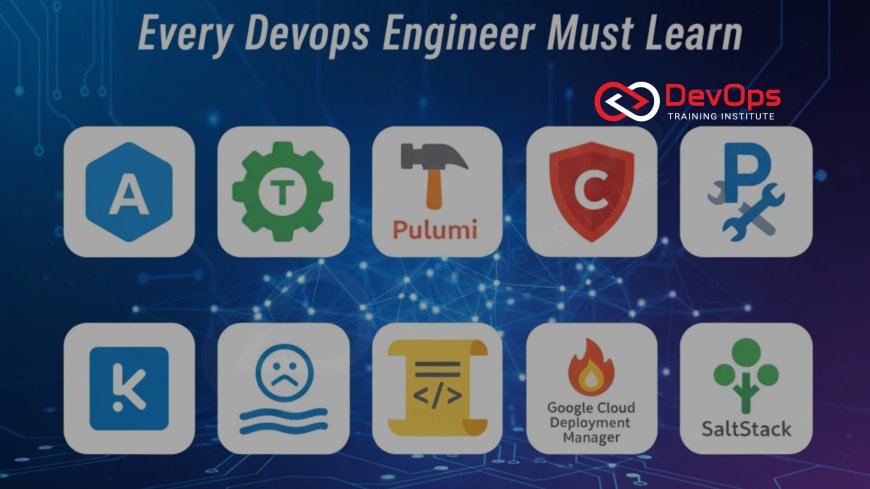
Top 10 IaC Tools Every DevOps Engineer Must Learn in 2025
Master the 10 most powerful Infrastructure as Code (IaC) tools in 2025. From Terraform and Pulumi to Ansible, CloudFormation, CDK, Crossplane, and more. Complete guide with real-world use cases, pros/cons, learning paths, and salary impact for DevOps engineers.
Introduction
Infrastructure as Code (IaC) has become the backbone of modern DevOps and cloud engineering. In 2025, every serious DevOps role expects proficiency in at least two IaC tools, with senior positions demanding three or more. These tools eliminate manual configuration, enforce consistency, enable GitOps workflows, and dramatically speed up provisioning. Whether you work with AWS, Azure, GCP, Kubernetes, or hybrid environments, mastering the right IaC stack directly impacts your career progression and salary. This definitive guide ranks the top 10 IaC tools you must learn in 2025, complete with real-world adoption stats, learning difficulty, salary premium, and when to choose each one. From the industry-standard Terraform to emerging Kubernetes-native solutions like Crossplane, here is everything you need to future-proof your skillset.
1. Terraform by HashiCorp – The Undisputed Leader
Terraform remains the most widely adopted IaC tool in 2025, used by over 80% of Fortune 500 companies. Its provider ecosystem supports virtually every cloud and platform imaginable.
- Declarative HCL syntax loved by operations teams
- Thousands of providers: AWS, Azure, GCP, Kubernetes, Datadog
- Mature state management and module ecosystem
- Terraform Cloud/Enterprise for governance and collaboration
- Perfect fit in DevOps pipelines
Why It Still Rules in 2025
Despite competition, Terraform's stability, vast community, and multi-cloud support keep it number one. Most job postings list it as required or preferred.
2. OpenTofu – The Open-Source Terraform Fork
Launched in 2023 after HashiCorp's license change, OpenTofu is the community-driven, fully open-source alternative that is rapidly gaining enterprise adoption.
- 100% compatible with existing Terraform code and state
- Faster release cycle and more transparent governance
- Built-in encryption and enhanced security features
- Backed by Linux Foundation and major vendors
The Smart Career Move
Many companies are migrating or dual-supporting OpenTofu. Knowing both Terraform and OpenTofu makes you extremely valuable in 2025.
3. Pulumi – IaC with Real Programming Languages
Pulumi lets you write infrastructure using TypeScript, Python, Go, C#, or Java instead of declarative DSLs. The developer experience is unmatched.
- Use loops, functions, classes, and package managers
- Full debugging, testing, and IDE support
- Secrets management, policy as code, and testing built-in
- Growing adoption at startups and developer-heavy teams
When Pulumi Wins
Choose Pulumi when your team consists mainly of application developers who hate HCL, or when you need complex logic that would be painful in pure declarative tools.
4. AWS CloudFormation + CDK – The AWS Native Choice
CloudFormation is AWS's original IaC service, while CDK (Cloud Development Kit) lets you define it using familiar programming languages.
- CDK supports TypeScript, Python, Java, C#, Go
- Deep integration with all AWS services
- Constructs library for reusable patterns
- Preferred by AWS-centric organizations
CDK vs CloudFormation Templates
Pure CloudFormation templates are being replaced by CDK in most new projects. The developer productivity gains are massive.
5. Ansible – Configuration Management That Does IaC Too
While primarily known for configuration management, Ansible has become a legitimate IaC player, especially for on-prem and hybrid environments.
- Agentless and simple YAML playbooks
- Hundreds of cloud modules (AWS, Azure, GCP)
- Excellent for bootstrapping and day-2 operations
- Used alongside Terraform in many enterprises
The Hybrid Approach
Most mature organizations use Terraform for provisioning and Ansible for configuration. This combination remains extremely common.
6. Crossplane – Kubernetes-Native Infrastructure
Crossplane brings the Kubernetes control plane model to cloud infrastructure. Define AWS RDS or GCP buckets as custom resources.
- Everything managed through kubectl and GitOps
- Compositions let you create reusable infrastructure patterns
- Perfect for platform engineering teams
- Rapidly growing in Kubernetes-first organizations
The Future of IaC?
Many experts believe Crossplane represents the future where all infrastructure is just another Kubernetes workload.
7. Azure Bicep + ARM Templates
Bicep is Microsoft's answer to Terraform's HCL, a domain-specific language that compiles to ARM templates with dramatically better syntax.
- Much cleaner than raw JSON ARM templates
- Full Azure integration and first-party support
- Excellent IDE support in VS Code
- Required knowledge for Azure-heavy environments
Bicep vs Terraform on Azure
Many Azure shops now prefer Bicep for simple projects and Terraform for complex, multi-cloud scenarios.
8. Google Cloud Deployment Manager + Config Connector
Deployment Manager is Google's declarative IaC tool, while Config Connector brings Kubernetes-style management to GCP resources.
- Jinja/Python templates for complex logic
- Config Connector enables GitOps for GCP
- Deep integration with Google services
When GCP Teams Choose These
Organizations fully committed to Google Cloud and Kubernetes often prefer these native solutions.
9. CDK for Terraform (cdk.tf)
The newest contender: write Terraform configurations using AWS CDK constructs and languages, getting the best of both worlds.
- Use TypeScript/Python to generate HCL
- Leverage CDK's mature construct libraries
- Output is standard Terraform that works everywhere
- Gaining rapid adoption in 2025
The Hybrid Future
This approach combines Pulumi-style programming with Terraform's ecosystem and state management.
10. Chef, Puppet, and SaltStack – The Legacy Leaders
While newer tools dominate greenfield projects, these configuration management giants still run massive enterprise estates.
- Chef: Ruby-based, used by Facebook and Bloomberg
- Puppet: Declarative manifest language, strong in finance
- SaltStack: Python-based, excellent for large-scale orchestration
- All have cloud modules and can function as IaC
When You Still Need Them
Brownfield environments, regulated industries, and companies with decade-long investments in these tools still require expertise.
IaC Tools Comparison Table – Make the Right Choice
| Tool | Primary Strength | Best For | Learning Difficulty |
|---|---|---|---|
| Terraform | Multi-cloud, maturity | Most organizations | Medium |
| OpenTofu | Open governance | Future-proofing | Low (if you know TF) |
| Pulumi | Real programming | Developer teams | Low-Medium |
| AWS CDK | AWS-native | AWS shops | Low |
| Crossplane | K8s-native | Platform teams | High |
Conclusion
The IaC landscape in 2025 is richer and more diverse than ever, but the winning strategy remains clear: master Terraform (and OpenTofu) first, as they dominate job requirements and enterprise adoption. Add Pulumi or AWS CDK as your second tool depending on your primary cloud and team composition. For Kubernetes-first organizations, Crossplane is rapidly becoming mandatory knowledge. The future belongs to engineers who can choose the right tool for each context while maintaining consistency across their stack. Start with Terraform today, then expand your toolkit strategically. The ability to speak fluently across these 10 tools will make you indispensable in any modern DevOps organization.
Frequently Asked Questions
Should I learn Terraform or OpenTofu in 2025?
Learn both. They are nearly identical, and many companies are migrating or supporting both.
Is Pulumi replacing Terraform?
No. They serve different audiences. Terraform for operations, Pulumi for developers.
Which tool has the most job postings?
Terraform by a massive margin, followed by AWS CDK and Azure Bicep.
Is AWS CDK better than CloudFormation?
Yes, dramatically. CDK has replaced raw templates in most new AWS projects.
Should I learn Crossplane if I already know Terraform?
Yes if you work heavily with Kubernetes. It is the future of platform engineering.
Are Chef and Puppet dead?
No, they run massive estates in finance and government. Brownfield expertise is valuable.
Which tool is easiest for beginners?
AWS CDK (if you know TypeScript/Python) or Bicep (simple syntax).
Can I mix multiple IaC tools in one organization?
Yes and common: Terraform for multi-cloud, CDK for AWS-specific, Crossplane for K8s.
What is the salary premium for IaC expertise?
Engineers proficient in 3+ IaC tools command 20-40% higher salaries.
Which tool has the best security features?
OpenTofu and Pulumi lead with built-in encryption and policy as code.
Is learning ARM templates still worth it?
Only if maintaining legacy Azure. Bicep has replaced them for new work.
Which tool works best with GitOps?
Crossplane (native), Terraform/OpenTofu (with Atlantis), Pulumi (with Bridge).
What is the future of IaC?
Kubernetes-native (Crossplane), programming language-based (Pulumi/CDK), and AI-assisted generation.
Should platform engineers learn all these tools?
Yes. The best platform teams abstract multiple tools behind golden paths.
How long to master the top 3 IaC tools?
3-6 months of daily practice with real projects for Terraform, Pulumi, and CDK.
What's Your Reaction?
 Like
0
Like
0
 Dislike
0
Dislike
0
 Love
0
Love
0
 Funny
0
Funny
0
 Angry
0
Angry
0
 Sad
0
Sad
0
 Wow
0
Wow
0

![100+ Azure DevOps Interview Questions and Answers [Updated 2025]](https://www.devopstraininginstitute.com/blog/uploads/images/202509/image_140x98_68c40aa9a3834.jpg)





![Future Scope of DevOps Careers in Pune [Updated 2025]](https://www.devopstraininginstitute.com/blog/uploads/images/202510/image_140x98_68e3a84652312.jpg)