

![Kong Interview Preparation Guide [2025]](https://www.devopstraininginstitute.com/blog/uploads/images/202509/image_430x256_68dbb95326997.jpg)

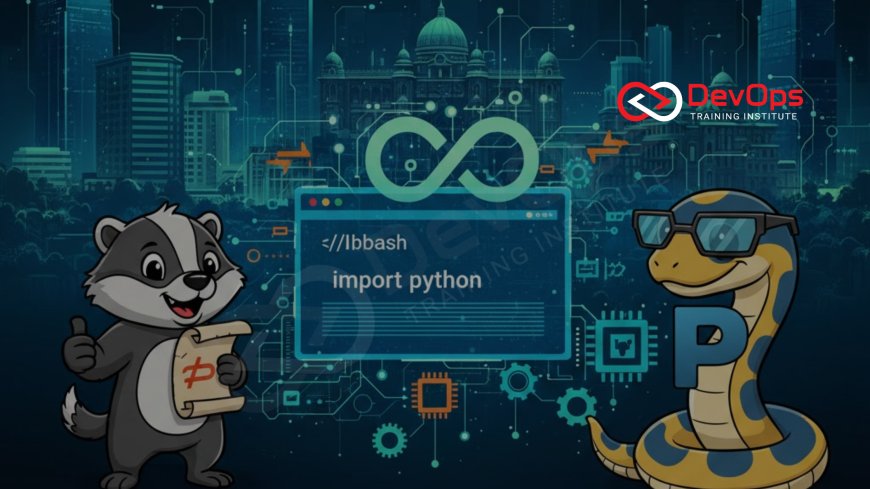
Automate Everything: DevOps Scripting with Bash & Python – Bangalore
Master DevOps scripting with Bash and Python – the two most powerful automation languages used by top SREs and DevOps engineers worldwide. This complete hands-on guide covers real-world scripting for CI/CD, infrastructure automation, log parsing, monitoring alerts, backup systems, Kubernetes operators, and cloud resource management. Join WebAsha Technologies – India’s No.1 DevOps Scripting & Automation Training Institute – and get 400+ hours of live labs, production-grade projects, certification prep, and 100% placement support to crack 20–65 LPA roles at Flipkart, Swiggy, PhonePe, Goldman Sachs, and JPMorgan.
Introduction
Every elite DevOps and SRE team runs on automation, and the foundation of that automation is rock-solid scripting in Bash and Python. While tools like Terraform, Ansible, and Kubernetes dominate headlines, the reality in production is that 70–80% of day-to-day operations, custom tooling, incident response, and glue logic are still written in Bash and Python. Companies don’t hire engineers who only click buttons in Jenkins or copy-paste YAML – they hire engineers who can write scripts that save millions in operational costs and prevent outages.
Freshers who can write a Python script that auto-remediates EC2 instance failures or a Bash one-liner that finds and kills rogue processes across 500 nodes are getting hired at 22–35 LPA packages. Senior engineers who build internal platforms using Python Flask + Prometheus exporter or custom Kubernetes controllers in Python command 50–90 LPA offers. This program at WebAsha Technologies turns you into exactly that kind of automation ninja – someone who doesn’t just use tools, but builds the tools others use.
Why Bash & Python Are Still the Kings of DevOps Automation in 2025
Bash is pre-installed on every Linux server and container in the world – zero dependencies, instant execution. Python has the richest ecosystem of cloud SDKs (boto3, google-cloud, azure), data processing libraries (pandas, requests), and web frameworks. Together they form an unbeatable combination: Bash for quick ops tasks and system glue, Python for complex logic, APIs, and internal platforms.
Every major company uses thousands of internal Bash/Python scripts: Netflix’s chaos engineering tools, Google’s Borg automation, Amazon’s operational runbooks, and every bank’s batch processing systems. Mastering these two languages gives you superpowers that no GUI tool or configuration language can match – the same reason why top DevOps tools are still built on them.
Complete Scripting Curriculum – What You Will Master
Advanced Bash Scripting
Shell functions, arrays, trap signals, process substitution, regex with grep/sed/awk, writing idempotent scripts, logging frameworks, parallel execution with xargs & GNU parallel, creating reusable libraries, and building CLI tools with argparse-style options.
Python for DevOps & SRE
Virtual environments, packaging with setuptools/poetry, boto3 deep dive (EC2 auto-scaling, S3 lifecycle, Lambda invocation), google-cloud-python, azure-sdk, writing custom Terraform providers in Python, building Prometheus exporters, Flask/FastAPI internal tools, and async programming with asyncio.
Real-World Automation Projects
Auto-healing EC2 instances using CloudWatch + Lambda + Python, log parser that detects anomalies and auto-opens Jira tickets, daily backup verification system with Slack alerts, Kubernetes pod eviction predictor using Python + Prometheus, automated SSL certificate renewal across 1000+ servers, cost optimization script that rightsizes RDS/EBS volumes nightly.
Scripting for Kubernetes & Cloud
Writing custom kubectl plugins in Bash/Python, building operators using Kopf framework, dynamic inventory scripts for Ansible, Terraform external data sources in Python, automated EKS/GKE cluster provisioning and upgrades using Kubernetes APIs.
Security & Best Practices
Writing secure scripts (no eval, proper quoting, secret handling with HashiCorp Vault), linting with shellcheck/pylint, unit testing Bash with bats and Python with pytest, CI/CD for scripts using GitHub Actions, code reviews, and versioning.
Production-Grade Projects You Will Build
Auto-Remediation Platform
Python system that monitors CloudWatch alarms → triggers Lambda → runs remediation script (restart service, reboot instance, scale ASG) → posts result to Slack → updates statuspage.io.
Smart Log Analyzer
Bash + Python pipeline that tails logs from 500+ servers via fluentbit → detects PII leaks, failed logins, OOM kills → auto-quarantines offending pods → creates incident report.
Internal Developer Portal Backend
FastAPI + React frontend (you write backend) that lets developers self-service create Kubernetes namespaces, AWS accounts, RDS instances with proper tagging and cost allocation.
Conclusion
Bash and Python scripting is the ultimate differentiator between average DevOps engineers and the elite few who get paid to solve impossible problems. While others struggle with GUI limitations, you will automate anything, anywhere, instantly. This is the skill that turns good engineers into irreplaceable ones.
WebAsha Technologies gives you unlimited lab access, real production-like environments, mentorship from engineers who have built automation platforms at scale, and direct placements into roles where scripting is the primary job. Join the program that produces India’s most dangerous automation engineers.
Frequently Asked Questions
Why are Bash and Python still the most important languages for DevOps in 2025?
Because they are universally available (Bash on every server, Python SDKs for every cloud), have zero deployment overhead, and can glue together any tool or API. Every major company runs thousands of critical scripts written in these two languages.
Can freshers really get high packages after learning scripting?
Yes – freshers who can show 10+ production-grade automation scripts on GitHub are regularly placed at 22–35 LPA. Companies value proven automation ability far more than certificates.
Is Go or Rust replacing Bash/Python in DevOps?
No. Go is used for compiled tools (Docker, Kubernetes), but day-to-day ops, glue logic, and rapid prototyping are still 90% Bash/Python. Even new tools expose Python SDKs first.
How long does it take to master DevOps scripting?
WebAsha’s intensive program is 10–12 weeks with daily scripting challenges and code reviews. You graduate with 50+ battle-tested scripts ready for production.
Will I get to work on real cloud environments?
Yes – personal AWS/GCP accounts with $500 credits + shared multi-account enterprise-like environments. All scripts run against real infrastructure, not local VMs.
Do you teach boto3 and cloud SDKs properly?
Complete deep dive: pagination, waiters, error handling, resource vs client, assuming roles, SSO, and building reusable libraries used by Netflix and Airbnb.
Is testing and CI/CD for scripts covered?
Yes – unit testing with pytest/bats, integration testing, GitHub Actions pipelines that lint, test, and deploy your scripts automatically.
Will I learn to write Kubernetes operators?
Yes – build a working operator using Kopf (Python) that auto-scales HPA based on custom metrics from external APIs.
What salary can I expect after mastering scripting?
Freshers: ₹20–35 LPA | 2–4 years exp: ₹35–65 LPA | 5+ years building internal platforms: ₹70–120 LPA at top companies.
Do you provide placement support?
100% placement assistance with direct interview calls from companies specifically looking for strong scripters and automation experts.
Are weekend batches available?
Yes – Saturday–Sunday full-day batches + weekday evening options for working professionals.
Can non-programmers learn this?
Yes – course starts from zero assuming no prior scripting knowledge. Thousands of QA, support, and networking engineers have successfully transitioned.
Will I learn log parsing and alerting?
Yes – build real-time log parsers using Python + regex that detect anomalies and trigger PagerDuty/Slack alerts automatically.
Do you cover security best practices?
Full module on secure scripting: secret management, least privilege, input validation, static analysis with Bandit/shellcheck, and preventing injection attacks.
Is this combined with any certification?
While there’s no official “scripting certification”, the portfolio you build is worth more than any certificate. Many students clear AWS/GCP professional exams easily after this course.
What's Your Reaction?
 Like
0
Like
0
 Dislike
0
Dislike
0
 Love
0
Love
0
 Funny
0
Funny
0
 Angry
0
Angry
0
 Sad
0
Sad
0
 Wow
0
Wow
0


![100+ Azure DevOps Interview Questions and Answers [Updated 2025]](https://www.devopstraininginstitute.com/blog/uploads/images/202509/image_140x98_68c40aa9a3834.jpg)



![Future Scope of DevOps Careers in Pune [Updated 2025]](https://www.devopstraininginstitute.com/blog/uploads/images/202510/image_140x98_68e3a84652312.jpg)