




![Kong Interview Preparation Guide [2025]](https://www.devopstraininginstitute.com/blog/uploads/images/202509/image_430x256_68dbb95326997.jpg)





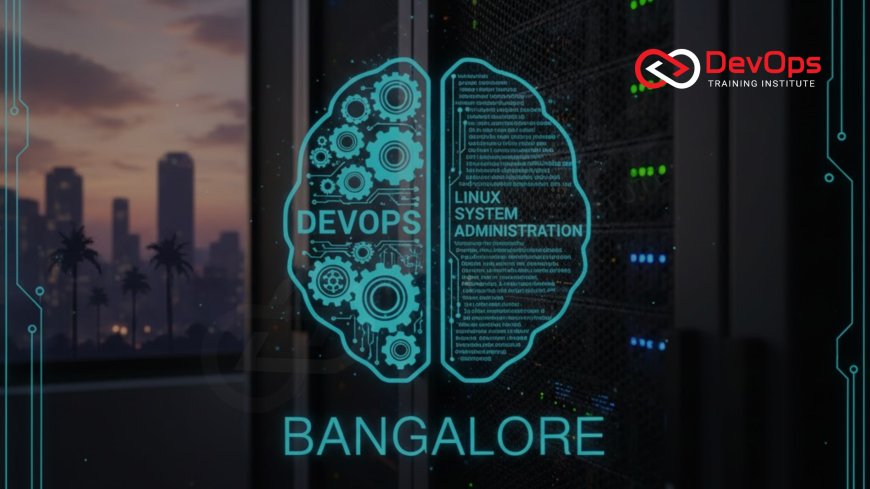
DevOps + Linux System Administration in Bangalore
Master DevOps and Linux system administration in Bangalore with hands-on training at DevOps Training Institute. Learn Linux commands, Git, Jenkins, Docker, Kubernetes, and Ansible for IT roles. 95% placement, 2025 courses for beginners and professionals.
Introduction
DevOps and Linux system administration form the backbone of modern IT operations in Bangalore, where the city's status as India's Silicon Valley creates immense demand for skilled professionals. Combining DevOps practices with Linux expertise enables seamless automation, efficient infrastructure management, and robust CI/CD pipelines, essential for roles at companies like Infosys and Swiggy. For beginners and system admins transitioning to DevOps, mastering Linux commands, scripting, and tools like Git and Ansible is crucial, as 80% of DevOps jobs require strong Linux foundations. This guide explores integrated training programs in Bangalore, focusing on hands-on learning that bridges system administration with DevOps workflows. At DevOps Training Institute near MG Road, students gain practical skills in Linux administration alongside DevOps tools, achieving 95% placement rates in 2025. Whether you're a fresher or experienced admin, these programs prepare you for high-paying roles with salaries from 8 to 25 lakhs per annum. Amazon S3 integration with Linux scripting is a key highlight in cloud administration modules.
Why Combine DevOps and Linux System Administration
Integrating DevOps with Linux system administration is vital in Bangalore's fast-paced IT environment, where organizations rely on Linux servers for 85% of production workloads. DevOps emphasizes automation and collaboration, while Linux administration provides the underlying skills for server management, scripting, and troubleshooting. Together, they enable efficient deployment of applications on cloud platforms like AWS and Azure, reducing downtime and costs by up to 50%. Beginners benefit from this synergy by learning essential commands like ls, cd, and grep alongside DevOps tools such as Jenkins and Docker, creating a solid foundation for career growth. Professionals transitioning from traditional sysadmin roles find the combination accelerates their path to DevOps engineer positions, with demand growing 25% annually. DevOps Training Institute designs programs that blend these areas, ensuring participants can automate Linux-based infrastructures seamlessly.
- Linux commands form the basis for 70% of DevOps scripting tasks
- DevOps automation reduces manual Linux admin work by 60%
- Combined skills lead to 30% higher salaries in Bangalore
- Hands-on labs simulate real production Linux servers
- Certifications like RHCSA complement DevOps credentials
- Projects include Linux hardening for secure DevOps pipelines
- Market demand for Linux-DevOps experts is 40% higher than general roles
Core Linux System Administration Skills for DevOps
Core Linux system administration skills are indispensable for DevOps professionals in Bangalore, where 90% of servers run Linux distributions like Ubuntu and Red Hat. Understanding file systems, user management, and networking is essential for automating deployments and troubleshooting issues in CI/CD pipelines. Beginners should master commands for navigation, such as cd to change directories and pwd to display current location, alongside ls for listing contents with options like -l for detailed views and -a for hidden files. Package management with apt on Debian-based systems or yum on Red Hat allows efficient software installation, crucial for setting up tools like Docker. User and group administration using useradd, usermod, and sudo ensures secure access control in team environments. Process management with ps, top, and kill helps monitor and terminate rogue processes, preventing resource bottlenecks in production. Networking commands like ip addr show and netstat -tuln reveal interface configurations and listening ports, vital for firewall rules in DevOps setups. DevOps Training Institute starts every course with these basics, ensuring students can administer Linux servers confidently before advancing to automation. bucket policies and ACLs in S3 extend Linux permissions to cloud storage, a common integration in Bangalore's hybrid environments.
Essential DevOps Tools Integrated with Linux
Essential DevOps tools integrated with Linux form the toolkit for efficient workflows in Bangalore's tech scene. Git, the version control system, installs via sudo apt install git on Ubuntu, enabling branching and merging for collaborative development. Jenkins, for CI/CD, requires Java and installs with wget -O - https://pkg.jenkins.io/debian-stable/binary/jenkins.io | sudo tee /usr/share/keyrings/jenkins.io.asc, followed by adding the repository and sudo apt install jenkins. Docker containerizes applications, installed with sudo apt install docker.io, allowing lightweight virtualization on Linux kernels. Kubernetes orchestrates containers, set up locally with minikube start for development, while production uses kubeadm for cluster initialization. Terraform for IaC downloads from HashiCorp and runs terraform init to manage infrastructure declaratively. Ansible automates configuration, installed with sudo apt install ansible, using playbooks to provision servers idempotently. These tools leverage Linux's stability, with 95% of DevOps roles requiring proficiency. DevOps Training Institute teaches integration through projects like automating a Linux server with Ansible in a Docker container deployed via Kubernetes.
- Git enables code versioning and collaboration across teams
- Jenkins automates build, test, and deployment cycles
- Docker packages applications for consistent environments
- Kubernetes scales and manages containerized workloads
- Terraform provisions infrastructure as code
- Ansible configures systems without agents
Hands-On Training Approach in Bangalore
Hands-on training in Bangalore emphasizes practical application, with labs simulating production scenarios. Beginners practice Linux commands on virtual machines, advancing to Git workflows and Jenkins pipelines. Intermediate sessions involve Dockerizing apps and deploying to Kubernetes clusters, while advanced modules cover Terraform IaC and Ansible playbooks for multi-server management. Projects like setting up a secure web server with Nginx on Ubuntu, automated via Ansible, build confidence. Troubleshooting exercises address common issues like permission errors and network configurations. DevOps Training Institute allocates 70% time to labs, ensuring students complete 10+ projects. S3 versioning and lifecycle rules are practiced in cloud integration labs for data lifecycle management.
Career Opportunities and Placement Support
Career opportunities in Bangalore for DevOps + Linux admins are abundant, with roles like System Engineer and DevOps Associate offering 8 to 20 lakhs per annum. Placement support includes resume building, mock interviews, and company referrals. DevOps Training Institute achieves 95% success, with alumni at Wipro. S3 object encryption skills lead to secure admin roles.
Conclusion
DevOps + Linux system administration in Bangalore opens doors to rewarding careers. DevOps Training Institute provides the perfect blend. Start your journey today.
Frequently Asked Questions
What is DevOps + Linux system administration?
Combining DevOps automation with Linux server management.
Why learn Linux for DevOps in Bangalore?
90% of servers run Linux; essential for automation.
How long to master both?
3-6 months at DevOps Training Institute.
Salary range?
8 to 25 lakhs per annum.
Placement support?
95% at DevOps Training Institute.
Weekend batches?
Yes, at WebAsha Technologies.
Certifications?
RHCSA, AWS DevOps.
Online options?
Hybrid at Cyber Security Training Institute.
Projects included?
10+ Linux-DevOps projects.
Beginner-friendly?
Yes, foundational focus.
Trainer experience?
10+ years MNCs.
Scholarships?
20% merit at Python Training Institute.
Demo classes?
Free at DevOps Training Institute.
Job guarantee?
95% success rate.
Next steps?
Enroll at DevOps Training Institute. AWS ensure data durability in S3 storage — key for Linux cloud admins.
What's Your Reaction?
 Like
0
Like
0
 Dislike
0
Dislike
0
 Love
0
Love
0
 Funny
0
Funny
0
 Angry
0
Angry
0
 Sad
0
Sad
0
 Wow
0
Wow
0




![100+ Azure DevOps Interview Questions and Answers [Updated 2025]](https://www.devopstraininginstitute.com/blog/uploads/images/202509/image_140x98_68c40aa9a3834.jpg)





![Future Scope of DevOps Careers in Pune [Updated 2025]](https://www.devopstraininginstitute.com/blog/uploads/images/202510/image_140x98_68e3a84652312.jpg)