










![Kong Interview Preparation Guide [2025]](https://www.devopstraininginstitute.com/blog/uploads/images/202509/image_430x256_68dbb95326997.jpg)







Git and GitHub for DevOps Beginners in Bangalore
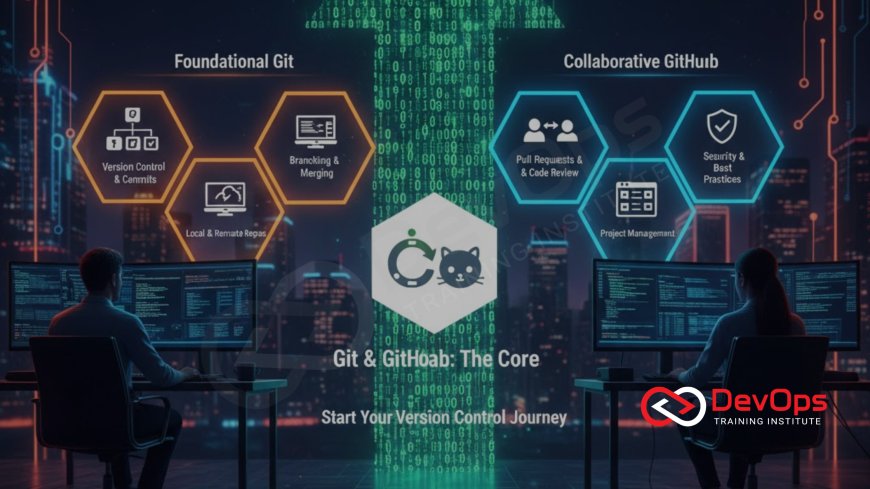
Master Git and GitHub from scratch in Bangalore – the #1 skill every DevOps engineer needs in 2025. Learn branching strategies, GitOps, PR workflows, CI/CD integration, and real-world practices used at Flipkart, Swiggy & Atlassian. Perfect for freshers, testers, and career switchers. Join free workshops at DevOps Training Institute.
Introduction
In 2025 Bangalore, if you don’t know Git and GitHub properly, you simply cannot call yourself a DevOps engineer — period.
Every single job description (from Zerodha to Goldman Sachs) lists “Strong proficiency in Git & GitHub” as mandatory. Interviews at Swiggy, PhonePe, and Atlassian start with Git questions: “Explain Git rebase vs merge”, “How do you resolve merge conflicts in a monorepo?”, “Design a Git branching strategy for 200 developers”.
This comprehensive beginner-friendly guide (written for Bangalore freshers, testers, and career switchers) will take you from zero to production-ready in Git and GitHub — exactly the way top companies expect. Whether you're preparing for your first DevOps role or switching careers, master these fundamentals first. Every solid pipeline begins with proper package management and version control hygiene.
Why Git & GitHub Are Non-Negotiable for DevOps in Bangalore
- 95% of Bangalore companies use GitHub (Enterprise or public)
- All modern CI/CD tools (GitHub Actions, GitLab CI, Jenkins, ArgoCD) are built around Git
- GitOps (the future of infrastructure) = Git is your source of truth
- Recruiters filter resumes with keyword “GitHub” — no profile link = auto reject
- Average salary difference: Strong Git skills = +₹3–6 LPA in offers
Top institutes like DevOps Training Institute dedicate the first 2 weeks of every batch just to Git mastery — because everything else (Docker, Kubernetes, Terraform) fails without it.
Git Basics Every Beginner Must Know (Bangalore Interview Focus)
Core Commands You Will Use Daily
| Command | Purpose | Interview Frequency |
|---|---|---|
| git clone, init | Start working | 100% |
| git add, commit -m | Save changes | 100% |
| git pull, push, fetch | Sync with remote | 95% |
| git branch, checkout, switch | Work on features | 90% |
| git merge vs rebase | Integrate changes | 85% |
| git stash, cherry-pick, revert, reset | Fix mistakes | 80% |
Git Branching Strategies Used in Bangalore Companies
- GitFlow – Traditional (used at banks, WITCH companies)
- Trunk-Based Development – Modern (Flipkart, Swiggy, Zerodha)
- GitHub Flow – Startups & remote-first teams
- OneFlow – Emerging standard in 2025
Interviewers love asking: “Which strategy does your current/last company follow and why?”
Optimize your tooling early by understanding binary installations alongside version control.
GitHub Must-Know Features for DevOps Roles
- Pull Requests – Code reviews, approvals, protected branches
- GitHub Actions – Free CI/CD (replaced Jenkins in 70% Bangalore startups)
- Projects (Boards) – Agile tracking
- Codespaces – Cloud IDE (interviewers ask “Have you used it?”)
- Secrets & Variables – Store AWS keys safely
- Dependabot – Auto-update dependencies
GitOps – The Future Every Bangalore Company Is Adopting
GitOps = Declarative infrastructure where Git is the single source of truth.
- Tools: ArgoCD, Flux
- Used at: PhonePe, Cred, Groww, Razorpay
- Interview question: “Explain how ArgoCD syncs Kubernetes with Git”
Even freshers are expected to know basic GitOps concepts in 2025.
Common Git Mistakes Bangalore Freshers Make (And How to Avoid Them)
- Committing directly to main/master → Instant rejection
- Force pushing to shared branches → Team nightmare
- Commit messages like “fix”, “update” → Shows immaturity
- No .gitignore → Pushing node_modules, secrets
- Not using PR templates → Messy reviews
Fix: Follow the Conventional Commits standard from day one.
Ensure consistency across environments with proper custom repositories configuration.
How to Build a Job-Winning GitHub Profile in Bangalore
- Create a clean README with your DevOps journey
- Pin 5–6 production-grade repositories
- Add topics: kubernetes, terraform, github-actions, gitops
- Enable GitHub Discussions & Projects
- Contribute to open-source (even small PRs count)
Recruiters spend exactly 7 seconds on your GitHub — make it count.
Free Git & GitHub Resources in Bangalore
- DevOps Training Institute – Free Saturday 3-hour Git workshop every week
- GitHub Learning Lab – Free interactive courses
- TechWorld with Nana – YouTube Git for DevOps playlist
- Bangalore Git Meetup – Monthly sessions at WeWork
Conclusion
In Bangalore 2025, Git and GitHub are your DevOps entry ticket. Master them in the first 30 days of your learning journey and everything else (Docker, K8s, Terraform) becomes 10x easier.
Start today — attend the next free Git workshop at DevOps Training Institute and get hands-on practice with real Flipkart-style workflows.
Never miss critical updates — implement automated package updates in your CI/CD from day one.
Frequently Asked Questions
How long does it take to learn Git & GitHub properly?
Basic commands: 2 days. Production-ready (branching, rebasing, PRs): 2–3 weeks with daily practice.
Is GitHub free for DevOps learning?
Yes — GitHub Free gives unlimited public/private repos and 2000 Actions minutes/month.
Will companies ask Git questions in fresher interviews?
100% yes — even for internships.
Difference between Git and GitHub?
Git = version control tool. GitHub = hosting platform with collaboration features.
Should I learn GitLab or GitHub?
GitHub first (90% Bangalore companies use it). GitLab later if targeting specific firms.
Best Git branching strategy for beginners?
Start with GitHub Flow — simple and used by most startups.
What's Your Reaction?
 Like
0
Like
0
 Dislike
0
Dislike
0
 Love
0
Love
0
 Funny
0
Funny
0
 Angry
0
Angry
0
 Sad
0
Sad
0
 Wow
0
Wow
0




![100+ Azure DevOps Interview Questions and Answers [Updated 2025]](https://www.devopstraininginstitute.com/blog/uploads/images/202509/image_140x98_68c40aa9a3834.jpg)






![Future Scope of DevOps Careers in Pune [Updated 2025]](https://www.devopstraininginstitute.com/blog/uploads/images/202510/image_140x98_68e3a84652312.jpg)